
#On the Name
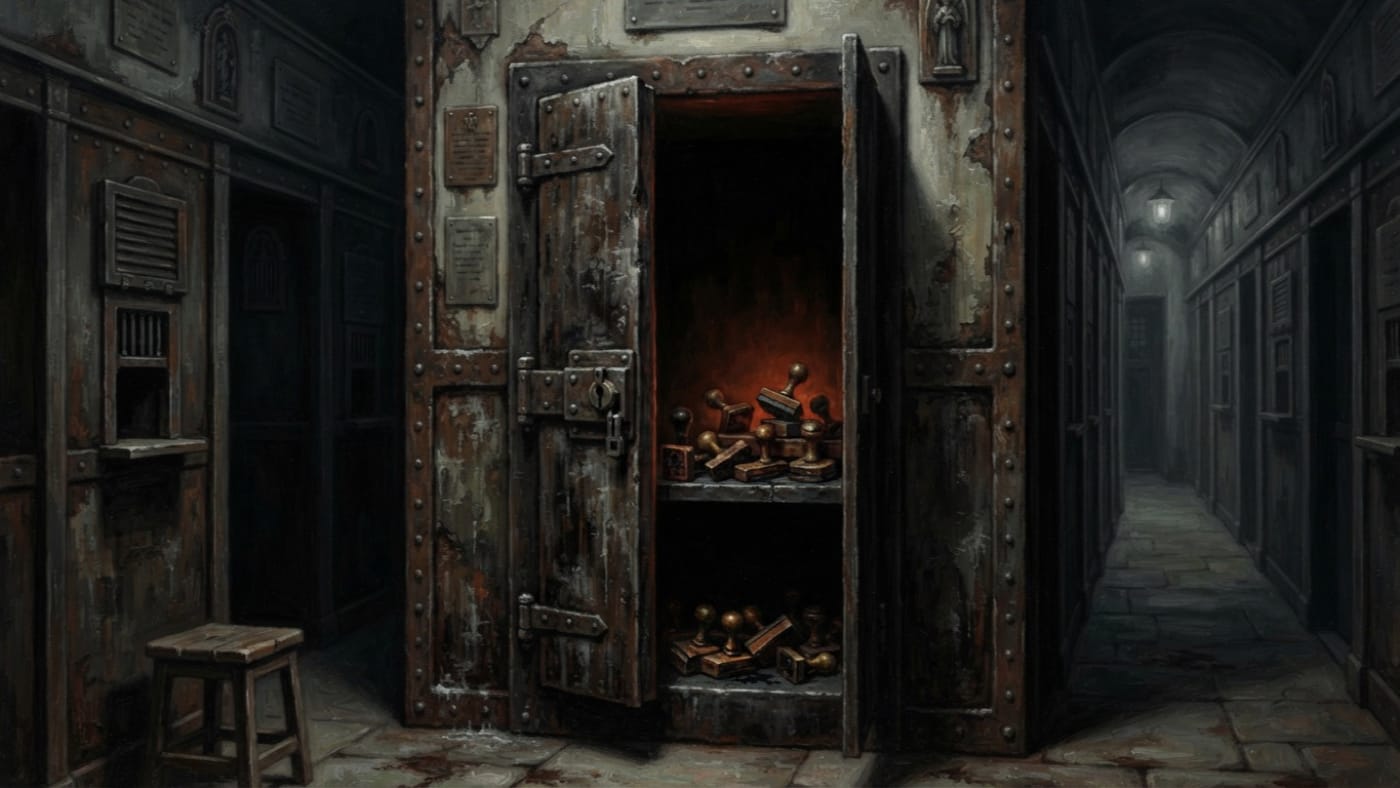
The Black Brine Cupboard is a thing Confessor-Booth Clerks say to one another after the shutter is latched and the day ledger sealed. The Codex can certify the saying. It cannot certify the cupboard.
Strip away the corridor ornament and the allegation is one sentence long: defective stamp sets are kept there overnight and returned warm. That is the whole of the professional testimony. It names no maker, gives no address, identifies no custodian and states no purpose. The sentence turns up most often when clerks speculate about the fate of the Silent Confessional of Vienna, whose present use the Bureau declines to specify. It has picked up some of that apparatus's reputation by sitting next to it, much as a junior clerk picks up a supervisor's habits.
The title promises more than the allegation delivers. Nobody reports black brine inside it, or brine of any colour. The name may come from the morning brine wipe, from the colour of record ink, or from the booth habit of naming every dread after something one scrubs with. It may come from nothing. Booth slang is a midden, and its etymologies rot there before anyone thinks to file them.
#On the Stamp Set
The stamp set is issued to the clerk as authority and works in practice as liability. The two are indistinguishable. With it the clerk turns a whispered confession into a receipt. A category is chosen from the rubric card, a penance assigned, an impression pressed onto a counted blank and the tally logged. The receipt proves processing and forgives nothing. Since the Mercy Rationing Reform confined mercy to licensed confessors, the ordinary clerk has been stamp-only. The equipment can absolve about as well as the brine bucket can baptise.
None of this makes the stamp trivial. Permits, rations and travel bonds often require clean stamps. A blurred impression on damp paper can hold a dock labourer at a checkpoint, suspend a household's ration chit, or send a perfectly ordinary sinner into an escalation he never earned. When the audit arrives, the inspector counts blanks, tests impressions, checks tallies against district drift, and asks why there are so many clean stamps. A set that jams, smears or bites unevenly hands the inspector a second question before the first has been answered.
The profession keeps this knowledge in its hands: ink grit in the knuckles, brine cracks along the thumb, the morning count of stamps and blanks, three taps on the stamp before the first penitent speaks. A set that never jams is the clerk's quiet boast, rarer than honesty and a good deal more useful. A defective set is a confession in its own right, entered against whoever carries it.
The allegation does not say what the defect was. It does not say the stamp was forged, stolen from a confessor, or suspected of anything worse than poor printing. Clerks who repeat the rumour sometimes add these details. The rumour itself does not.
#On the Overnight Keeping
The rumour rests on two observations, and both concern time. The set goes in at night. It comes out warm.
The Codex can describe nothing between those two points. No clerk claims to have watched the keeping, and none reports the cupboard's interior, its lock, its keeper, or any sound from inside. The rumour does not say whether the set came back mended, or whether it came back accurate. It does not say whether the clerk who received it was allowed to use it again, or dared to. Warmth is the only thing reported, and nobody gives it a degree.
Ordinary heat is easy to find. Booths have lamps, annexes have stoves, and a supervisor's pocket is warm for a supervisor's reasons. A set left on a hearthstone overnight would come back warm, and nobody would whisper about it. The clerks know this as well as I do. They whisper anyway, because every dull explanation needs someone to have seen the set sitting by the stove, and nobody has.
The profession's own cleansing happens in the open and is done by the clerk. Grille and stool are wiped with brine, mouth and fingertips washed at the end of the shift, a pinch of salt left in the corner for the things that listened. The clerk performs every one of these rites on their own instruments. What the cupboard reportedly asks is that the clerk give up the instrument for the night and accept whatever comes back.
#On the Viennese Association
The Silent Confessional has a description on record, and its wardrobe is fuller. Black iron outside, mirrored metal inside, hinges that breathe cloves, a door that seals with a sigh. Those placed inside come out without tongues, ears or eyes and go on confessing until death. The Bureau of Purity reads this as demonic residue. The Bureau of Doctrine reports only that the apparatus was repurposed and has not said into what.
Clerks fill that silence with guesses: storage, a reliquary, parts for authorised booths, a cell beneath some annex, a cupboard where defective stamps spend the night. The cupboard is one guess among several. It has outlived the others because it is the only one that involves a clerk's own tools.
The Black Brine Cupboard is the Silent Confessional, repurposed into clerical service.
The Black Brine Cupboard is the Silent Confessional, repurposed into clerical service.
Withdrawn. The word "repurposed" belongs to the Confessional by official statement. No office has applied it to the cupboard. On record, the Confessional has mirrors, cloves, a sighing seal and the mutilated dying. On record, the cupboard has an overnight interval and a temperature. A cabinet that unmakes bodies and a cabinet that warms stamps can be joined only by the clerks' fear. That fear is evidence of the clerks.
Much of the association comes from nearness in conversation. The cupboard is named when Vienna is named, and Vienna is named when someone wants a room to go quiet. At Bastion-Constantinople, as I have recorded under the Confessional's own entry, I heard a Booth Supervisor mention "the Austrian cupboard" and watched six clerks stop breathing. He said nothing about brine or stamps. The breathing stopped anyway. That proves how much the word "cupboard" can do in a booth corridor. It proves nothing about the cupboard's address.
#On Clerks and Their Furniture
The booth already asks too much of the people who sit in it. Clerks never joke about contamination, the belief that too many confessions will leave you speaking other people's sins. They are trained to close the shutter when cadence goes wrong and to report it. They follow the rule "never listen twice." A whole tradition of night-shift lore warns that the booth may one day answer. Against all of that, the stamp has been the one instrument the hand could trust. The cupboard rumour asks the clerk to hand that instrument to an unseen keeper, for an unknown purpose, for one night, and the clerk is never told what the keeper put into it, or took out.
Other ports have their own versions of this fear. At Bastion-Brest, sins spoken into booths are said to come back later as whispers on the deck. The Echo Booth there, all cold wax and metal, is said to repeat confessions not yet made. Brest's booth and the reported cupboard share no maker and no cause on record. Brest is cold, the cupboard warm. What they share is clerks who have learned to distrust the wood and metal they work in.
The Lore Book separates terror that is put on show from terror that lives on whispers, and it places the Silent Confessional in the second class. The cupboard rumour behaves as that class behaves. It is portable, deniable, and useful to any supervisor who wants a slack clerk to treat their stamp with more care. The Codex has found no record that any office wrote it. Rumours of this kind seldom need an author. A tired profession and an unexplained silence will compose them for free.
What the rumour does to the audit is easy to see. A Codex Doubt Auditor tests impressions without caring where the stamp spent the night. A Street-Vicar collecting a concern packet does not ask whether the stamp on it was warm. The Bureau of Rites offers no rite for receiving a returned instrument, and the clerks have not waited for one. Some wipe a returned set twice with brine, and some refuse to tap it three times. The prudent ones make no remark.
#On the Present Standing
As of this survey in A.S. 201, the Black Brine Cupboard has no custody file, inventory number, viewing schedule, maker or keeper on record. It has no relic authentication and no destruction certificate. It exists as a sentence clerks repeat to one another: defective stamp sets go in overnight and come back warm. The sentence is attested. The cabinet is not. Its identity with the Silent Confessional rests on speculation within the profession and has no official statement behind it. What the Confessional was repurposed into remains, by the Bureau's choice, unsaid.