
#On the Origin of the Office
"The Vicar walks where the bell cannot reach. He is the bell's feet." — Charter of the Street-Vicar Corps, Strasbourg, A.S. 104
The Synod does not rely upon architecture alone to keep the faithful faithful. Bells ring from towers; hymns echo through the Line's corridors; the Bureau of Bells schedules the hours with a seven-second tolerance that would shame a clockmaker. All of this presupposes walls, steeples, resonance chambers — fixed points from which sound radiates outward and fades. The bell's authority diminishes with distance. At the edge of the market square, where the fishmongers shout and the carts rattle and a child screams because it has dropped its bread into a puddle, the bell is a rumour of order without enforcement.
The Doctrine Street-Vicar exists because the Bureau of Doctrine understood, sometime around A.S. 100, that sermons were insufficient. Citizens attended chapel; citizens recited the Eternal Creed at dawn; citizens crossed themselves before lifting tools and blessed their meals before tasting them. They did all of this within consecrated walls. The moment they stepped into the street, faith became a coat they folded and tucked under one arm.
The Market Drift Years confirmed it. Between A.S. 98 and A.S. 103, the Rhineland districts (Unregistered) reported a measurable decline in public creed recitation — measured, naturally, by the Bureau of Records, which measures everything, including the things it would prefer not to have counted. Market rumours replaced doctrine as social adhesive. Barter-oaths sworn on a handshake supplanted the Creed-sealed transactions mandated by the Bureau of Tithes. A grocer in Cologne was overheard telling a customer that "the Creator is for Sundays; Tuesdays belong to turnips." He was not arrested. He was not even reported. His neighbours laughed.
That laugh cost Cologne eleven Street-Vicars, assigned by decree in A.S. 104 under the Catechism Third Revision. The grocer was corrected. His neighbours were corrected. The turnips, presumably, continued as before.
#On the Substance of the Work
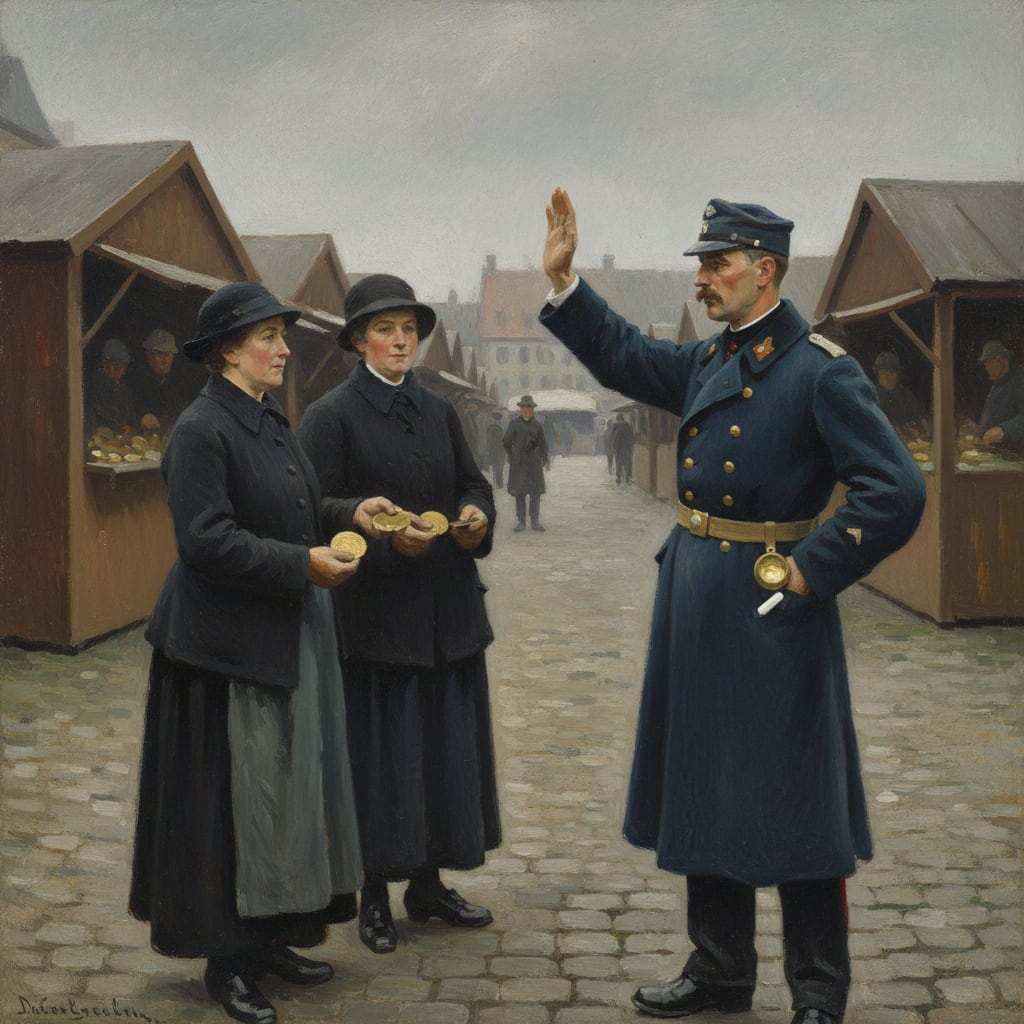
A Street-Vicar is a moving spotlight, and every person caught in its beam must perform. The mechanism is the square-stop: the Vicar raises a hand, sometimes rings a pocket chime, and foot traffic halts. Call-and-response. Creed lines, tested at random. Purity tokens inspected — attendance stamps, confession receipts, ration-hall proofs. A stumble on the third article earns a correction slip: mandatory recitation at a chapel annex within forty-eight hours, signed by a presiding cleric, returned to the issuing Vicar for filing. Failure to return the slip escalates the matter to a Codex Doubt Auditor, and from there the consequences multiply in ways the Bureau prefers to call "pastoral."
The chalk is the Vicar's lasting authority. White for clean — a household in good standing, its tokens current, its recitations correct. Yellow for watched — a discrepancy noted, a slip pending, a conversation overheard that warranted neither arrest nor absolution. Red for uncertain — and a red-chalked doorframe is a wound that bleeds reputation. Neighbours see it. The ration-hall clerk sees it. The Tithe Assessor sees it and adjusts the household's levy upward by a margin the Bureau calls "precautionary." The mark fades in rain, which is merciful; but the Vicar returns, which is doctrine.
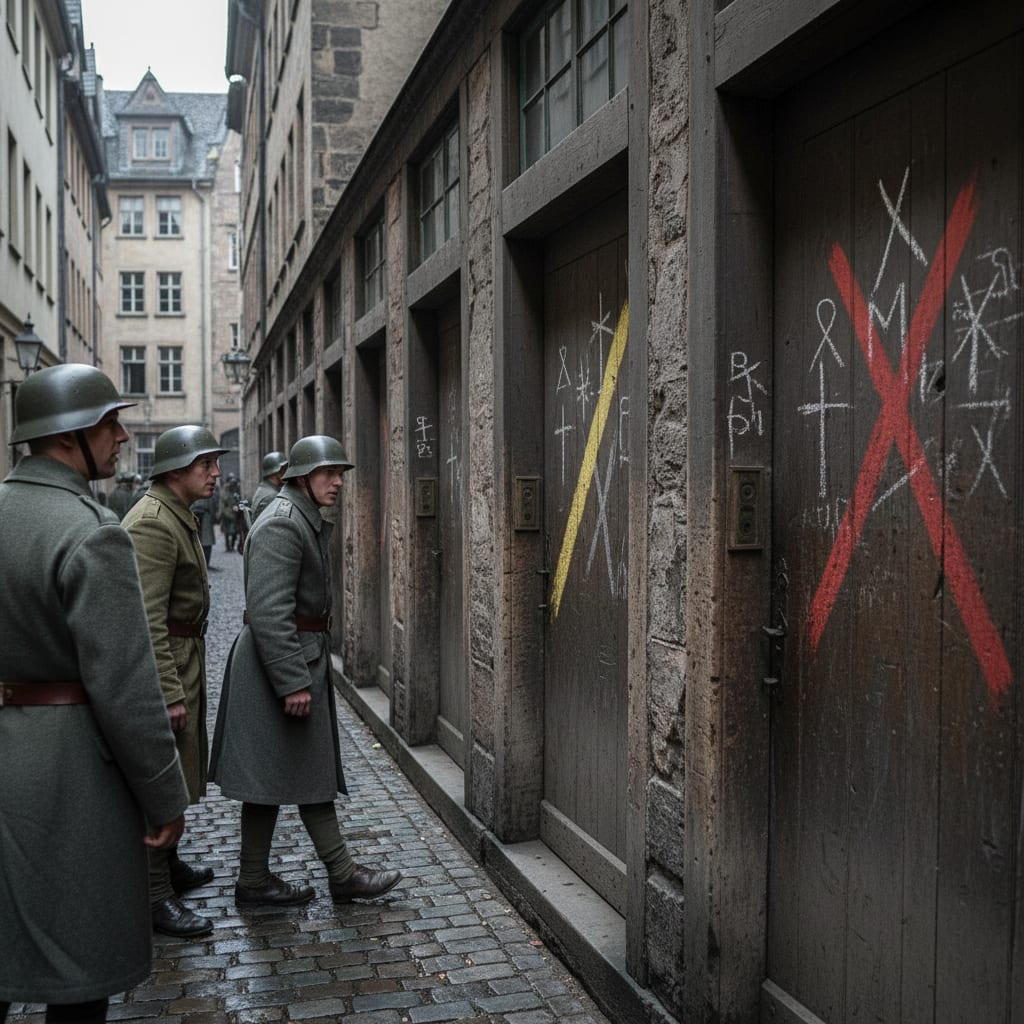
Storefront markings operate on the same chromatic theology. A baker whose morning creed was slurred receives a yellow slash on the lintel. His customers drift to the baker three doors down, whose lintel is white. No edict compelled them. No Lictor threatened them. The market disciplined itself, which is the Street-Vicar's finest trick and the Inquisition's favourite miracle: obedience outsourced.
The tokens are another layer. Every citizen carries, or ought to carry, a purity token stamped with their last chapel attendance, their last confession date, and their current ration-hall assignment. The token is a palm-sized brass disc — the Bureau of Masks and Seals produces eleven thousand per quarter, each with a unique ligature — and it must be presented at any Vicar's request. A missing token prompts a correction slip. A forged token prompts a White-Mantled Inquisitor. The distinction between "missing" and "forged" is, in practice, a matter of the Vicar's mood, the district's quota, and whether the citizen's hands are shaking.
#On the Chalk Riots and Their Aftermath
The system would be elegant if it were not administered by human beings.
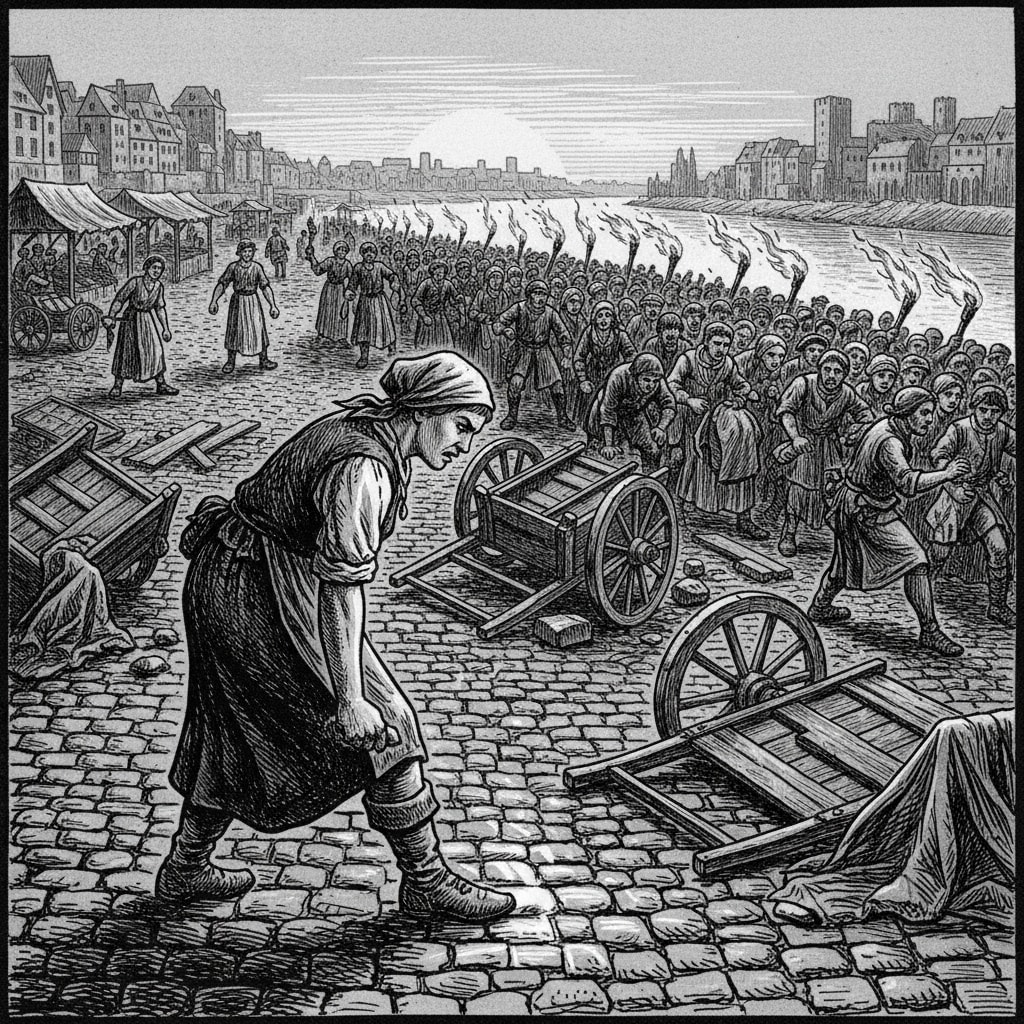
In A.S. 119, a Street-Vicar in the Trier market district (Unregistered) — his name has been expunged, which tells you everything — marked fourteen doorframes red in a single afternoon. Fourteen households publicly branded as uncertain. By dusk the market had emptied. By midnight the marked families had pooled their grievances into a crowd. By dawn the Vicar's body was in the Moselle and his chalk was being ground into the cobblestones by a woman who, the surviving witnesses agreed, had never missed a chapel service in her life.
The Chalk Riots spread to Cologne, to Halle, to three districts of Strasbourg itself before the Bureau of Purity restored order with its customary blend of selective violence and administrative reclassification. The riots were filed under "Seasonal Unrest (Devotional)" rather than "Insurrection," which spared the Bureau of Doctrine the indignity of admitting that its own enforcement mechanism had provoked rebellion.
The aftermath produced reforms. The "soft marking" codes — chalk that fades within hours, applied as warning rather than brand — were standardised in A.S. 120. Escort norms were introduced: a Vicar in a riot-prone district was to be accompanied by two Covenant militia, visible but silent, their presence a reminder that the chalk had teeth behind it. The fourteen-mark limit was never formally codified, but no Vicar since has marked more than six doorframes in a single patrol without filing a justification with the District Doctrine Office.
The Bureau of Doctrine previously attributed the Chalk Riots to "heretical agitation by elements sympathetic to the Rationalist remnant."
The Bureau of Records has noted, with its habitual tact, that every participant in the Trier disturbance held current purity tokens and unblemished confession records. The attribution has been revised to "excess of zeal in application of marking protocols." The unnamed Vicar's posthumous record has been amended accordingly. His body has not been recovered accordingly.
#On the Echo Season
Crowds are dangerous for reasons beyond politics. The Street-Vicar learns this in the first week or does not survive to learn anything else.
During Echo Season — the Bureau's polite designation for periods when Lust's agents or Sloth's drifts contaminate urban populations — the crowd's voice cannot be trusted. A square-stop proceeds: the Vicar calls the first line of the Creed; thirty voices answer. The cadence is correct. The words are correct. One voice among thirty is wrong, and the wrongness is so slight — a vowel held a half-breath too long, a consonant softened where the orthodox pronunciation hardens it — that the Vicar feels it before hearing it. A chill. A sense that the chorus has been steered by a throat that is not human.
The cadence tests were developed for this. A Vicar trained in echo-detection — the rank is Cadence Examiner, and there are fewer than forty in the entire Rhineland — carries a tuning fork blessed by the Bureau of Bells and a wax tablet for transcribing the crowd's rhythmic pattern. Deviations of more than one-eighth of a beat trigger a standing withdrawal order. The crowd is released. The district is reported. The Bureau of Purity sends its own specialists, and by that point the Street-Vicar's role is finished.
The echo protocols saved Cologne in A.S. 178, when a district chorus began reciting the Creed in a cadence that matched no orthodox pattern — a rhythm that, when transcribed onto the Examiner's wax tablet, formed a shape the Bureau of Doctrine recognised as a Pale Chanter unhymn signature. The district was evacuated. The Examiner who identified the pattern was promoted, reassigned to a filing annex in Sofia, and never spoke of the incident. He counts paper now. Paper does not sing back.
#On the Profession's Interior Life
The Street-Vicar occupies a position that the Bureau of Doctrine describes as "pastoral" and the street describes as "the man who makes you perform your prayers in public so your neighbours can watch you fail."
Both descriptions are accurate. The Bureau does not trouble itself with the distinction.
A Creed Runner enters the corps at sixteen, testing tokens and running correction slips between chapel annexes. By twenty, if competent and still alive, the Runner is elevated to Street-Vicar proper: chalk-bearing, stop-authorised, empowered to mark doors and issue corrections without oversight. The District Doctrine Officer — a senior rank, typically held by a Vicar with fifteen or more years of unmarred service — oversees a grid of eight to twelve Vicars and reports directly to the Synod Doctrine Registrar (Unregistered). Above the Registrar sits the Bureau of Doctrine. Above the Bureau sits the Hierarchy. Above the Hierarchy sits the Creator, Who has never once complained about a chalk mark.
Two factions divide the corps with the quiet venom of a confessional argument. The Mercy Vicars correct privately — a word in the ear, a gentle recitation together on the corner, the correction slip delivered with a handshake rather than a stamp. They argue that public shame breeds resentment, resentment breeds heresy, and heresy breeds the very demons the Synod was constituted to oppose. The Marking Vicars reply that mercy without consequence is indistinguishable from permission, and that a yellow chalk-mark on a doorframe has prevented more heresies than a thousand whispered corrections. Both factions are represented in the District Doctrine Offices. Neither faction acknowledges the other by name. Their disagreement is conducted entirely through statistical reports filed with the Bureau of Records, whose clerks have learned to read the passive aggression encoded in quarterly compliance figures.
The night shift is where the role strips itself to bone. After the Ninth bell, when curfew fog rolls through the streets and the taverns shutter their windows, the Vicar walks alone — or with a single escort, if the district warrants it — listening. Wrong hymns from alley shrines. Unlicensed recitations. The murmur of a household whose door is closed but whose voices carry. At midnight, the Vicar meets with a Codex Doubt Auditor in a chapel annex and delivers names. This is the transaction that keeps the system alive: the Vicar sees the street; the Auditor reads the patterns; the Bureau of Purity receives the product. The Vicar goes home smelling of brine and chalk dust and sleeps, if sleep will come, with the sound of thirty voices reciting in perfect unison stuck behind his eyes like a hymn he cannot finish.
#On the Present Condition
The Synod employs four thousand three hundred Street-Vicars and does not employ them enough. The Quiet Purges of A.S. 112 — in which four hundred and eleven teachers, choirmasters, and Street-Vicars were removed from Rhineland postings without public trial — gutted a generation of experienced Cadence Examiners and left the corps reliant on Creed Runners promoted before their chalk had dried. The Market Drift Years are a memory. The Chalk Riots are a cautionary file. The Echo Season is not a memory; it is a standing threat, and the forty Cadence Examiners spread across eight zones are forty candles held against a wind that learns, with each passing year, to blow from new directions.
Saint Oren of the Corner — the corps' patron, who corrected a district without a single arrest, only by making people sing together until the street "remembered itself" — is invoked at every shift-start brine wash. His method is admired. His method is also impossible, because Oren operated in a district where the population trusted the Synod, and the Street-Vicar's paradox is that trust is the one thing public enforcement cannot manufacture. The chalk creates compliance. Compliance creates resentment. Resentment creates the conditions that require more chalk.
The grocer's grandson in Cologne still garbles his Creed at market-speed. His doorframe is white. His tokens are current. His faith is a performance so polished it gleams like brass, and like brass it is hollow when struck.
The Bureau of Doctrine has classified this observation.