
#On the Box That Hears Without Hearing
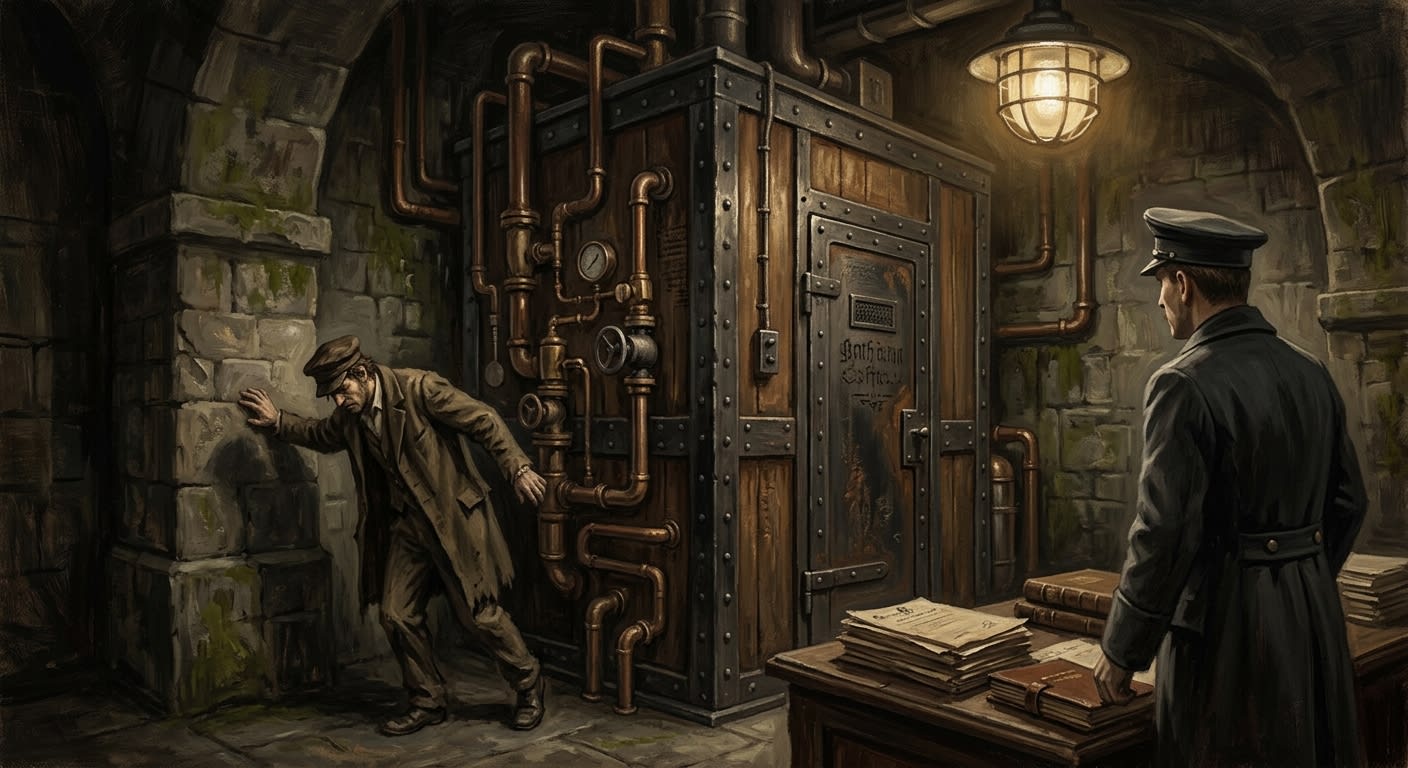
The Silent Confessional of Vienna is the confession booth as nightmare, correction, rumour, instrument, warning, and furniture. It is a black iron cabinet into which the accused is placed. The door closes. The hinges breathe. The Bureau waits.
Those who emerge do so without tongues, ears, or eyes, yet babbling confessions for days until death claims them.
Every Confessor-Booth Clerk in the Synod has heard of it. Few have seen it. None agrees on its current location. The Bureau of Doctrine says it was repurposed. Into what, the Bureau has not specified. That omission is the hinge. Terror works best when the door is known to exist and the room beyond is left unlabelled.
#On Its Construction
Vienna's Silent Confessional denies the jurist's favourite comforts: voice, light, witness, sequence. The box is iron outside and mirrored metal within. The accused sits in darkness that brims with their own reflection. The interior plates were said to be polished until a face appeared from every direction at once, multiplied into a private congregation. The hinges exhaled a breath sweet as cloves. The door sealed with a long sigh rather than a click, a choice so theatrical that I must credit either genius or an engineer with too much time and a cruel aunt.
No standard confession booth resembles it. A booth has grille, shutter, stool, stamp shelf, rubric card, brine bucket, candle, and clerk. This device has no grille because it does not conduct conversation. It has no shutter because it offers no interval. It has no clerk because the clerk would be unnecessary, and because very few clerks have the temperament to sit calmly beside a screaming wardrobe.
The apparatus appears in Purity teaching fragments as a proof against Rationalist evidentiary arrogance. The accused demands process. The box supplies revelation. The accused withholds speech. The box produces confession. The accused insists upon innocence. The box removes the organs by which innocence hoped to negotiate.
#On the Vienna Origin
The earliest secure mentions place the Confessional in Vienna, that old Rationalist jewel, where lecture halls, academies, laboratories, and desecrated churches left the Synod a rich inheritance of rooms that deserved better masters and received worse ones. Vienna had loved proof before it loved obedience. It had loved instruments, observations, mirrors, lenses, tables, and the neat blasphemy of measurement. The Silent Confessional suits Vienna perfectly: a machine that humiliates evidence by producing too much of it.
The Rationalist Republic built devices to make the world speak in numbers. The Synod inherited the habit and taught it pain.
A Viennese pamphlet once described the device as “a Rationalist interrogation cabinet seized and sanctified.”
Withdrawn. Seizure is plausible; sanctification is established; Rationalist authorship remains unproved and, if true, would only confirm the Creator's sense of irony.
The Bureau never published a founding date. Silence is not absence. The Confessional belongs to the post-Concordat age of institutional appetite, after confession had become an intake system and before shame had been fully standardised into receipt formats. It appears in old Purity teaching scraps beside the Iron Choir and the spectacle calendar: some terrors must be shown; some must be rumoured; some must be heard through a wall by men who will later deny hearing anything at all.
#On the Procedure
The accused is placed inside. Shackles are mentioned in three secondary abstracts and denied in two training glosses. The door closes. The exterior attendants wait until the first sound changes.
That is the phrase. Changes.
The first sound is human: demand, prayer, obscenity, bargaining, doctrinal citation, old family names dragged out like talismans from a drawer. The second sound has been described as breath through wet paper. The third has no approved description. Purity reports call it “compliance onset.” Booth Clerks call it “the box finding the root.”
VIENNA CUSTODY NOTE — EXTRACT, FILE DAMAGED Subject entered under charge of contagious equivocation. Duration before compliance onset: ███ minutes. Door temperature rose by █ degrees. Subject's reflection visible on exterior seam despite no aperture. Exit condition: tongue absent; ocular cavities clean; ears sealed by smooth tissue. Speech continued for █ days. Names produced: ██████████████████████████████
The body emerges emptied of the ordinary instruments of testimony. The mouth moves. The voice continues. Witnesses record confession strings, names, fragments of catechism, childhood thefts, hidden books, impossible dates, sins committed by dead relatives, sins committed by men not born, and occasional recipes. The Bureau discards the recipes. This is a mistake. Kitchens confess more reliably than tribunals.
#On Proof and Rumour
Purity claims the device proves demonic residue. Doctrine claims it proves sin's compulsion toward utterance. Rites claims almost nothing, a rare and admirable survival instinct. The Booth Clerks claim it proves that every grille is a mouth waiting to bite the listener.
The Silent Confessional entered professional folklore because ordinary booths already ask too much of the imagination. A citizen whispers through wood. A clerk writes. The sin becomes category, tally, concern packet, audit colour, possible visit from a Street-Vicar, possible examination by a Codex Doubt Auditor. The booth hears. The Synod decides. Behind that neat formula lurks the question clerks ask after midnight: what if the booth decides first?
The Confessional answers in iron.
It is invoked when cadence goes wrong, when a voice behind the grille grows too smooth, when candle flames bend toward the speaker, when a penitent describes a sin before committing it, when a Night Clerk hears the same confession in three accents from three queues. The Bastion-Brest Echo taught the profession that booths can talk back. Vienna taught them the answer may have teeth.
#On Repurposing
The Bureau's statement is brief: the Silent Confessional was repurposed. That word is a cathedral with a trapdoor.
Repurposed into storage? Into a reliquary? Into an instructional cabinet? Into parts for authorised booths? Into a punishment cell beneath a Vienna annex? Into a confessor's seal-vault? Into the thing some clerks call the Black Brine Cupboard, where defective stamp sets are allegedly kept overnight and returned warm?
No office answers. Silence fattens the rumour.
The phrase also protects the Bureau from chronology. A decommissioned object may be asked after. A destroyed object invites relic-hunters. A repurposed object remains obediently elsewhere, doing something necessary under a name you lack clearance to know.
In some districts, supervisors threaten lazy Receipt Runners with Vienna. In others, the threat is forbidden because it lowers throughput. At Bastion-Constantinople, I heard a Booth Supervisor refer to “the Austrian cupboard” and watched six clerks cease breathing for three heartbeats. Efficient management requires neither truth nor volume. A little clove-scent in the corridor would have done the rest.
#On the Present Standing
As of A.S. 201, the Silent Confessional has no public custody file, no approved viewing schedule, no relic authentication, no destruction certificate, and no funeral. It persists as a professional fact: deniable, portable, pedagogically excellent. The Mercy Rationing Reform separated processing from forgiving. The Silent Confessional separates confession from speech, testimony from sense, proof from the body's consent.
A normal booth does not forgive. It files. Vienna files the body first.
Certain district manuals instruct clerks that the Silent Confessional has been “retired from operational relevance.”
Corrected. The approved phrase is “removed from ordinary procedure.” Ordinary procedure is not the full map of mercy, discipline, or furniture.