
#On the Failed Substance
Black lime is mortar that has refused its job. It comes out of the slaking pit wrong. A dark bloom spreads through slurry that should be as white as a clean altar cloth, and the paste will not set however long the trowel waits. When water reaches it, it makes a sound the trade calls whispering. The Saint-Bone Melters who have stood over such a pit have never found a better word. Nobody pays them to look for one.
Other signs are reported, and none of them is required. A batch may carry a black film across its surface. A batch may hold through the day, pass every touch-test the Kiln Tender knows, and then sweat black after demon hour. Kiln yards also record ticking, weeping, premature set and singing. Every one of those faults has turned up in mortar later judged guilty of nothing worse than bad water or worse management. Black mortar is common. Black lime is a classification, and the Synod does not grant classifications to anything that merely changes colour.
The danger lies in what the material is for. Bone-lime closes seams. It carries ward continuity from one course of stone to the next, so that a curtain wall behaves as one consecrated object instead of several thousand loose quarrels. Mortar that will not set leaves the seam open twice over, once to the mason's plumb line and once to the chaplain's rite. A repair made with it exists in the ledger and nowhere else. The pressure on the far side of the wall does not read ledgers.
#On the Kiln and the Wall
The render chain is short to describe and long to sign. The Saint-Bone Melting Acts of A.S. 96 sent chipped, surplus, damaged, disputed and unassignable relic fragments toward the kiln. By then the Ossuary Overflow Winters had filled the forward shelves past counting, and the Cracked Ring Sieges had shown what an unhallowed seam costs. Renderability is decided at the intake table and written on a tag. A disputed fragment is therefore not an illicit one. A protected fragment is never a convenient one, whatever the colonel says.
From intake the fragment goes to cleansing: salt wash, smoke pass and the quiet hour under bell-hush. Then come calcination, slaking, mixing, stamping, and covered delivery to the seam. The burn itself follows the seven stages of the chant wheel: First Feed, Rising Heat, White Glow, Full Calcination, Cooling, Slake Preparation, Final Set. Every gap between operation and stage holds a clerk, a witness ribbon or a pair of scorched gloves. An error can get in there, and a record can fail to see it.
The Purity Kiln Decree of A.S. 142 was issued jointly by the Bureau of Rites and the Bureau of Engineering. It standardised hymn and heat so the chain could be read backward, from seam to barrel to batch to fragment. When a pit blooms, that backward reading is the entire investigation.
Melters who need a reason to keep working invoke Saint Aurel of the White Wall, who by occupational tradition gave his bones to the bastion. The legend turns rendering into shelter freely offered. It certifies nothing about any particular fragment, and the Bureau of Doctrine has declined, with its customary courage, to be asked.
#On Alleged Causes
The Purity Melters hold that black lime comes from error, and they keep a list of the errors. Their list names wrong hymn sequence, wrong provenance and contaminated water. It adds illicit additive, mis-staged heat, an omitted or abbreviated quiet hour, and a fragment rendered against its proper classification. Each item points to a station, each station to a ledger, and each ledger to a worker. That is why the list is popular with everyone except the people who stand at those stations.
The rival factions keep their own accounts. The Siege Melters say that a crack under bombardment does not wait for Terce. To them, a quick batch that holds tonight beats a perfect batch delivered to a breach already full of the enemy. The Additive Heretics say nothing in public, being heretics. In private they strengthen their slurry with hardening salts, unlicensed binders and demon-glass heat listeners. Purity investigators find both affiliations convenient to suspect, but neither proves a bloom. A Siege yard that skipped two verses and an Additive cell that salted its pit may each produce sound mortar. Engineering has the measurements to show it and keeps them in a drawer.
Under the doctrine lies a plainer fear. Purity Melters fear a batch that is correct in tag, hymn, heat, water, ratio and quiet hour, and blooms anyway. No office has proved that such a batch exists. No Purity Foreman will say aloud that it cannot.
This office has previously affirmed that every black-lime bloom establishes procedural fault, and that the fault, once located, constitutes the cause.
Correction: a bloom establishes an investigative presumption of procedural fault. The presumption authorises seizure of ledgers and questioning of witnesses. It does not make the first defect found into the reason the lime turned. Defects have been found in every yard ever audited, including the copying room of this office.
#On the First Response
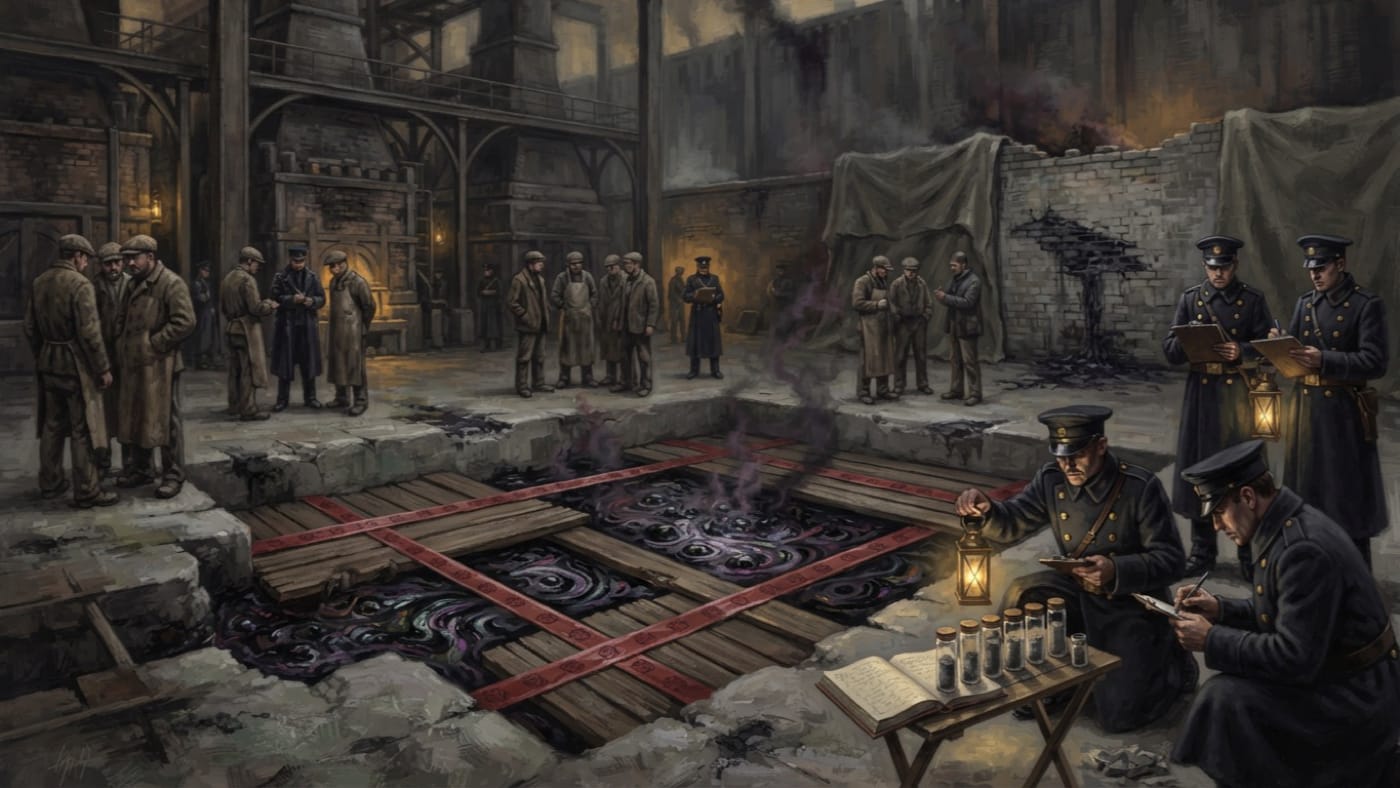
When a bloom is called, the yard stops in sections. The affected pit is sealed with boards and red wax tape. The chant over that batch stops mid-line, wherever the line happens to be. The Kiln Tender who was singing writes down the last syllable before anyone else can write it for them. If mortar from the batch has already reached the wall, the seam is covered. Personnel are separated by station: Ash-Hands from Tenders, Tenders from the Batch Scribe, and everyone from the water.
All the ash is preserved, including the floor sweepings and the grey film on the gloves. It goes into labelled vials and is counted twice. Nobody scrapes the bloom until a witness is present to watch the scraping. If the pit ticks, nobody answers it, whether by voice, by knock or by the small nervous prayer the trade has learned to swallow.
These orders bind the affected operation and nothing wider. A fortress that keeps its wards by bell and valve cannot silence its acoustics because one slaking pit has misbehaved. Any Purity officer who proposed it would find the garrison commander suddenly very interested in the doctrine of martyrdom.
The investigation follows the seal. The batch ledger is seized and the water is tested. Hymn witnesses are questioned one at a time in a room with no chant wheel on the wall. The provenance tags are hung in order on a cord, so that the whole render chain can be read by lamplight like a string of charges. Barrels from the same burn are held. Seams already patched are logged for re-inspection. The masons who laid them are told nothing, and they take that as information.
The Black-Lime Containment Leads arrive after that, on whichever day Records chooses to recognise them. Theirs is an established specialist rank within the Melter trade, and they climb to it from the same intake tables as everyone else. No register this office may cite records what they carry, how they are trained or where the scraped matter finally goes. Purity Melters scrub their benches before a Lead enters, which is the nearest that faction comes to humility.
#On the Irongate Warning
In A.S. 161 an emergency quick-kiln at Bastion-Irongate, above the Danube gorge, omitted the quiet hour on an order meant to save a failing section. The mortar set within specification. It then exuded clear fluid from the seam for seventy-one hours, which the yard rounds to three days. The Melter was retired. The emergency order was reclassified as never issued. The wall-section remains in service.
That batch was not black lime, and the difference matters to anyone who has to sign the file. It set. It wept clear. Nobody reported a whisper. The Purity Melters cite it as proof that omitted procedure gets answered. The Bureau of Rites recorded condensation, a word it has applied generously over the years. Both readings survive because the seam is still holding and still goes under a tarp whenever the inspectors visit. The Bureau prefers most of its evidence kept that way.
#On Present Handling
As of A.S. 201 the Sagittal Line still runs on bone-lime. Every bastion from Königsberg to Constantinople has seams laid with it. No Bureau has proposed giving it up, because nothing else carries a ward across a joint, and the walls cannot wait for a theologian to find a substitute. Black lime remains rare. Because it is rare, no audit is permitted to forget it.
A clean certificate protects the yard, the signatories and the Foreman's pension. It records what was done at each station. A bloom shows what the record could not reach, and the inquiry that follows goes looking for the station the record missed.
The cost falls where it always falls. Melters already work through lime burns and through lungs that eventually give out. Their masks have cracked straps, logged by a quartermaster who has never breathed slake dust. A called bloom adds the audit, the seized ledger, the separated bay, and a week of waiting to learn whose service record has been chosen. Nobody jokes about black lime. Nobody jokes about singing set. In a trade that laughs about saints holding the wall together, that silence is the most reliable warning the yards have.
Cause and final disposition remain open. Until the Bureau of Doctrine instructs otherwise, a sealed pit stays sealed and its ash stays in the vial. A witness must be present before anyone scrapes. Any Melter who hears a sealed pit tick is to note the hour, report it to the station clerk, and finish the shift without answering.