
#On the White-Handed Faction
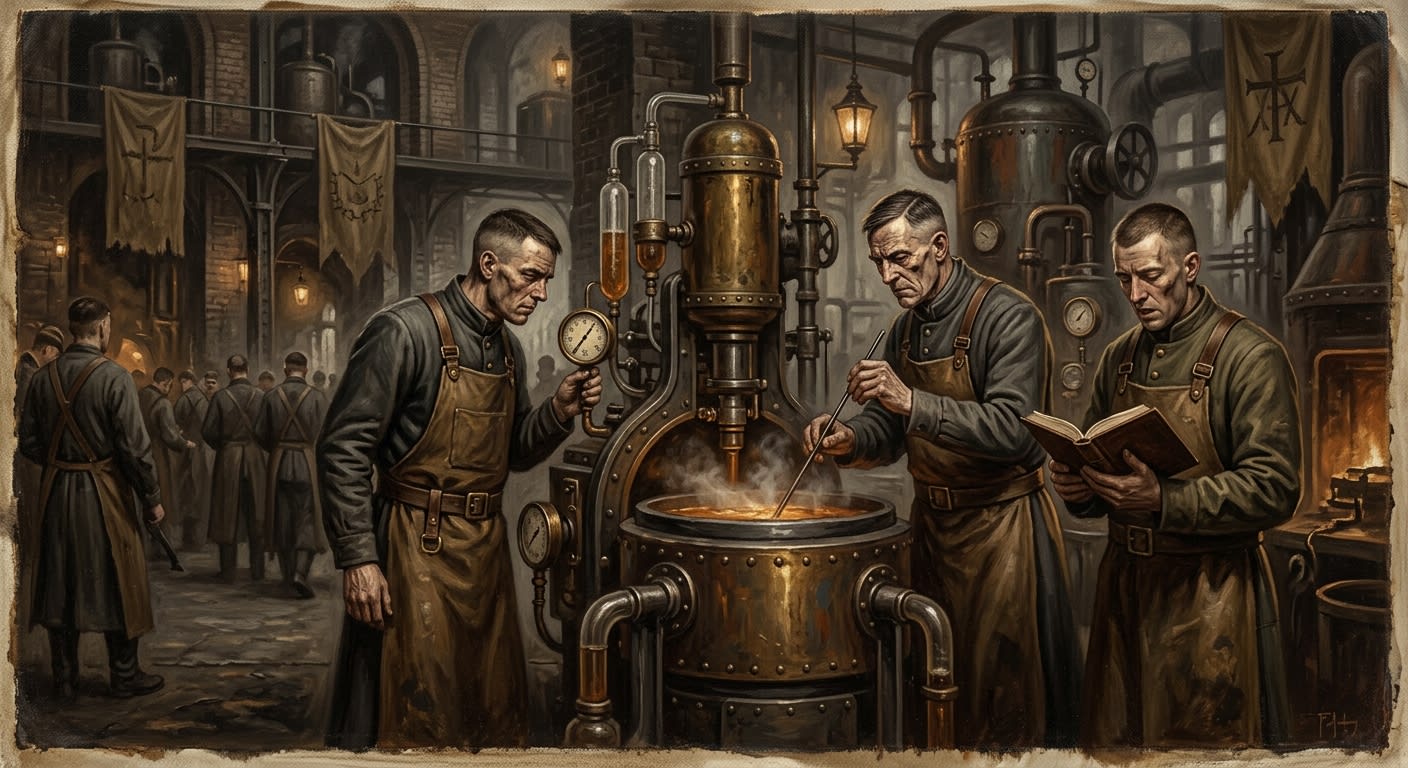
The Purity Melters are the severe faction within the Saint-Bone Melter profession: hymn-counters, provenance auditors, ratio wardens, quiet-hour absolutists, and the sort of people who can look into a slaking pit while a wall is splitting under bombardment and ask whether Appendix IV-C authorises the third verse in damp weather.
This makes them maddening. It also makes them useful. The Synod has always preferred maddening usefulness to agreeable failure, which is why half our institutions resemble an argument preserved in vinegar.
They hold three propositions with the flat tenderness of zealots handling hot glass. First: sanctity is measurable. Second: mortar strength is a function of correctness. Third: a saint rendered under improper hymn is not shelter but insult, and insult mixed into a wall will, given time, answer.
Their rivals, the Siege Melters, laugh at this until the wall sings.
#On Their Origin
The faction was born from the profession’s shame. The Ossuary Overflow Winters filled the forward shelves past counting. The Saint-Bone Melting Acts of A.S. 96 made use of that failure, declared sanctity deployable capital, and sent relic fragments toward the kiln under forms cleaner than the act. In the first decades, Melters worked by yard habit, local prayer, fuel temperament, and whatever ratios the Master Melter had learned from someone with intact hands.
The results were mixed. Walls held. Walls cracked. Mortar cured white, grey, yellow, and once at Bastion-Constantinople a colour that made three masons vomit into their sleeves before pretending they had not. Some batches set too quickly; some wept; some produced small ticking sounds during frost; some accepted paint but rejected icons. The Siege Melters called this field variation. The Purity Melters called it evidence.
By A.S. 142, after enough unclean burns had embarrassed masons, chaplains, and the sort of engineers who think embarrassment is less serious than collapse, the Bureau of Rites and Bureau of Engineering issued the Purity Kiln Decree. The Purity Melters did not write it. They behave as if they wrote it in their own blood and corrected the spelling afterward.
Several Purity Melter house histories state that the Purity Kiln Decree was issued at the faction’s petition.
Correction: the Decree was issued after operational failures, jurisdictional embarrassment, and Engineering’s discovery that sung procedure could be cheaper than rebuilding southern wall-sections. Petitions were received later and filed as prophetic support.
#On the Doctrine of Correctness
The Purity Melter’s doctrine is offensive because it is nearly sane. Bone-lime is not common lime with a blessing pasted to it like a cheap indulgence slip. It is sanctified material under stress: physical, liturgical, archival, and, in the most irritating cases, personal. The fragment remembers provenance. The kiln remembers heat. The wall remembers application. Doctrine must bind memory before memory chooses its own vocabulary.
That is their claim.
A Purity Melter begins with intake. Renderable, protected, disputed, duplicate, chapel-owned, politically owned, nameless, named too many times. He checks the provenance tag against the crate seal, the crate seal against the batch book, the batch book against the chapel relinquishment notice, the notice against the Relics mark, and the Relics mark against the smell of forgery that accumulates wherever grief and money share a desk. He will delay a batch for one missing witness ribbon. He will halt a convoy over a smeared wax edge. He will make a colonel wait in sleet while he confirms whether “Saint Ephraim Minor” and “Saint Ephraim the Lesser” are the same devotional asset.
They were, in that case. The colonel lost two toes.
The chant wheel is their sacrament. First Feed, Rising Heat, White Glow, Full Calcination, Cooling, Slake Preparation, Final Set. Each stage receives its line, pace, breath, and correction. A Purity Melter hears a skipped syllable the way a banker hears a counterfeit coin hit marble. The voice matters because the burn answers to rhythm. Heat may be measured by gauge, colour, and experience; proper heat is measured by obedience.
#On Their Practices
Purity Melter yards are recognisable before the gate opens. The tools are aligned by handle length. The slake paddles hang with inspection tags facing outward. Respirator masks are logged by strap condition. Ash-Hands wash in vinegar before and after shift, and again after any fragment classified Tier Four or above touches the intake table. The quiet room contains no stools because comfort encourages theological drift.
The quiet hour is observed in full. Linen cloth. Bell-hush. No personnel in the chamber. No observation slit. No prayer spoken outside the approved start and close. The Siege Melter calls this superstition in uniform. The Purity Melter calls it professional memory, citing the A.S. 161 Irongate batch that wept for three days after the quiet hour was skipped. Rites called that condensation. Rites has called many things condensation, including two miracles and one threat.
BATCH REVIEW — IRONGATE QUICK-KILN, A.S. 161 Quiet hour omitted under emergency order. Mortar set within specification. Seam exuded clear fluid for seventy-one hours. Fluid tasted of salt and spoke no audible word. Melter retired; emergency order reclassified as never issued; wall-section remains in service under tarp during inspections.
Purity Melters keep condolence notices in the batch office. This is not sentiment. It is doctrine wearing mourning clothes. When a wrong render is discovered, or a protected fragment is burned, or a wall patch fails after a provenance dispute was ignored, the notice must name the error without granting scandal a handle. Purity Melters are famous for arguing over wording while stretcher crews wait outside.
The mockery is deserved. The discipline is necessary.
#On Their Enemies
Their enemies are many, as all proper people’s enemies are.
The Siege Melters hate them because delay kills under bombardment. A crack does not pause while a Batch Scribe verifies whether the chapel seal was pressed at Prime or Terce. Siege yards have sealed demon-pressure breaches with whatever lay in the crate, including fragments whose provenance would make a Purity Foreman bite through his own tongue. Those walls held often enough to make the Siege faction insufferable.
The Purity answer is simple: a wall that holds tonight may condemn tomorrow’s garrison if the mortar cures wrong. This argument has never comforted anyone standing beside a widening crack.
Additive Heretics offend them more deeply. A Siege Melter breaks rules under pressure. An Additive Heretic improves the batch while smiling. Illicit binders, demon-glass heat listeners, unlicensed hardening salts, black-market filters, marrow-glue from civic kilns — all the little crimes by which a weak mortar becomes strong and a strong doctrine becomes ridiculous. Purity Melters insist that hidden strength is hidden failure. Engineering, with its usual genius for cowardice, publishes no opinion while privately measuring the results.
Shrine-keepers hate Purity Melters in a different key. A Siege Melter at least looks guilty when he burns your chapel’s fragment to seal a parapet. A Purity Melter looks at the tag, corrects your spelling of the saint’s epithet, and explains that the render category is valid.
#On Black Lime
Black lime is their nightmare because it proves the world is less obedient than the form.
The Purity position holds that black-lime bloom comes from error: wrong hymn sequence, wrong provenance, contaminated water, illicit additive, mis-staged heat, failed quiet hour, or a fragment rendered against its proper classification. The Melter’s secret fear is worse. The Melter fears a perfect batch that turns black anyway.
Purity Circular 17-K states: “All black-lime incidents are traceable to procedural defect.”
Corrected for restricted instruction: all black-lime incidents are to be treated as procedural defect until the alternative becomes prosecutable, survivable, and printable. No office has yet achieved all three.
When a bloom appears, Purity Melters become beautiful in the way a guillotine is beautiful: clean, exact, and suddenly surrounded by silence. Pit sealed. Batch ledger seized. Ash-Hands separated. Water tested. Hymn witnesses questioned. Provenance tags hung in order on a cord. Nobody jokes. Nobody says the fragment remembered. Nobody says the wall objected. The phrase wall-risk does all the work, blessed little mule.
The Black-Lime Containment Leads arrive after that, if Records admits they exist for the day. Purity Melters resent them, admire them, fear them, and keep their benches clean before they enter. This is the nearest the faction comes to humility.
#On the Present Use
As of A.S. 201, Purity Melters dominate certification, training, and post-incident review while losing most trenchline arguments by volume, artillery, and profanity. They staff the schoolrooms, chair the batch courts, approve chant wheels, inspect condolence wording, and make themselves hated in every kiln yard that still hopes to finish work before nightfall. The Bureau of Rites likes their discipline. Engineering likes their records. Purity likes their punishments. War tolerates them until a wall cracks.
They have never been popular. Popularity is for festivals, soup sellers, and saints with uncomplicated bones.
The Purity Melter remains where he has always stood: between the fragment and the kiln, between the hymn and the heat, between the living who need a wall and the dead whose names still cling to calcium. He checks the tag. He corrects the verse. He signs the notice. He delays the barrel. He saves the wall often enough that no one has yet been permitted to throw him into the slake pit.