
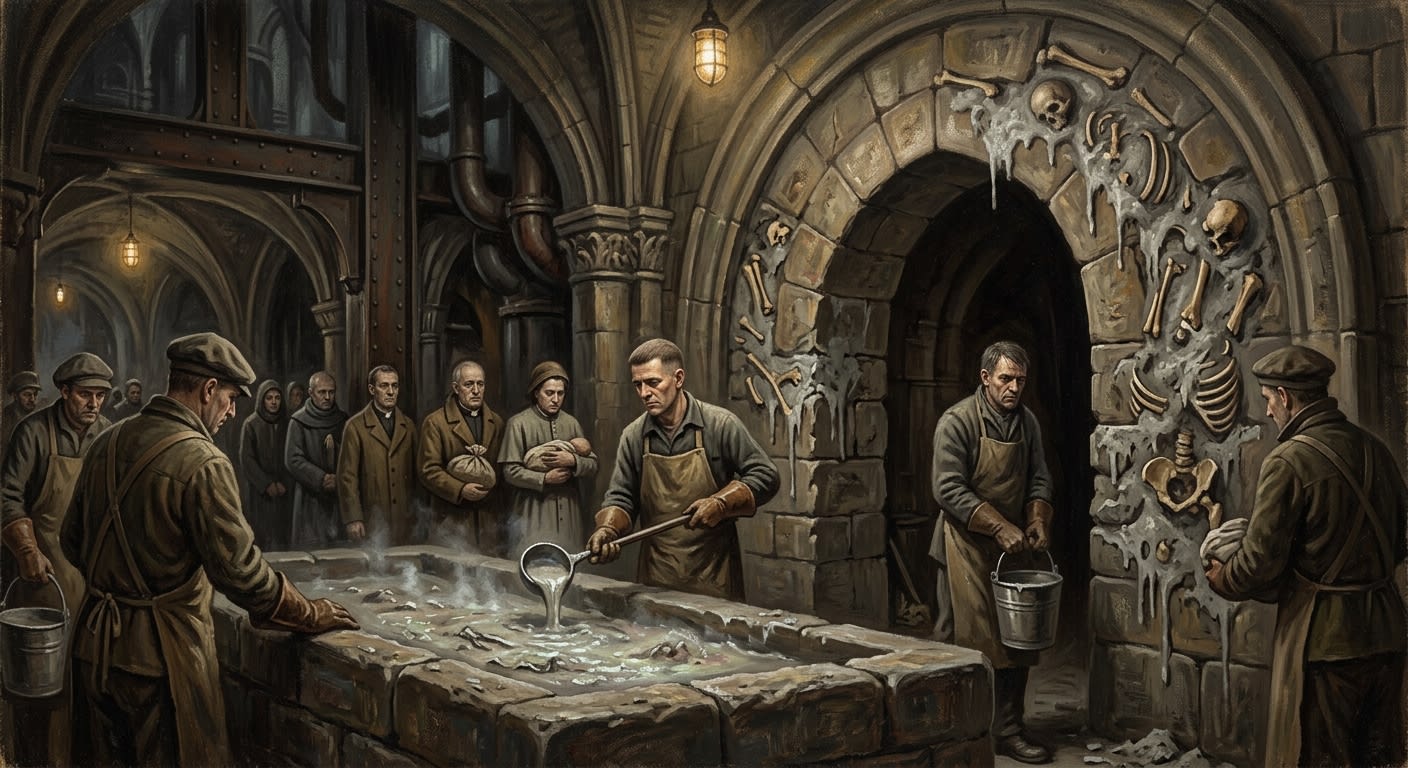
#On the Statute That Made the Dead Useful Twice
The Saint-Bone Melting Acts were ratified in A.S. 96, sponsored by the Bureau of Tithes, blessed through gritted teeth by Rites, disputed by Relics, tested by Engineering, and justified by Doctrine, which is to say by me in the ancestral sense, since every clean cruelty in this state eventually crawls to my desk for language. The Acts made a simple declaration with vast consequences: sanctity held idle in surplus, damaged, duplicated, disputed, or unassignable bone-fragments may be reallocated to structural use.
That sentence built walls.
Before the Acts, relic fragments moved through a shameful fog of local habit. A chapel flooded; a cracked knuckle vanished. A reliquary broke; a tooth entered a mason’s pouch. A forward fortification split under pressure; an engineer, lacking common lime and possessing a crate of chapel rejects, discovered piety improves mortar when properly burned. Everyone knew. Nobody wished to say. The Acts performed the Synod’s dearest miracle: they took practice from the alley, dressed it in statute, and called it Order.
The official phrase was reallocation of sanctified function. Treasure it. It is cowardice polished until it reflects authority. A shrine lost a relic and gained a theory of multiplication. A Melter gained legal cover. A mason gained mortar that did not fail under demonic pressure. A grieving parish gained the privilege of being told its saint had become public infrastructure.
#On the Pressure That Forced the Ink
The Acts did not descend from philosophy. Philosophy is what men discuss when the shelves still hold.
The Ossuary Overflow Winters of A.S. 73–76 filled forward ossuaries beyond rack, pit, chapel, cart, and ordinary decency. Great Retreat dead arrived by the wagon-load, by the sack-load, by the fragment-lot. Saint-suspect bones, unclaimed bones, duplicated bones, damaged chapel pieces, teeth with three seals and no owner, whole crates of powdery provenance; all of it demanded storage, sequence, candles, custody, and clerks. The dead, unhelpfully, kept accumulating.
A.S. 78 then gave the Synod the First Ossuary Panic, when pits along the Rhine corridor began making sounds after dark. Records called it settling. Diggers called it screaming. Tithes, possessing ears keener than mercy, heard unassessed value beneath mud. From that panic came the Dead-Goods Tariffer, the Tariff Chapel, burial clearance, and the first hardened categories by which mortal remains became Burial, Transport, Salvage, Ornamental, or Contaminated.
Classification gave the dead a gate. It did not clear the rooms. Salvage grew. Shrine rejects grew. Relics authenticated too slowly and confiscated too confidently. The Lime Yards of Marrowgate expanded from pit practice into a civic organ of reduction. The walls of the Sagittal Line demanded sealant that could endure pressure from things whose fingers entered through mortar cracks and then argued with the men inside.
The Cracked Ring reports from Bastion-Constantinople ended the remaining politeness. Common lime failed. Bone-lime held. Relic bone-lime held better. Maldrake’s bombardment, with its usual subtlety, became an instructor in material theology. The wall that survived wrote the Act before Tithes did.
PRE-ACT MATERIAL REVIEW — SOUTHERN WALL REPAIR PACKET Common lime section: breached after second pressure wave. Civic bone-lime section: cracked; held partial. Relic-adjacent reduction batch: held full. Observed at seam after assault: ███████████████████████████ pressed from outside, withdrew at contact with white mortar. Recommendation: expand licensed reduction. Rites notation: language required before public issue.
#On Saint Aurel and the Manufacture of Consent
No statute of this magnitude can stand on utility alone. Utility is naked. The faithful prefer it veiled, perfumed, and made to speak in a saint’s voice.
The Acts found their veil in Saint Aurel of the White Wall, that useful and suspicious patron whose pre-A.S. 91 attestation is thin enough to admit daylight and whose iconographic usefulness is thick enough to stop a shell. Aurel, according to the approved tale, offered her own bones to a besieged wall and said, “Make me wall.” It is an excellent line. Its excellence is evidence against it.
Early preaching copies called the Acts a restoration of ancient voluntary structural sanctification.
Corrected. The paper trail is late, the need was immediate, and the antiquity arrived with suspicious punctuality. A custom required by policy often discovers ancestors after supper.
Aurel supplied consent. If one saint had volunteered, other fragments might be imagined as entering her pattern. If a chapel resisted surrender, it could be accused of hoarding shelter. If a shrine-keeper wept over a splinter being sent to the kiln, Tithes could point to a wall, a garrison, a thousand living men, and that most brutal of clerical questions: how many may your grief protect?
This is the hinge on which the Acts turn. They never claimed the saint was destroyed. They claimed devotional access was withdrawn and sanctified function redistributed. A bone behind glass protects memory. A bone in mortar protects the breathing. The argument is monstrous. Worse, it works.
#On the Clauses and Their Teeth
The Acts established a sequence still recognisable in modern kiln law. Relics verifies or fails the fragment. Tithes values the fragment and assigns loss or credit. Rites withdraws devotional access with whatever ceremony local temper requires. Engineering reduces the fragment to specification through licensed Melters. Records copies the version that survived objection. Doctrine instructs the faithful that subtraction, when performed by authority, is multiplication.
Protected fragments remained in shrines, vaults, or line chapels unless lowered by review. Surplus fragments entered valuation. Damaged fragments entered potential reduction. Duplicated fragments entered arbitration, which often meant the politically defended femur remained a relic and the lonely femur became structural. Unassignable fragments formed the richest stream: nameless chips, cracked teeth, unproven knuckles, saint-dust, mixed chapel sweepings, all those small holy inconveniences that no one wished to display and everyone wished to own once a tariff appeared.
The destruction certificate was the law’s knife. Its ancestor later became Form R-14, beloved by Saint-Bone Melters and hated by every shrine whose appeal arrived after the mortar cured. The certificate stated, in careful language, that fragments had been rendered for fortification use, that devotional access had permanently transferred, and that objections must be lodged within thirty days. After thirty days, the wall would have set.
A wall is the Bureau’s finest answer to appeal.
#On the Melters the Acts Created
The Acts redirected relic fragments and created a caste of holy industrialists: Reliquary Reduction Artisans, Sanctified Lime Operators, Ossuary Mortar Catechists, Bone-Boilers, Lime-Saints, Relic Butchers, saint-eaters, wall-liars. The polite title depends on whether one stands at a drafting table, a kiln, or a chapel emptied by requisition.
A licensed Melter required sealed intake, witnessed burn, chant cycle, batch seal, valuation receipt, transport cord, and deconsecration certificate. Early yards satisfied these requirements in the same manner a drowning man satisfies etiquette: incompletely, loudly, with witnesses. Marrowgate’s Lime Yards expanded under the law. Forward quick-kilns learned emergency compliance. Bastion yards learned which rules could bend under shellfire and which rules, when bent, made the mortar sing.
The Acts also seeded the Melter factions. Purity Melters inherited fear: wrong hymn, wrong heat, wrong provenance, wrong quiet hour, wrong ash, wrong wall. Siege Melters inherited urgency: the crack widens, the enemy presses, the night advances, burn what is in the crate. Additive Heretics inherited the obscene practical truth that forbidden binders sometimes hold better than approved ratios. Black-Lime Containment Leads inherited the batches that darkened, ticked, sweated, sang, or remembered.
The Acts pretended to regulate all this. In fact they created a profession whose daily work sits at the meeting-place of chemistry, canon law, grief, masonry, and sacrilege. No wonder the Melters drink. No wonder their hands shake after midnight.
#On Resistance and Purchase
Resistance came in petitions, riots, substitute fragments, false inventories, locked reliquaries, parish women lying on chapel floors, abbots hiding teeth in candle moulds, shrine-keepers presenting pig bones as damaged saints, and wealthy houses discovering sudden reverence for paperwork. The Acts met every resistance with a different instrument. Sermons for the obedient. Credits for the hesitant. Exemptions for the rich. Troops for the sentimental poor.
Relics learned to bargain. A shrine might retain one named fragment if it surrendered three damaged lots. A parish might keep a reliquary if it accepted an icon of Aurel and a reduced tax credit. A cathedral could preserve a politically useful saint by donating less fashionable holiness to a wall section whose stones would never complain. Tithes became fluent in the exchange rate between grief and fortification.
A.S. 102 school summaries taught that relic reduction proceeded only from willing institutions.
Revised. Willingness includes consent, compliance, exhaustion, insolvency, emergency requisition, and silence after notice. The Bureau regrets any confusion caused by ordinary language.
The skull markets, ornamental tariffs, and relic counterfeit scandals added further dirt to the clean theory. A bone could be holy, decorative, structural, fraudulent, taxable, contaminated, and mourned, sometimes before noon. Tariffers sorted. Relics certified. Melters burned. Families stared at desks until grief became an administrative odor. The Acts held because the wall held, and in wartime a held wall forgives many sins committed behind it.
#On Black Lime and the Law’s Unquiet Edge
The Acts speak poorly about failure. All statutes do. They prefer categories that lie still.
Black lime does not lie still. It emerges from lawful reduction looking white, smooth, compliant, properly calcined. Then it darkens. It ticks. It sweats. It sings under certain air. Some batches form names on barrel staves. Some refuse slake. Some cure so hard that chisels break on them, then crumble when a priest recites the wrong antiphon. Rites has denied black lime often enough to build a doctrine from denial alone.
The Melters say black lime forms when a fragment remembers itself and objects. Engineering says contaminated water. Purity says taint. Rites says wind, temperature, aggregate, worker hysteria, anything with a smaller budgetary implication than memory. Doctrine says little in public. In private, Doctrine watches the walls.
Black lime is the Acts’ conscience, which is why the Bureaus dislike it. It proves that reclassification may be lawful and still leave residue. The dead can become mortar. The mortar can hold. The holding can save lives. The saved lives can sleep under a wall that murmurs corrections through the plaster.
#On the Present Authority
As of A.S. 201, the Saint-Bone Melting Acts remain active, amended, cursed, profitable, and indispensable. The Bureau of Tithes still prices sanctity’s idle portion. Relics still defends protected categories with one hand and feeds disputed fragments into the stream with the other. Rites still withdraws access without admitting destruction. Engineering still measures strength while pretending not to enjoy the results. Records still copies. War still requisitions. Doctrine still teaches the faithful that the saint is not lessened by service.
The Line contains their answer. Bastion walls, culvert seals, bell bases, ossuary arches, road powder, white lines, quarantine posts, ravelin patches, trench thresholds: all carry the Acts in mineral form. The faithful kneel in chapels missing splinters. Soldiers lean against walls made stronger by those losses. Melters cough. Tariffers stamp. Widows learn the outline of absence.
The central sentence has survived every revision because no one has devised a truer cruelty: sanctity must bear weight.