
#On the Decree That Taught Bones to Burn in Order
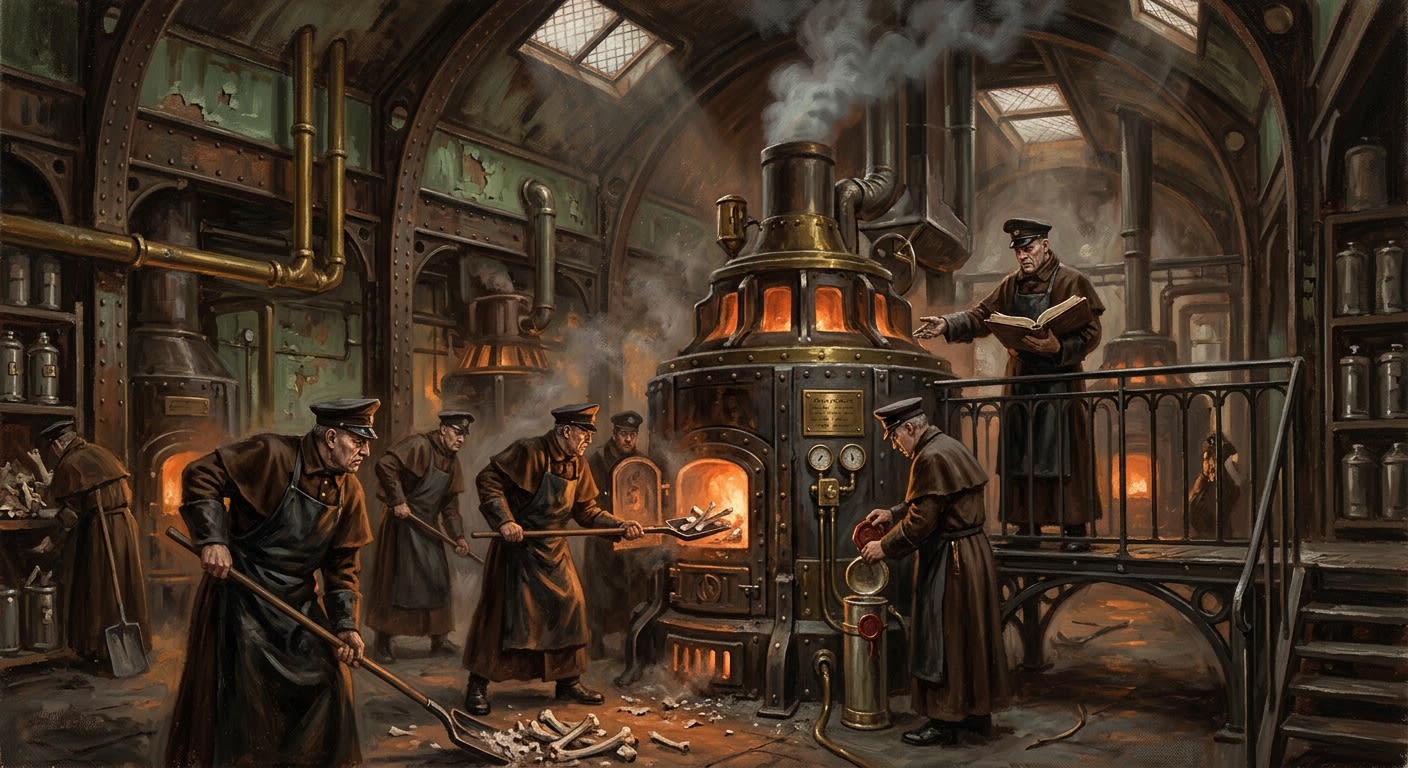
The Purity Kiln Decree of A.S. 142 is the joint instrument by which the Bureau of Rites and Bureau of Engineering standardised the rendering of sanctified remains into structural bone-lime: heat stage, chant cycle, witness form, quiet hour, batch seal, Fume-Inspector notification, and the little clause by which an incorrect hymn became a wall-risk rather than merely an embarrassment.
The name deceives in the usual efficient manner. The Decree came from no Bureau of Purity authorial desk. Purity supplied enforcement, which is to say it supplied teeth, smoke, accusation, and eighty per cent of the final text by volume. Rites supplied the prayers. Engineering supplied the ratios. Purity supplied the punishments. The saint supplied the bone. The wall, being wiser than all of them, supplied the verdict.
Its governing sentence is famous among Saint-Bone Melters and misquoted by everyone else: Holiness must bear weight. It appears in the Third Revision rather than the original issue, because the original drafters had not yet learned that a useful doctrine should fit on a kiln wall where smoke, steam, and panic may all read it at once.
#On the Shame That Made It Necessary
The Saint-Bone Melting Acts of A.S. 96 declared sanctity deployable capital. A femur in a reliquary inspires one chapel. A femur rendered to lime protects a thousand feet of wall. The arithmetic was brutal, persuasive, and exactly the kind of arithmetic the Bureau of Tithes mistakes for theology when theology becomes inconveniently expensive.
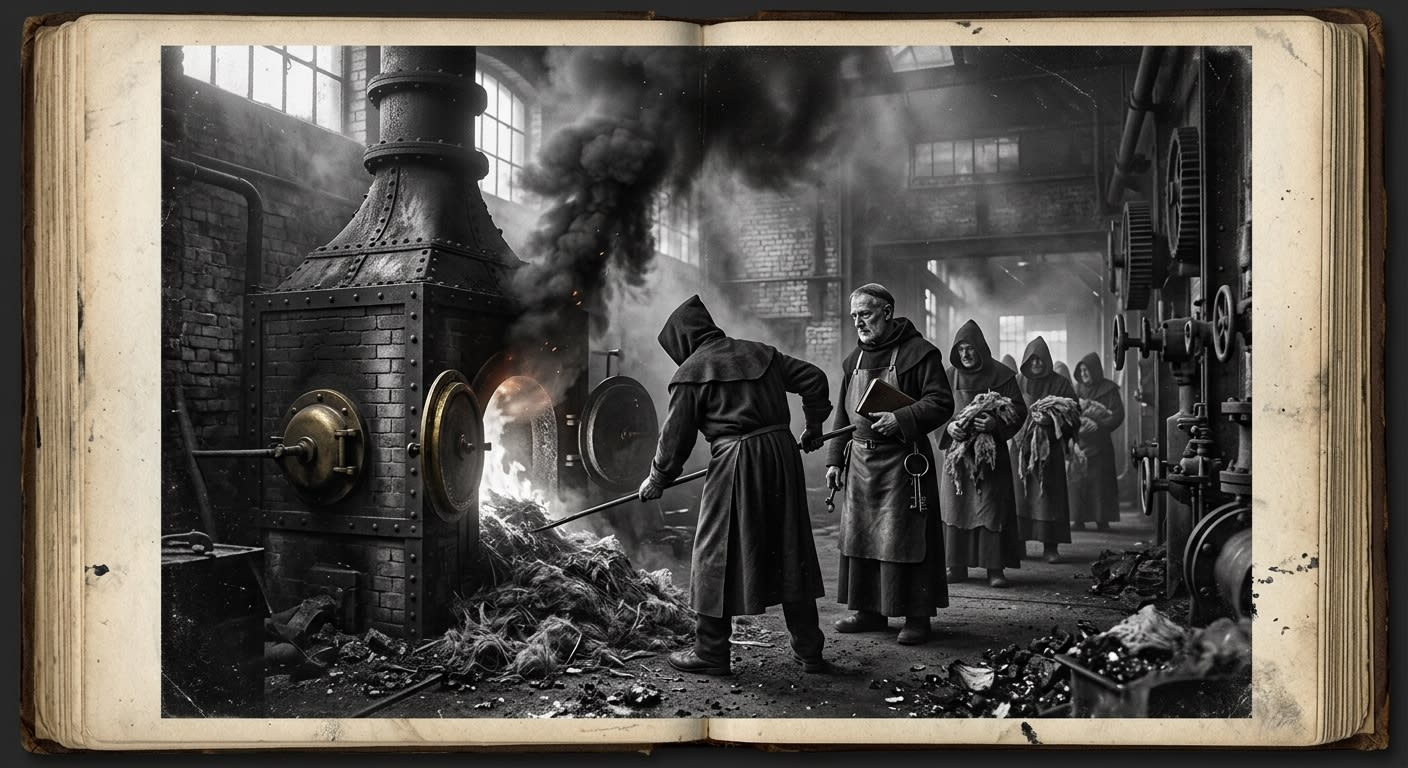
The first decades after the Acts were a handsome disorder. Kiln yards worked by local habit. Master Melters guarded family ratios. Trenchline crews burned under shelling with more courage than paper. Shrine agents bribed Batch Scribes. Ossuary clerks mislabelled fragments with the serenity of men who believe all bones eventually forgive sorting errors. Some walls held. Some cracked. Some cured white, some grey, some yellow, and one southern seam set in a colour that made three masons vomit before they remembered they were devout.
The Decree was born from those failures, though every faction now claims to have predicted it. The Purity Melters say it ratified their discipline. The Siege Melters say it arrived late, after emergency practice had already invented survival. Engineering says it regularised material behaviour. Rites says it restored form. Purity says little and keeps the irons warm.
Several devotional histories state that the Purity Kiln Decree followed a petition by the Purity Melter houses.
Correction: the Decree followed operational embarrassment, unclean burns, singing set, disputed provenance, and Engineering’s discovery that prescribed chant was cheaper than rebuilding a southern wall-section. Petitions arrived afterward and were filed as evidence of prophetic obedience.
The decisive pressure was unclean burn: mortar that set improperly, or set properly and then behaved as if setting had given it opinions. Masons reported ticking inside seams. Wardwrights reported hymn drift. Two chaplains at a forward culvert claimed a fresh patch answered the Litany of Measure one line early. Rites blamed cadence. Engineering blamed heat. Purity blamed everyone in reach. The Decree was the compromise by which all three Bureaus could be correct and the workers could be punished.
#On the Seven-Stage Chant Wheel
Appendix IV-C of the Decree fixed the seven-stage chant wheel: First Feed, Rising Heat, White Glow, Full Calcination, Cooling, Slake Preparation, Final Set. Each stage received a prescribed hymn, a heat window, a witness mark, and a variance threshold. Before A.S. 142, a Melter knew the burn by colour, smell, hand, and fear. After A.S. 142, he knew it by colour, smell, hand, fear, and a Batch Scribe standing behind him with a slate asking whether the fear had been logged.
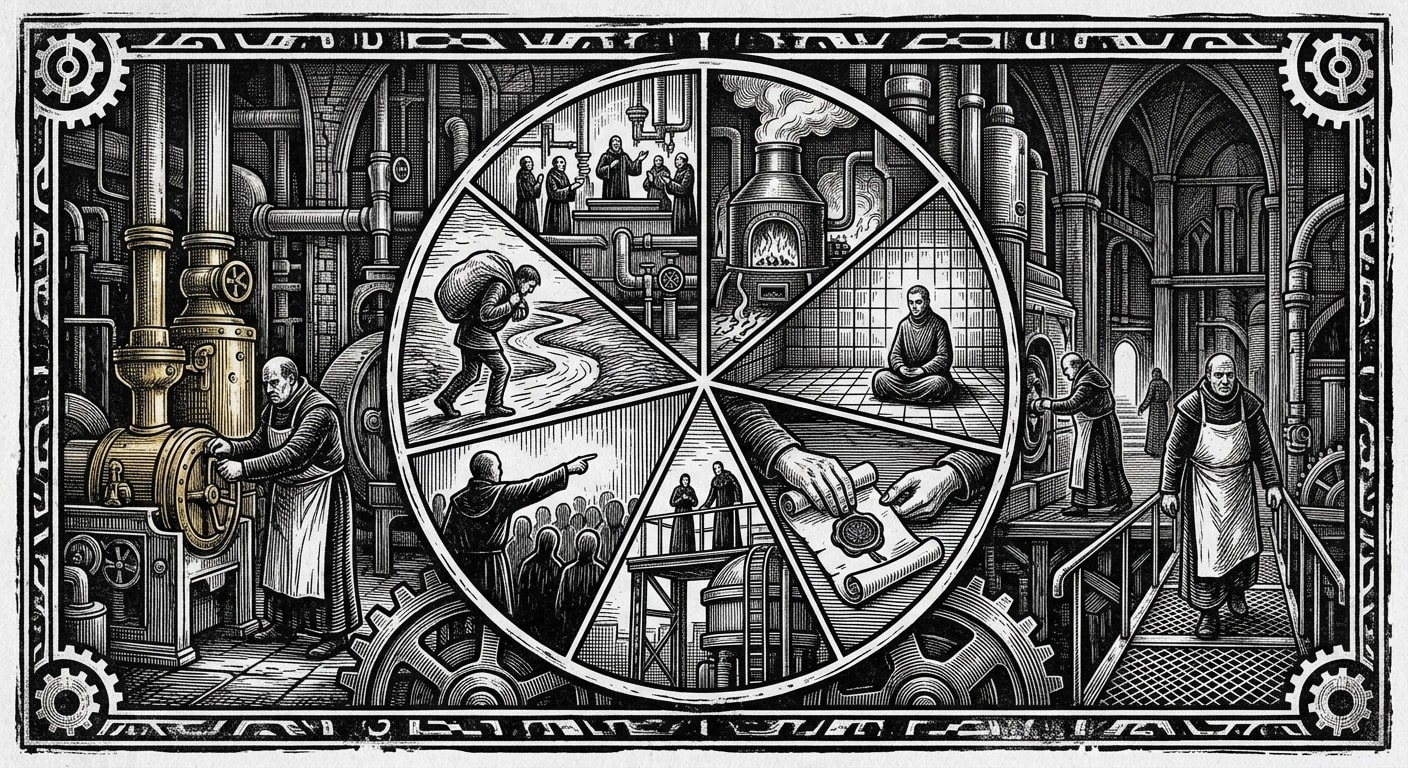
First Feed governs the entry of fragments into the kiln. The crate seal is broken under witness. Renderable, protected, disputed, duplicate, chapel-owned, politically owned, nameless, and named too many times: all must be classified before flame. The hymn is short because grief lengthens everything else. The Decree forbids improvisation at this stage after the Marrowgate Saint Vellum incident, in which a shrine-keeper added a private farewell and the burn took forty minutes longer than fuel allocation permitted.
Rising Heat governs the first whitening of the fragment. The chant climbs by measured intervals. Engineering insisted on this. Rites disliked the word interval when spoken by men whose hands smelled of coal. Purity resolved the quarrel by adding a punishable category: tonal negligence.
White Glow governs the dangerous beauty of the work, when bone ceases to resemble bone and begins resembling something a clerk might call mineral if clerks were allowed near the chamber without supervision. Full Calcination is the stripping point. Cooling is the first silence. Slake Preparation is the moment when every apprentice learns whether his courage extends to water meeting dead calcium. Final Set binds the batch to wall-service and closes devotional access.
Every Melter carries the wheel now: brass, bone, card, or cheap tin in yards whose budgets have been eaten by repairs. Purity Melters polish theirs. Siege Melters scratch private corrections on the reverse. Additive Heretics use theirs to hide packets. The wheel endures because it is useful, hated, small enough for a pocket, and large enough for an indictment.
#On the Quiet Hour
The Decree’s most mocked provision is the quiet hour, which is how one recognises a provision that matters. After cleansing and before calcination, renderable fragments rest beneath linen in a sealed room: no bell, no chant, no witness, no observation slit, no pious aunt pressing her ear to the door. Rites calls this consolidation of sanctity. Engineering calls it stabilisation. Siege calls it one hour too many. Purity calls it mandatory.
No one knows what occurs. The fragments emerge unchanged. That is the official comfort. The unofficial comfort is that the one famous skipped quiet hour, at Bastion-Irongate in A.S. 161, produced mortar that set perfectly and wept clear fluid for seventy-one hours. The Melter retired. The emergency order was reclassified as never issued. The wall-section remains in service under tarp during inspections, because the Synod’s courage is mighty and often made of canvas.
BATCH REVIEW — IRONGATE QUICK-KILN, A.S. 161 Quiet hour omitted under emergency order. Mortar set within specification. Seam exuded clear fluid for seventy-one hours. Fluid tasted of salt. No audible word recorded. Emergency order reclassified. Melter retired. Wall-section retained under operational necessity.
The quiet hour divides the factions cleanly. Purity Melters observe it in full, even if colonels freeze, convoys wait, and the wall bell grows rude. Siege Melters shorten it under bombardment and then lie with professional economy. Black-Lime Containment Leads ask only whether it was skipped, who signed, who ordered, and whether the room was truly empty. They have learned that the room is never truly empty. Saints are poor at paperwork but excellent at attendance.
#On Enforcement and the Fume-Inspector’s Nose
The Decree gave enforcement to Purity’s Fume-Inspector arm, a choice that proves the Bureaus possess a sense of humour and keep it locked where only cruelty may borrow it. A Purity Fume-Inspector may enter any kiln yard upon scent, report, rumour, smoke variance, batch complaint, worker silence, unauthorized sweetness in the burn, or the troubling absence of expected odour. He carries fume paper, ash vials, ledger-lantern, citation wax, and the nasal arrogance of a man whose nostrils have been mistaken for jurisdiction.
Under the Decree, the Inspector owns the burn rather than the seam. That later distinction belongs to Containment Lead practice. The Inspector owns the burn: air, smoke, residue, chant variance, worker testimony, and the blessed right to make everyone present wish the kiln had taken them too. He may halt a batch. He may mark a batch suspect. He may seize ash. He may order a re-chant. He may require a Melutio Form — that miserable sheet by which the worker explains why heat, hymn, and saint failed to agree.
Popular speech treats the Purity Kiln Decree as a Purity statute.
Incorrect. It is a Rites-Engineering instrument with Purity enforcement. The confusion persists because citizens remember the person who burned their uncle more vividly than the committee that authorised the heat.
The Fume-Inspector’s report travels to Rites, Engineering, and Purity. Records receives a copy if the copy is not lost, sealed, eaten by jurisdiction, or declared unnecessary because the wall held. The worker receives discipline. The batch receives classification. The saint, having been reduced to lime, receives no correspondence.
#On the Factions It Created
The Decree did not invent Purity Melters or Siege Melters. It gave them language sharp enough to cut each other properly.
The Purity Melters took the Decree as scripture. Provenance tags became moral organs. Chant cadence became structural necessity. Quiet hour became covenant. Batch ledgers became confession. A wrong tag was a saint offended; a wrong hymn, a crack delayed; a wrong ratio, a funeral with scaffolding. Their severity has saved walls and ruined tempers in roughly equal measure, which in a forward trade counts as balance.
The Siege Melters took the Decree as enemy and tool. They know the wheel. They can recite the stages while deafened and bleeding. They also know that a crack widening under Maldrakean pressure will not pause for Appendix IV-C to clear its throat. Siege practice shortens, defers, approximates, and survives. Then the morning review arrives and discovers irregularity standing where a breach would have been.
The Additive Heretics grew in the cracks between decree and reality. Engineering published official mix ratios in A.S. 147. The Melters ignored them where the world failed to resemble a laboratory. Illicit binders, hardening salts, marrow-glue, oathglass grit, hinge powder, demon-glass heat listeners: all entered the trade through the old door marked necessity. The Decree forbids them. Some walls owe their lives to them. The Bureau resolves this by condemning the packet, measuring the seam, and pretending the two acts do not share a desk.
Black-Lime Containment Leads emerged from the same pressure, though the Decree never names them in public. A law that creates wall-risk will eventually require people who can stand inside the risk without answering when the seam says their father’s name. They know the Decree by heart. They also know every place it fails.
#On Black Lime and the Limits of Correctness
Black lime is the Decree’s private enemy. It is the bloom that darkens sanctified mortar after set, beads fluid on dry days, ticks behind plaster, sings in narrow corridors, and occasionally offers small grammatical corrections in damp soot. Purity says black lime proves procedure failed. Siege says it proves procedures are smaller than walls. Additive Heretics say nothing because talking near black lime is a good way to acquire a file. Containment Leads wait until all three have finished being stupid.
The Decree classifies all black-lime incidents as irregular until proven otherwise. The restricted commentary, which I have read and which several committees would prefer I had not, adds a cowardly sentence: where no irregularity can be demonstrated, irregularity shall be presumed in unavailable evidence. Magnificent. A perfect batch that turns black is, by statute, an imperfect batch whose flaw has hidden itself. The Bureau does not call this circular. The Bureau calls it administratively complete.
The fear beneath the law is simple: a saint rendered correctly may still object. No Bureau wishes to write this. Rites will not admit form can fail. Engineering will not admit measurement can miss the relevant fact. Purity will not admit innocence can bloom black. Doctrine will admit nothing until the sentence has been improved.
So the Decree stands. It orders hymn, heat, silence, seal, and witness. It catches many failures. It misses others. It gives the worker a way to say, with a straight face and scorched hands, that the burn was lawful. Sometimes lawful mortar sings anyway.
#On the Decree’s Present Force
As of A.S. 201, the Purity Kiln Decree governs every licensed Saint-Bone Melter yard from Strasbourg’s sealed reliquary annexes to Bastion-Constantinople’s quick-kilns, from Bastion-Przemyśl’s Kiln Yard Seven to the smaller wall-repair pits that appear wherever the Sagittal Line develops a crack and a clerk develops the courage to classify it. It is revised, ignored, cited, hated, corrected, and carried.
Its genius lies in custody. Before A.S. 142, a failed batch belonged to misfortune. After A.S. 142, it belonged to someone. The hymn had a keeper. The heat had a number. The ash had a jar. The quiet had a duration. The seal had a hand. Responsibility, that rarest building material, entered the kiln yard and immediately began burning people.
The Decree made Melters legible, taught black lime where the margins were, armed Purity and Siege with quotations, and left theft, improvisation, shortcut, grief, bribery, hidden packets, bad water, false saints, tired apprentices, and the miserable courage by which a worker breaks a rule and saves a wall still breathing in the yard.
But it gave the Synod a sentence to paint above the kiln: HOLINESS MUST BEAR WEIGHT.
And beneath that sentence, in smaller letters added by some unlicensed wit and painted over thirteen times without success: SO MUST THE MEN WHO BURN IT.