
#On the Three Winters
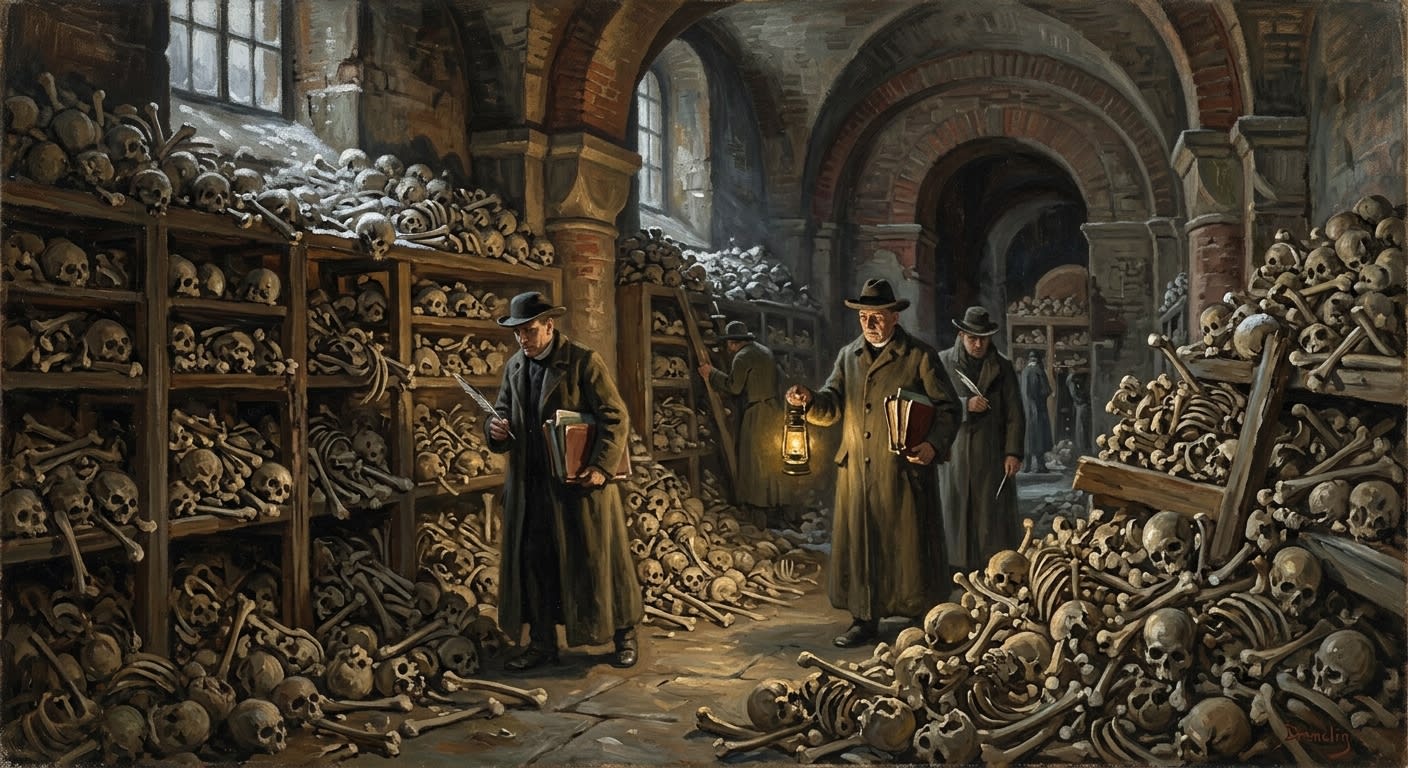
The Ossuary Overflow Winters were three consecutive winters in the A.S. 70s when the forward ossuaries filled past capacity, past dignity, past that administrative frontier at which a problem ceases to be logistical and becomes theological because no office wishes to own the smell. Records sealed the ratio of dead to living as “operationally discouraging,” a phrase of such cowardice and precision that I have considered having it embroidered on a pillow for the Sub-Vault of Failed Euphemisms.
They began after the worst convoys of the Great Retreat had settled into permanent suffering along the early Sagittal Line. Men died in ward tents. Women died in queue pens. Children died in carts waiting for clearance. Horses died in harness and were, for one profitable fortnight, given better inventory treatment than infantry because a horse arrived with tack, brand, and resale potential. The dead entered the forward ossuaries in numbers that made burial arithmetic collapse.
The winters are usually placed between A.S. 73 and A.S. 76, though some bastion calendars compress them, and one Przemyśl chapel calendar pretends there were only two. That chapel calendar also describes the smell as “seasonal vapour.” Its author later became a Records instructor, proving that incompetence, if sufficiently polished, becomes curriculum.
#On the Forward Ossuaries
A forward ossuary is a compromise built of stone, panic, and poor ventilation. It stands close enough to the front to receive casualties before the bodies turn inconvenient, far enough behind the guns to pretend it is not part of battle, and always below the moral eye-line of visiting prelates. Its purpose is classification: named, unnamed, partial, contaminated, suspected saint, common salvage, protected relic, doubtful fragment, sealed jaw, infectious cloth, political corpse, useful bone.
During the Overflow Winters, classification lost its hands.
Stacks rose in the intake bays. Racks bowed. Chapel floors disappeared under tagged bundles. The cold delayed rot but sharpened everything else: the stiffness of fingers around medals, the split of frozen skin, the little ticking of teeth in jaw trays when carts passed. Clerks wrote at standing desks until ink froze in the wells. When ink failed, they used soot and vinegar. When soot failed, they scratched tallies into limewash. When limewash ran out, they turned the wall itself into a ledger and discovered, too late, that walls remember poorly when wet.
Early instructional accounts describe the overflow as a “temporary storage excess.”
Corrected. Temporary storage excess is three carts in a courtyard. The Overflow Winters required nine chapel annexes, twelve sealed pits, emergency rack carpentry, and at least two memoranda instructing officers not to compare the ossuary population to the garrison census.
The Bureau of Records forbade the phrase the dead outnumber the living. It appeared anyway. On door lintels. On ration slips. In latrine songs. Once on the back of a bishop’s winter cloak in charcoal so fine that nobody noticed until he entered the candle hall and the whole company saw the sentence bend across his shoulders.
#On the Ratio
The sealed ratio is the heart of the matter, and the heart is locked in Records because hearts, unlike stomachs, may be made to wait. We know the official phrase. We know the ratios were suppressed across more than one forward installation. We know the worst files concern the Przemyśl feeder ossuaries and the southern convoy mortuaries that later supplied Bastion-Constantinople with its first disciplined bone-lime streams. We know the dead exceeded the living in at least one compound if one counts full bodies, partial bodies, and authenticated fragments as separate administrative persons, which Records does when it wants revenue and refuses when it wants sleep.
This is where the arithmetic became dangerous. A corpse was a person for mourning. A fragment was evidence for Relics. A bone was material for Engineering. A named saint-fragment was capital for Tithes. The same femur could occupy four ledgers and one shelf, producing five obligations before breakfast. Multiply this by winter, shelling, disease, and clerks with chilblains, and the ossuary became a parliament of calcium.
The living heard the shelves settle at night. They heard tags click. They heard, in some districts, voices. Records called this contraction, cold shift, post-interment atmospheric settling, and other little coward-bells rung by men with warm offices. The soldiers called it the dead asking for room. The soldiers were closer.
PRZEMYŚL FEEDER OSSUARY — WINTER LEDGER SUPPLEMENT, SEALED Rack Hall C exceeded declared capacity by ███%. Chapel floor classification suspended after ninth bell. Fragment bins reassigned as sleeping shelves for fever orderlies. Three orderlies reported being counted aloud from beneath the wall. Morning census showed four additional names in the ash column. Disposition: file sealed; wall replastered; orderlies transferred to road duty.
#On the Choice of Walls Over Shelves
Every doctrine has a rude ancestor. The Saint-Bone Melter trade descends from a queue of dead people that nobody wished to store.
Before the Saint-Bone Melting Acts, rendering existed as practice, exception, improvisation, and crime wearing an apron. Common remains already fed lime pits at places like Marrowgate. Salvage bone already strengthened roads, culverts, white lines, and cheap walls. Relic fragments wandered through gray channels whenever a shelf broke, a chapel flooded, or a shrine-keeper died without heirs alert enough to defend the box. The Overflow Winters made the habit visible.
Too many fragments. Too few shelves. Too many walls in need of sealing.
The Synod chose walls over shelves and then spent twenty years teaching itself to pronounce the choice without gagging.
The conversion began in small permissions. Damaged fragments could be retired. Unassignable fragments could be reduced. Duplicate saints — a phrase that should trouble the faithful and delight the auditor — could be redistributed. Relics objected when Tithes undervalued a fragment; Tithes objected when Relics protected a fragment too expensive to store; Rites objected to deconsecration language; Engineering objected to ratios; War objected to delay; Doctrine objected to any sentence that made the process sound like desecration rather than deployment.
By A.S. 96, the argument had been given a statute. The dead entered the wall under seal.
#On the First Ossuary Panic
The Overflow Winters prepared the ground for the A.S. 78 First Ossuary Panic, when unsealed burial pits along the Rhine corridor began producing sounds at night and the Bureaus discovered that the dead, like unpaid contractors, become louder when ignored. The Panic did not invent the crisis. It made the crisis audible to offices that preferred smell to testimony.
The Dead-Goods Tariffer rose from that year’s clearance mandates, stamped into being by the Bureau of Records, the Bureau of Rites, and the Bureau of Tithes. No remains were to be interred, transported, processed, or displayed without certificate. This was advertised as respect. It was also control of the bottleneck. The hand that classifies the dead decides whether the next cart goes to burial, transport, salvage, ornament, contamination hold, or the lime stream.
Later Melter sermons imply the Overflow Winters ended when sanctified rendering began in orderly form.
Correction: the winters ended because spring came, disease changed shape, and several intake sheds were quietly burned with contents uncleared. Order arrived later, wearing clean gloves and claiming seniority.
Marrowgate learned quickly. Its first burn pits had been temporary practice after A.S. 72. After A.S. 78, the pits became kilnfields. Kilnfields acquired roofs. Roofs acquired clerks. Clerks acquired rules. The dead lost another appeal.
#On the Surviving Relics of the Event
The Overflow Winters left few heroic relics, which is proper. Heroism requires witnesses with leisure. The surviving objects are administrative: cracked rack tags, frozen ink tablets, a chapel tally wall hidden beneath six layers of limewash, two unissued clearance seals, and the famous Przemyśl shelf hook bent under a load Records describes as “improperly distributed material.” The hook is kept in a drawer, not a shrine. Drawers embarrass less.
There is also the ratio.
Records has not released it. Records will not release it. The sealed note has become an object of devotion among certain Melters, who tap two fingers on batch barrels before winter convoy dispatch and say, “More shelves in the wall.” Purity Melters dislike the phrase. Siege Melters use it louder.
As of A.S. 201, the Ossuary Overflow Winters remain the profession’s buried hinge: the season when storage failed, pity jammed, and the Synod learned that a shelf full of sanctity inspires no one if the wall beside it cracks. A femur in a reliquary gathers kisses. A femur in mortar receives artillery. One of these is prettier. The other answers.