
#On Cartage Sold Privately
"Who pays?" — the only question a blackwheel asks twice
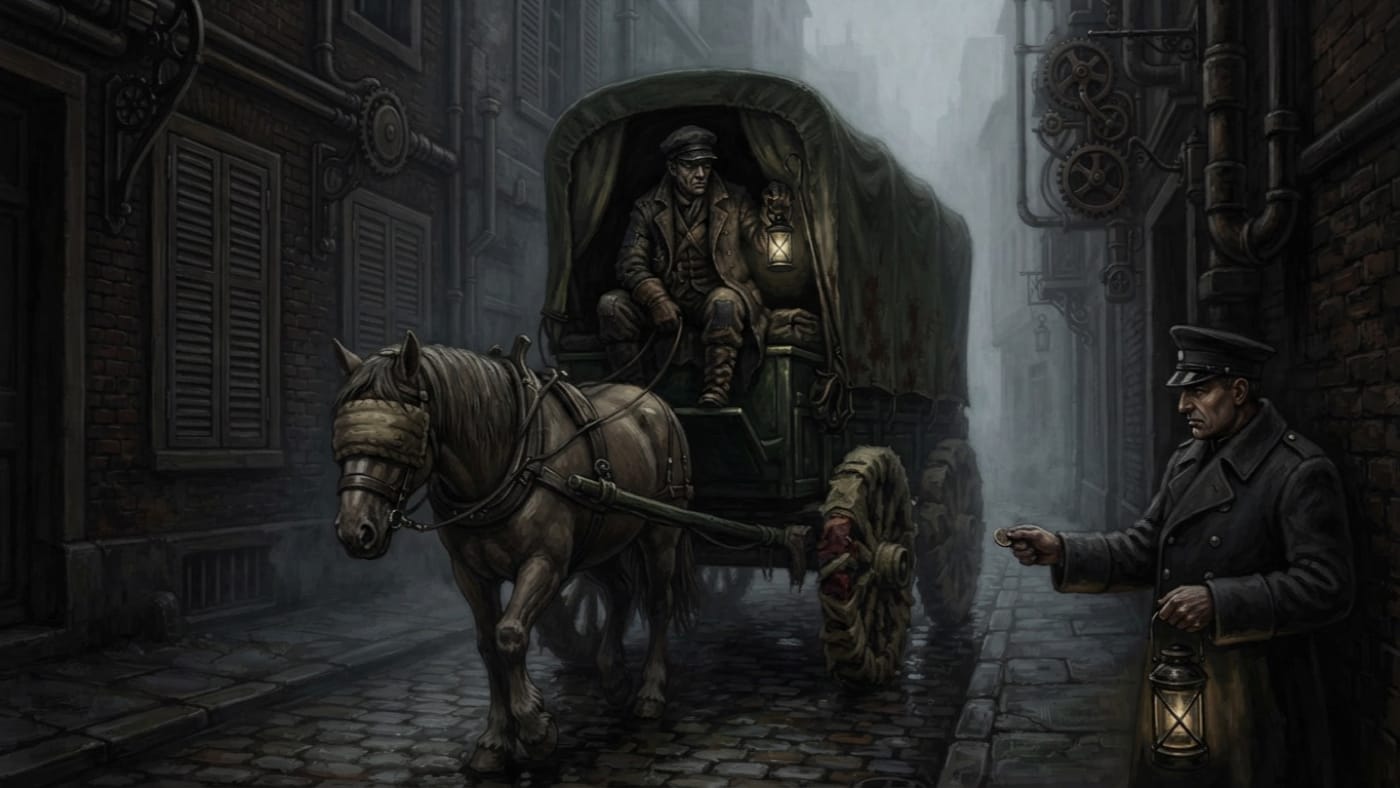
The Night Wagon Driver carries what the Bureau of Shadows cannot be seen to carry. The Blackwheel Freelancer carries the same weight in the same wagon down the same unlit lanes. Then he commits the one sin the Bureau has never learned to forgive. He sends the bill to someone else.
That is the whole trade. A carter who can move a body across Strasbourg after the last peal without any gate-man remembering it eventually learns that the skill has buyers. Smugglers will pay for it. So will rebels, abbots with untidy cellars, and mothers who know the exact morning a son stopped existing. The driver sells passage without a manifest, a route without a name, and an arrival nobody will later swear to. The client buys one night in which the city looks away on his behalf.
Street usage muddies the record. "Blackwheel" is common cant for any Night Carter, loyal or otherwise, and a drunk in the Warrens who points at a passing wagon and says the word has identified only his own poor judgment. Inside the trade the line is sharper. Gray Wax Men drive what the Night Papers order. Blackwheels drive what the purse orders. Both wrap their spokes in the same felt.
#On the Borrowed Method
The freelancer invented none of his kit. The hooded lantern, the quiet harness, the blindfolded horse and the ring of keys bound in rag so they never jingle are all Bureau issue or Bureau habit. So are the grease worked into every hinge, the ash that masks the smell of what rides behind the curtain, and the wet straw that soaks up whatever leaks. The negative route is Bureau doctrine as well. Keep away from a bell-tower while its bell is still warm. Never use the same gate twice in one week. Never let one lantern be seen twice on one street. The blackwheel drives the negative exactly as he was taught, only on his own account.
He keeps the cover labour too. By day he hauls chapel ash, fuel, or penitential-hospital laundry, and he is dull enough at it that the neighbourhood stops counting his trips. By night the ordinary horse goes back to its stall and the blind one comes out. Before dawn the straw is burned and the ruts raked. The driver's maxim holds for the private trade as firmly as for the sacred one: straw remembers.
None of this makes a wagon invisible. A wrapped wheel only makes a wagon boring, and after curfew in Strasbourg that serves nearly as well. The rest is cooperation. He needs a gate-man who drinks on schedule and a stable chief who lends the blind horse and lies about its mileage. He needs a depot chaplain who sells absolution slips after midnight, and a junior clerk of the Bureau of Records willing to log the passage as routine supply. Above all he needs a bell contact who will say, a day early, which peal of the Bureau of Bells is going to run late.
The freelancer cannot issue Night Papers, and the most dangerous mistake a client can make is to believe he can. A Night Papers Courier carries warrants. A blackwheel carries forged curfew tokens, false saints' ribbons and a seal kit. Gray wax pressed by an unauthorised thumb will satisfy a sleepy gate. Any auditor will see it for what it is.
#On the Price of Passage
There is no fixed fare. I have looked, out of professional curiosity and some personal malice, and found none. The blackwheel is paid in coin, fuel, stable rights, favours owed, and names, which spend best of all. Most of the money leaves his hand before the wagon moves. The old bribe grammar still governs: the first coin buys passage, the second buys forgetting, and the third buys a lie with ornaments. A freelancer who has not paid all three by midnight will be paying a fourth to someone with a lantern and a pike.
What the client receives is narrower than he imagines. He has hired one crossing for one load in one window. He has not bought the road. The road stays in the driver's head and in the scratches on the underside of his seat-board, where auditors do not kneel. Next week the same route can go to the client's rival, to a Bureau of Purity informer, or back to the Bureau of Shadows as the price of the driver's continued good health. Any client who wants the route kept closed after his passage must pay for that separately, and dearly, and even then must trust the man who sold it. Among blackwheels this is the one clause anyone keeps honestly. It is honest because it is plainly an extortion.
The absence of a manifest should not be mistaken for ignorance of the cargo. Written manifests remain the trade's deepest taboo, and the blackwheel honours it. He still knows the weight, the smell, which crate sweats, and which passenger bargained. That knowledge is his insurance. It also gives his clients every reason to want him dead.
A few freelancers once worked as Corridor Masters, or claim they did. Such a man may know one unmarked stair from a tariff chapel down to a mill-wharf berth. Leaving the Bureau's service did not give him the rest. Strasbourg's quiet doors were never Bureau property in any sense a notary would accept, and some of them refuse any wagon that arrives without the Bureau's errand.
#On Those Who Hire
Smugglers make the steadiest custom. The River Quarter moves relics, books and foreign goods under a Bureau of Purity that, by its own reckoning, catches about one load in ten. A wagon that cannot be traced lowers that tithe further.
Rebels pay less and argue more. A Lantern mercy-preacher who wants a family out of the Warrens ahead of a warrant will hire a blackwheel when no safer route exists. These mercy-men should be kept distinct from the tolerated Lantern vigilantes who harass loyal drivers for sport. The freelancer serves both without asking which is which. Taking a rebel's money makes him a rebel about as much as carrying a bishop makes him a bishop.
Corrupt churchmen pay best of all. An abbot with a ledger to lose, a novice to relocate or a crate of inconvenient fingers to rehouse will hire privately for one simple reason. A Bureau wagon would note the errand somewhere, if only in a Custodian's memory.
Last come the families. The widow who pays for an "illegal return" is paying for one of two things. Either the wagon goes into a holding cellar, or out to the Null Verge on the Queue Road, to fetch a person still breathing, or it goes to fetch remains so they can be buried under a true name. Nobody comes back from the dead in a blackwheel's wagon. The trade sells cartage, and the Creator keeps His own hours.
The fraud practically writes itself. A freelancer takes the widow's coin, drives off, and comes back with a sack of somebody's bones, or with nothing and the explanation that the road ate him. No register records such a case. Registers are kept by people who do not hire blackwheels.
#On the Bureau's Favourite Enemy
The Bureau of Shadows denies all cartage. It therefore has no lawful way to complain when its cartage is stolen.
The standing reply of the Bureau of Shadows holds that no wagon runs for Shadows, and that no Shadow method therefore exists to be stolen.
Corrected: the method exists, it is being stolen nightly, and the thieves trained in the Bureau's own stable-yards. The Bureau cannot charge them without first admitting what they took. It has chosen to collect them instead, which requires no admission of anything.
That is the remedy, and it suits the institution. A blackwheel the Bureau wants back usually ends up as cargo. He rides in a Gray Wax Man's wagon, sometimes along a route he sold the month before, and sits facing a Custodian who says nothing. Loyal drivers hate freelancers for good reason. Every private fare makes the gate-men more expensive, the bell contacts greedier, and the sacred routes more crowded with strangers' lanterns. A gate captain paid by both sides will in time sell either to the other.
Other dangers press in from every side. Auditors find wax where wax should not be. Inquisitors with jurisdictional vanity seize wagons to embarrass rival bureaus. Rival crews poach routes. A bell runs early, an axle squeals, a wrapping slips. Worst of all is the paying client who decides afterwards that the only safe witness to his passage is a dead driver.
I will say what the Bureau cannot. The blackwheel's market is the best proof the Bureau's method has ever received. A doctrine that works only in the hands of the anointed is a liturgy. One that works for any carter with felt, grease and a bribed chaplain is engineering, and engineering can be sold. The Bureau's fury is the fury of a monopoly discovering that its sacrament has a recipe.
The freelancer pays for his share in the same flesh as the loyal driver. He shows wax under the nails, rope-burned palms and the permanent night-squint. He counts peals in his cups. He loses ordinary speech, until "no one" and "nothing" are the only answers left in him. He also drives the old roads more often than the Bureau does, and his hours are worse. Drivers say a route used too often begins to wound. Hoofbeats stop on certain stretches, and straw comes back wet on dry nights. Nobody has explained this. The blackwheels mark such places on their seat-boards and raise their prices.
#On Present Passage
In A.S. 201 the private trade runs wherever the sacred one does, and it runs thickest in Strasbourg. Its custom comes from the River Quarter's smugglers, from Warrens families with more relatives than permits, and from chapter-houses whose cellars connect to the river by routes the Records office calls drainage. Nobody can count the freelancers. Counting them would mean admitting that Night Wagons exist.
The Latchford Permit-Yards show the same appetite under heavier law. There the bribe of choice is wax blocks, clean paper, warm food or a stolen minute of the bell. A blackwheel at Latchford sells time more than distance, and the Records and War officers who quarrel over the yard's bribe-stream both drink from his.