
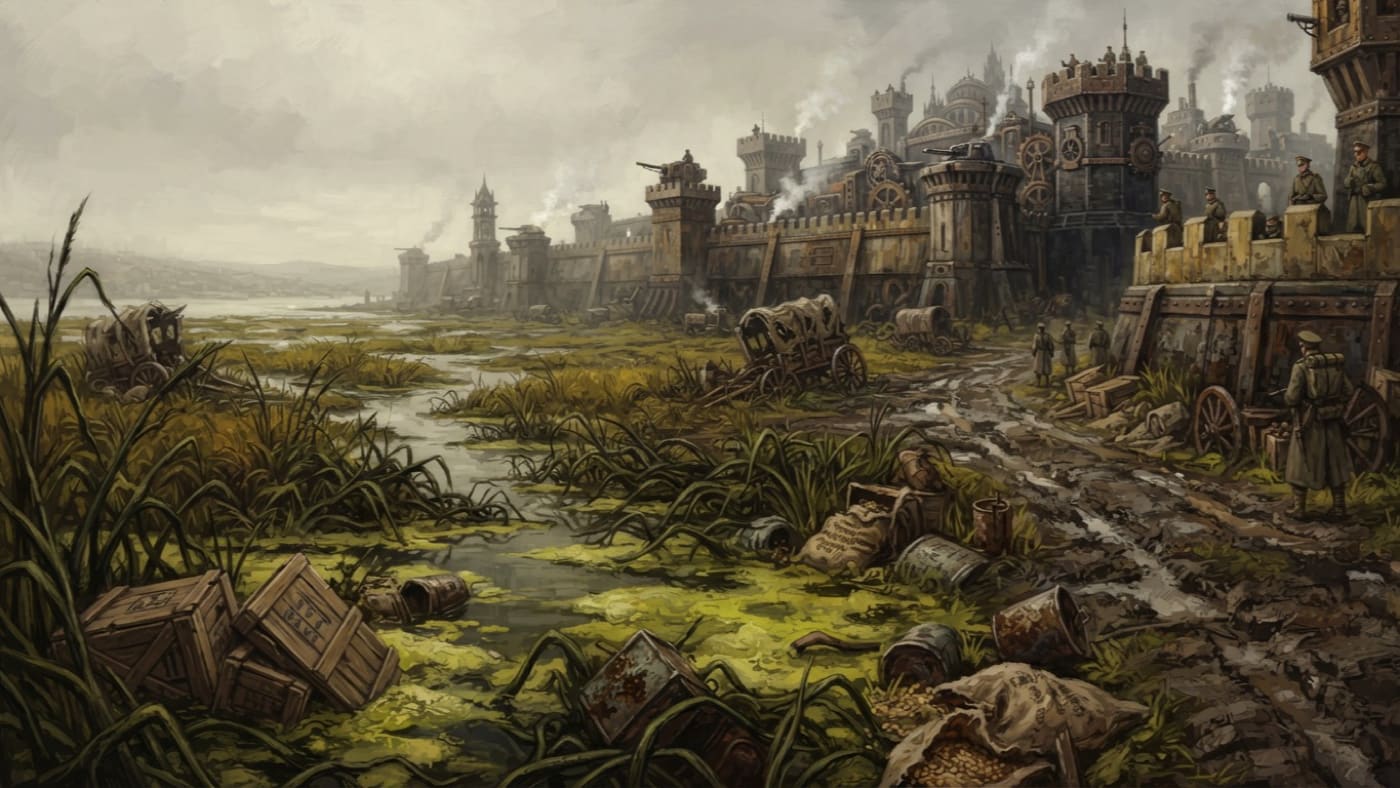
The following is a survey of present conditions, taken in A.S. 201 (1911 CE), of the Bosporus marshes opposite Bastion-Constantinople. This is the reed-ground and standing water before the Ravelin of Purity, which this Codex calls the Blackening. It describes what the marsh is now. It is not a history of how the marsh came to be that way, because no such history has been sealed, and I, Valerius Drax, Hieromnemon and Warden of the Sacred Ledger, do not seal what I cannot source.
The Ravelin of Purity is the second of the Bastion's six outer works, counted sunwise from the north. Its parapet faces the marsh. The Bastion's entry states the boundary with the economy proper to engineers: the dominion of Kargath "begins where the reeds begin to crawl." I have found no better boundary description in any Bureau. I have found several worse.
The survey confines itself to that approach. Where the sources say marsh, I say marsh. They do not describe the whole strait or both shores as changed alike, and the survey does not stretch their testimony to cover water they never named.
#What the Marsh Was
The Kargath entry records the ground's former use in a single clause, and I give its substance without improvement: it was rich fishing-ground and the seat of a small monastic order. That is the whole of the testimony. The entry does not give the order's name, its rule, its house, its brethren or their end, and I will not supply them. A clerk who invents a monastery so that he may mourn it has committed two offences, and only one of them is sentimental.
Still, consider what the clause contains. Fishing-ground means boats drawn up on mud, nets on poles, and a catch that went somewhere: to a table, a market, a city. A monastic order means bells at fixed hours and men whose vocation was to stay where they were put. Both are uses of land that expect the land to give back what is asked of it.
#What the Marsh Is
The Kargath entry introduces its description with the words what is agreed, as though agreement were itself an achievement. What is agreed is brief.
The reeds crawl. The sources do not say they sway, bend or rustle in the wind. They say crawl, and the word has survived every committee that has read it. Older field material speaks of reeds crawling with maggots. The Codex entries keep the plainer verb and leave the reader to decide where the motion lives. I keep it plain as well.
The water froths with algae the colour of old bile. I underline colour. No assay filed with this Codex has found bile in the Bosporus, and this survey does not claim to have found any. The comparison belongs to the observers. They chose the colour of what comes up out of a sick man, and I do not believe they were reaching for poetry.
Between reed and froth lies the water. Nowhere in the record is a net cast into it.
#On Attribution
Observation ends there. Doctrine begins here, and I ask the reader to notice the seam.
The Bureau of Doctrine holds these marshes to be Kargath's territory, the nearest of his holdings to the Theocracy's walls, and it credits the Blackening to him. The geographic reference says so without ornament: the Blackening was his work. I am an officer of that Bureau, and I file its finding as a finding. I also file it as an attribution. The crawling reed and the bile-coloured froth are what was seen. The hand behind them is what was concluded.
The conclusion has its reasons. Kargath is Sin-General of Gluttony, and the Bureau's corrected teaching, now in its fifth version after four committee shortenings, defines his sin as need that grows with feeding: consumption that leaves the consumer emptier than before. A fishing-ground that yields no fish and a road whose wagons arrive with nothing fit to eat are, in Doctrine's reading, his grammar. The reading holds together. That does not give it a date.
#On the Calendar Nobody Can Fill
No one knows when the Blackening began. The sentence is the Codex's own, and it remains true in A.S. 201. The Bureau's cartographers argue the matter annually. The argument has a fixed place in their calendar and no conclusion in sight, and the survey takes no side in it.
Readers who wish to file the Blackening beside the Sundering of A.S. 45 will find no document that permits them to. The Sundering has a day. The Blackening has a dispute. The Ledger keeps them on separate pages, and so shall the reader.
#On Provisions
Bastion-Constantinople is the southern anchor of the Sagittal Line and a city of some three hundred thousand registered souls. If its walls are not fed, they fall. The Bastion's own entry is blunt on this point. During the long siege the walls held because logistics held: Anatolian grain kept moving through the Pilgrim's Coast, and the strait could be closed at the Harbor of Chains. To the west run the roads of the Hintermark, carrying its orchards, its foundry-towns and the dried fish of the coastal villages. Supplies come by sea from the south and by road from the west, and the marsh lies close beside both.
This Codex records the marsh's effect on wagons twice, and the two records disagree about direction. The Kargath entry describes caravans running from Istanbul toward the western provinces. The Bastion entry describes caravans meant for the city. In both accounts they arrive as wagons of rot, when they arrive at all. I have not reconciled the two itineraries and will not invent a third. The Bureau of Records can hold a disagreement longer than any wagon can hold a load.
The Kargath entry adds one particular, which I set down under its name and no other: the rot does not decompose. It waits. I offer no account of why. The survey records the claim, and a reader who handles such a cargo may form an opinion with gloves on.
The Bastion entry also describes ships on the southern coast that leave Anatolian ports in good order and arrive short, through an accounting gap no audit has closed. It lays that loss at Kargath's door as well. That is a coastal matter, and the survey does not charge it to the marsh. One Sin-General may keep more than one ledger.
Inside the walls, the result of a shortfall is simple. In Constantinople the kitchens lock at the noonday peal, and the bell keeps its hour whether or not the wagons kept theirs. The Bastion entry counts every failed convoy, and every soldier reduced to gnawing his own boot leather on a long march, as a tithe in Kargath's ledger of famine. I record that soldier without contempt. The Codex has already corrected itself on this point: the hungry are Kargath's opportunity, not his accomplices. A man chewing leather on a march has committed no sin except marching.
The frontier is affected as well. A ravelin that faces corrupted ground can take nothing from it. A garrison fed from behind depends on roads it does not hold with its own bayonets and on ships it does not crew. The Bureau of War keeps those roads in repair because, as the Bastion entry observes, maintained roads are how armies eat. With the marsh beside the outer works, every one of those roads matters more.
#On Maps and Fire
The Kargath entry records that the Bureau of Cartography has revised the Bosporus boundary seventeen times in forty years, each revision moving it slightly west. The Bureau of War declines to comment on the trend. I repeat the figure because it is published. I do not divide it, subtract it from the present year or turn it into a rate of advance. The half-mile-per-generation figure given for Kargath's dominion at large applies to his dominion at large. Nobody has measured this marsh against it.
On reclamation, the Codex has been less careful and has said so in print.
Earlier editions of this Codex asserted that the Bosporus marshes were reclaimable by the application of sufficient holy fire.
The Bureau of Doctrine now considers this claim premature. The Bureau of Purity has withdrawn the operational memorandum on which it rested, and the responsible Hieromnemon has been reassigned to the Paper Mines of Ulm. Pilgrims are reminded not to discuss the reclaimability of the Bosporus in public correspondence.
Read the correction exactly. It withdraws a confidence and goes no further. No Bureau has sealed a finding that the marsh is beyond recovery. The present position is only that nobody has shown the fire to work. The complete record of reclamation is a claim, a withdrawal and a reassignment, and this survey adds nothing to it.
#Present Condition
As of A.S. 201, the reeds before the Ravelin of Purity crawl. The water froths the colour of old bile. The fishing-ground and the monastic seat survive only as a clause in someone else's entry. The boundary on the Bureau's maps has moved west by revision. Holy fire has been withdrawn as a promise. The Bastion stands, and the ravelin is manned. The provisions that feed both come by sea and by road past ground that spoils what crosses it.
The marsh is close to the walls, and the bread comes from far away. I commend the reader to the noonday peal and to counting what it brings.