
#On the Country Behind the Last Lock
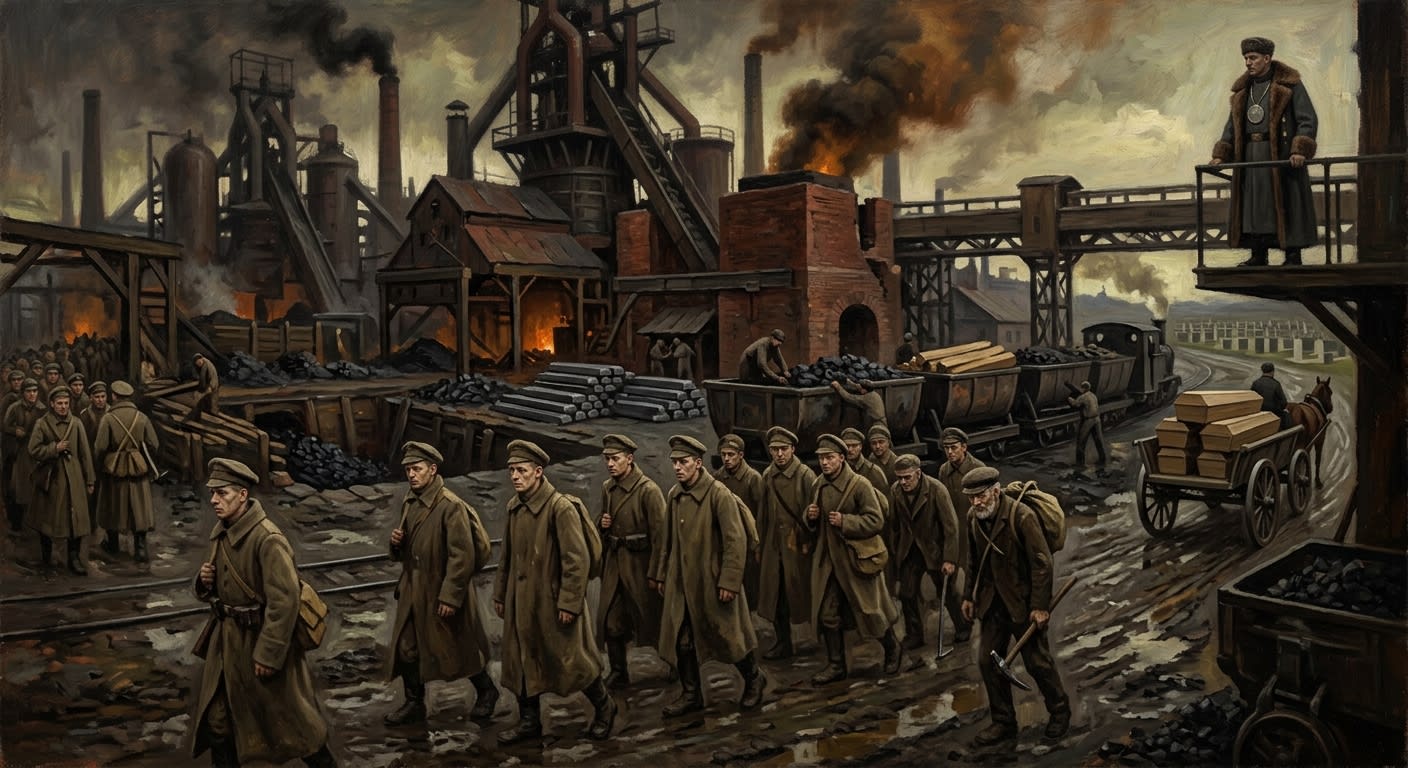
The Hintermark is the industrial hinterland west of Bastion-Constantinople, spread along the road-and-rail throat that carries coal, pig iron, tin, copper, bone-ite compound, replacement rivets, coffins, conscripts, liturgical oil, and all the smaller indignities by which the southern anchor continues to stand. The Harbor of Chains receives its coal from here. The Foundry Quarter receives its overflow, its dirty contracts, and several consignments no public inspector has been paid enough to understand.
On a map, the Hintermark is a grey smear of Zone 3 industrial-forward settlements between Sofia’s southern corridor and the Constantinople approaches. On the road, it is orchards gone thin from ash, foundry-towns fattened on War contracts, levy-villages with memorial squares larger than marketplaces, grave-fields pushing against pasture walls, and railway sidings where children learn to count wagons before saints.
#On Foundry-Towns and Useful Villages
The Hintermark grew from hamlets attached to supply roads after the Concordat taught Strasbourg that a military need becomes more obedient when given a town seal. Furnace Station K-6 became Keska in A.S. 116 and a full foundry-town by A.S. 160. Other stations followed: Edremit, smoke-black and ledger-shy; Saint Orban’s Channel settlements along the Black Run; a third Brann-route designation that changes across files with a frequency suggesting either error or craft.
The towns serve different appetites. Keska smelts and reworks. Edremit casts boiler throats and low-grade rivet stock. Smaller villages burn charcoal, sort scrap, cut coffin boards, and raise sons whose hands are measured by War before their catechism is tested by Doctrine. The orchards still exist. Their fruit tastes faintly of soot. The Bureau of Medicine calls this harmless trace deposition. Housewives call it breakfast.
The Hintermark is where labour ceases to look like labour and begins to resemble climate. Men are born near furnaces, apprenticed to furnaces, married in chapel yards smelling of furnace ash, buried in ground warmed by slag heaps, and praised afterward for having contributed to the Line. Contribution is the holy verb of regions that receive orders and export sons.
#On Brann’s Routes
Arch-Artificer Lute Brann draws from three Hintermark foundry-towns for the Shackled Flame lower works. Two are consistently named: Keska and Edremit. The third appears under four designations in seven filings. I have seen them. I have also seen a Records clerk insist, with a straight face and a visible tremor, that all four names refer to “regional routing adjustments.”
Shipments marked sanctifiedite, industrial grade move through the Hintermark by covered rail and descend in Constantinople to level five without passing through ordinary Purity inspection. Coal leaves under War seal. Pig iron leaves under Engineering seal. Bone-ite compound leaves under Relics notation if the shipment is clean, Shadows notation if it is useful, and no notation at all if everyone involved has acquired wisdom.
Older supply primers describe the Hintermark as a coal district supporting the Harbor of Chains.
Corrected. Coal is the district’s simplest offering. The Hintermark supplies metal, labour, route discretion, burial capacity, and the moral insulation by which Constantinople receives useful things without learning exactly how they were made.
ROUTE CELL FRAGMENT — HINTERMARK / BRANN CONSIGNMENT Crate series: S-5, industrial grade. Origin: ███████. Intermediate stamp: Keska western siding. Cargo declared: sanctifiedite. Cargo observed: warm to touch; responding to bell count; one handler heard name of dead brother from sealed lid. Disposition: forward without delay.
#On the Redrawing
The Administrative Redrawing of A.S. 188 proved what the Hintermark already knew: Strasbourg can move a boundary faster than it can move a bed. Mandate 188-A redistricted the Hintermark, Constantinople’s eastern terraces, and seventeen rear-echelon Line settlements. Four hundred pages were drafted in six months, reviewed in three, and implemented in fourteen days. This ratio is not administration. It is artillery fired in paper form.
Forty thousand civilians were displaced or reclassified. Villages that had become foundry-towns were finally dragged from rural tables into production-weighted Zone bands. Some households became taxable twice. Some levy quotas attached themselves to empty cottages. Keska fell through the tables altogether and spent eleven months without a Zone, which is the closest a Synod settlement can come to becoming a ghost while still shipping metal on schedule.
Yvette Langres reconciled the Keska packet in A.S. 189 with such vicious precision that several offices were forced to agree with her in self-defense. Her work made the Redrawing survivable on paper. The ground took longer. It still is taking longer. The Hintermark remembers which families received strangers with stamped claims to bedrooms, which cemeteries moved their gates, which forge masters acquired labour by boundary accident, and which children became Zone 3 on the second copy of their baptismal attachment.
#On the Black Ledger and the Widows
Official authority in the Hintermark is ambient rather than immediate. The Ledger-Carrier arrives because the road expects him. The tax bell rings because the bell has always rung. War wagons receive priority because opposing them requires theatrical stupidity scarce even among peasants. In such places, the gap between command and presence becomes rentable.
The Black Ledger operates through Hintermark settlements with cells estimated at three to five, depending upon whether Shadows is counting knives, accountants, dependents, or guilty bread. The recovered A.S. 199 second-book fragment lists households, access routes, pressure points, and expendable children. The Black Ledger learned the Hintermark’s central fact: when lawful ink is late, unlawful ink arrives warm.
The Widow’s Syndicate runs ash-credit through seven villages. The Pilgrims’ Court controls road franchises. Caretaker Saints manage grave-field sleeping rights where official housing runs out. None of this is rebellion. Rebellion wastes banners on people who need bread, burial, and a permit that works after dark.
A Bureau of Settlement review described Hintermark irregular authorities as “parasitic upon Synod absence.”
Clarified. They are parasitic upon Synod delay. Absence would be cleaner. Delay lets every parasite learn the bell schedule.
#On Present Condition
As of A.S. 201, the Hintermark remains indispensable, overcounted in production, undercounted in grief, and watched chiefly when something reaches Constantinople warm, late, or screaming. Its roads are among the best maintained in the southern corridor because armies eat by road. Its houses are among the least repaired because houses do not fire artillery. Its grave-fields expand in disciplined terraces toward orchards whose trees have grown accustomed to smoke.
The Bureau of Tithes wants cleaner ledgers. The Bureau of Settlement wants obedient boundaries. War wants output. Purity wants someone else to open Brann’s crates first. The people want cough draughts, roof slate, honest weights, and sons returned with both hands.
At dawn, the coal trains move east. At noon, the foundry bells count bodies back from shift. At dusk, the road lamps burn toward the Last Lock, and every wagon wheel turns in the same sacred direction: away from the villages that paid for it.
Phase 2a correction log: no date, bastion, geography, or link-density errors found. Article dateline set to A.S. 188 for Mandate 188-A, the administrative act that made the Hintermark legible as a redrawn industrial-forward region; public seal stamps remain A.S. 201.