
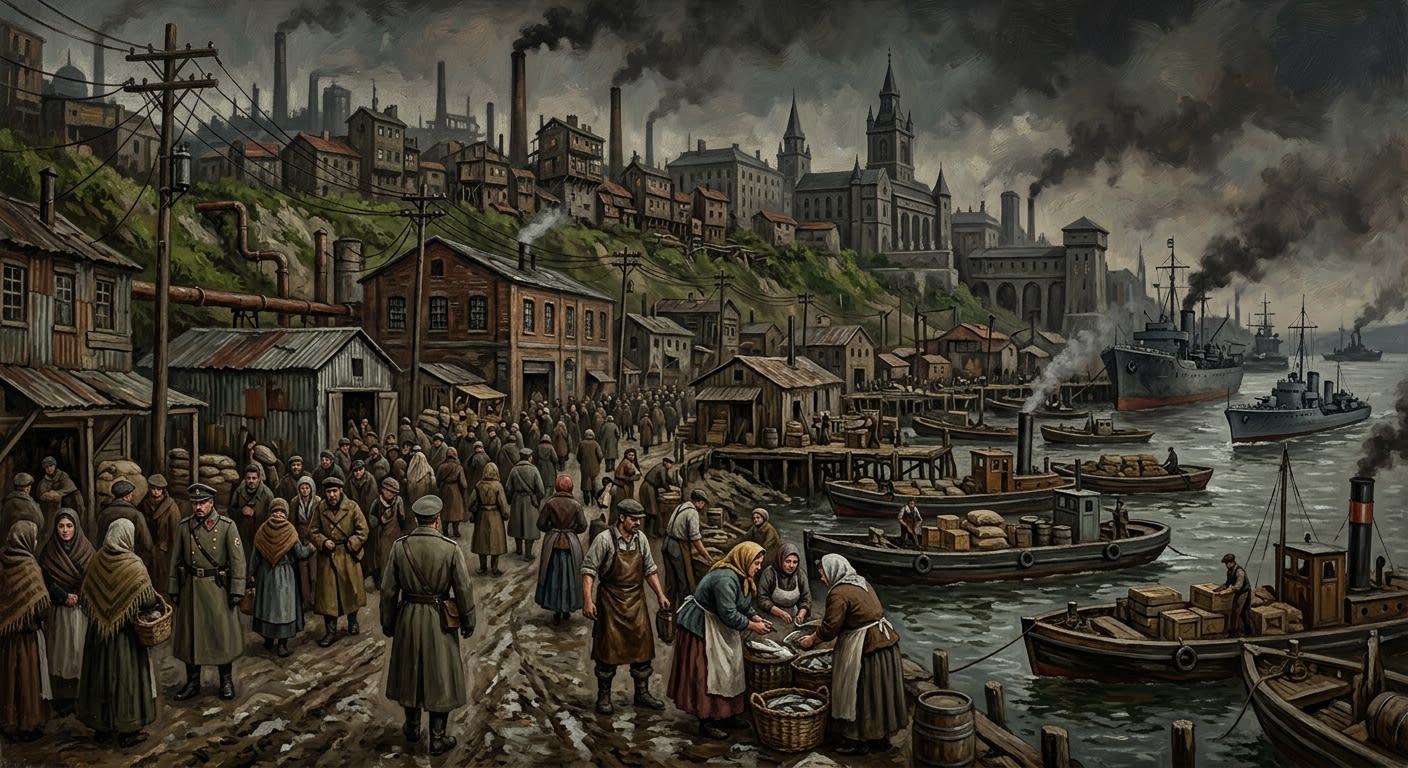
#On the Shore That Pretends to Be a Road
The Pilgrim's Coast is the Anatolian shore south and east of Bastion-Constantinople, a strip of harbors, causeways, sanctuary towns, fishing wards, military depots, ad hoc markets, green-permit villages, and garrison growths that the Bureau of Settlement colours Green on its maps because green suggests life and does not require anyone to admit mould. It is called a coast because water lies beside it. It is called pilgrim because no other word more politely gathers refugees, merchants, conscripts under devotional cover, smugglers with candles in their cargo, widows hunting names, relic-sellers, grain clerks, and frightened souls who believe proximity to holy war will improve their bargaining position with Heaven.
Heaven has not countersigned the theory.
The Coast feeds the southern anchor. Anatolian grain comes through its piers. Pilgrim vessels from Marseille, Genoa, and lesser ports cough up bodies into its processing sheds before those bodies are sent north to the sanctuary harbor or westward along inspected causeways. Repair stock, coffin timber, lamp oil, salt fish, mule teams, prayer paper, cheap icons, wet gunpowder, and rumours all move through the same lanes. The Harbor of Chains may be the jaw of the Bosphorus, but the Pilgrim's Coast is the cheek, gum, molar, and persistent infection.
It belongs administratively to the Green ledger-colour of Constantinople's seven-zone model. This fact is useful in the same way a painted line on a flood wall is useful after the water passes it. The Coast's settled reality exceeds its colour. Forts built for two hundred men have villages of twelve thousand pressed around them. Chapels acquire markets; markets acquire brothels; brothels acquire confession corners; confession corners acquire archives; archives acquire men with knives who can make a birth register more persuasive by dawn. That is urbanism in the Synod: sin arrives first, then trade, then housing, then a Bureau claiming it planned the sequence.
#On the First Green Line
The Coast's present role begins after the A.S. 68 ratification of Constantinople and the first hardening of the Harbor of Chains. The old shore already held fishing villages, Byzantine stones, pilgrim tracks, salt pans, market slips, and those stubborn families who survive every empire by learning which tax collector drinks and which one counts nets. The Synod did not found the Coast. It requisitioned it, named it, measured it, and spoke thereafter as if measurement were birth.
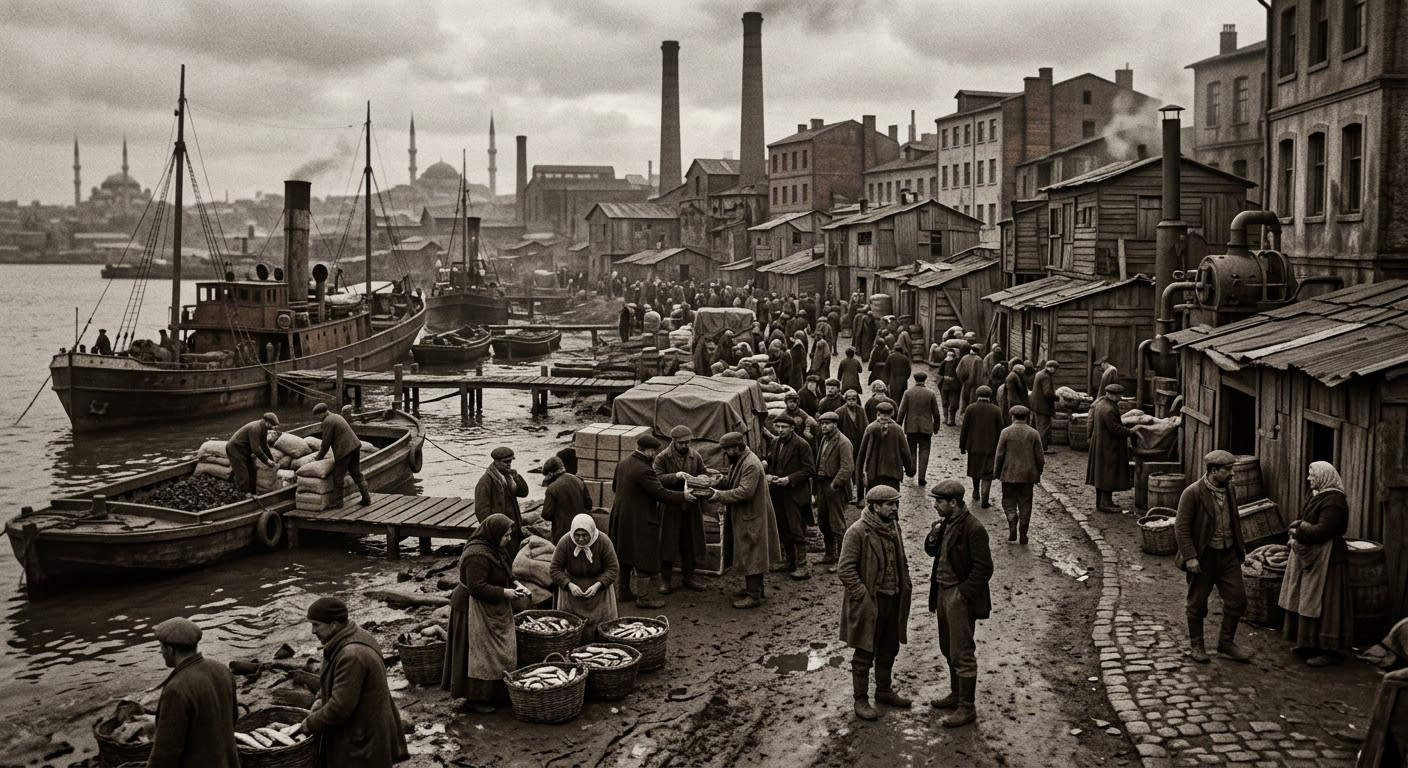
By A.S. 95, when Constantinople was made a permanent garrison city rather than an armed panic with walls, Settlement imposed its seven-colour model. Green covered the Pilgrim's Coast approach and its satellite communities: the outer devotional landing paths, the shrine roads to the sanctuary harbor, the village piers feeding grain and fish, the coastal roads used by ox teams when inner gates jammed, and the uncomfortable spaces where the holy and the logistical became indistinguishable.
Earlier harbor guidebooks identify the Pilgrim's Coast as a planned devotional quarter of Bastion-Constantinople.
Corrected. The Coast was a shore with inhabitants before it was a quarter, a supply seam before it was devotional, and a headache before anyone in Strasbourg discovered the courage to colour it Green.
The A.S. 130 revision folded more landing towns into the colour. The A.S. 155 revision expanded military supply corridors after southern pressure made every road a potential ration throat. The A.S. 188 Administrative Redrawing did the real damage: forty thousand civilians were pushed from eastern terraces toward the western approach, where their arrival displaced residents already clinging to marginal land, who pressed into Coast settlements, depot skirts, fishing wards, and shrine lanes. Settlement called this secondary adjustment. Families called it moving twice with the same dead grandmother in a cart.
Yvette Langres understands the wound because Langres understands addresses as other officials understand weapons. She has pressed for authority over the organic garrison towns of the Pilgrim's Coast, those communities large enough to riot, trade, birth, bury, and corrupt, yet too useful for War to surrender and too unprofitable for Tithes to classify honestly. Her request remains pending. Pending is the Synod's method of saying no while preserving the pleasure of later surprise.
#On Settlements That Grew Teeth
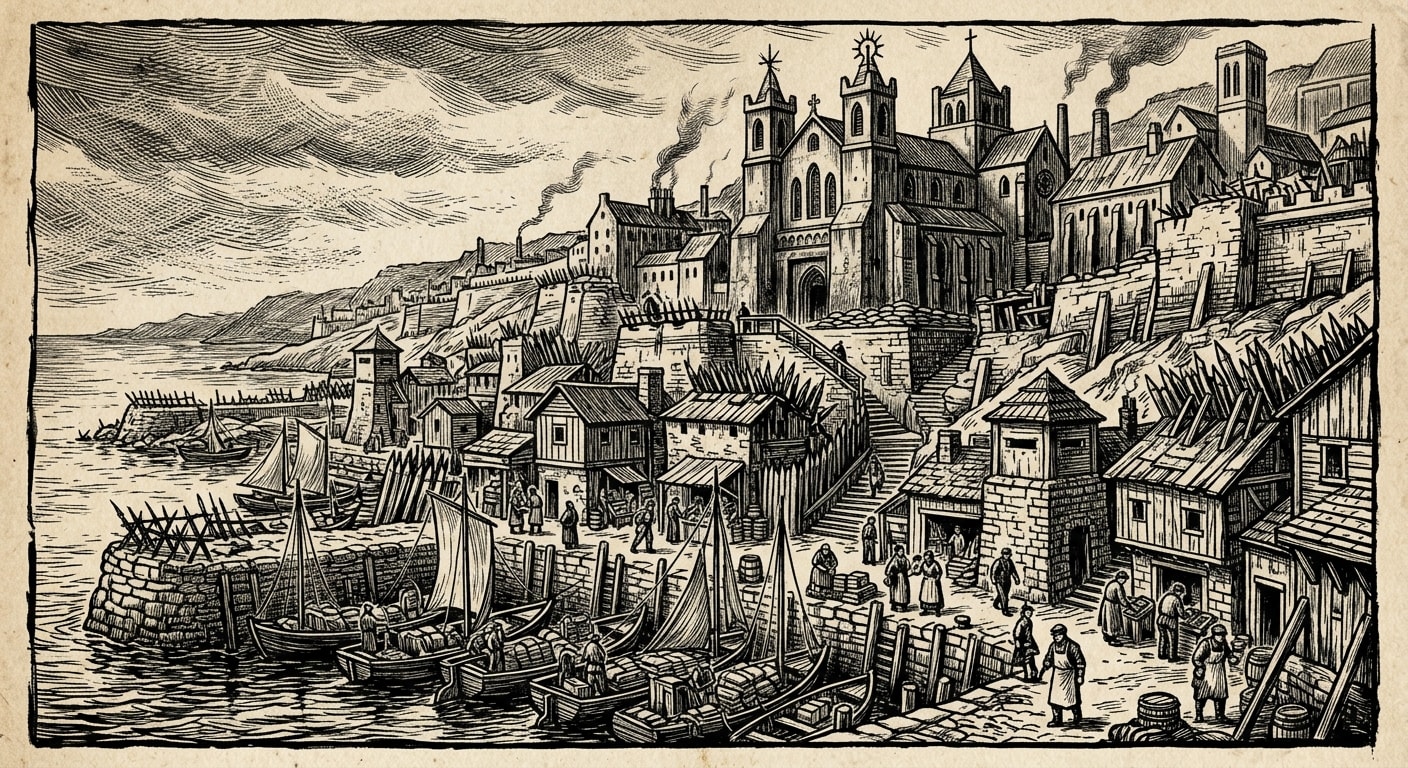
An organic garrison town begins innocently, which is how the better crimes begin. A watch post needs bread. A fort needs laundresses. A gun battery needs mule drivers. A harbor checkpoint needs rope, tar, fish, nails, clean water, dirty water carried elsewhere, candles, women to mend shirts, boys to run messages, old men to remember the road, and a priest who can bless a corpse without asking how it acquired two seals. Within five years the service camp has lanes. Within ten, lanes have names. Within twenty, the fort's commander discovers that the village outside his wall has more inhabitants than the garrison and a better intelligence service.
The Assignor arrives late with a satchel, map, denial wax, and an escort requisition form no escort wishes to honour. He asks where the settlement begins. The fishwives point inland. The sergeants point seaward. The tavern-keepers point at the fort. The fort points at War jurisdiction. Tithes points at market receipts. Records requests a street list. Nobody points at himself. This is civic maturity.
One unnamed settlement twelve miles from Coastal Station Theron has been inhabited for thirty years and appears on no official map. It has a church built in A.S. 184, a market, a retired sergeant administering justice from a barrel table, and roughly eight hundred residents whose children can name every inspection route by dust smell. Settlement's A.S. 190 map marks the site as rocky shoreline, uninhabitable. The map is handsome. The village is stubborn. Handsomeness loses most fights against bread.
Other towns present larger sins. Sanctuary Landing, which is too grand a name for a pier with three fever sheds and seventeen relic stalls, handles overflow pilgrims when the main harbor refuses another boatload of pious breath. Greenhook Market sells fish by day and ferry stamps by candlelight. Kettle Strand repairs convoy wheels beside a chapel of Saint Cadrin where Route-Stampers pray over tokens before sending pilgrims into roads that may or may not still match the printed cadence. Three-Mast Hollow is officially a rope store and unofficially a voting bloc with knives.
The Bureau calls these places satellite communities. A satellite obeys an orbit. The Coast's towns obey hunger, weather, pay arrears, local saints, smuggler credit, garrison moods, and the nearest officer with enough rifles to make his misunderstanding law for one afternoon.
#On Pilgrims, Grain, and Kargath's Patience
The Pilgrim's Coast is Kargath the Devourer's secondary theatre, which is to say it is not where he most hungers, only where his hunger has learned administration. Supply ships depart Anatolian ports in good order and arrive light. Holds promised twelve hundred tons of grain deliver eleven hundred and forty. Barrels seal correctly and open short. Salt fish rots in the middle layer while top and bottom remain clean. Mule teams arrive with all animals present and half the feed impossible to locate. Clerks blame weighing error. Captains blame pilferage. Tithes blames everybody by invoice.
Kargath does not always steal. Theft is crude and leaves gratifying evidence. On the Coast his pressure produces absence with paperwork attached: a ration cart misdirected by valid stamp, a ship delayed one tide too long, a pilgrim queue blocking a grain causeway at the exact hour rain spoils sacks, an entire warehouse ledger showing full stores beside an empty floor that smells of warm bread. Hunger, dressed as logistics.
Pilgrims intensify the weakness. They are holy cargo until they become crowd, crowd until they become disease, disease until they become labour, labour until they become residents, and residents until Settlement discovers it has no address for them. The Coast's processing sheds sort them by permit, port, vow, health, destination, coin, sponsor, and danger of sermonizing in queues. A man bound for Constantinople's sanctuary quarter may sleep three nights in a Green shed while his shoes are disinfected, his papers compared, and his optimism reduced to manageable size.
The pilgrim economy attaches itself to every delay. Relic stalls sell chain filings that have never seen the Chain. Dock priests sell quicker blessings for slower boats. Ferry brokers sell windows through Blue harbor checks. Widows sell dead men's permits to boys with similar cheekbones. Children sell directions, then sell corrections to the directions, then sell silence about both. The Coast teaches mathematics early.
A Bureau of Pilgrimage circular praises the Pilgrim's Coast as “a cleansed threshold where the faithful pass from sea-road into fortress-sanctity.”
Amended for internal circulation. The threshold is crowded, taxable, frequently sick, and cleansed chiefly by rain, vinegar, and the removal of bodies before inspectors arrive.
#On Phaleron, the No-Net Line, and Seaward Fear
South of the main sanctuary harbor lies Phaleron Bay, officially a minor coastal settlement in the Bosphorus inner approach, practically a fishing ward, pilotage pocket, smuggling seam, pilgrim nuisance, and surface witness to the thing beneath the water. Its people count boats because boats return with fewer lies than men. Its old women know when not to look seaward. Its children learn the no-net line before the formal Creed.
Seven miles off the Coast, the Iron Idol lies on the seabed. Fishermen call it the Sleeper. Engineering calls it a submerged obstruction when forced into grammar. The approved history links it to the A.S. 162 Black Sea Armada, forty-seven demon-crewed vessels against the Chain of Saint Anakletos, forty-three destroyed, three retreated, one unaccounted. The Coast inherited the unaccounted one. That is how history behaves when Doctrine leaves arithmetic untended.
The Bureau of Engineering surveyed Phaleron in A.S. 189 and filed one sentence: The survey is complete. No soundings appended. No diver testimony released. No public hazard notice beyond distance, a wise instruction and so doomed to be ignored by pilgrims seeking a better class of terror.
GREEN APPROACH PILGRIM INCIDENT, A.S. 196 Fourteen penitents from a western vessel bribed a boatman to row them toward Sleeper water for “visionary devotion.” Boat recovered at dusk inside the no-net line. Oars present. Shoes present. Bead strings present. Pilgrims absent. One bead string counted fifteen persons. File transferred from Pilgrimage to Harbor Command; receipt denied by both.
Phaleron does not define the entire Pilgrim's Coast, but it reveals the Coast's governing truth: the official road runs beside unofficial knowledge. The map says landing, chapel, pilotage, market. The village says no iron over Sleeper water, no whistling on Submission Eve, no third cast after white foam, no counting eyes aloud. The first set of rules permits commerce. The second keeps people alive. The Synod, in its indulgent majesty, tolerates the local rules while pretending they are decorative.
#On Warrants, Smuggling, and Green Permits
The Green permit is supposed to make the Coast legible. It identifies a resident of the Pilgrim's Coast approach and its satellite communities, distinguishes him from Blue harbor personnel, Ochre terrace citizens, Grey barrack auxiliaries, Crimson foundry workers, Black ossuary garrison, and White sanctum officials whose shoes cost more than a fisherman's boat. It grants residence, ration eligibility, road use, and the right to be blamed by the correct office.
The permit also creates a market. Green permits are rented to pilgrims seeking longer stays, sold to deserters, inherited by nephews who are legally cousins by candlelight, duplicated on washed paper from harbor refuse, and traded for boat access during fog closures. Records hates this. Tithes taxes it when possible. Purity raids it when theatrical. War ignores it until a false Green permit puts the wrong man near a powder shed, at which point War discovers principle with cannon-like speed.
Smuggling thrives because the Coast has too many authorities and insufficient shame. The Strait-Rats move demon-glass in fish barrels, ration coupons beneath icon panels, false saints in wax-lined crates, private letters inside hollow oars, and men under tarps labelled net repair. Some cargo serves greed. Some serves survival. The distinction matters greatly to confessors and little to hungry households.
Assignors sent to the Coast learn humility or become comedy. They can revoke a permit, but enforcement requires escort. War escorts protect forts, not maps. Purity escorts prefer offences with cleaner screams. Tithes escorts arrive if coin is visible. A lone Assignor standing in Greenhook Market with denial wax can make a family illegal by noon and dead by winter. He can also be chased into a fish shed by women carrying gutting knives. Both outcomes appear in Settlement training notes under field variability.
#On Present Condition
As of A.S. 201 the Pilgrim's Coast remains Synod-held, indispensable, badly counted, overused, and spiritually aromatic. Convoys still move. Pilgrims still arrive. The Green towns still swell around forts whose commanders insist they command only the fort and then purchase bread from the town they pretend not to govern. Phaleron still watches water it refuses to name. Settlement still files reports. Langres still asks for authority. War still declines to share jurisdiction until a problem catches fire. Tithes still counts taxable surfaces with all the compassion of a saint carved from brass.
The Coast's danger is not open rebellion. Open rebellion requires banners, leaders, slogans, and a degree of organizational clarity the Coast sensibly spends on smuggling. Its danger is unheld life: children born outside ledgers, markets settling disputes before courts hear of them, pilots obeyed over officers in fog, garrison towns learning their own strength, permits becoming currency, and hunger entering the files through gaps no one owns.
The Synod can lose territory by enemy advance. It can also lose territory by failing to know what it already holds. The Pilgrim's Coast is held by chains, piers, stamps, shrines, soldiers, fishwives, smugglers, and mothers counting children by touch when fog calls names from the water. One of those authorities will outlast the others. I have my suspicions.