
#On the Mercy That Hisses
“A vent is a vow.” — masonry-yard proverb, usually spoken by men who have already broken three.
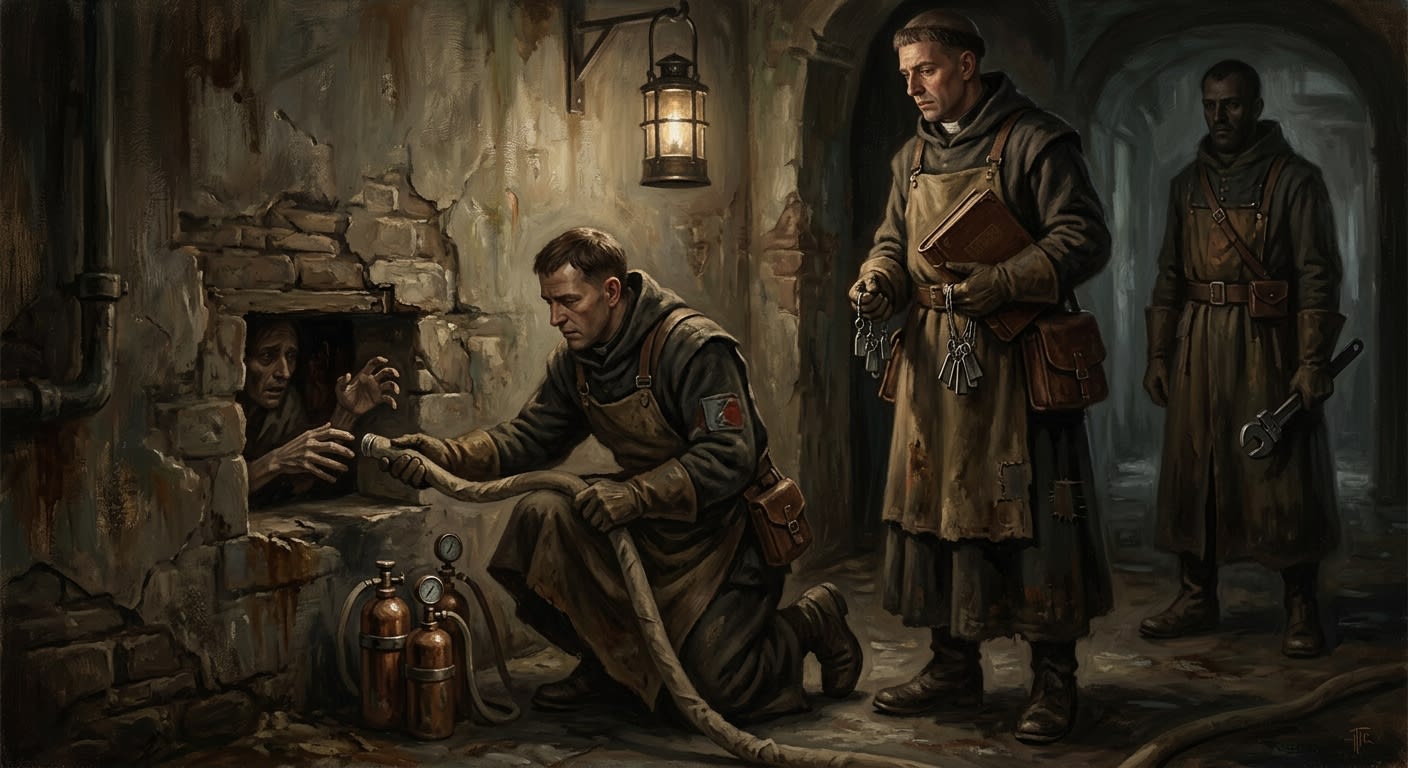
The Breath-Givers are the merciful faction of the Immurement Masons, and if that phrase seems to offer comfort, the reader should sit down until the fit passes. Mercy inside a wall delivers nothing. It prolongs. It is a reed no wider than a quill, routed through a finished seam with a thin chisel, angled behind the plaque or under the lintel, carrying just enough air to keep a condemned man articulate after the sentence should have made him quiet.
Their doctrine is vulgar, practical, and difficult to refute without making oneself sound like a man who enjoys suffocation. A dead sentence teaches briefly. A living sentence teaches in shifts. Three hours makes a rumour. Three days makes a district calendar. The Breath-Giver does not claim to save the condemned. He keeps the lesson breathing.
Their rivals, the Pure Sealers, call them saboteurs. The Bureau of Doctrine calls them nonexistent. Families call them blessed until the price rises. Condemned men call them different things depending on the hour, the depth of the niche, the quality of the air, and whether the pipe carries breath alone or also the sound of relatives crying on the other side of the masonry.
#On the Argument They Make
The Breath-Giver begins with Standing Order 14-M and smiles like a clerk finding an unguarded comma. Air provisions are at the discretion of the presiding Judge. The Bureau recommends none. A recommendation is not a prohibition; a silence is not a seal; a margin may be inhabited by those with sufficient nerve. The Breath-Giver’s entire theology lives in that margin, and, like most things living in margins, it eats better than the main text.
Some vents are lawful in the narrow, ugly sense. A Judge specifies a slit the width of a reed. A Trench-Court Clerk writes the clause badly enough that interpretation may enter. A bailiff coughs at the correct moment. The mason routes air through the backing course, notes “Judge’s discretion observed,” and returns to his trough. Other vents are purchased: a wife with salt sewn into her hem, a deserter broker with fuel chits, a quartermaster trading morphine, a gang paying tool oil to keep its man alive long enough to pass names through the wall.
A Bureau circular of A.S. 187 describes unauthorised mercy vents as “rare deviations arising from individual sentimental weakness.”
Corrected. They are a market. Sentiment may open the first hole; debt keeps it open; blackmail turns it into infrastructure.
Breath-Givers resent the accusation that they are soft. Soft men do not work wet lime with trembling families at their backs. Soft men do not angle a tube through mortar while shells shake dust into their teeth. Soft men do not listen through a reed to a man they have not saved thanking them as though gratitude were not another form of indictment.
#On the Craft of the Hidden Channel
The breath-thread is a poor name for an expert fraud. Thread suggests softness, cloth, the harmless work of women and tailors. A proper breath-thread is a masonry decision: bore angle, lime stiffness, seam timing, plaque depth, exterior disguise, interior mouth clearance, water risk, frost risk, audit risk, family risk, demon risk, priest risk, the risk that the condemned will spend his purchased hours screaming the mason’s name.
The simplest channel is a reed set through the rear course before wash, trimmed flush, hidden under lime bloom. The better sort uses a bent tin tube scavenged from lampwork, flattened near the outer seam so an inspector’s tap hears stone rather than hollow. The finest are routed behind the plaque itself, using the metal plate as acoustic shield and legal joke. Families prefer plaque vents because they can kneel close and whisper. Inspectors prefer finding them because a plaque vent condemns everyone: mason, clerk, bailiff, buyer, and sometimes the priest who blessed the plaque too slowly.
Breath-Givers keep clean tool kits for inspections and dirty tool kits for truth. Thin chisels ride in boot seams. Reed cores sit inside plumb-line handles. A brine flask may contain water, sedative, or a slurry that keeps lime from closing too quickly. Records describe such contraband as “minor irregularities of trade practice.” Records, being Records, has never watched a man purchase six more hours for his brother with a wedding ring and two spoonfuls of salt.
AUDIT FRAGMENT — FORWARD WALL, ZONE 4 Recovered breath-thread contained dried blood, lime grit, and three syllables repeated through the tube by acoustic residue: ███ / ███ / ███. The family claimed the words were a prayer. The assessor sealed the transcript. The mason’s stamp was removed with a chisel and most of his thumb.
#On Money, Debt, and Mercy’s Collar
No Breath-Giver remains free for long. The first vent may be mercy, or theatre, or professional curiosity. The second has a price. By the third, the mason owes someone: a bailiff for looking away, a clerk for phrasing the mercy clause, a quartermaster for unlogged tin, a family for silence, a gang for protection, an auditor for losing interest. A vent is a vow because every opening creates a chain. The chain tightens at night.
The standard bribe is small enough to pass hand to hand and large enough to damn a household: salt, fuel chits, cigarettes, morphine, safe passage, forged addenda, tool oil, “extra lime,” “dry mix,” “plaque fee.” The vocabulary is almost sweet in its cowardice. Tool oil means a bribe. Dry mix means air. Extra lime means hurry. Plaque fee means the family wants to speak through the wall. A mason who forgets which euphemism belongs to which buyer is soon corrected by men who collect debts with brick hammers.
The Bureau of Records denies aggregate figures. The denial has the polished sound of a door bolted from the inside. Yard gossip gives better arithmetic: one vent in twenty in quiet months, one in eight after famine, one in three when desertion courts run hot and families begin sleeping against the punishment wall. The Bureau of Doctrine hears these rumours, files the silence under operational adequacy, and condemns the next mason unlucky enough to be caught.
#On the Rivalry with the Pure Sealers
Pure Sealers despise Breath-Givers as structural liars. Breath-Givers despise Pure Sealers as men who have confused a clean seam with a clean soul. The argument is old enough to have acquired jokes and bitter enough that the jokes require witnesses. In mixed yards, apprentices learn which masters drink at which trough. Pure Sealers knock twice on a finished wall and listen for hollows. Breath-Givers knock back from the other side of the room just to watch them flinch. This is called professional fraternity.
Saint Karron belongs to both and blesses neither with clarity. Pure Sealers quote the old hagiography: the heretic screamed, Karron sealed, the demons withdrew. Breath-Givers press their thumb into the same story at another joint. Karron acted because sound mattered. Sound drew enemies. Sound could also instruct allies, warn clerks, terrify thieves, preserve confession, extend remorse. If silence has military value, they say, then breath has administrative value. This is theology as locksmithing.
Pure Sealer memoranda identify Breath-Giver work as “pity compromising structure.”
Partial correction. Pity compromises structure only when poorly angled. Properly routed vents can preserve load-bearing capacity while corrupting everyone involved.
The Demon-Listening Incidents of A.S. 158 damaged both factions. Pure Sealers lost their claim that answered walls always meant illicit vents. Breath-Givers lost their comforting lie that a pipe merely carries air. Three sealed niches at Bastion-Przemyśl tapped in exact trench-bell cadence months after death should have settled the matter. Hush-powder entered the mix. The assessor went to the Paper Mines of Ulm. Breath-Givers began cutting steeper angles, fitting ash baffles, and refusing to listen after Ninth.
#On the Present Condition
In A.S. 201, Breath-Givers persist wherever fear and family can reach the wall. They are strongest in forward bastions with crowded punishment schedules, weak audits, lime shortages, and enough civilian traffic to bring salt to a cordon. Bastion-Przemyśl breeds them from dread. Bastion-Irongate breeds them from scandal. Bastion-Brest punishes them efficiently and produces them anyway, which is the ordinary fate of efficient punishments.
They survive by being useful to everyone who denounces them. Judges use ambiguous clauses when they want torment extended without signing cruelty too plainly. Clerks sell addenda. Bailiffs rent blindness. Families buy one more hour. Gangs buy names whispered through mortar. Priests buy time for confession and then preach against the purchase. Even Pure Sealers, in private catastrophes, have been known to ask who can route a reed through a finished seam without cracking the plaque.
Their end is rarely gentle. Discovery brings confiscation, penance, immurement, erasure. Debt brings worse. Some vanish into breach repair. Some become shadow masons, routing vents into smugglers’ crawlspaces and prison annexes. A few, the most dangerous, stop thinking of breath as mercy and begin designing talking walls for inquisitors — walls that keep a mouth alive because a mouth may still produce names.
The Breath-Giver kneels at the seam. He listens once. He cuts. He hides the cut beneath lime, plaque, hymn-line, and lie. On the other side, a man sentenced to become structure receives another measure of air.
Another measure. Not absolution.