
#On the Hard Hand
“Mortar does not negotiate.” — Pure Sealer yard maxim, scratched above a lime trough at Bastion-Brest and painted over four times by inspectors with insufficient paint.
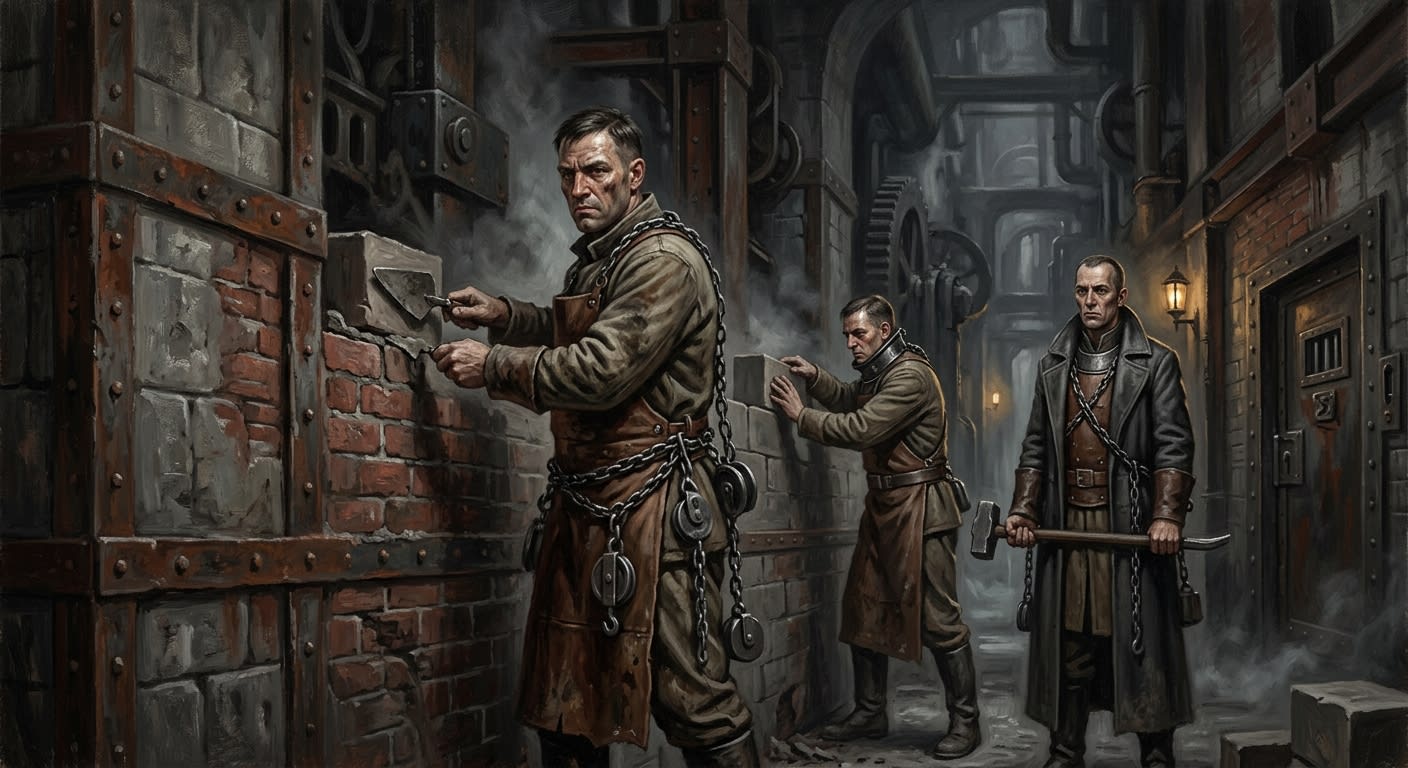
The Pure Sealers are the hard faction of the Immurement Masons, though faction is a generous word for men who deny factional existence with the patience of stone. They do not publish a rule. They do not sign a compact. They possess no banner, no seal, no oathbook kept under a yard altar. Ask a Pure Sealer whether he belongs to a party and he will show you his plumb line. Ask again and he will return to work, which is the closest his kind comes to a sermon.
Their creed is shorter than mercy and cleaner than pity: the writ is holy; the wall is structural; the condemned has already spoken through the court; a mason who alters air, angle, cavity, or course has become a second judge without appointment. The presiding Judge may specify an air slit under Standing Order 14-M. The Bureau recommends none. The Pure Sealer hears the recommendation as doctrine with its gloves removed.
They are called pure because they refuse concealed mercy vents, refuse breath-threads, refuse reed slits hidden behind plaque lips, refuse the little angled channels by which the rival Breath-Givers lengthen a sentence and sell a family three more days of moaning for salt, fuel chits, morphine, or a forged mercy-clause addendum. The Pure Sealer names such work sabotage. The Breath-Giver names it curriculum. Both wash lime from their hands at the same trough.
#On Their Origin in Order
The Pure Sealers trace themselves, when drunk enough to admit chronology and sober enough not to embellish it, to the Ration Plunder Winter of A.S. 97. Famine was making accountants poetic. Ration convoys along the Queue Road arrived lighter than they departed. The Bureau of Tithes calculated losses exceeding nine per cent of total caloric throughput, which is the sort of figure that makes even mild clerks reach for chains. A sealed Judge in the Rhineland ordered a supply clerk immured at eye level in the depot’s east wall for diverting three barrels of flour. Theft fell to zero within a week.
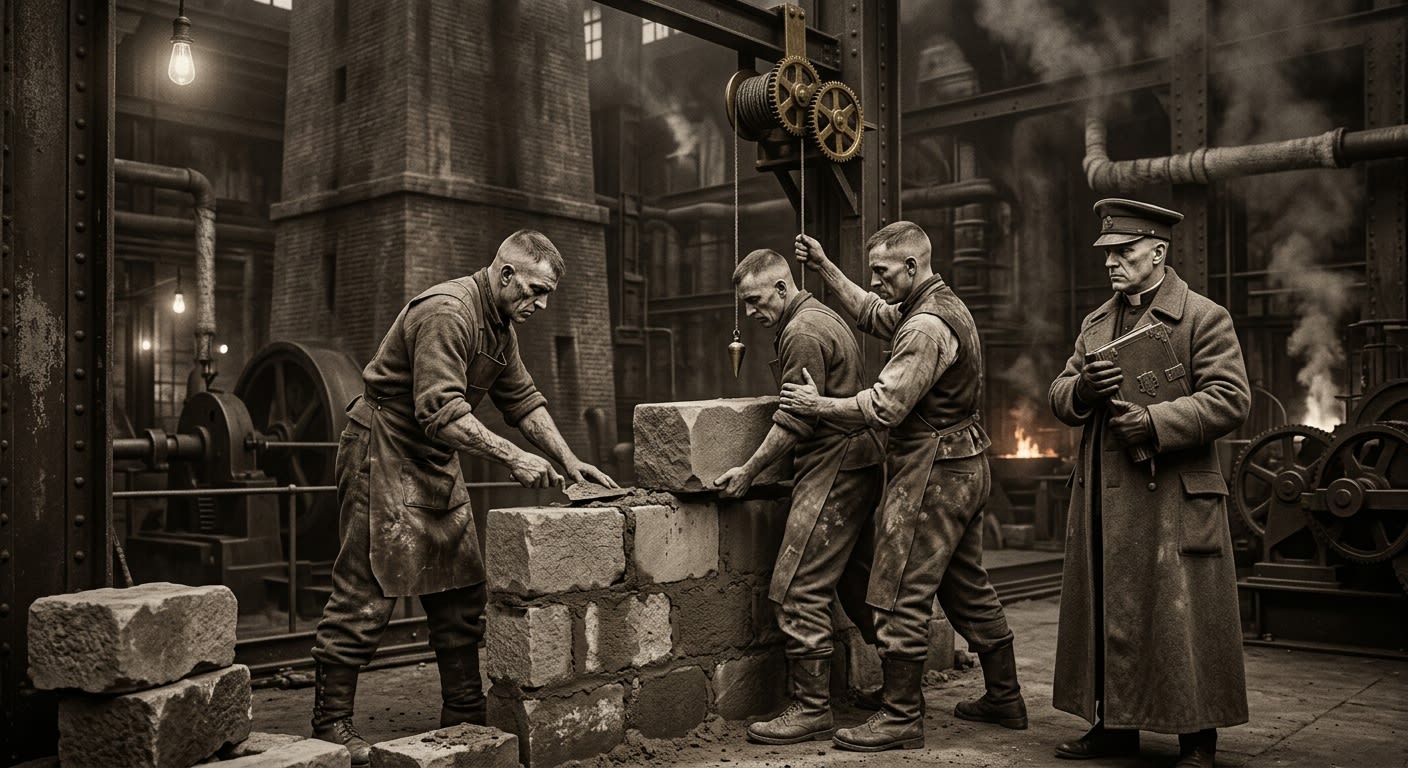
The lesson that later became Pure Sealer doctrine concerned amendment, not deterrence. Every fool with a plaque could see that immurement deterred theft. The wall worked because no one amended it. No sister purchased a reed. No cousin bribed a Lime Boy to leave a gap. No chaplain pried at the mortar in the second watch. The sentence remained the sentence, and the depot clerks passed the plaque each morning with their hands visible.
Several charitable histories describe the first formal immurement as “severe frontier justice softened by pastoral attendance.”
Withdrawn. The clerk received a plaque, a hymn-line, and enough air to understand the meaning of both before the wall took him. Pastoral attendance consisted of a priest standing at a distance because the depot smelled of flour, fear, and new lime.
Standing Order 14-M followed in A.S. 104. The Pure Sealer temperament hardened with it. Where other masons saw discretion, they saw contamination. Where bailiffs saw room for arrangement, they saw wall breach in social form. Where families saw a last chance to purchase a hole the width of a reed, Pure Sealers saw bribery entering the structure as surely as water enters a cracked seam.
#On the Method Without Mercy
The Pure Sealer’s method differs from ordinary sealing by absence. That is its genius and its horror. The niche is inspected for soundness. The writ is matched against the plaque slip. The condemned is measured according to crime class: standing for theft, kneeling for desertion, folded for heresy. The three locking bricks are laid. The plaque is set after the second course. The closing bricks follow. Lime wash covers each seam. The mason’s stamp enters the wet surface with a pressure learned through years of work and one bad dream repeated until death.
No hidden reed. No angled chisel. No “air kindness” through the rear course. No porous lime swapped in under a mercy clause. No thumb-width gap behind the saint line. No family note tucked beside the ear. The Pure Sealer speaks after the writ and before the final course when circuit custom demands a hymn. Some gag. Some permit the Creed. Some require silence from both mason and condemned. Pure Sealers prefer silence, because silence gives the wall its first instruction.
Inspection rituals favour them. A tap-walk finds no hollow. Bright gloves come away clean. Mix tests show no soft lime. Plaques do not breathe. Hairline cracks, when they appear, can be blamed on winter, shelling, poor stone, mud-calcium shortages, or the moral softness of adjacent crews. The Pure Sealer’s records match because he has made no private bargain that requires a public lie. This gives him a professional serenity widely mistaken for virtue.
INSPECTION NOTE — ZONE 4 CURTAIN WALL Pure Sealer work, six niches, no authorised air provision. Interior acoustic probe returned no breath, no speech, no tapping. Fourth niche produced one pressure pulse at bell change, source undetermined. Inspector marked “settled.” Later marginal hand: ███████████████████████████████
#On the Rivalry with the Breath-Givers
The feud with the Breath-Givers is theological in the same way a knife fight behind a chapel is theological: everyone invokes doctrine and someone bleeds on consecrated ground. Breath-Givers argue that a sentence must last long enough to teach. A man who dies in three hours is a rumour; a man who moans for three days becomes curriculum. They route concealed breath-threads through finished mortar with a skill Engineering would admire if Engineering were allowed to admire crime.
Pure Sealers answer with structure. A vent is a weakness. A weakness becomes water. Water becomes crack. Crack becomes scandal. Scandal becomes audit. Audit becomes wall failure, and wall failure becomes dead soldiers when the trench skin splits under shelling. Pity, in their ledger, is not tenderness. It is poor load distribution.
They despise the Breath-Giver bribe economy: salt, fuel chits, cigarettes, morphine, safe passage, forged mercy clauses, tool oil that is not tool oil, plaque fees that buy no plaque. They despise the families pressing against cordons with coins in their palms. They despise Trench-Court clerks who sell addenda. They despise bailiffs who look away. Most of all, they despise the knowledge that the Breath-Giver can point to Standing Order 14-M and say, in that maddeningly accurate low voice, air provisions are at the discretion of the presiding Judge.
The Pure Sealer’s counterphrase is older: The Bureau recommends none.
#On What They Hear at Night
Steady hands do not guarantee quiet sleep. Pure Sealers do not discuss what they hear at night because discussion would give the sound jurisdiction. Their apprentices learn the symptoms before the vocabulary: compulsive measuring, brine-washing, refusal to eat bread baked near lime kilns, waking at bell change with one hand shaped around an absent trowel. A Breath-Giver may fear discovery. A Pure Sealer fears certainty.
He did the work correctly. That is the terror.
The Murmur Line at Târgu wounded them. Thirty-one soldiers sealed for collective hesitation in A.S. 128; Creed spoken in unison from inside the wall until bombardment interrupted the lesson; quarterly inspection, no further action. Pure Sealer yards cite Târgu as proof that prayer-adjacent sound may arise without defective work. Their rivals cite the same wall and ask whether a reed would have changed the song. The argument has lasted seventy-three years and has improved no one.
The Demon-Listening Incidents of A.S. 158 struck deeper. Three niches at Bastion-Przemyśl tapped in metrically exact trench bell cadence six to fourteen months after sealing. The condemned were dead by any medical schedule worth filing. Hush-powder entered the binding mix within the month. Pure Sealers adopted it without complaint and spoke of shell-concussion until the Bureau withdrew that explanation by errata. Men who never altered a seam began tapping finished walls before sleep, less to test the mortar than to make certain the wall did not answer first.
Pure Sealer yards formerly maintained that all post-sealing acoustic phenomena indicate unauthorised vents or Breath-Giver interference.
Amended after A.S. 158. Some walls answer without mercy having touched them. The Pure Sealer accepts this correction, applies hush-powder, and refuses comfort from it.
#On Their Present Condition
In A.S. 201, the Pure Sealers are strongest in the northern and central bastions, where audits are frequent, lime is counted, and every seam has a clerk’s eye upon it. Bastion-Brest respects them. Bastion-Przemyśl fears them. Bastion-Irongate uses them after scandals, then returns to local habits once the inspectors depart. Strasbourg praises them in memoranda it will not admit are factional. The Bureau of Doctrine prefers their work because sealed sentences leave fewer administrative afterlives. The Bureau of Records prefers them because their files stay thin. Families hate them for the same reason.
Their weakness is lime scarcity. A Pure Sealer can refuse mercy, refuse bribes, refuse a chaplain’s soft eyes, but he cannot refuse bad material forever. Mud-calcium blends crack. Inferior ash blooms. Bone-lime clots if stored wet. In Zones 4 and 5, even hard doctrine must be mixed with whatever the quartermaster has not already sold. A Pure Sealer who leaves no vent may still leave a seam that weeps, and a weeping seam invites rumours, and rumours are the poor man’s audit.
They endure because the Synod needs men who can close a wall and not improve upon the sentence. Breath-Givers keep stories alive. Pure Sealers keep structures quiet. When the writ arrives, when the condemned bargains at the last brick, when the family presses salt through the cordon, when the bailiff coughs and looks away, the Pure Sealer sets his line.
Three bricks is forever.