
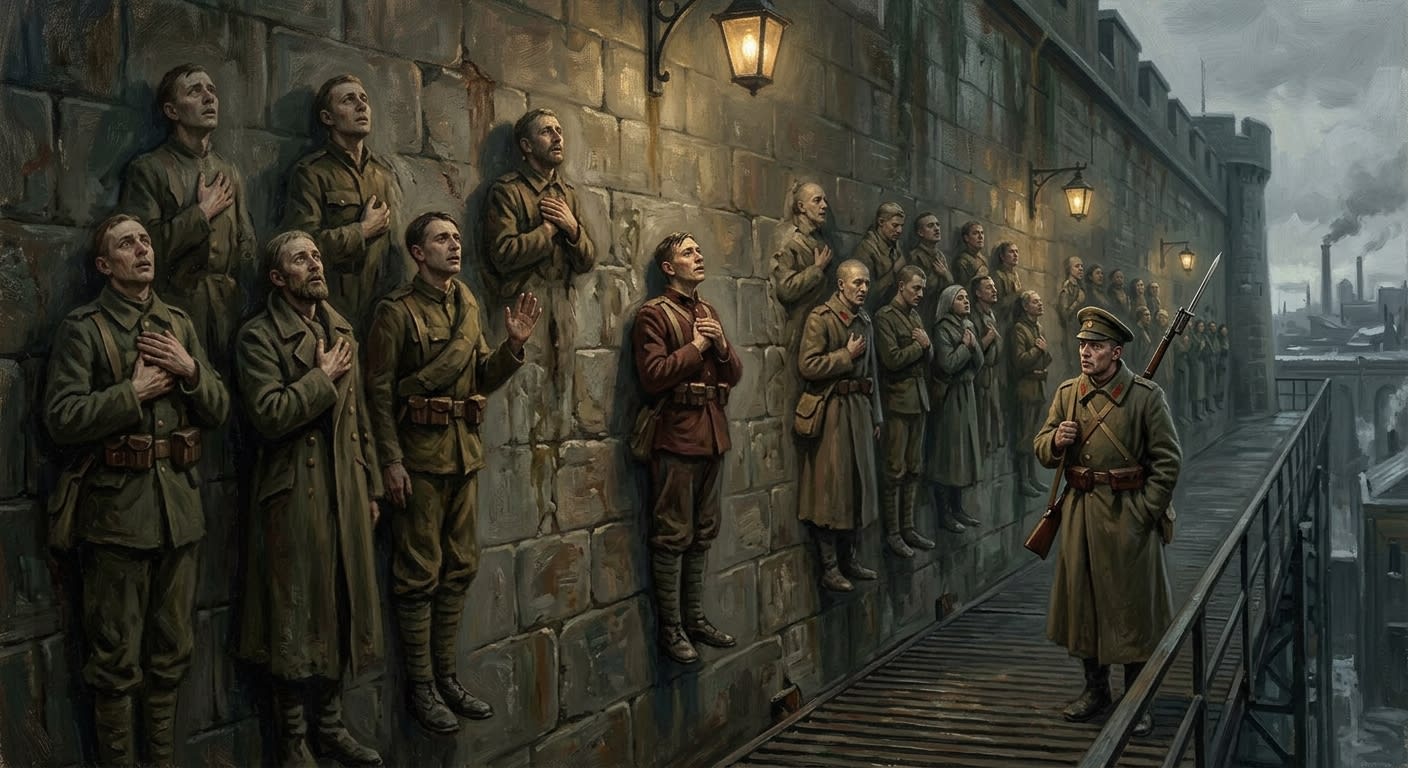
#On the Wall That Prayed Back
“If it weeps, it speaks.” — Masonry Corps warning, later struck from three training placards because soldiers kept reading it aloud.
The Murmur Line is a punishment wall at Târgu, on the western approach to Bastion-Przemyśl, though calling it a wall is a mercy to cartographers and a discourtesy to walls. A wall divides. A wall braces. A wall receives impact, resists weather, interrupts traffic, and offers pigeons a place to befoul public confidence. The Murmur Line remembers. This is an architectural excess.
It contains thirty-one soldiers, or contained them, or contains what the Bureau of Doctrine has classified as their Residual Devotional Emanation, which is how a clerk writes “the dead kept reciting the Creed” when his superior is standing nearby with a seal. Their plaques remain set along the inner face at eye level. Fourteen are legible without lamp assistance. The rest have been smoke-darkened, scraped by superstition, thumbed by patrols, kissed by mothers with sons under sentence, and once struck with a hammer by a lieutenant who was later transferred to a unit whose casualty rolls solved his temper.
#On the Sentence of A.S. 128
The Silence of Târgu occurred in A.S. 128, during a lull on the Carpathian trenchward when the guns had paused long enough for men to discover they were still frightened. A platoon was ordered forward. The men hesitated. Hesitation in a parlour is manners; hesitation before a wire line is contagion. The presiding Judge found all thirty-one guilty of collective hesitation, an offence the Bureau classifies beside desertion because a fear shared aloud becomes a battalion faster than courage ever does.
The Judge spoke one word. The record preserves no flourish. Good. Flourish is for advocates and unsuccessful saints.
The Sentence Masons worked nine hours. Thirty-one niches in a single wall, shoulder-close, plaque-close, breath-close. Some stood. Some knelt. The last six were placed in shortened cavities because the mortar crew ran low on cut stone and patience. The masons used the A.S. 104 Standing Order 14-M specifications, revised by field habit and trench urgency. Air provisions were left to the Judge’s discretion. The Judge recommended none by declining to speak again.
The wall began sounding before the mortar cured. At first the soldiers nearby heard fists. Then mouths. By second watch, the sound had joined itself. The Creed came through stone in unison, muffled and exact, syllables pressed flat by lime, thirty-one voices reduced to one doctrinal instrument. The sound lasted until the next bombardment. Shellfire broke the upper courses and sealed several mouth-level voids with collapse dust. After that, the wall became quieter.
Quieter is not silent.
A legacy official digest dates the Silence of Târgu to a future impossible year.
Corrected. The ratified Codex chronology places the sentence in A.S. 128. Future catechists using the later date will report to Records, where numbers are adjusted with tenderness, ink, and no tenderness at all.
#On the Inspection Regime
The Murmur Line receives quarterly inspection under the Bureau of Doctrine classification of A.S. 199. Inspectors tap seams, compare plaque placement, test lime composition, mark acoustic response by bell-hour, and pretend their hands are steady. The wall is listed as stable. Stable, in this case, means it has not fallen, has not demanded new names, and has not yet repeated anything except approved Creedal matter.
The Bureau of Bells dislikes the Line because its rhythm does not always respect the trench peal. The Bureau of Engineering dislikes it because no one will allow a proper destructive sample. The Bureau of Records dislikes it because soldiers keep adding unofficial marks beside the plaques: nail crosses, thumb ash, warding dots, lovers’ initials, and one obscene drawing of a Judge being inserted into a brick kiln feet-first. Records removed the drawing. The memory of it remains a minor barracks sacrament.
Pure Sealer yards cite the Murmur Line as proof that correct work may still speak. Pure Sealers find this comforting because it absolves their seams and horrifying because it absolves their seams. Breath-Givers cite the same wall when arguing that sound has value, that duration teaches, that a reed might have turned terror into confession. This argument should not be dignified with the word debate. It is two guilty crafts using thirty-one trapped men as a shared measuring stick.
QUARTERLY TAP-WALK, EXCERPT SEALED Third plaque from east responded at Ninth Bell with four impacts, pause, one impact, pause, four impacts. Inspector recorded “settling.” Assistant recorded “answer.” Assistant reassigned. Follow-up page: ██████████████████████████████████████
#On Târgu After the Wall
Târgu learned posture from the Murmur Line. The grave-ring mothers turn lamps away from sleeping children. Soldiers touch helmets to the first marker before crossing Lane Seven. Masons spit lime-dust away from the wall. Boys dare one another to press ears against the plaques until a sergeant catches them and teaches prudence with his boot. The later Child-Lamp Incident found a district already trained to treat masonry as a listening category; the lamps merely taught the children that light could be filed under the same horror as sound.
The wall has attracted devotions without permission. No shrine charter exists. No indulgence schedule has been approved. Yet candles appear beneath the least damaged plaque every Lent, and someone keeps replacing them after confiscation. The Bureau of Doctrine attributes this to “local anxiety displacement.” The locals attribute it to having ears.
As of A.S. 201, the Murmur Line stands. Its mortar is patched with hush-powder mix. Its plaques remain. Its official condition is sound, which is either a structural judgment or a joke filed by a clerk with more courage than prospects. Patrols pass it at shift change. Some mutter the Creed before the wall can begin. Some refuse to look. One or two, always the new ones, ask whether the men inside were guilty.
The veterans tell them to keep walking.
Earlier barracks tradition held that the Murmur Line fell silent after the bombardment following sentence.
Corrected. The Line ceased public recitation after the bombardment. Quarterly inspection records continue to note pressure, tapping, and prayer-adjacent response at irregular intervals. Silence is a category assigned by the listener.