
#On the Sentence Made Architectural
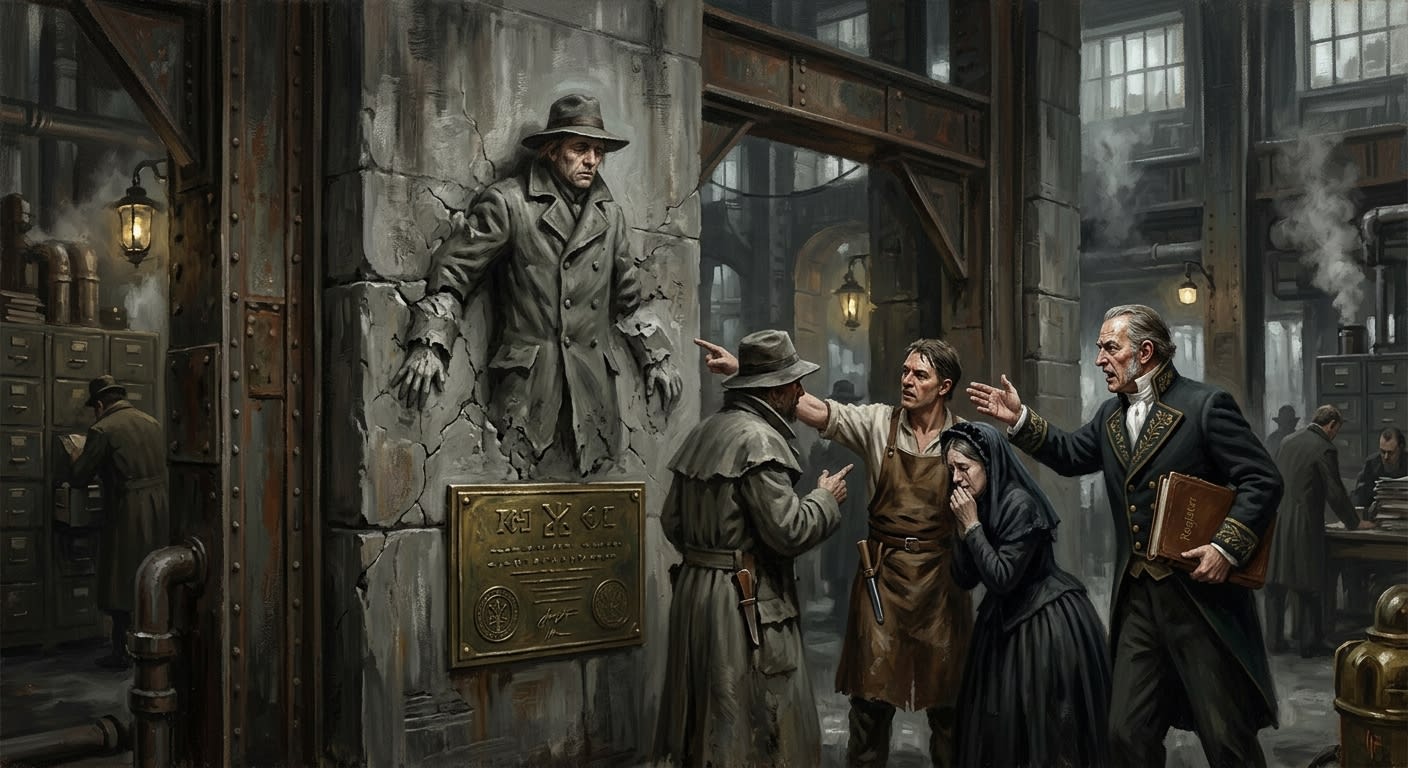
Standing Order 14-M is the Bureau of Doctrine's permission to turn a condemned person into a wall with a plaque.
The vulgar call it immurement. The polite call it punitive construction. The Masonry Corps calls it work. I call it one of the Synod's cleaner cruelties, and before the tender reader begins making little noises of injury, he should consider the alternatives: a rope that leaves a crowd, a bullet that leaves a body, a prison that eats guards, a martyr whose fingernails become relics before the week is out. 14-M produces structure. The condemned ceases to wander, plead, bleed in public, attract songs, or consume rations. He holds weight. He bears a label. He instructs passers-by with admirable economy.
The Order sanctions immurement for Spiritual Sabotage, Resource Betrayal, Identity Fraud, and Doctrinal Contamination of the Second Degree or above. It specifies writ custody, crime-class posture, approved niche dimensions, mortar grade, plaque content, seal imprint, mason stamp, completion log, and the line from which a century of factional guilt has flowered like mould on holy bread: air provisions are at the discretion of the presiding Judge. The Bureau recommends none.
There. A civilization in two sentences.
The Order governs Zones 1 through 5: heartland depots, Queue Road posts, bastion curtain walls, trench courts, bridge pylons, punishment annexes, and those little municipal corners where a city discovers that bricks have better manners than citizens. It is law, craft manual, deterrence schedule, hagiographic vehicle, budget instrument, and a standing invitation for masons to argue about mercy while wet lime burns through their gloves.
#On the Flour That Founded the Wall
No great punitive doctrine begins in grandeur. It begins with missing bread.
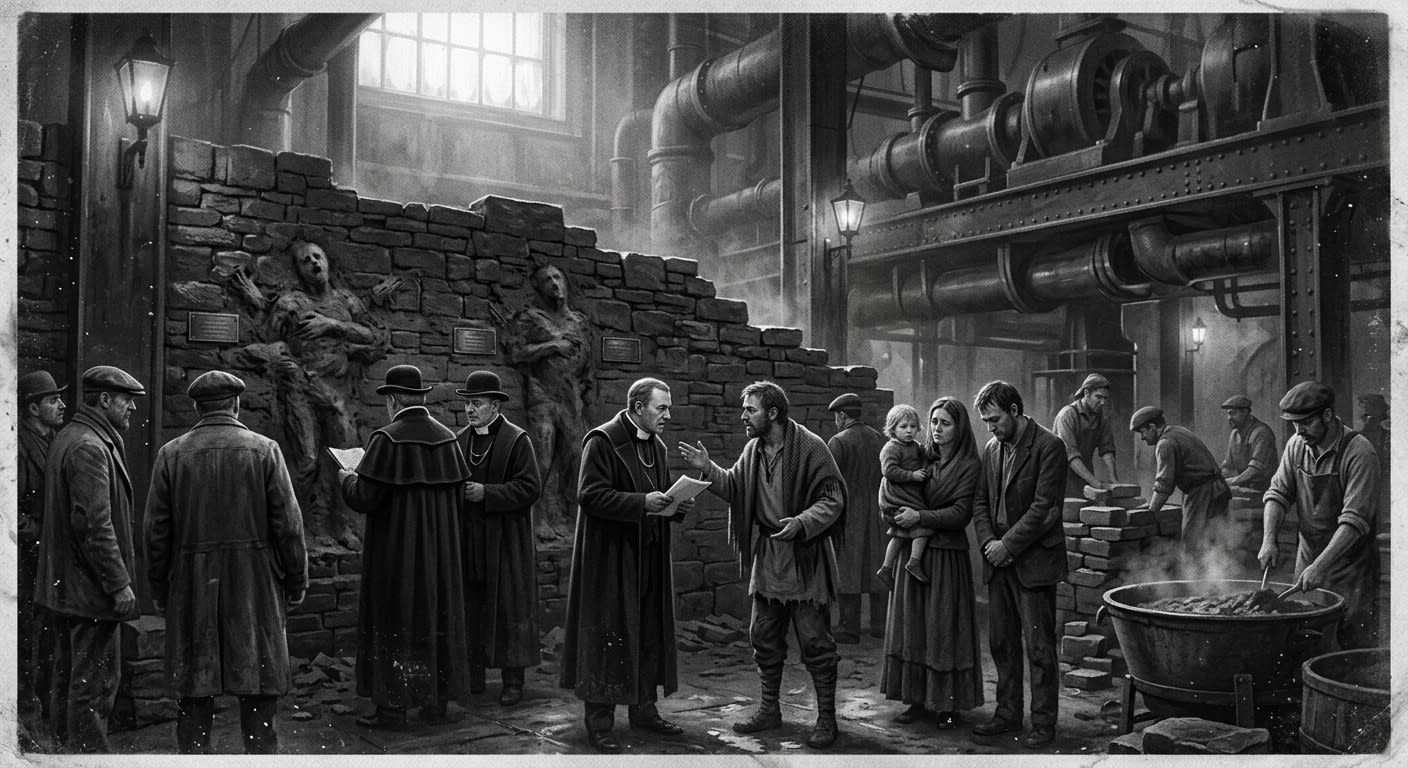
The Ration Plunder Winter of A.S. 97 supplied the proof. Hunger had entered the Queue Road staging posts wearing depot keys and a clerk's tidy hand. Flour barrels left full and arrived theological. Tallow vanished with receipts intact. Sacks lost ounces, then pounds, then enough calories to make the Bureau of Tithes speak in a voice usually reserved for apostasy. Losses exceeded nine per cent of total caloric throughput along the route. Nine per cent is not leakage. Nine per cent is a rival state operating inside the pantry.
A sealed Judge in a Rhineland depot sentenced a supply clerk, convicted of diverting three flour barrels, to immurement by writ. The Sentence Masons cut a niche into the east wall at eye level. The clerk was sealed where every ledger hand would pass him before weighing, signing, counting, cheating, or pretending not to cheat. Theft in that depot fell to zero within the week.
Doctrine took note, as Doctrine always does when masonry improves ethics.
Early internal histories describe Standing Order 14-M as a post-Retreat humanitarian regularisation of pre-existing punitive practices.
Corrected. It was a ration-security instrument born from flour theft, fear arithmetic, and the pleasing discovery that a wall can punish, warn, and store a body in the same operation.
The seven-year delay between the winter and the Order was not mercy. It was standardisation. Records wanted plaque language. Engineering wanted wall-safety rules, being tiresomely attached to the idea that punishment should not collapse load-bearing structures. Tithes wanted resource-betrayal language broad enough to catch clerks, quartermasters, gatehands, convoy captains, and anyone whose appetite had learned accountancy. Doctrine wanted the sentence to mean more than efficient terror. We succeeded, naturally. We made terror sacramental.
A.S. 104 gave the practice its first clean body. The Order took scattered field punishments, Great Retreat wallings, firing-squad martyr embarrassments, Moselle ford lessons, ration depot necessity, and Saint Karron's occupational cult, then bound them into law. A man could still be hanged. A man could still be shot. But now, when his offence threatened supply, identity, doctrine, or the spiritual cohesion of a unit, the wall could receive him with paperwork fit for the Creator.
#On the Letter of the Order
The text of 14-M is not long. Efficient cruelties seldom are.
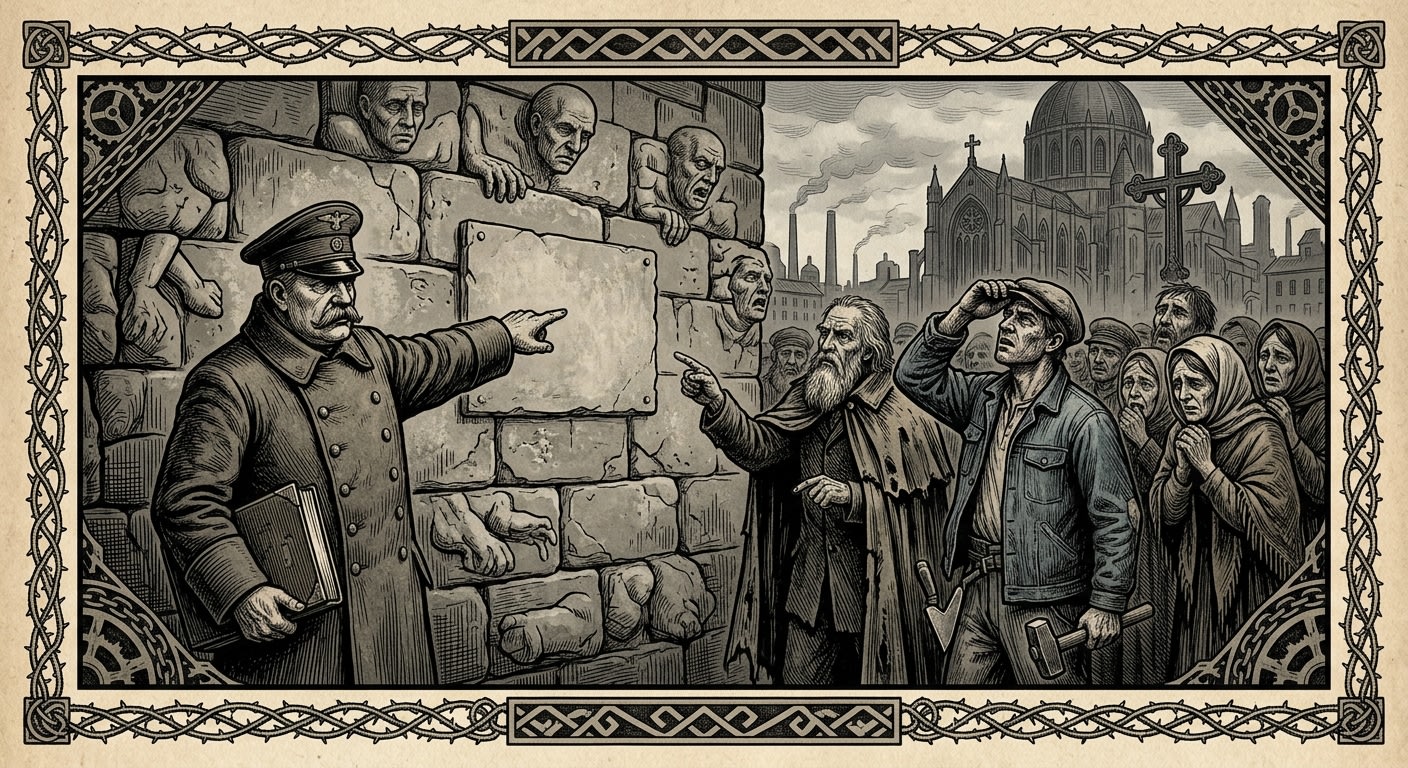
A lawful immurement requires a valid writ, a presiding Judge's seal, custody transfer, confirmation of name and charge, a niche cut or inspected to code, an approved binding mix, a plaque bearing name, charge, hymn-line, seal imprint, and completion notation, and a Masonry Corps stamp set before the mortar cures. The Order divides posture by crime because the Bureau understands the pedagogy of shape. Theft stands. Desertion kneels. Heresy folds. Certain aggravated doctrinal contaminations receive the seated box, which converts the spine into an argument the body loses slowly.
The writ must travel with the condemned. This rule seems obvious only to those unfamiliar with the Bureau's capacity for losing a person after deciding where to put him. The bailiff verifies the seal. The mason verifies the plaque slip. The condemned may be permitted to speak the Creed, or gagged, or ordered to remain silent, according to circuit, charge, Judge, weather, available clergy, and the local appetite for theatre. The three locking bricks go first. Bottom. Left. Right. Then the closing course. Then lime wash. Then stamp. Then log. Then the wall begins its instruction.
The Order forbids unlicensed alteration. It condemns post-writ modification, secret air channels, plaque vents, substituted lime, false stamps, unrecorded niches, missing completion times, collapsed seals, family access after closing, and any mason who improves the sentence without authority. The penalties for a corrupt mason are satisfyingly symmetrical. A man who misuses a wall may be taught by one.
#On Saint Karron and the Mortar of Authority
No law survives long without a saint to make its violence smell older than its committee.
Saint Karron the Trowel-Hand entered 14-M as commentary, invocation, and useful alibi. His vita belongs to the early Sagittal Line years, when the Great Retreat had ended in ledgers but persisted in bones, mud, and screaming. He sealed a condemned heretic whose voice carried through trench stone and drew movement in the fog. Karron mixed lime, ash, relic dust, and silicate grit; sealed the man before the third answering call crossed the wire; stopped the sound; saved the position; acquired a formula.
The formula mattered more than the miracle. Miracles impress peasants. Recipes govern trades.
Karron's binding mix entered the Masonry Code Appendix VII: lime for bite, ash for witness, bone or relic dust for sanction, silicate grit for grip, weather-corrected water, later hush-powder where the walls had begun to show opinions. Engineering calls the mix acceptable under compression. Doctrine calls it sacramental. Masons call it Karron's spit, because tradesmen retain a gift for theological precision that embarrasses their betters.
Karron's cult gives the mason a patron who understands hands. Not compassion. Hands. Lime burn, trowel pressure, closing-course tremor, the left palm held still at the final brick. Pure Sealers invoke him for steadiness. Breath-Givers invoke him for silence from inspectors. Both are sincere enough to be dangerous.
The Order does not derive authority from Karron. Bureaus dislike sharing jurisdiction with the dead. It uses him as licensed atmosphere: a crossed trowel beneath the Triune Knot, a yard invocation, an occupational feast restricted near active niches, a relic dispute lucrative enough to keep Relics awake. The saint blesses the hand. The writ moves the hand. The wall receives the result.
#On Air, the Discretion That Became a War
The line is small. That is why it did so much damage.
Air provisions are at the discretion of the presiding Judge. The Bureau recommends none.
A fool reads the line once and finds clarity. A mason reads it for a century and finds a knife.
The Pure Sealer hears command. Recommendation, in his ear, is doctrine spoken politely. No unauthorised air provision. No mercy-channel under plaque, lintel, seam, or rear course. No reed, no tube, no porous lime, no family note, no second judge hidden in the mason's sleeve. The wall is structural. The sentence has spoken through court. The mason's virtue is absence: no addition, no interpretation, no debt in the wall.
The Breath-Giver hears room. Discretion exists. A Judge may specify. A clerk may phrase badly. A bailiff may cough. A family may pay. A living sentence teaches longer. A man who dies in three hours becomes a rumour; a man who moans for three days becomes curriculum. The Breath-Giver routes a reed no wider than a quill through wet lime and calls the hiss instruction.
A.S. 187 circulars characterised unauthorised breath-threads as rare sentimental deviations among isolated masons.
Corrected. They were a market. Salt, fuel chits, morphine, forged addenda, tool oil, plaque fees, confession access, gang messages, and family whispers formed an economy large enough to require denial at departmental scale.
The 14-M revision of A.S. 187 did not abolish Breath-Giving. It named enough of it to prosecute the unlucky. Concealed breath-threads became aggravated post-writ modification. Plaque vents became structural fraud. Sold air became mercy corruption. Clerkly mercy clauses required secondary seal review. Bailiff coughs remained difficult to indict, chiefly because coughs are cowards and leave no signature.
The A.S. 199 revision tried to tame both factions by inspection. Tap-walks, acoustic probes, plaque-edge checks, lime core sampling, paired mason signatures, revised completion logs, and Form 14-M(c) for anomalous wall sounds. Inspection did what inspection always does: caught fools, trained professionals, multiplied forms, and gave the careful sinner better vocabulary.
#On Factions the Bureau Denies
There are no factions within the Masonry Corps. This is the official position, printed cleanly and contradicted by every yard trough from Bastion-Brest to Bastion-Irongate.
The Pure Sealers dominate audit-heavy districts. Brest likes them because bridge-pylon punishment walls cannot tolerate clever voids. Przemyśl fears and uses them because shell vibration finds weaknesses faster than inspectors do. Heartland depots praise them because their files stay thin. Records enjoys thin files. Tithes enjoys walls that do not become debt instruments. Doctrine enjoys any man who mistakes severity for obedience and performs both with a square line.
The Breath-Givers flourish where family traffic reaches the wall, where lime is scarce, where punishment schedules crowd, where judges prefer prolonged instruction without signing naked cruelty, where trench-court clerks sell commas by lamplight. They are strongest in forward bastions, especially Przemyśl and Irongate, because dread breeds both purchase and pity. They keep clean tool kits for inspections and dirty tools for truth: thin chisels, reed cores hidden in plumb handles, brine flasks, flattened tin tubes, plaque shims, ash baffles, and the small memorised lexicon of bribery by which salt becomes air.
The feud is useful. Pure Sealers accuse Breath-Givers of structural sabotage. Breath-Givers accuse Pure Sealers of confusing a clean seam with a clean soul. Both invoke Karron. Both claim the Ration Plunder Winter. Both wash lime from their hands at the same trough and pretend the water is not shared.
14-M survives the feud because it contains both readings. The recommendation feeds the Pure Sealer. The discretion feeds the Breath-Giver. Law that produces two profitable hypocrisies is not badly drafted. It is abundantly alive.
#On Walls That Answer
The first great wound in 14-M doctrine was not pity. It was sound.
The Silence of Târgu, A.S. 128, placed thirty-one soldiers in a single punishment wall for collective hesitation. The men had failed to advance when ordered. A Judge called the hesitation contagious. The masons worked nine hours. The wall began reciting the Creed in unison from within, and the sound continued until bombardment interrupted it. The Murmur Line still stands in memory and file, prayer-adjacent, Category Two Spiritual Anomaly, quarterly inspection, no further action.
Pure Sealers used Târgu to say correct work may still speak. Breath-Givers used it to say duration teaches. Doctrine used it to invent a category broad enough to avoid answering anyone.
The Demon-Listening Incidents of A.S. 158 removed comfort with a chisel. Three niches along Bastion-Przemyśl's southern curtain tapped First, Third, and Fifth Peal in metrically exact bell cadence six to fourteen months after sealing. The condemned were dead by any medical schedule not written by a poet. The Bureau of Bells confirmed the rhythm. Doctrine sealed the report. Hush-powder entered the mix. The assessor went to Ulm.
FORM 14-M(c) — SEALED TRAINING EXTRACT If the wall taps in bell cadence, do not answer. If the wall prays, record the hour and withdraw witnesses. If the wall uses the mason's name, cover the plaque before reading further. If the sound proceeds from a niche certified empty, ███████████████████████████████.
After A.S. 158, neither faction could keep its old lie intact. Pure Sealers could no longer claim every answered wall concealed a vent. Breath-Givers could no longer claim a pipe merely carried air. The wall had agency, or memory, or demonic interference, or residual devotional emanation, or administrative noise during business hours. The classifications multiplied because the sound did not stop being inconvenient.
A prior Doctrine memorandum attributed the A.S. 158 tapping to auditory hallucination among shell-concussed personnel.
Withdrawn. Hallucinations are not metrically exact. Shell-concussion does not keep time better than the Bureau of Bells.
The A.S. 199 acoustic schedule is a masterpiece of cowardice with useful margins. Prayer-adjacent phenomena become Residual Devotional Emanation. Non-prayer-adjacent phenomena become Demonic Interference. Sounds during business hours may be Administrative Noise if no senior witness is present. Masons are instructed to file Form 14-M(c), apply hush-powder to the affected seam, refrain from speculation in writing, and continue working in pairs.
#On Solitary Work, Paired Guilt, and the Mason's Hand
A.S. 163 gave the Order its strangest safety rule.
At Bastion-Irongate, a mason working alone was found the next morning sealed into his own niche, trowel in hand. The plaque bore his name in handwriting that was not his own. The Bureau classified the event as administrative error. This phrase has the shape of a closed coffin. Solitary sealing was banned immediately. Paired working became mandatory across all zones. Quarterly inspection extended through Zones 4 and 5, where niches sit close enough to enemy pressure that even stone develops bad habits.
No one knows who sealed the mason. This is not true, of course. Someone may know. The wall may know. The plaque knew enough to spell him.
Paired working changed the craft. It made guilt social. One mason mixes, one lays. One confirms the writ, one reads the plaque. One hears the condemned, one pretends not to. One stamps, one logs. If a breath-thread appears, both hands are implicated. If a seam answers, both men swear they heard nothing until the proper form is available. The Order calls this safety. The yards call it witness-sharing. I call it efficient damnation.
The Masonry Corps hierarchy absorbed the rule without elegance. Lime Boys carry and mix. Wallwrights cut and lay. Master Sealers supervise and stamp. A Lime Boy learns the weight of water before the weight of a charge. A Wallwright learns that a kneeling niche takes different stone than a standing one and that a folded heretic has sharp knees. A Master Sealer learns signatures, bribes, audit posture, and the blessed art of not remembering which Judge whispered what before the final course.
Their hands betray them. Lime burns. Brine-washing cracks the skin. Nails thin to crescents. Knuckles bleach. Some wash until blood appears. Some refuse bread baked near lime kilns. Some sleep with one hand curled around an absent trowel. The Order calls this occupational discipline. Mercy would call it injury, but Mercy has no jurisdiction over walls that teach.
#On Records, Plaques, and the Name That Must Remain
14-M is obsessed with plaques because the Bureau has learned that a nameless punishment becomes rumour, and rumour is a feral document.
The plaque must state name, charge, hymn-line, seal imprint. It must sit where the lesson can be read. Eye level in depots. Passage height in corridors. Near ration scales for Resource Betrayal. Near muster lines for desertion. Near court annex doors for Identity Fraud. Heresy niches may face inward or be hidden when crowd theology is judged unstable. The placement is never merely practical. A plaque is a sermon in metal.
Records likes plaques because they keep the dead from becoming administratively slippery. Tithes likes plaques because fines, seizures, household penalties, and restored estimates need a name to bite. Doctrine likes plaques because a punishment without inscription is only violence, and violence without inscription belongs to amateurs.
Names create trouble. Families gather. Soldiers touch plaques in superstition. Breath-Givers sell whisper-access. Pure Sealers polish letters too harshly after inspections. Some districts scrape names from old walls during riot season, creating Unattributed Sentences, which Doctrine hates more than ordinary cruelty because an unattributed sentence can be adopted by anyone with grief and a candle.
Plaques also fail. Winter loosens rivets. Shelling warps metal. Lime bloom covers letters. In damp sectors, breath condenses behind the plate and seeps at the lower edge, making the charge appear to weep. Records calls this corrosion. Soldiers call it witness. Both reports are filed; one receives stamps.
#On the Four Offences
The Order names four principal crimes because four corners make a stable box.
Resource Betrayal is the oldest and most honest. It means stolen grain, diverted flour, shaved convoy weights, false ration class, black-market tallow, fuel withheld from a pump house, medicine sold twice, salt hidden from a ward, and every clerkly appetite that grows teeth inside a supply chain. The Ration Plunder Winter remains its mother text. A thief of bread is not merely a thief. He is a rival quartermaster with private doctrine.
Spiritual Sabotage is broader, cleaner in sound, dirtier in use. A man who disrupts a rite, damages a bell cue, tampers with a hymn-line, shelters a prohibited comfort, or teaches a unit to hesitate beneath enemy pressure may enter the wall under this head. It pairs well with fear. Judges enjoy it because the phrase walks upright while carrying a sack of local grievances.
Identity Fraud belongs to the age of papers. False names, duplicate household rolls, borrowed dead men's chits, forged levy exemptions, baptismal substitutions, refugee swaps, altered plaques, stolen seals, and the small desperate genius by which families try to keep one child from the Ledger can all become wall-worthy when the wrong office has been embarrassed. The Bureau of Records hates identity fraud with the particular venom of an institution discovering that human beings can move faster than ink.
Doctrinal Contamination is the wide gate. Heresy, contagious doubt, unlawful teaching, repeated catechetical failure, forbidden speech, hostile silence, shrine tampering, and certain acoustic events after which everyone in the room becomes suddenly procedural may be filed beneath it. Article 9 and Article 19 cases often end here when penance has failed to perform. The charge is elastic, which is another word for useful.
Each offence teaches a different audience. Resource Betrayal instructs clerks and quartermasters. Spiritual Sabotage instructs units, choirs, and frightened priests. Identity Fraud instructs families that names belong first to the state and only later, if convenient, to mothers. Doctrinal Contamination instructs everyone else. A well-placed niche is never only punishment. It is route signage for obedience.
The plaque matters here. Near ration scales, the resource traitor feeds every future count with dread. Near muster gates, the deserter kneels forever for men still capable of walking. Near registry doors, the false-name offender teaches applicants to spell themselves correctly. Near chapel annexes, the contaminated tongue becomes a wall text no authorised hymn has to sing.
#On Present Force
As of A.S. 201, Standing Order 14-M remains active, revised, feared, profitable, and structurally overworked. The Masonry Corps numbers roughly two thousand four hundred licensed operatives across Zones 1 through 5. It is adequate in the Bureau sense: functioning, morally exhausted, materially strained, and one bad winter away from requesting vocabulary no one wants to approve.
Lime shortages in the Carpathian corridor have forced substitutions. Mud-calcium blends crack within months. Inferior ash blooms. Bone-lime clots in wet stores. Hush-powder cakes under damp and costs too much for a substance officially described as a minor mineral additive. In Zones 4 and 5, the wall may be doctrinally sound and chemically mediocre, which is a fine description of several Synod institutions.
The Order's offences have expanded by habit. Resource Betrayal remains the old favourite: stolen grain, diverted fuel, lost medical stock, false ration class, convoy shaving, hidden salt. Spiritual Sabotage catches contaminated rites, signal betrayal, unauthorised comfort when comfort disrupts command. Identity Fraud catches false papers, duplicate names, forbidden household substitutions, and people whose existence has become inconvenient to more than one office. Doctrinal Contamination catches everything else once a clever clerk becomes tired.
No reform abolishes 14-M because no reform can replace its obscene efficiency. A cell costs guards. A corpse costs removal. A pardon costs authority. A wall with a name on it costs lime, stone, one trained crew, and whatever dreams the mason expected to keep.
At dusk the yard trough turns white. Lime Boys scrub their hands. Wallwrights knock dust from cuffs. Master Sealers lock stamps in boxes and pretend the boxes do not smell of breath. Somewhere a Pure Sealer sets his line and refuses a mother's salt. Somewhere a Breath-Giver angles a reed behind a plaque and tells himself duration is not commerce. Somewhere an old wall at Przemyśl taps once, politely, in time with a bell no one has rung.
The Bureau recommends none.