

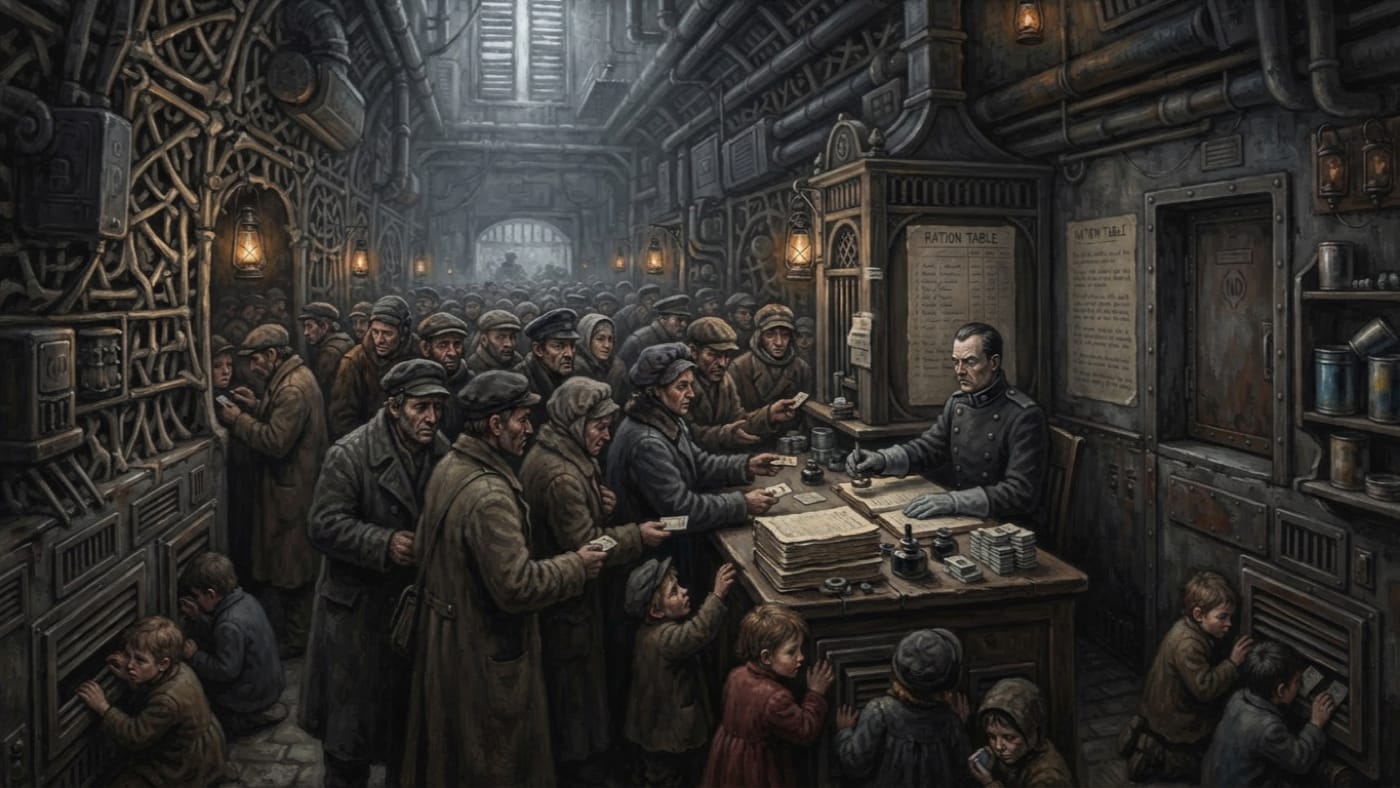
#On the Place, and the Year of Its Survey
The Breath Market is the district of Black-Snow Lor where air is distributed by ration and sold by every other means. Lor's own accounts list it among the town's seven districts, and it is held as Breath Office territory. I cannot certify where its edges meet the Warrens, the Breath Cordon or the road in from Filter Gate. No plan of it has reached my desk. Lor builds low and burrows deep, and a district that measures its wares in minutes has never bothered to measure itself in yards.
This survey is dated A.S. 201, 1911 by the common reckoning. The year belongs to the survey. It is not the year the market opened, and the Bureau knows no year of opening. The Breath Office was never cleanly chartered, so the market it keeps has no founding day to celebrate. Lor's lore says rations were first standardized and then monetized. The record does not say when the second followed the first.
What the record can describe is what a visitor meets. Vinegar and lime at the Clean Room. Wet cloth and lamp oil from the direction of the gate. Soot on the grilles, bone in the lattice. Grey gloves at the tables, each with an inked thumb. And queues, in a town where standing in a queue is a form of prayer that expects an answer before third bell.
#On the Clean Minute and the Lawful Table
The market's central coin is the clean minute. My extract on the Breath Office defined it as a token representing guaranteed breathable shelter during storm cycles, and I keep that definition. Lor's street speech uses the same words for the time left before closure, and the town's own account calls the storm-window token a unit of time before the next sealing. Both usages are current. I have found no document that converts one into the other, and I will not invent the arithmetic for a town that already has too much of it.
A token is a claim. It contains no air. It promises shelter, and the promise is only as good as the room, the filter, the bell and the clerk behind it.
The lawful trade is posted openly. The Market displays equal-ration tables, and the tables are not lies; they record what each account is owed by the Office's own measure. Beside them runs the other lawful business. Through clean-minute transfers, rich households buy priority and poor households sell future labour for present inhalation. Both transactions are legal. One is written on the wall. The other is written in the transfer ledger, which hangs nowhere.
Tokens are inherited. The Office's Clean-Minute Transfer CMT-4 provides for reallocation after death, disappearance, debt, confiscation, or what the form calls clerical improvement, and the Market is where reallocated minutes turn up again in somebody else's hand. A widow may receive her husband's hours. A creditor may receive them first. Tokens are also hoarded, wagered, tithed, and in some cases swallowed, for reasons the town does not share with auditors.
A rich man holds hours. A poor man holds a promise that will not outlast the bells. Breath debt fills the space between them. Owed rations are settled in labour or by surrendering shelter rights, and Lor's accounts add names to the list of things a debtor may hand over. I have found no single contract that governs these settlements, and no published rate of interest. In Lor, the absence of a published rate is the most honest fee.
The Breath Office extract gave the Clean Room's terms as fifteen minutes for a bone-chit, an hour for a day's ration, and a night at the clerk's discretion.
Clarified. Those figures were the Clean Room's terms as reported in that account. They have not been verified as prices anywhere else in the Breath Market, and they must not be quoted as a tariff for tokens, filters or transfers. The Bureau regrets printing a price list with the confidence of a man who never had to pay it.
#On the Side Door, the Grilles and the Vents
My earlier extract recorded that the Market posts its equal-ration tables beside a side door through which superior air moves in covered tins to superior rooms. As an observation, I stand by it. I do not know what the tins hold, where it comes from, how it is kept or who signs for it, and I will not make those things up. A covered tin conceals what it carries. That is all I can say about it.
The grilles are the Market's more democratic feature. Children reach under them with fingers thin enough to find dropped or loosely held tokens. Lor's children count clean minutes on their knuckles and hide the thumb for debt. The town's storm-orphans are said to know the vent routes better than their own names.
The trade the tables do not post runs beneath the Market, in the vents. Lor's lore lists the stock: counterfeit breath stamps, illicit filters, and rentals advertised as storm-safe. The street calls a forged stamp choke-ink and an unproven storm-safe claim a lattice-lie. Reportedly the vent market has one limit of its own: real tower bell keys are not for sale there. The Soot Kites are the town's known vent-running smugglers, carrying filters, people and secrets through the under-warrens. I name no broker, counterfeiter or Kite at any particular grille, because nobody has named one to me with evidence attached.
The line between the lawful upper floor and the vents below it does not fall where the pious would draw it. A forged token is illicit. A lawful transfer that moves a poorer household down the queue is not. Lor's lore counts among its red lines the sale of clean minutes stamped with the Synod seal, yet the Breath Office's own practice treats priority transfers as lawful. I have read both. I cannot tell you which seal, which seller or which sale the prohibition reaches, and the Market has not offered a ruling. The vagueness serves every party except the buyer.
#On Bell, Ledger and Lattice
Breath Comptroller Juno Varr keeps the ledgers the Market runs on: filter cloth, lamp oil, shelter capacity, storm-window tokens, clean-room access and breath debt. The Warrens accuse her of selling air twice. The charge is still an accusation. No audited double entry under her name has reached the Bureau of Records. I place her hands on the ledger and nowhere else, because that is as far as the evidence goes.
The ledger does not ring. Storm Warden Ilex Marr commands closure through the Storm Warden Corps and the closure bells of the Ribwatch Towers, while the Office administers capacity and access. The tension sits on every token in the Market: a purchased minute is worth what the ledger says until the bell says otherwise. Published accounts record that an early third bell cancels purchased minutes and paid rooms, and that no clean minute buys time after third bell. The bell issues no refunds. Neither does the Office.
The rooms themselves fall under a third competence. The Bone-Guild of Rib and Reed maintains storm shutters, tower vents, safehouse seals and Breath Market screens under charter. It also supplies, from Maskers' Row and the Latticeworks, the masks and lattice on which every shelter claim rests. Rib-Mother Sael disputes the Office's emergency certification of non-Guild shelter upgrades. A token for a room that fails was never a clean minute at all. It was a receipt.
The Market's cruelty serves a purpose, because the Market works. Tokens put bodies behind shutters before black snow fills the street, and even crooked allocation allocates. A market that sometimes saves its customers keeps them coming back, coughing.
#On the Distinction from Irongate
The Breath Office keeps a second theatre at Bastion-Irongate, and clerks who have visited neither place routinely bungle the comparison. At Irongate the Office's instruments are voice-license seals, candle tests, heat allocations and quarantine clearances. There it sells the conditions under which breath stays warm and licensed beside the Gasket Choir. Lor keeps no candle at the table. It trades in clean-minute tokens, shelter registry and storm rations. The glove is the same grey; the goods are different.
Nor is the Breath Market the Minute Market at Latchford, which sells its own intervals beneath its own boards. Correspondents who confuse the two will have their letters returned unopened, which is to say opened and filed.
#On the Present Condition
At the date of this survey, Lor's storms have been arriving off-cycle since A.S. 199, and the pressure on the Market's tables has not eased in A.S. 201. Filter cloth is short. The dispute between Office and Guild over shelter-upgrade permits is still open. The accusations against the Comptroller are still unadjudicated. No riot, audit or reform at the Market is recorded for the year, and I will not file one in advance.
The equal-ration tables are still posted. The side door is still beside them.