

Sources are read: the continuity reference, the style guides, the Lor lore file and the timeline/locations entries. Drafting the article now.
#On the Watch Above Lor
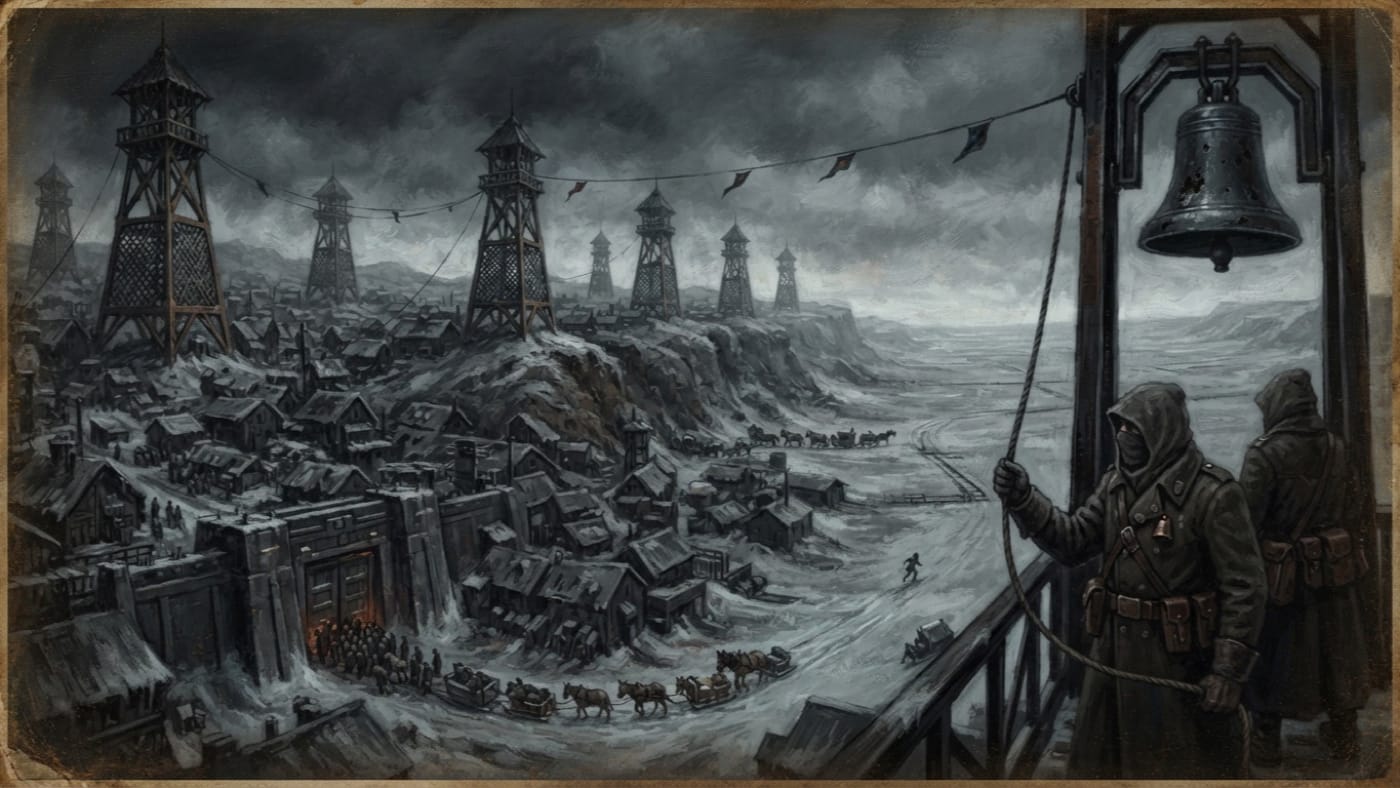
Black-Snow Lor lives with its head down. Its roofs sit low and furred with ash. Its streets sink between storm berms, and its people sleep in burrows stacked like drawers in a damp archive. Above all this crouching stand the Ribwatch Towers: rib-frame lookouts raised into the wind on Lor's windward ridge, each hung with a bell of cold iron and staffed by a crew paid to stare at the ash flats until the flats move.
The flats move often. Below the ridge lie trench-cut gullies, exposed bonefields, a rail spur that buries itself whenever the drift is heavy, and the supply road along which convoys crawl toward Bastion-Przemyśl. From a Ribwatch platform a warden sees all of it, or as much as the drift permits, and must decide whether the grey on the horizon is weather or a death sentence.
The Bureau's dossier on Storm Warden Ilex Marr records Lor's beginning as Storm-Shelter Node 14-C in A.S. 71, and places the first convoy lookouts after that founding. They were men and women paid in filter cloth to climb rib-frames and tell ordinary bad weather from weather that intended murder. No record before me dates the towers now standing. Frames in Lor are re-lashed, re-screened and rebuilt so routinely that asking a tower's age is like asking the age of a cassock that has been patched for forty years.
#On the Frames and the Relay
The towers are built from the town's own materials: bone-lime, rust-iron and soot brick at the footings, rib struts above, and reed lattice stiffened with marrow glue for the screens. Each platform carries a bell-frame, and from each frame a closure rope descends to a gloved hand. The lattice screens break the wind for the watch, and under pressure they click. Wardens read those clicks the way a confessor reads a pause.
Forecasting in Lor is unglamorous work. At Tower Three, Marr gave me the methods without ornament: cycle tables, particulate loads, pressure clicks in the lattice screens, and the interval between ash-sled runner sightings on the approaches. The Storm Warden Corps adds closure diagrams, approach warnings and the sealed storm-cycle ledger. That ledger's authority depends entirely on storms keeping their appointments.
The bell-line carries warnings between towers, and runners carry them where the line cannot. Bell-riggers keep the ropes, knots and hangings sound. The street saying holds that one missed knot kills a district, and the riggers are paid as though nobody had heard it. Wardens wear bell pins. Tower bell keys are controlled objects. The vent markets beneath the Breath Market sell counterfeit stamps, illicit filters, "storm-safe" rentals and a great deal of air that does not exist, but no broker there can sell a genuine bell key. Lor counts sabotage of a tower bell among its few unforgivable acts, alongside opening a safehouse during a storm.
#On the First, Second, and Third Bell
Lor's closure code has three stages, and every child in the Warrens can recite them before learning the ration oath.
One bell warns. The towers ring, the bell-line carries the signal across the ridge, and Lor looks up. In practice the haggling stops, people count their filters, and the queue at the Filter Gate grows thicker.
Two bells move bodies. Shutters slam along the Latticeworks. Market stalls vanish. Vent-runners sprint for their junctions. Ash-sled crews whip their teams toward the gate, and convoy masters on the approaches calculate the distance to the berm against the speed of their worst mule. The Breath Office begins revising capacity, always downward and always aloud.
Three bells close Lor. The Filter Gate locks. The Breath Cordon seals around the safehouses. Anyone who holds a token, a writ, a bribe or a priority listing goes inside. Everyone else presses against the lattice and learns that a permit stamped yesterday carries no weight with a gate that is already shut. A storm-labour deponent, questioned after an incident at Gate Two, explained why the gate was not opened for the people outside it: Because the bell had already made them weather.
The Corps does not publish its stroke counts or its intervals, and I will not invent them on its behalf. The stages are what matter. Each one hands control from the market to the gate and from the gate to the rope.
The written rule forbids opening a safehouse during a storm. Marr has ordered safehouses reopened for children and refused them to soldiers. No law permits this, and nobody can say whether the refusal or the mercy breaks it more.
Lor is safe if you follow procedure.
Struck from the public storm-placards of Lor, where it has stood longer than some towers. Corrected: Lor is safe if procedure matches the storm. A citizen who obeys every bell can still be outside at third bell. Procedure regrets nothing.
#On Those Who Keep the Towers Standing
A bell is an order only if someone has rigged the bell, someone hears it, and the screens hold long enough for anyone to obey it. The towers depend on three separate kinds of labour, and Lor quarrels over all three.
Marr commands. The closure bells, the Filter Gate closure lines, the bell-frame relays and the Breath Cordon seals answer to the Storm Warden. The bell-riggers and bell-line runners pass the order on, and none of them may alter it.
The Bone-Guild of Rib and Reed keeps the towers standing. Its crews maintain the bell-frames, tower lattice, shutters, vent screens and shelter seals, which means Rib-Mother Sael controls how quickly Marr's orders can be obeyed. A slow repair to one lattice screen is a quiet veto. Marr has an answer: the Warden can condemn a safehouse line and empty the Guild's premium rib-houses for a storm cycle. Neither can win this quarrel without losing the town.
Breath Comptroller Juno Varr has no hand on any rope and every reason to watch them. When the third bell rings early, purchased clean minutes are cancelled, rooms paid for at the Breath Market are lost, and the Breath Office's ledger becomes a list of refunds it will never issue. The Frontier Chapterhouse may pray at the towers. The Line quartermaster may demand that a convoy pass. Neither can make a sealed gate open.
The Corps itself is no monastery. Its own priority-shelter lists are bought and sold, and some wardens profit from closures they are paid to call.
#On Warnings That Arrive Wrong
The towers can fail in three ways, and Lor's grief does not distinguish between them. The Ledger does.
A late warning is the oldest failure. The dedicated survey of Lor records the Nine-Bell Night, when the towers rang late and a whole district suffocated after it had been sealed in. The survey gives no year, no casualty roll, no named officer and no cause. I reproduce exactly that much. Warren antiquarians argue from the name that Lor once had nine towers, or a nine-stage code. A name is not an inventory, and antiquarians should be kept away from bell-ropes.
An early closure is the second failure, and the most hated. During an off-cycle storm in late A.S. 199, Marr rang closure eight minutes before the Breath Office had posted its official warning. Twenty-seven civilians, two ash-sled crews and one convoy chaplain were still outside the Cordon. The chaplain was found fused to his reliquary case. The Breath Office protested, citing lost clean-minute revenue. Marr's written reply survives in the dossier: The storm arrived nine minutes after first bell. Your notice would have buried three hundred. The figure is Marr's. It has not been refuted, and it has not been audited.
The third failure is a ledger that stops predicting. Between A.S. 199 and A.S. 201 the sealed storm-cycle ledger failed three times. That count does not mean only three storms came; it means three times the ledger was wrong. The black snow that fell after the Year of Ash Rain in A.S. 143 had already begun arranging itself at seams and vent screens, and nothing in the cycle tables accounts for it.
Warren residents also report that the tower bells ring half a beat late. These are reports. The Bureau of Purity would welcome them as an excuse for an investigation, so I have filed them under acoustics.
#On the Present Watch
The Joint Frontier Assessment of A.S. 201 serves as the reporting frame for this survey. It finds the towers manned, the bells answering, and the storms off schedule. Black snow clogs filters from the inside. Lor's population is growing with refugees and storm-orphans, and every new arrival is one more body to admit at the Filter Gate on second bell.
Marr has requested bell-riggers, lamp oil, filter cloth and authority. The first three have not arrived. The Bone-Guild has threatened a work stoppage in the season when the screens are needed most. The Bureau of War has considered replacing the Warden, and every paper proposing it has failed on the same question: who rings next?
The towers, meanwhile, stand on the ridge above the low roofs, iron bells cold, crews masked and facing the flats. The ropes hang ready.