

#On the Instrument
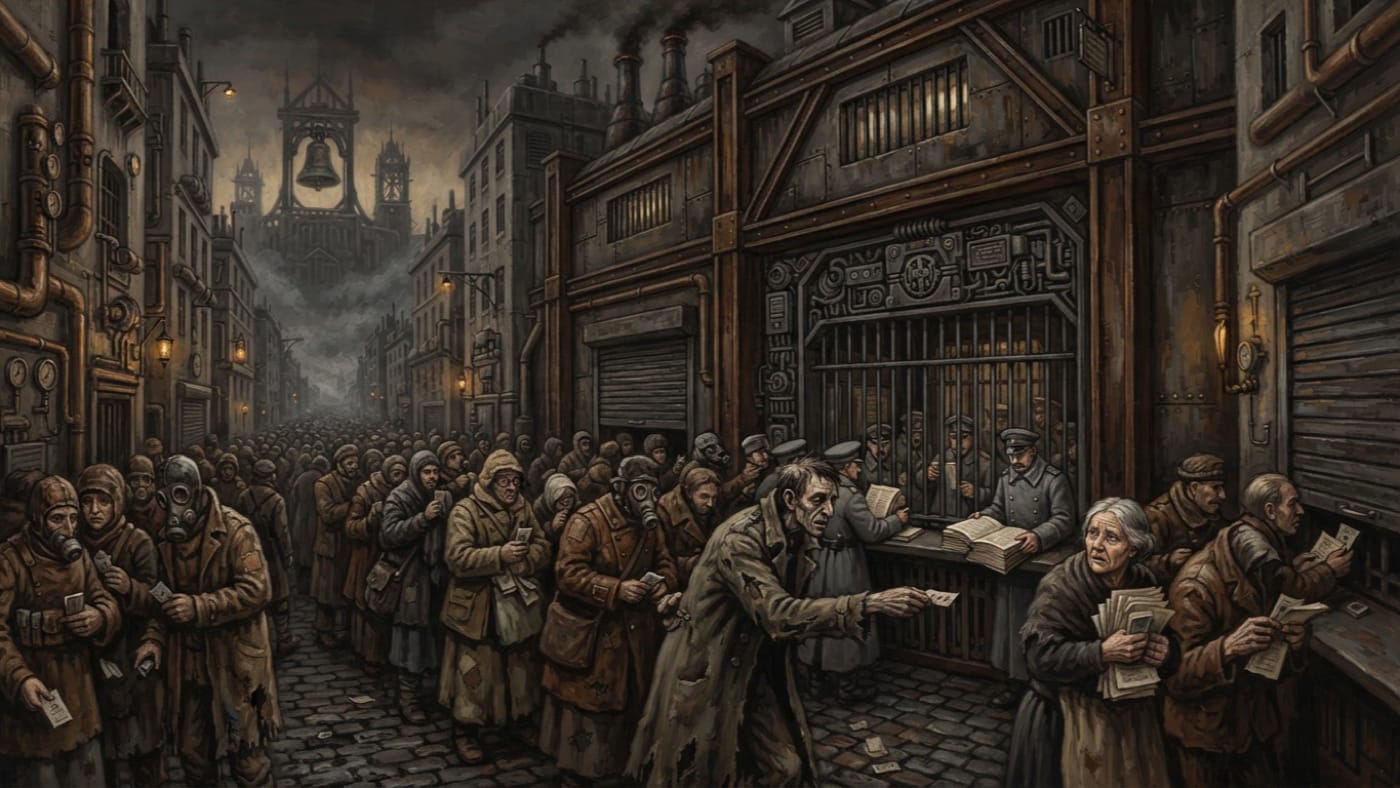
A clean minute contains no air. Heartland correspondents keep writing to the Bureau as if it did. They picture a phial of breath corked and stamped somewhere in the Breath Market, and I have tired of returning their letters with the same correction. The token is a claim. The air stays where it always was: in the room, the filter, the lattice, and the lungs of whoever got there first. What changes hands at Black-Snow Lor is standing in a ledger. It is the right to be counted among the sheltered when the storm crosses the ash flats and the shutters come down.
This survey is entered under A.S. 201. The year dates my inspection of the instrument as it now stands. It is not a founding date. Nobody has produced one, and I will not forge a charter for a coin that never applied for one.
The record gives two definitions, and I keep both. My extract on the Breath Office described each token as a guarantee of breathable shelter during a storm cycle. Lor's own speech uses the words for time until closure. The town's account calls clean minutes storm-window tokens, tradable because the interval before sealing is the scarcest thing on the ridge. One definition measures a place inside. The other measures how long it will be before inside stops admitting anyone. No document I have read reconciles the two, and the clerks do not seem troubled by the gap. A unit with two meanings can always be sold under the one the buyer forgot to ask about.
The Breath Office extract states that each token represents guaranteed breathable shelter during storm cycles.
Corrected as to "guaranteed." Published accounts of the Ribwatch Towers record that an early third bell cancels purchased minutes, and that no clean minute buys time after third bell. A guarantee the bell may revoke without notice is a hope with a serial number. The rest of the definition stands.
#On Its Descent from the Shelter Ledger
My account of the Breath Office places the clean minute's growth between two Lor milestones it records: the certification of bone-lime construction in A.S. 89, and the Bone-Guild's formal power after A.S. 105. In that interval, by that account, the instrument passed through four conditions. It began as practical shelter accounting. It became a token, the token became currency, and the currency became debt. No year is fixed for any stage and no founder is named. I supply neither.
The account gives the stages but not the reasons. The Bureau can still read the arithmetic it began from: one sealed room, forty breathing bodies, thirteen filters, two lamps, and a clerk outside claiming equal distribution. A shelter is a sum, and the sum has to be settled before the shutter drops, because nobody can audit it afterward. Every name on that list carried value from the hour it was written. How the name came to be carried in a hand instead of read off a page, the record does not say. That it happened, the record does.
Once the claim could be carried, it could be handed over. Once it could be handed over, it had a price. A household with a price in its pocket and nothing in its ration tin will borrow against tomorrow's allotment, and the Office will be standing there with a column ready.
Published accounts list the token's present uses without shame: it is traded, hoarded, forged, inherited, wagered, tithed and stolen. Lor's own record ranks clean minutes among the bribes accepted at the Filter Gate, next to spare cloth, lamp oil and marrow glue. A currency people bribe with has finished its schooling.
#On Transfer, Writ and Debt
The lawful market is the part most often misreported. The Breath Office account states that wealthy households buy priority through legal clean-minute transfers, and the Breath Market hangs its equal-ration tables in plain view beside the trade that unbalances them. A transfer is recognized. Its procedure is unpublished. So is any rate, and so is any rule of eligibility I have been shown. What the record does establish is the direction of travel. Priority moves toward the household that can pay. The queue rearranges itself behind that household, and nobody has been thrown out of it. Being moved down a line is not eviction. In a storm the two can end the same way.
Clean-Minute Transfer CMT-4 is the form named for reallocation after death, disappearance, debt, confiscation or clerical improvement. The Office has not said whether every transfer passes through it or only the involuntary kinds it lists. The form names five grounds for moving a claim, and one of them is the clerk.
Shelter Priority Writ SP-2 is a different instrument and has to be filed separately. Lor recognizes a civil law called Shelter Priority, which lets officials seize rooms for the common good, and SP-2 is the paper that does it. A writ takes a room. A transfer moves a claim. Bundling the two together gives a tidy story of one machine with one appetite. The documents describe two instruments, and I have no evidence of which clerks issue which, or whether they ever act together.
The last line of that stamp deserves its own paragraph. Among Lor's red lines is the sale of clean minutes stamped with the Synod seal. Among the Office's ordinary business is the lawful transfer of priority. I have read the prohibition and the permission side by side. They avoid contradicting each other only because nobody has said what either one covers. Which seal, which seller, which sale: no ruling has reached the Bureau. Until one does, a buyer cannot tell a sacrilege from a receipt.
Breath debt is where the currency shows its teeth. It is owed ration value, settled in labour, in names, or by surrendering shelter rights. The Office's account names the labour: berm shifts, filter laundry, ash-sled duty. A minute received this cycle is paid for with a shift the next. A debtor who cannot work pays in the other two coins. A burrow can be reassigned to a creditor while the debtor goes down to the unvented lower warrens, and the Office files the matter under labour settlement.
#On the Irongate Difference
The clean minute belongs to Lor. At Bastion-Irongate the same Office keeps a different till, and correspondents who blur the two have plainly visited neither.
At Irongate the Breath Office keeps voice-license seals, candle-test records, heat allocations and quarantine clearances. The Choir Magistracy owns audition, stanza and discipline. The Gasket Choir sings the pressure works into holding, and a worker's license tier governs residence and warmth. Seal-Broker Lysa Murne is the seal on the permits and the quarantine clearances. Lor rations shelter against weather that comes in from outside. Irongate rations warmth and standing beneath a mountain that has to be sung into staying put.
The instruments differ in their bones. A tier is read off a living throat by candle and clerk. A clean minute can outlive the person holding it and pass to a widow or a creditor on Form CMT-4. Irongate measures the body and then prices it. Lor prices the place and lets the body compete for it. I have found no evidence that Lor's token trade or its Clean Room terms operate at Irongate, and I would not advise any traveller to put a clean minute on Murne's desk.
#On the Present Account
A clean minute is honoured only where three authorities happen to agree. Breath Comptroller Juno Varr keeps the accounts, so the ledger says according to account. Storm Warden Ilex Marr commands closure through the closure bells, so the bell says now. Rib-Mother Sael and the Bone-Guild of Rib and Reed hold the craft of shutter, lattice and mask, so the room says whether it will hold. A token is worth what the ledger records until the bell overrules it. After that it is worth whatever the walls can deliver.
Each of the three is under strain this year. The Breath Office account records off-cycle storms at Lor beginning in A.S. 199, and a schedule priced against expected closures cannot price an unexpected one. The Warrens accuse Varr of selling air twice: entering the same minutes against two accounts. That charge remains a street accusation and has not been adjudicated, and I record it as one. The A.S. 201 quarrel over certifying non-Guild shelter upgrades puts the third authority in question. A token redeemed in a room the Guild never inspected buys exactly as much as that room's straight lines will bear.
None of this abolishes the instrument, and Lor does not want it abolished. The Breath Office account warns that without the Office, clean minutes become knife minutes before third bell. Crooked allocation still allocates. It still puts bodies behind shutters before black snow fills the street, and the bodies it puts there are disproportionately the ones that paid.
When third bell rings, every unredeemed token in the town stays in the hand that holds it. The ledger does not cancel it. The ledger waits. In due course the claim is reallocated on Form CMT-4, under whichever ground applies. Disappearance is on the list.