
#On the Cloth
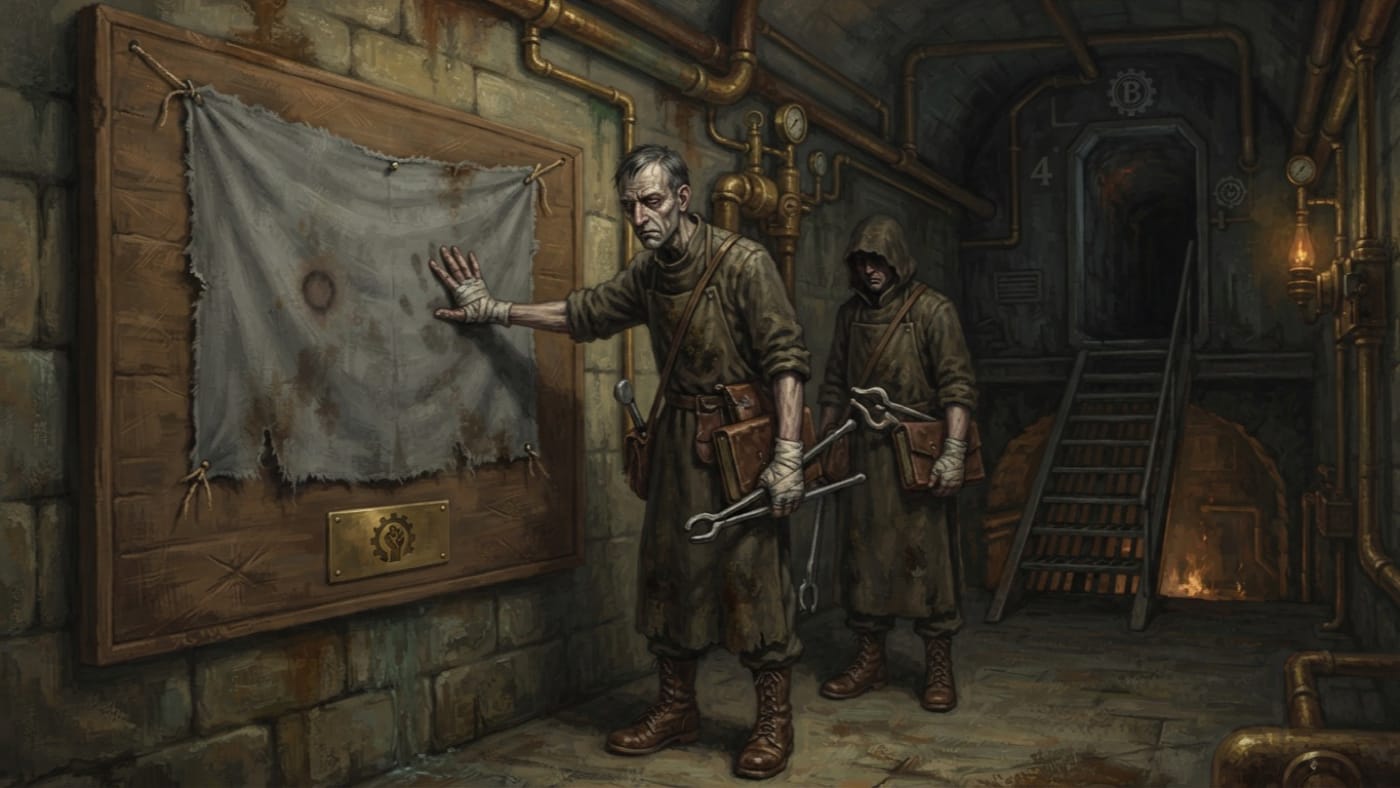
The Brest Palm-Cloth is the palm-cloth of Saint Vellum-of-the-Quiet-Hand: a piece of grey linen that would shame a sacristy and go unnoticed in a field hospital's rag bin. It bears two marks. The first is a circular wax burn, browned at the rim and glazed at the centre, where something hot once sat long enough to bite. The second is the faint impression of her four fingers, laid side by side and pressed shallow. There is no palm in it and no thumb, as though the hand had changed its mind halfway through leaving evidence.
That is the whole object. It has no embroidery, no gold, no reliquary lace, and no inscription asking the faithful to weep in a particular direction. Saints with better lawyers have left behind fancier laundry.
The name ties it to Bastion-Brest, the Brass Ribs, which sits on the Bug River at Brest-Litovsk, in the northern reach of the Sagittal Line. The river reaches into everything there. Stone sweats, paper softens, and wax sealant goes tacky in the underworks by the second bell. A cloth that survives such a place has already done something.
The Bureau of Relics examined it in A.S. 140 (1850 CE) and concluded against authenticity. That year belongs to the examination alone. The Codex holds no year of making, no finder, no donor, and no first touch. I decline to furnish a weeping widow, a flooded crypt or a lantern-lit discovery to fill the gap. The gap is the provenance.
#On the Hand Required Below Ground
Vellum is the disputed operational patron of Ritual Bone-Stampers, Night Notaries, Seal-Wardens and the lesser wax-handlers of the Ossuary Rings. The Bureau of Records lists her feast. The Bureau of Rites has never confirmed her canonisation. Relics has authenticated nothing of hers: no bone, no wafer, no ring, no rag. Whether she lived is unresolved. Which of her vitae is true is unresolved. Whether the stampers care is resolved, and the answer is that they do not.
Their trade explains the cloth. Records constituted bone-stamping as a licensed vocation by Directive in A.S. 92, after the Corridor Twitching taught the Church that unregistered remains do not always lie still. The work since then has run in six steps. The stamper taps the bone and listens for live drift. They clean and orient it, apply the wax, add ink and notch as secondary marks, enter it in the ledger, and set it in its correct place. Every step is done in damp stone with a hot stamp-head, a tap-rod, bone tongs and a ledger that must not get wet. Every step also depends on the stamper's conviction. Doctrine would prefer otherwise, but the stamp bites in proportion to belief, and belief runs out sooner than wax does.
So a worker going below needs steady hands, and Vellum is invoked to steady them. In her icon her hand is bare and held over an unnamed skull. Working stampers protect their hands, because marrow-dust, ink brine and burns punish the faithful as readily as anyone else. The saint may be painted doing what the stamper is forbidden to do. Nobody has shown that a painted hand pressed the linen.
"the faint impression of her four fingers"
Corrected. The impression is of four fingers belonging to nobody identified. The bare hand in Vellum's icon is iconography, and it does not sign anything. Read the four fingers above, and blame the opening paragraph's enthusiasm for the possessive.
The cloth has five siblings: the Quiet Wafer of Ulm, the Mainz Stamp-Head, the Strasbourg Apron Strip, the Ashen Thumbnail of Cologne and the Little Finger Bone of No Parish. All six turned up, drew veneration, were tested, were doubted and went back into custody. None is an authenticated relic of Vellum. Each sibling's examination is its own business, and nothing in this entry borrows from theirs.
#On the Examination of A.S. 140
Relics reported four findings. The linen was ordinary. The soot was ordinary. The wax was ordinary. No demonic contamination was found. The report concluded against authenticity.
Readers who confuse their questions will confuse their verdicts, so I keep the questions apart. What is it made of? Linen, soot and wax, according to the report. Has the Great Deceiver fouled it? The examiners found no sign of it. Whose hand marked it? Not one Relics would certify as Vellum's. Does it work? Relics never asked, because no reagent measures a stamper's nerve and no grade on the authenticators' scale records that a frightened person went down the ladder anyway.
Each answer stands alone. Ordinary linen tells the Ledger nothing about sanctity in either direction, since saints are buried in ordinary linen like everybody else. The absence of demonic contamination tells the Ledger that the cloth is clean, and nothing more. A clean rag is still a rag. And the conclusion against authenticity cannot settle what happens when a worker touches the cloth, because the examiners were never asked that question.
I have not seen the examiners' instruments, their witness list or the order of their tests. The Codex holds the findings and the conclusion and nothing more. Others are welcome to invent the rest. They will find the Bureau ready to tax the invention.
#On Contact Before the Corridor
The custom is short to describe. Before stampers enter a hot corridor, they touch the cloth.
In a hot corridor the tap-rod comes back wrong. The racks hold a faint hum, and a skull that was set straight at intake has turned a degree toward the lamp. Such places are worked by people who know the six steps and have stood in enough bad air to doubt their own hands. Those are the people who touch the Palm-Cloth.
The record stops there. It does not say which hand, or for how long, or whether through a glove or with bare skin. It does not say whether a prayer goes with the touch, or in what order. Some workers presumably mutter Vellum's short invocation, Quiet the hand. Bite the wax. Hold the dead., because that is what her people mutter. Records never prescribed the gesture. The stampers never asked it to.
Then the worker goes down and does the job. They tap the bone, clean it, turn it, wax it, ink and notch it, enter it, and set it in its place. The cloth seals nothing. Nobody has shown that it stills a bone, repairs a failing wax or drives anything back into the wall. All the source says, and all I will say, is that the cloth quiets the workers who use it. A quiet worker keeps a steadier stamp, and a steadier stamp is the only defence the corridor recognises.
That leaves a stamper, frightened, empty of conviction and late for shift, getting it back from a square of grey linen that Relics has called ordinary. Call it miracle, habit, nerve or a borrowed hand. The Codex does not have the evidence to choose for you, and I have not been paid to guess.
#On Retention and Objection
Relics objected to the continued use, as it was bound to. An attribution had failed examination and was still being venerated with a worker's palm before every bad shift. Records answered with one question: had the objection improved corridor outcomes? Relics withdrew into vocabulary and has stayed there.
The figures that would settle the matter are under seal, and I do not have them. Records has not published a count of how many corridors stayed quiet after contact, so Records' question is still only a question. Under any vault light, an outcome claimed without numbers is administration and not proof. Records knows this. It also knows the stampers are frightened, and that the Ossuary Rings run on frightened people who keep going down.
The Palm-Cloth went back into custody like its five siblings. The general reason given for keeping Vellum's objects was pastoral-operational utility, which in Bureau Latin means keep it, they need it. Where it is kept, under what lock and on what terms, the Codex does not say.
Rites, meanwhile, has its own question. Whether Vellum is a saint belongs to Rites, and Rites has not answered. Whether this linen was ever hers belongs to Relics, and Relics answered no. A future canonisation would not make the cloth authentic, and the cloth's failure does not make her less of a saint. The Bureau of Doctrine could combine the two questions with a single seal. So far it has shown no appetite for the paperwork.
Below the Brass Ribs, the river seeps through the masonry, the wax goes soft and the dead keep their racks or fail to. Stampers still touch the grey linen before going down.