

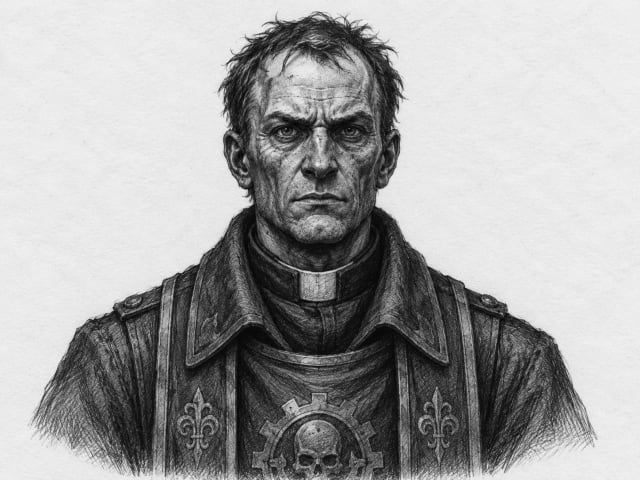
#On the Station of Brother Mathis
This dossier was compiled in A.S. 201 from papers already in Bureau custody. That year is the date of the clerk's desk, and the trench has no share in it. Brother Mathis of Rouen was an Ash Chaplain, one of the Bureau of War's field clergy, and he died in the action filed as the Saint-Malo flank collapse. The action has no year, and no month or day either. It has a shelf mark, Ledger DCLXVI. Careless readers keep turning that into A.S. 666, and I keep turning it back into a shelf mark.
The rest of his life has left fewer traces than his ash. The surviving papers give no age, no family, no parish of birth, no earlier posting, no seminary report and no face. Rouen claims him, and all the claim rests on is his name. Whether the city bore him or merely exported him is unrecorded. Nobody wrote down a word he said. Every word attached to him belongs either to the Litany of Stones, which no file credits to him, or to the men who outlived him.
#On the Work One Throat Was Never Meant to Carry
An Ash Chaplain's labour is assigned to a breach before the breach exists. The current field copy of the Doctrine of Layered Death counts five layers, and the wall comes first. That is the Shield-Paladins: first rank interlocked, second rank bracing and breathing Credo Lapidem, third rank recovering fallen shields. The charge comes next, with the Litany-Engineers setting their work behind the Lock. Ash is the chaplain's layer. He stands on rear elevation, opens the relic-ash thurible and leads the Litany of Stones so that iron and powder answer to one tempo. Rhythm belongs to the Processional Band: its drums tie to the brace and its pipes key the detonations. The dividend comes last, and Records collects it.
The design assumes the Band. The chaplain's voice binds the count and the drum keeps it. Take away the drum and the chaplain must do the Band's work with an instrument made of wet tissue. The file does not say whether Saint-Malo was taught on this five-layer reckoning. I use it because it is the reckoning in force in A.S. 201, and a compilation reads old blood through current ink.
#On the Loss of the Band
The sequence survives in one order, and I give it in that order.
The first barrage destroyed the Processional Band. Drums, pipes, horns and the men carrying them all stopped together. The Paladin Lock carried on by jawbone chant for six minutes, passing the count through collar, plate and teeth with nothing outside their own skulls to correct it. Six minutes is a creditable figure. War quotes it in drill halls when it wants recruits to be afraid on behalf of drummers.
Then the shared timing failed. The accounts record two missing beats. The Engineers' charges went off two beats early, and in breach arithmetic a charge fired two beats early lands on friends. The flank opened.
That is the whole of the mechanical record. It names no officer, no casualty return, no enemy formation and no map. It does not explain why the trench lay at Saint-Malo, and I will not explain it on the annal's behalf. The file keeps the town's name, and so do I. The action has nothing to do with the Massacre at Saint-Malo of A.S. 10, whose memorial falls on Corvus 14. Sentimental copyists have merged the two before. They were corrected, and the corrections are on file.
#On the Solo Litany and the Disputed Hours
Mathis climbed onto the parapet. The drill puts a chaplain on rear elevation, and the parapet lies forward of it, which tells a competent reader what had become of the drill by then. He swung his censer like a flail and began the Litany of Stones alone.
His voice cracked. The Ash Chaplains' own account places the crack in the second stanza and the recovery, into raw noise, in the third. After that no courtly listener would have called it song. The soldiers rallied. In the Lore Book they hold without artillery or reinforcements. Rouen's shorter account says without proper artillery. Both phrases are the annal's. The annal lists no guns and mentions no relief. It records no victory either. What it records is a flank that stopped opening.
What he supplied was a count. The Band had carried the common time, the Lock had carried it six minutes further on bone, and then the count broke. A voice from the parapet gave it back. With a count to stand on, the shieldmen re-locked and the Engineers reset what memory let them reset. All of those hands belonged to other men.
The account gives nine hours. The restricted addendum also gives nine hours, then argues with itself: disputed by sundial, confirmed by ammunition expenditure. Two instruments disagree. The sun is the older witness and the cartridge box the better paid. I record both and settle neither. The six minutes belong to the Lock's fallback and the nine hours to Mathis and the holding action that followed. A clerk who adds them into one figure has measured two different men with one ruler.
SAINT-MALO FLANK COLLAPSE — LEDGER DCLXVI, RESTRICTED ADDENDUM (EXTRACT) Subject: Brother Mathis of Rouen. Duration of solo Litany: nine hours, disputed by sundial, confirmed by ammunition expenditure. Condition at recovery: lungs cindered; tongue blackened; right hand fused to thurible chain. Unapproved witness phrase: "the dead sang the lower line." Disposition of witness: █████████████████.
#On the Recovery and What Was Said of It
When the body was recovered, the lungs were cinders, the tongue was blackened and the right hand was fused to the thurible chain. Those are the addendum's findings, and there are no others. The file names no examiner, no recovery party and no hour. It offers no mechanism by which a man's breath becomes fuel, and nobody has asked the Bureau of Medicine for one. The Creator may know how a hand fuses to iron in the course of a litany. The addendum does not guess.
The testimony runs in two channels, and the two must be kept apart. The first is what the soldiers swore: that his voice lingered in the trench for days. That testimony is attributed, published and repeated. The repetition shows that the published accounts copy one another. It does not show that more men heard the voice. The second channel is one phrase from one witness: "the dead sang the lower line." The addendum marks it unapproved and blacks out what became of the witness. I reproduce the phrase because it is on file. I do not narrate it as an event, because I cannot name anyone who saw the dead sing.
The Bureau of Relics holds a blackened tongue in a case under Mathis's name. Relics cannot tell whether it is his, a drummer's, or a strip of burned leather misfiled during the second copying. That doubt belongs to the object in the case. The addendum's description of the tongue in his mouth at recovery is a separate matter. Any clerk who uses one to authenticate the other will be issued a smaller desk.
#On the Exemplar in Current Custody
Five custodians now hold Mathis, and each holds a different man.
The Bureau of Records files him as "local morale stabilization," three words in which nobody breathes ash. The Bureau of Doctrine names him exemplary. The Bureau of War names the method replicable, which is the colder honour. Doctrine admires a man. War admires a procedure that can be repeated with another chaplain's lungs. The Ash Chaplains venerate him and keep him as the proof-text of their office. He is "not widely canonized," and the phrase means exactly that. Nothing in custody turns it into a decree, a feast, a patronage or an approved miracle. He remains Brother.
Rouen calls him one of ours. The pride is civic and durable, and harder to say aloud since three Ash Chaplains of the convoy strangled choirboys in time at the collapse of Saint Aurelia's Convoy in A.S. 184. That is a separate file. Rouen keeps both. A city that weighs its dead at the Ash-Banks has learned to carry awkward sums.
He is not Brother Matthias the Unbowed, whose attributed jawbone belongs to another file. Nor is he the chaplain who wrote "A missed note is a misfire" in a margin before Vienna. Copyists fond of a single tidy martyr have merged all three. I separate them every year.
Popular chapel cards state that Brother Mathis "held the line single-handedly."
Corrected. The cohort held the flank. Shieldmen re-locked under fire, Engineers reset their work from memory, and the line spent the ammunition the addendum counts. Mathis gave them back the count they lost with their Band. One throat cannot hold a breach. It can return the timing a breach needs in order to hold.