
#On the Men Who Became Wall
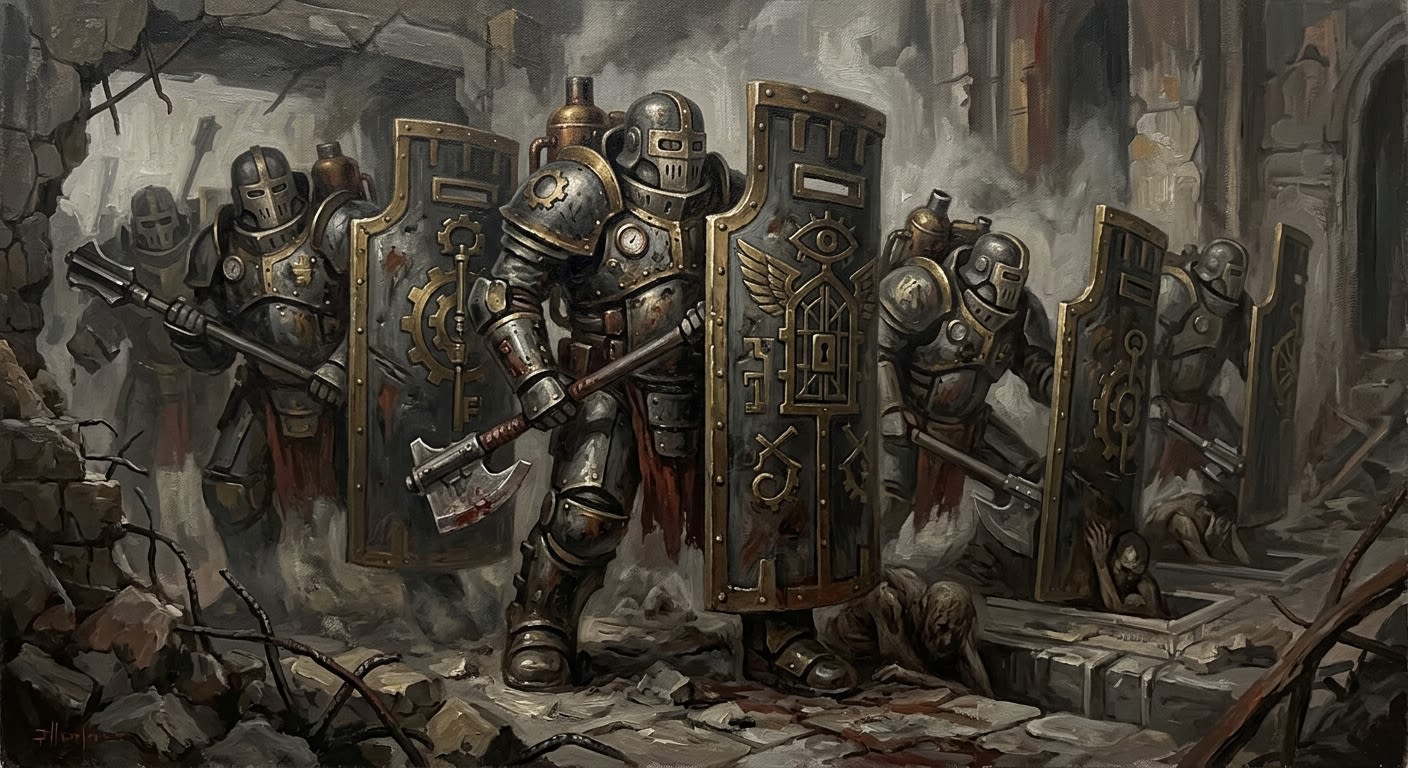
The Shield Paladins are the Covenant's wall-born anchor: heavy infantry trained until the distinction between man, shield, trench, oath, and grave becomes administratively inconvenient. The citizen imagines them as soldiers with tower-shields. The citizen is wrong, which surprises no trained observer of citizens. A Shield Paladin is a tower-shield granted legs for the brief interval between manufacture and burial.
Their creed is carved on the inner rim of every plate: Stone to stone, creed to creed, none shall pass who doubt. The phrase is older than the present manuals, older than the corrected maps, older than most of the officers who quote it during inspections with faces so solemn one suspects constipation. It persists because it is useful. The Paladin reads it while braced behind iron; the dying Paladin leaves it where the next man can read through blood.
They are slow, ugly, and by any sane measure inefficient killers. Efficiency belongs to rifles, shells, knives, poison, accountants, and marriage contracts. The Paladin's work is uglier and higher: to make a place refuse. A breach opens. Men panic. Bells stammer. Smoke erases command. The Paladins enter, interlock, brace, chant, and by this ritual convert open ground into a doctrinal objection.
#On Recruitment and the Gift of Becoming Heavy
The first requirement is mass. The second is obedience. The third is a peculiar dullness of imagination that War mistakes, often correctly, for courage. Recruits are drawn from quarry towns, dock-hauling guilds, furnace wards, failed seminary classes, condemned militia units, and families whose sons grew wide before they grew clever. The Bureau of War does not apologise for selecting bodies by load-bearing promise. A cathedral does the same with stone.
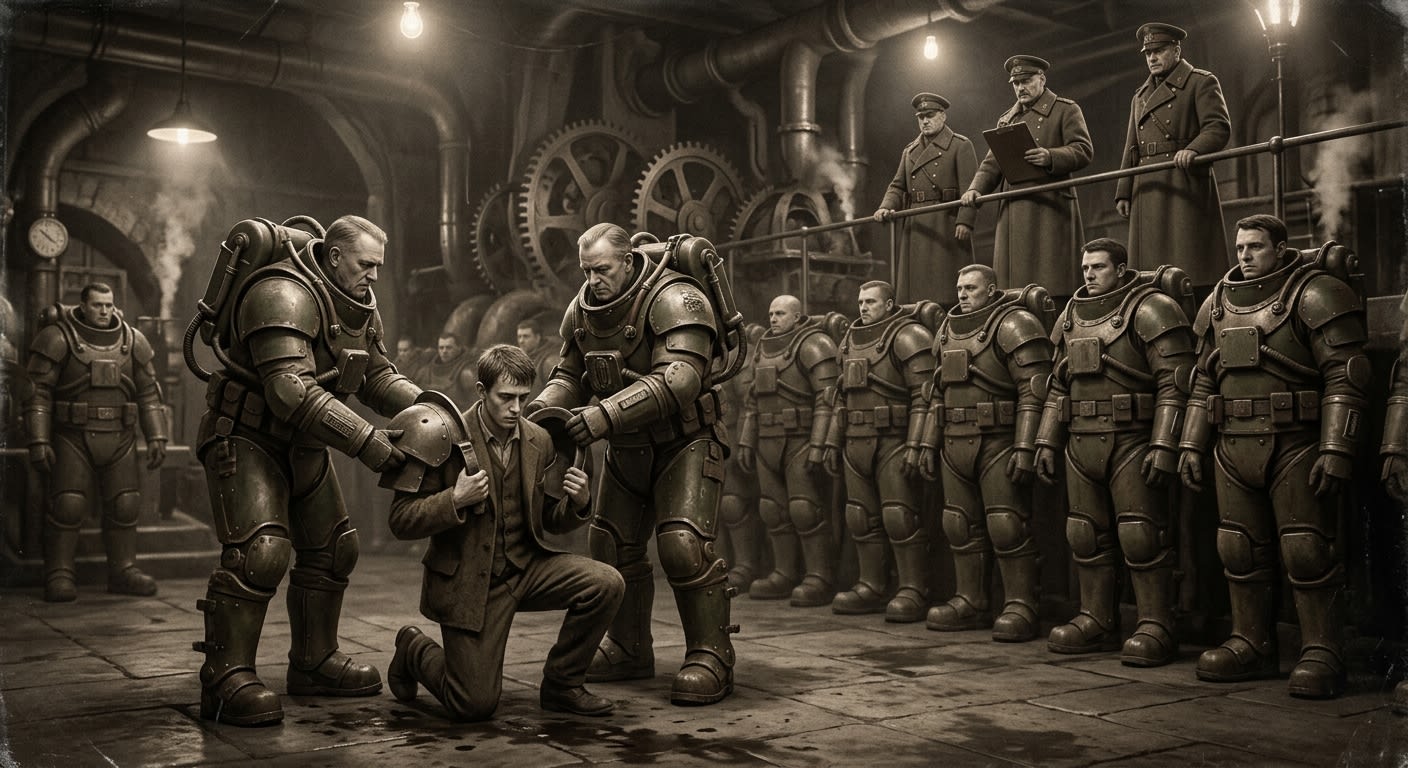
Training begins with standing. This disappoints recruits who expected heroic violence and delights instructors who understand that heroic violence lasts nine seconds while standing may be required for three days. A recruit stands in mud, in smoke, under bell, without bell, under sermon, under insult, under simulated ash-rain, under actual rain, before officers who measure ankle tremor with the tenderness of jewelers. Men who shift are struck. Men who fall are lifted and struck. Men who remain learn the first truth of the order: the body has opinions, and doctrine outranks them.
The shield is issued before the recruit receives his field name. This is intentional. Civil identity produces sentiment; shield designation produces invoices, repair logs, and prayers that fit on brass tags. A recruit may have been Tomas, Alaric, Jan, Matteo, or some other sound his mother wasted tenderness upon. Under shield he becomes Third Brace, Chapel Left, Saint Ardent Variant; or Mud Lock Reserve, Lower Hinge; or Seventh File, Breach Plate. Mothers hate this. Mothers are rarely consulted on military metaphysics.
Earlier recruitment broadsheets describe entry into the Shield Paladins as voluntary devotion among the strongest sons of the Faith.
Corrected. The category “voluntary” includes family offering, parish allotment, sentence commutation, levy sorting, and the recruit's failure to run quickly enough when the War assessors arrived. Devotion may follow. Paperwork always precedes it.
#On the Lock-Formation
The Lock-Formation is a catechism performed in iron. First rank drops. Second rank overlaps. Third rank braces the backs of the kneeling men with shield-hooks and shoulder poles. Fourth rank, if present, becomes either reserve, corpse removal, or additional wall, depending on how optimistic the officer feels before contact. The Saint Ardent variant adds chant markers cut into the shield rims so adjacent Paladins can align by touch when smoke erases sight.
The motion appears simple to spectators. Spectators also think bells ring because ropes are pulled. Simplicity is the visible lace on top of a great deal of hidden coercion. Each shield must meet the next at the proper angle, neither gapped nor crushed; the left knee must enter mud at a depth that stabilises without trapping; the breath must settle before impact; the chant must remain low enough to carry through jawbone and collar rather than vanish into artillery.
The Paladin does not shout. Shouting opens the body. The Paladin murmurs into iron. The shield receives it. The line receives it. The trench, if properly instructed, receives it.
A backward corpse is the most shameful technical category in Paladin records. Death is permitted. Falling is negotiable. Falling backward is apostasy with anatomy. Paladins train to die forward, down, or upright. A body that falls backward opens space. Space invites the enemy. The enemy, being discourteous, accepts.
#On the Siege of the Southern Gate
Old documents call it the Siege of the Bastion-Constantinople Gate. Corrected documents place the episode at Bastion-Constantinople, the southern anchor of the Sagittal Line, during the period when refugee names still clung to stone like damp labels. Wrath's forge-beasts struck the southern gate for three days and nights. Their heads were iron rams, their ribs furnace bars, their breath a red industrial blasphemy that blistered paint from saint-icons thirty yards behind the wall.
The Seventh Bastion-Constantinople Cohort of Shield Paladins held the gate without rotation. Records preserve the inspection detail because Records occasionally performs a kindness by accident: half the cohort dead upright, six shields fused at the rim, nineteen men without visible pupils from heat exposure, two chanting after their tongues had carbonised, every corpse locked forward. Relief troops found no body fallen backward. The gate had dents deep enough to hold rainwater. The Paladins had become a second gate behind it.
Antique memorial cards identify the action as proof that Bastion-Constantinople was the western anchor of the Line.
Corrected. The engagement belongs to Constantinople, southern anchor, under a legacy name retained in devotional usage. The Paladins do not care what map title preserved their deaths. Cartographers care. This is why cartographers should speak softly near tombs.
The shields were planted as tombstones after the breach was relieved, consecrated in place, and catalogued under War's Relic-Adjacent Materiel Schedule. Pilgrims kneel before them still. Some believe the iron figures are statues of saints. This is inaccurate, sentimental, and sufficiently pious to remain uncorrected on feast days.
#On the Knife-Mile and the Mud Lock
The Knife-Mile Catastrophe of A.S. 137 remains one of those glorious files the Bureau polishes until no human fingerprint remains. The trench walls melted into stakes. Mud swallowed boots, knees, horses, stretchers, and three chaplains who had been sent forward to improve morale and instead improved drainage. The enemy poured in. Ash-Fodder clogged the approach; behind them came heavier things whose names lengthen casualty reports by several inches.
The Paladins formed the Mud Lock. They drove shields into the muck flatwise, edgewise, crosswise, creating a temporary causeway across a trench that had become a mouth. Whole companies died waist-deep, arms fixed through shield straps, bodies pressed under later ranks as footing. The Radiant Fusiliers crossed that iron-and-flesh path and volleyed the breach closed.
Bureau annals call this logistical stabilisation. Survivors remembered walking on backs.
FIELD TESTIMONY — KNIFE-MILE, A.S. 137 Fusilier Corporal S—— states: “The shield shifted under my boot. I looked down. A face was looking up through mud. He blinked. I stepped anyway.” Marginal ruling: retain in sealed instructional appendix; exclude from public morale edition.
The Mud Lock is now taught as a model of adaptive anchor doctrine. The diagram is clean. The arrows are blue. The shield placements are numbered. No diagram includes the sound of a man under two hundred pounds of Paladin plate trying to complete the Litany of Stones while another regiment walks across his spine. Instruction improves when it lies by omission.
#On the Red Frost and the Silent Lock
The Year of Red Frost, A.S. 194 in corrected forward annals, remains one of those winters whose file appears to have been frozen, thawed, and refrozen until every signature cracked. Records dislikes this sentence. Records may correct it in the next century, by which time I expect to be blamed with scholarly reverence.
In that infamous winter, the Danube froze crimson. Supply lines collapsed. Fish died under blood-ice. Ninth Peal failed for one evening at Győr when bell-foundations cracked, and three regiments deserted in the dark before Doctrine discovered they had never existed. A mile of trench was assigned to a Paladin cohort with forty-seven days of position order and no meaningful food after the eighth.
When the Inspector-General arrived, he found men skeletal, lips blackened from psalm-recitation against hunger, shields locked, bodies frozen into the trench wall. His note survives in War's private extracts: These men are not alive, yet they do not know they are dead. That line has been quoted in sermons, recruiting halls, and disciplinary hearings against men who requested soup.
The frozen bodies remained in the wall. Passing regiments whispered thanks to the Silent Lock. A practical officer proposed thawing and burial. He was transferred to ammunition humidity audits, where imagination could harm fewer legends.
#On Enemies That Make Walls Porous
The Enemy has learned the Paladins because the Enemy, though wicked, is not illiterate in pain. Ash-Fodder columns exist to exhaust the lock, to spend Paladin arms minute by minute until trembling becomes a breach. Wormhosts are worse: bodies left intact until battle, then ruptured by sorcery so parasites erupt inside the line. No wall can remain a wall when a man in its second rank opens from the ribs and disgorges armoured coils.
Rotbelchers liquefy ground beneath locked feet. At Rostov, a Paladin company held the northern approach while bile struck shields hard enough to ring them. The earth betrayed them first. Men sank chest-deep into soil turned slurry, shields still locked above the surface, drowning in ground that had forgotten its duties. Bureau records summarised the action as line compromised by chemical liquefaction. Soldiers named it the drowning without water.
Pale Chanters attack the chant. Velkara's agents perfume shield-straps so fingers loosen. Maldrake's forge-beasts strike at rhythm, not bodies, timing blows between brace-calls. Syrion gifts sleep to men who must remain heavy with waking. Each sin has discovered its preferred crack. Each crack has received a memorandum, a countermeasure, a prayer, and a list of dead demonstrating both necessity and insufficiency.
#On the Present Order
As of A.S. 201, Shield Paladins serve at every major bastion, though concentrations vary with terrain and sin. Brest spends them against lowland mass, where lines of Ash-Fodder arrive like bad arithmetic given legs. Przemyśl uses ridge locks, shields braced into wire and frozen clay. Sibiu embeds them in mountain gatehouses where a dozen men can become a hillside's refusal. Irongate drills them under pressure-door thunder, their shields lacquered against river damp. Shipka hates them most tenderly, because Sloth turns heaviness from virtue to tomb.
Their internal culture is as cheerful as one expects from men trained to become architecture. Paladins carve prayers where no inspector looks: under shield rims, inside boot plates, on mess benches, across coffin lids when coffins can be spared. They gamble on how long new officers take to say the word “immovable.” They laugh rarely and with startling violence, like stones dropped down wells. They distrust Fusiliers for being showy, Litany-Engineers for enjoying mathematics, and Ash Chaplains for smelling worse than necessary.
The shield is returned when possible. The body is optional. A recovered shield receives inspection, exorcism, dent accounting, strap replacement, and reissue if the prayer-grooves remain legible. Some shields have carried five men. A few have carried more. War discourages naming them because named objects attract relic claims, and Relics can turn a useful shield into a chapel ornament faster than a demon can open a seam.
The Paladin remains the least theatrical of the Synod's miracles: a man told to become wall, given iron enough to make the lie plausible, and punished until plausibility hardens into fact. When the breach opens, the bells do not ask whether he is afraid. The shield does not ask whether he is ready. The man steps forward. The wall begins.