
#On the Doctrine That Makes Failure Useful
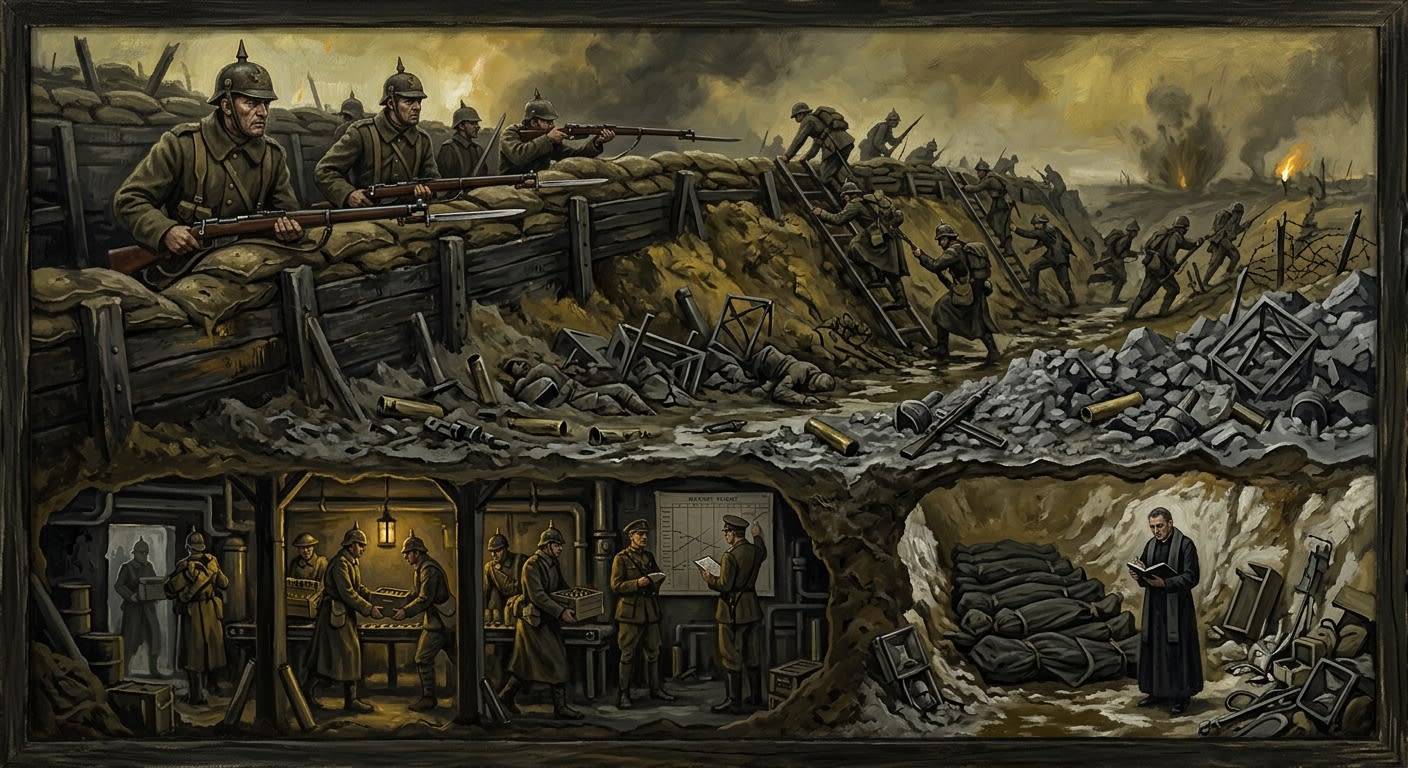
The Doctrine of Layered Death is the Bureau of War's breach-holding protocol, issued under the joint seal of War, Doctrine, and the Bureau of Orison, then loved by Records because it permits catastrophe to arrive in numbered stages. This virtue deserves incense and a locked drawer. Panic is vulgar when unarranged. Panic with layers becomes procedure.
The doctrine answers one question: what must happen when a breach opens and ordinary courage begins leaking out of men like soup from a cracked bowl? The answer is sequential. First, iron. Second, powder. Third, ash. Fourth, rhythm. Fifth, classification. The doctrine's genius lies in the last element. It teaches soldiers how to hold a breach. It tells the Bureau what to call the breach after the holding fails.
#On the First Layer: Wall
The first layer is the Lock Formation. Shield Paladins interlock tower-shields in the Saint Ardent variant (Unregistered): first rank drops, second rank overlaps, third rank braces and recovers fallen shields, fourth rank exists when manpower and optimism have not yet been exhausted. The first barrier is iron arranged around obedience. A shield dropped is a psalm unsung; a gap is heresy with space to grow.
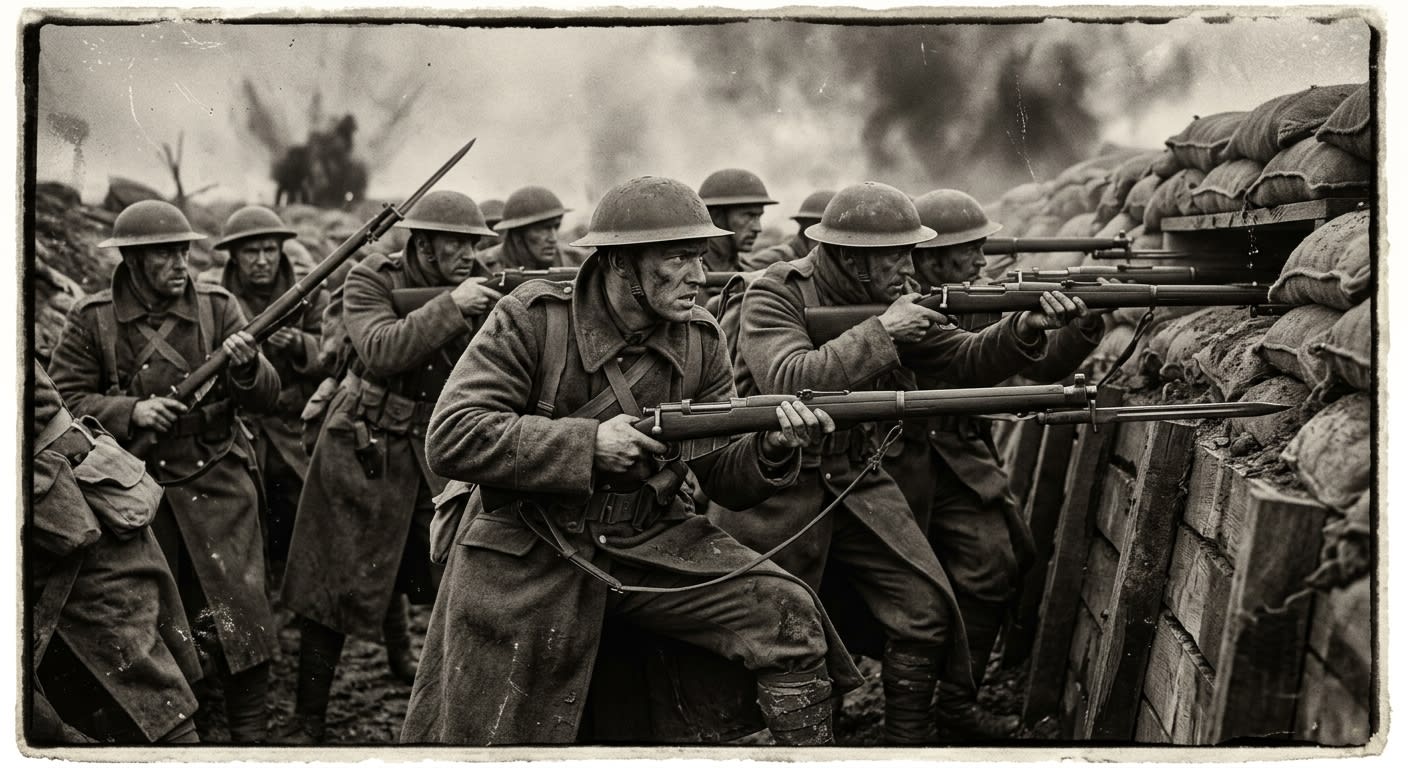
The Paladins do not try to win the breach. That error belongs to young officers, theatre critics, and provincial boys who confuse screaming with command. The Paladins make the breach hesitate. They convert motion into impact, impact into strain, strain into time. Time is what the other layers require. Time is purchased in knees, jawbones, shoulders, and corpses trained to fall forward.
Their chant is low: Credo Lapidem on each exhale, carried through collar and jaw when artillery swallows air. The first layer must hear itself. When sound fails, shield-rim pressure replaces speech. Press, hold, release. Press, hold, release. Press until answered or until the arm no longer belongs to the living file. Doctrine calls this communion by pressure. The trenches call it checking whether the bastard beside you is still useful.
#On the Second Layer: Charge
The second layer belongs to the Litany-Engineers, the sacramental sappers who crawl behind the Paladin Lock with charges, fuse-cord, chalk, oil-stained hymnals, and a professional relationship with death so intimate that even Mercy finds it indecent. Their task is simple in statement and hideous in performance: drive charges into breach-side earth while reciting Counter-Sorcery Verses Twelve through Nineteen, then detonate in sequence with the shield-lock cadence.
The Engineer places powder and absolves it. The charge is set against the breach wall, packed under enemy ingress, braced where earth has softened, laid beneath sorcery-root if the breach has grown organs. Each fuse is measured by thumb, breath, and syllable. A half-day fast may replace five pounds of powder in the marginal arithmetic of old hymnals. Engineering denies this in committee. Engineering also keeps copying the marginal note.
The Prague Collapse of A.S. 61 remains the engineer-priests' proof-text: twelve men under a Rationalist observatory, chanting until their throats bled, three returned, the tower folded into the earth at dawn. Toledo remains their warning: charges beneath a desecrated cathedral, calculation exceeded by four hundred percent, half a city converted into an argument nobody won. The doctrine borrows from both. Precision first. Absolution after. Excavation if convenient.
Old training recensions state that Litany-Engineer charges are detonated when the breach is “safely contained” by the first layer.
Corrected. There is no safe containment during active breach. There is only containment, attempted containment, and the blessed interval before the Paladin line discovers what has entered its knees.
#On the Third Layer: Ash
The third layer is breath under authority. Ash Chaplains ascend rearward elevation where seventy percent of the cohort can hear them, or where seventy percent could have heard them before the shells took ears, bell towers, and the drummer's left side. They deploy relic-ash thuribles. Priority: lungs before sight before morale. This has startled civilians, who prefer seeing to breathing sanctity. Civilians are rarely asked to hold breaches.
Relic-ash thickens the air. It scratches the throat, scours panic, marks deserters, fouls hostile song, and settles into every wound like a saint choosing tenancy. The chaplain leads the Litany of Stones to synchronize Paladins and Engineers. If a soldier falters, the chaplain may name him. If a soldier runs, the chaplain may cease hymn at his name. Silence equals condemnation. The doctrine is merciful in this respect: it gives cowardice a musical notation.
Ash is also witness. When smoke, mud, and hostile glamour dispute the account, ash clings to the obedient and the disobedient differently. Or so Doctrine says. Records has asked for a repeatable standard. Doctrine has replied with seventeen sermons and no standard. The sermons are filed under Material Evidence, Pending.
#On the Fourth Layer: Rhythm
The Processional Band regulates tempo. Drums tie to shield-step. Pipes key to detonation sequence. Horns reserve the Creed Volley for Radiant Fusilier intervention if present. Beauty has nothing to do with it. The music is a measuring device with a soul attached, and sometimes the soul is optional.
A missed note is a misfire. One Ash Chaplain wrote that before Vienna and died shortly after, proving either the sentence's holiness or the danger of composing quotable regulations near artillery. Bands know the pace of boots, the interval between brace and breath, the seconds required for a fuse to accept fire, the horn shape that tells Fusiliers to fire low into the breach without asking whether the thing wearing a human coat is still technically human.
SYNCHRONIZATION FAILURE — SAINT-MALO FLANK COLLAPSE, LEDGER DCLXVI First barrage erased Processional Band. Paladin Lock continued by jawbone chant for six minutes. Litany-Engineer charges detonated two beats early. Ash Chaplain Mathis of Rouen mounted parapet and maintained Litany of Stones for nine hours. Lungs recovered: cindered. Public account: “local morale stabilization.”
The doctrine's enemies know the fourth layer well. Pale Chanters perforate cadence. Rotbelcher bile enters instruments and makes them wail without hands. Silence domes cut command from obedience and leave mouths moving around useless prayers. When rhythm fails, men discover their bodies again. This is unfortunate, since the body usually has cowardly suggestions.
#On the Fifth Layer: Dividend
The fifth layer is the most honest and the least suitable for public recitation. If shield, charge, ash, and rhythm fail, the breach is recorded as a temporary martyrdom dividend. The phrase is obscene, efficient, and theologically well-armoured. It means the position was lost, the personnel were spent, the delay achieved measurable value, and the dead have been transferred from tactical accounting to devotional accounting.
Do not sneer. Well, sneer a little. Then observe the machinery. A failed breach without the doctrine becomes rout, shame, inquiry, blame, grieving letters written with too much truth. A failed breach under the doctrine becomes layered expenditure: first barrier exhausted, second barrier discharged, third barrier maintained, fourth barrier disrupted, fifth barrier credited. Families receive martyrdom certificates. Officers receive revised maps. Records receives a sequence it can enter without vomiting into the ink.
War's Fourth Revision described the fifth layer as “symbolic spiritual recompense.”
Corrected. The dividend is practical. A breach held for nine minutes may save a depot, a convoy, a sleeping battery, or a commander's reputation, and the last of these is often the best defended.
This is the part soft readers dislike. They prefer death either meaningful or wicked, not useful. The Synod improved upon this childish division. Death may be meaningful, wicked, useful, misfiled, celebrated, taxed, and returned to the parish in three copies.
#On the Controversies
The Bureau of Engineering objects to prayer replacing powder in marginal tables and then prints the tables because the men in mud use them. The Bureau of Orison objects to drum commands being treated as mechanically binding and then excommunicates drummers for mechanical failure. The Bureau of Mercy objects to the fifth layer in every decade and loses with admirable consistency. The Bureau of Records objects only when someone changes terminology without filing the amendment.
The loudest dispute concerns whether Layered Death is doctrine, drill, or administrative euphemism. The answer is yes. It is doctrine because it teaches the soul how to stand while flesh is being negotiated. It is drill because men who have not practiced the sequence will improvise, and improvisation is where casualties become aesthetically untidy. It is administrative euphemism because the Ledger deserves elegance even when the floor is wet.
Enemy sorcery has forced revisions. Wormhost rupture required inward-burn permissions and second-rank severance inside the first layer. Pale Chanter attacks required jawbone chant and shield-rim pressure. Shadow Noon calcified an entire division of Litany-Engineers who pressed forward while their shadows crawled elsewhere; now the doctrine includes a halt clause, which veterans obey and young commanders resent until they become salt or sensible.
#On Present Application
As of A.S. 201, Layered Death is taught at every major bastion on the Sagittal Line. Brest drills it for lowland mass breaches where Ash-Fodder arrive like arithmetic with teeth. Przemyśl drills it in ridge cuts, where charges misbehave in frozen stone. Sibiu drills it at mountain gates with the Transylvanian Alps serving as the sternest instructor. Irongate drills it under pressure-door thunder. Shipka adds waking pins and bell rotations against Syrion's sleep-fog. Constantinople teaches the doctrine with excessive seriousness, which is to say correctly.
Field officers pretend to dislike the doctrine's fatalism. Then a breach opens and they reach for it like a drowning man reaching for a tax receipt, because both prove something was owned before it vanished. The doctrine gives them order when maps burn, titles when ranks dissolve, and a sentence to say over men whose faces cannot be found.
The final command is rarely spoken in training halls. It is too plain, and training halls prefer banners. Hold until the next layer is ready. Die facing the correct direction. If all layers fail, make the failure expensive.