
#On the Men Who Make Breath Obey
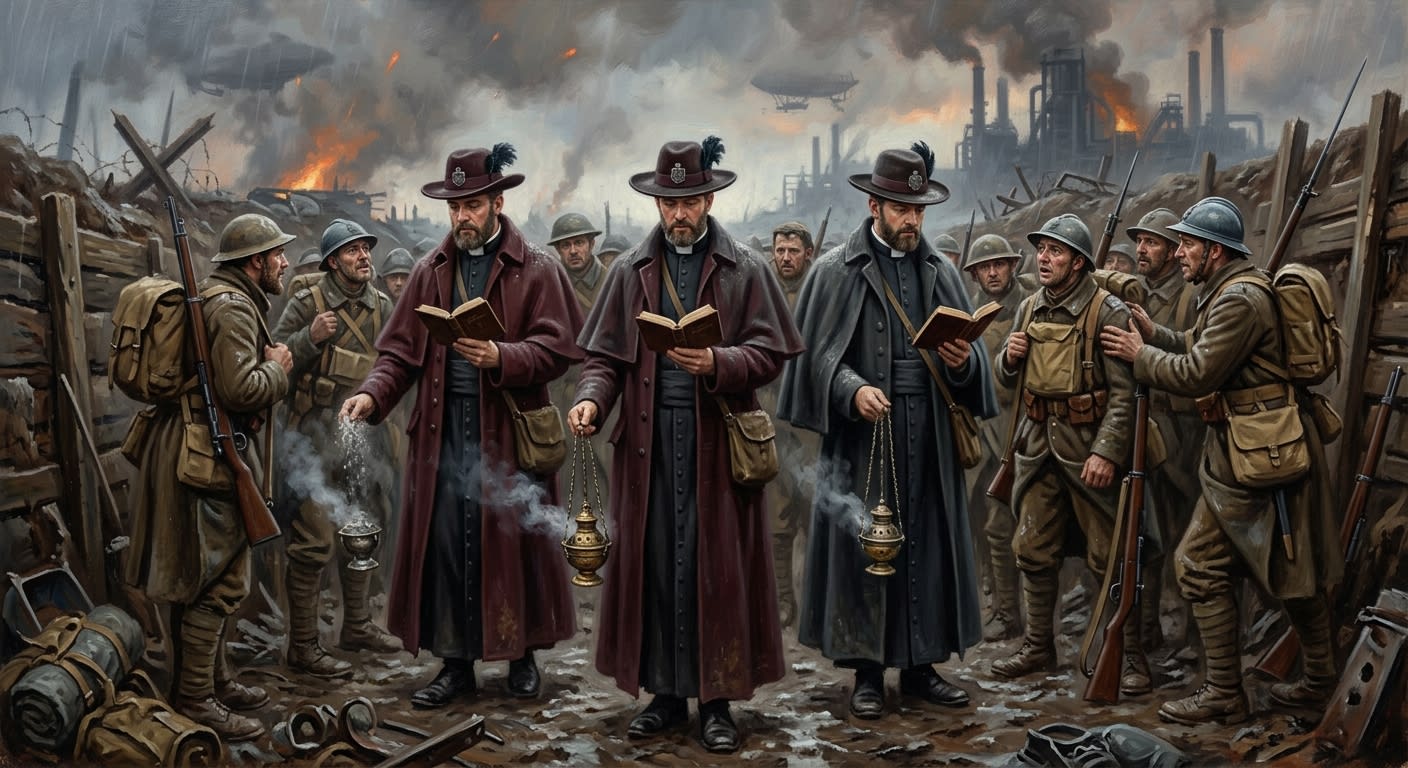
The Ash Chaplains are the Bureau of War's lung-clergy: field liturgists who carry relic-ash (Unregistered) in iron thuribles, raise hymn above shell-roar, and teach frightened men that breath, once disciplined, may be used as mortar. They are called chaplains because the Synod is fond of small words for large cruelties. A chapel is a room where men kneel. An Ash Chaplain is the man who prevents kneeling when the breach needs standing.
They are distinct from Tribune-Chaplains, though the two offices share cassock, mud, and the professional habit of turning terror into grammar. The Tribune-Chaplain commands prayer forward; the Ash Chaplain binds men already committed to the line. The first shouts Amen as an order. The second keeps the order breathing after the shells have torn Amen into weather. This distinction is lost on civilians, which is why civilians continue to ask whether soldiers find comfort in field hymns. Comfort. Charming little word. One imagines lace curtains on a trench.
In the Doctrine of Layered Death, the Ash Chaplains are the third layer: ash after wall, ash after charge, ash before rhythm. Shield-Paladins interlock iron and bodies. Litany-Engineers set charges with Counter-Sorcery Verses between their teeth. The Ash Chaplain climbs rearward elevation, opens the thurible, and makes the air costly. Behind him the Processional Band (Unregistered) hammers time into boots, fuses, rifles, and the stubborn animal pulse of men too scared to be brave and too trained to run.
The office's motto is unofficial, filthy, and more useful than the approved one: breathe where I tell you. The official motto reads Pulvis Sanctus, Spiritus Rectus — Holy Dust, Corrected Breath — which is elegant enough for embroidery and therefore less trustworthy.
#On Relic-Ash
Every Ash Chaplain carries ash. The proper mixture contains powdered saint-bone, certified funeral charcoal, palm-branch cinder, chapel soot, salt, oil residue, and a grey binding dust whose recipe is claimed by the Bureau of Relics, disputed by the Bureau of Orison, audited by Records, and adulterated by quartermasters with the low cunning of men who have learned that holiness often arrives short by weight.
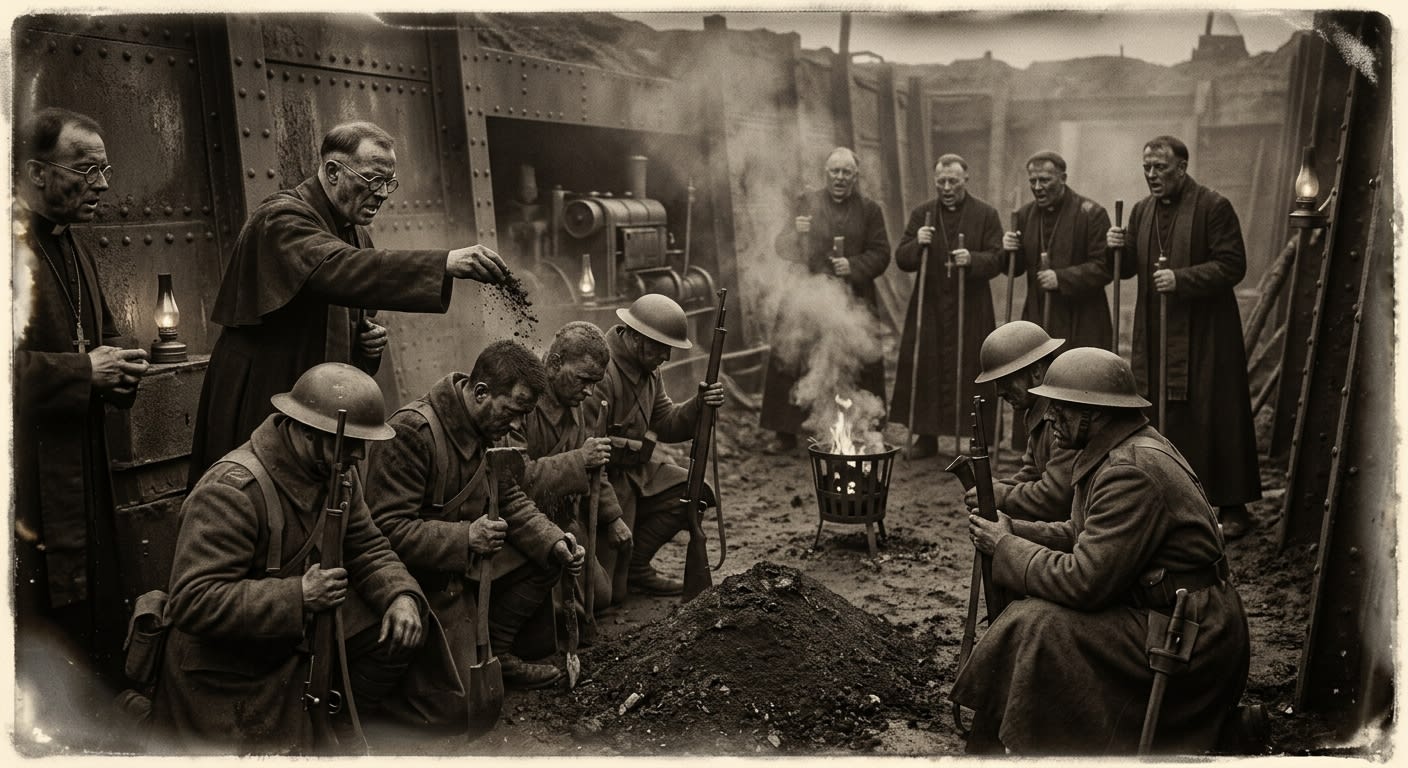
Relic-ash is loaded into thuribles before action under witness. The chaplain seals the bowl, names the source, kisses the chain, and signs the ash docket. In better units the ash smells of old incense and burned linen. In worse units it smells of damp plaster, cookhouse soot, and the moral condition of a supply clerk. Both may work. The Bureau has not yet developed an assay that distinguishes sanctity from successful theatre under artillery conditions.
To inhale relic-ash is to breathe memory. That is the approved line, and for once the approved line has teeth. Ash scratches the throat, clots panic, fouls hostile song, stings open wounds, and leaves a grey taste on the tongue that soldiers remember longer than sermons. A man under ash cannot pretend the air is neutral. Each breath is inspected. Each cough becomes testimony. Each swallowed particle says the dead have entered him without permission and expect conduct.
The medical effects are disputed in the usual sterile rooms where men with clean cuffs debate the lungs of men they will never meet. The Bureau of Medicine lists scarring, cough, fever, eye irritation, and long-term narrowing of the throat. The Bureau of War lists steadier ranks, fewer routs, improved breach survival, and reduced incidents of voluntary collapse. Doctrine reconciles the ledgers by noting that sanctity has never promised to be breathable.
An early instructional sheet described relic-ash inhalation as harmless to properly faithful personnel.
Corrected. Relic-ash harms the faithful, the faithless, the useful, the doomed, and the chaplain deploying it. Faith changes the filing category, not the lung.
Ash Chaplains cough like old furnaces by thirty. Senior chaplains develop the ash-voice: a cracked lower register capable of cutting through bell, rain, gunfire, and the peculiar wet roar made when men discover a breach is no longer outside them. Recruits fear that voice. Veterans follow it. Demons hate it. Bureau inspectors record it as vocal degradation and recommend rest. The recommendation is kept as evidence of the inspector's innocence.
#On Training and the Making of a Throat
An Ash Chaplain begins as a voice candidate under War-Orison custody (Unregistered). Some are priests whose parish superiors found them too severe for funerals. Some are former Processional Band cantors whose hands shook too badly for drum or horn but whose lungs remained offensive to despair. Some are soldiers who sang after being ordered silent. A few are choirboys who survived field exposure and grew into the terrible adult form of obedience.
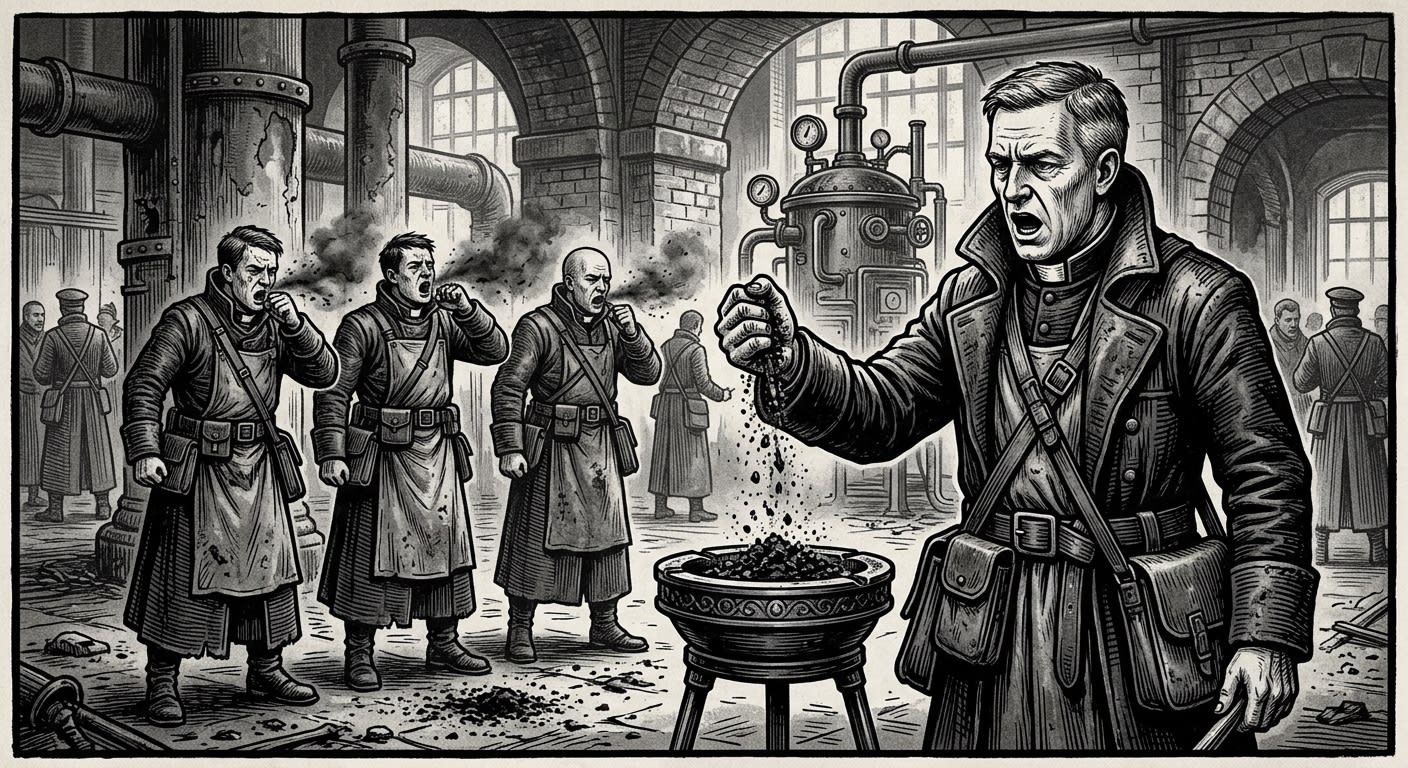
Training occurs where sound cannot behave: Metz rain courts, Stuttgart powder chapels, Lyon echo vaults, forward schools at Bastion-Przemyśl and Bastion-Irongate, and whichever trench currently possesses enough survivors to serve as instructors. Candidates learn ash custody, thurible handling, name discipline, breath counting, counter-cadence, Bellward coordination, deserter marking, mourner management, and the Litany of Stones in nine field recensions, none of which agree because mud edits music faster than committees.
The first lesson is breath ownership. A chaplain does not merely breathe; he counts breath, spends breath, lends breath to men who have misplaced theirs, and steals breath from panic before panic can organise a vote. Candidates are made to sing while marching, kneeling, crawling, hanging by one arm from trench timber, and lying flat with a sandbag on the chest. The body protests. The instructors call the protest evidence.
The second lesson is cruelty with timing. A chaplain who rebukes too early shatters the company. A chaplain who rebukes too late writes names into the dead docket. A soldier who falters in song may be named before the unit and forced to continue alone. If he recovers, the company recovers with him. If he fails, the band strikes the execution drum. This is not metaphor. The drum has a short roll for spiritual fracture, a longer roll for physical cowardice, and a flat double-beat for officers whose rank requires discretion.
The third lesson is silence. The Ash Chaplain's most frightening tool is the withheld hymn. To cease singing at a man's name marks him outside the breath of the company. Silence equals condemnation under field rule, and men will run into fire to avoid hearing their name fall into that hole.
#On Processional Bands
The Ash Chaplain rarely works alone. His Processional Band is the iron skeleton of his voice: drums, pipes, horns, hand-bells, cadence boards, and those long brass throat-pieces whose notes sit below ordinary hearing and make teeth ache in the obedient. The Band's music is not for beauty. Beauty is for court chapels, marriage Masses, and expensive funerals where no one present has had to reload under bile rain. Processional music measures war.
Drums pace boots and shield-brace. Pipes key detonation sequence. Horns signal the Creed Volley for Radiant Fusiliers. Hand-bells reset prayer cadence after shock. Cadence boards slap wooden time against trench walls when fog or hostile sorcery eats the air. Every instrument bears scars. A clean drum is either new, useless, or owned by a liar.
The Band answers to the chaplain in doctrine and to the drummer in timing. This creates arguments of a kind I cherish: theological enough to be pompous, practical enough to matter. A chaplain may wish to prolong a refrain for morale. The drummer may know the Paladin brace will fail on the next half-step if the beat does not change. In good units, the drummer wins until after the battle, when the chaplain wins the report.
A missed note is a misfire. The sentence entered field regulation after a pre-Vienna Ash Chaplain wrote it in a margin and then died before he could become insufferable about authorship. It remains the best summary of the Band's office. A faltered beat may detonate charges early, leave Paladins overbraced, make Fusiliers fire between banner pulses, or give a Pale Chanter an opening through which to insert its counter-hymn. Music here is ammunition with a throat.
#On the Litany of Stones
The Litany of Stones is the Ash Chaplain's central field text. It is older than the current doctrine, younger than the first panic, and revised every time enough men die in the same rhythm to justify new wording. The full cathedral recension runs forty-three stanzas and has never been useful to anyone under fire. The field form uses seven primary stanzas, three emergency fragments, and one wordless jaw-vibration employed when the mouth is full of ash, blood, mud, or somebody else's glove.
The opening stanza sets wall-breath: inhale on shield lift, hold on lock, release into brace. The second sets engineer-breath: short count for charge placement, long count for fuse prayer. The third sets rifle-breath: half-inhale beneath banner-light, trigger after release. The fourth names the dead already present. The fifth names the living still useful. The sixth denies the Enemy ownership of either category. The seventh is usually shouted rather than sung, because by the seventh stanza the breach has acquired opinions.
The last word is the point. Hold. Not triumph. Not salvation. Not the lovely absurdities preachers distribute to civilians like sugared pills. Hold. A small word, hard as a tooth, fit for men whose immediate theological task is to remain where dying has become likely.
During Pale Chanter exposure the Litany changes. The chaplain drops melody first, then ornament, then words. Bone-conducted chant replaces air. Paladins press shield rims. Fusiliers bite wax. Engineers feel for cadence through the ground. The chaplain beats the thurible chain against his own breastplate to keep time. This looks savage to observers. Observers at the correct distance often survive with opinions. The closer ones learn.
#On Saint-Malo and Mathis of Rouen
Every office requires a proof-text, preferably one that bleeds. The Ash Chaplains keep Brother Mathis of Rouen (Unregistered).
The Saint-Malo flank collapse belongs to the old annals, a trench calamity so often copied that its mud has become theological ink. The first barrage erased the Processional Band. Drums gone. Pipes gone. Horns flattened. The Paladin Lock continued by jawbone chant for six minutes while Litany-Engineers tried to set charges by memory and terror. Two beats went missing. The first charge answered early. The flank opened.
Mathis climbed the parapet with his censer in one hand and no reasonable future in the other. He began the Litany of Stones alone. His voice cracked on the second stanza, recovered into raw noise by the third, and by the fifth had ceased being song in any courtly sense. Soldiers rallied because the alternative was hearing him sing alone, and even fear retains manners.
SAINT-MALO FLANK COLLAPSE — LEDGER DCLXVI, RESTRICTED ADDENDUM Subject: Brother Mathis of Rouen. Duration of solo Litany: nine hours, disputed by sundial, confirmed by ammunition expenditure. Condition at recovery: lungs cindered; tongue blackened; right hand fused to thurible chain. Unapproved witness phrase: “the dead sang the lower line.” Disposition of witness: █████████████████.
When his body was found, his lungs were cinders. Soldiers swore the echo of his voice lingered for days. Records filed the event as local morale stabilization, a phrase so bloodless it should have been made to stand in the trench and apologise. Doctrine named Mathis exemplary. War named the method replicable, which is the crueler canonization.
Popular chapel cards describe Brother Mathis as having “held the line single-handedly.”
Corrected for field use. Mathis held the breath by which the line held itself. The distinction matters to officers, chaplains, and anyone who has ever tried stopping a breach with one pair of hands and a throat full of ash.
Mathis is venerated by Ash Chaplains but not widely canonized. The Bureau of Relics cannot agree whether the recovered blackened tongue is his, a drummer's, or a strip of burned leather misfiled during the second copying. The chaplains do not care. They kiss the case before field assignment. Relics, when useful, may dispense with certainty.
#On Failures Under Song
The Ash Chaplains' enemies understand them too well. The Pale Chanters are their dark mirror, though Doctrine dislikes mirrors that show family resemblance. Where the Ash Chaplain binds breath to obedience, the Chanter loosens breath from purpose. Where the thurible makes air heavy with sainted memory, the counter-hymn makes memory betray the hand. Men do not drop rifles because they are afraid. They forget the rifle belongs to resistance.
The Collapse of Saint Aurelia's Convoy in Rouen, A.S. 184, remains the office's shame-file. Three Ash Chaplains accompanied the reliquary transfer with seven choirboys and a pilgrim guard. No Chanter was seen. The sound arrived as remembered melody. The convoy swayed, turned inward, and began destroying its own cargo. The choirboys sang the Antiphon of Safe Passage in counterpoint. The Ash Chaplains corrected them.
That is the verb in the sealed account. Corrected. They strangled their own choirboys with vestment cords, in time, with faces wet and serene. Purity burned every exposed survivor as acoustic carrier. The file taught the office two lessons. First, a trained chaplain can be captured through cadence. Second, mercy must never be allowed to choose the tempo.
After Rouen, field thuribles received dead-drop chains, allowing a chaplain to release ash if his hands began moving outside command rhythm. Choirboys were removed from high-risk convoy bands, then restored after Orison objected, then removed again after three smaller incidents, then restored under the name junior cadence assistants, because bureaucracy loves resurrection by title. As of A.S. 201, choirboy deployment near Chanter-risk zones is discouraged, permitted, condemned, and routine.
The Reversed Hymn of Saint-Verrine (Unregistered) produced a different embarrassment. Litany-Engineers miscalculated chant; the psalm-shell rose in flawed cadence and returned as a dirge, causing Covenant trenches to sob for three nights. Ash Chaplains broke the effect by singing louder. Not better. Louder. There are hours when subtlety is treason. Purity ruled the engineers heretics. Records sealed the file as unhymned munitions. The chaplains took the practical lesson and added lung endurance to second-year examinations.
#On Discipline, Cruelty, and Mercy
The discipline of the Ash Chaplains is cruelty disguised as care because care without cruelty cannot survive the eastern wind. A chaplain marches with his flock, eats the same wet bread, coughs the same ash, sleeps near the same rats, and learns the names of men he may condemn by silence before sunset. The intimacy is deliberate. A stranger's rebuke irritates. A known voice can shame men into remaining human for another ten minutes.
A soldier who falters in song is brought forward after action if there is after action, during action if the falter endangers cadence, and never if he is dead unless Records needs an example. The chaplain asks him to sing alone. The company listens. Men hate this more than flogging. Flogging is private pain made public. Solo song is private fear made audible. If the voice steadies, the chaplain returns him to line. If it cracks again, the drum may speak.
Yet Ash Chaplains also perform the work civilians expected first and soldiers admit last: they keep men from dying unvoiced. They sing over the wounded when stretcher-bearers cannot reach them. They carry last words in soot-stained notebooks. They translate gurgles into permitted confession, which is presumptuous, merciful, and administratively convenient. They beat time for amputations. They stand in fever tents and sing low enough that the dying think the earth has learned compassion.
The Bureau of Mercy has objected to their field authority over dying speech, especially where a chaplain assigns doctrinal meaning to sounds produced by men missing half a mouth. The objection is elegant and doomed. War prefers a questionable confession to an unfiled silence. Doctrine concurs. Records provides ink.
#On Breach Deployment
In active breach, the Ash Chaplain ascends. A crate, a broken gun step, a trench ladder, a corpse pile covered decently enough to stand on, the roof of a dugout, the shoulder of an overturned shrine-cart: elevation is theology once the breach opens. The doctrine requires visibility and audibility to seventy percent of the cohort. The doctrine also assumes intact ears, honest geometry, and no demon currently wearing the fog. Field chaplains interpret percentage with admirable savagery.
He opens the thurible only after the Paladin Lock has set. Too early, and the ash blinds men before alignment. Too late, and panic has already begun appointing officers. The first swing marks breath. The second marks brace. The third marks the Engineers. If Radiant Fusiliers are present, the horn master waits for the chaplain's left-hand cut before Creed Volley. If Wormhost rupture begins inside the wall, the chaplain shifts from wall-breath to inward-burn cadence and smokes the breach with relic-ash dense enough to choke men whose throats were worth saving five minutes before.
The chaplain's thurible chain is weighted to serve as instrument, censor, and last resort weapon. Some carry chain-links made from recast bell fragments. Some carry saint-nail charms. Some carry small knives hidden in ash spoons because even holy men occasionally meet a problem too close for song. This is discouraged in public instruction and expected in private.
#On Relations with Other Holy Offices
The Ash Chaplains occupy an uncomfortable place in the military ecclesiology. Tribune-Chaplains think them narrow, smoky, and overfond of field authority. Ash Chaplains think Tribune-Chaplains talk too much before men die and too beautifully after. Litany-Engineers respect them when the chant aligns and curse them when a thurible swing obscures fuse sight. Shield-Paladins distrust them for smelling worse than necessary. Radiant Fusiliers adore them only while the volley goes clean.
The Bureau of Orison claims custody over their musical formation. War claims custody over their deployment. Doctrine claims custody over meaning. Relics claims custody over ash. Records claims custody over the docket. Purity claims inspection rights whenever a chaplain has sung too long near enemy sound. This leaves the chaplain with his lungs, his chain, and the small consolation that every Bureau depends on him while pretending ownership.
Their closest allies are often the Processional Bands, though allies is a warm word for men who shout metre corrections at one another under shellfire. The drummer knows when the chaplain is about to lose breath. The chaplain knows when the drummer is hiding fear behind precision. They save one another without admitting affection. Soldiers trust this arrangement. Soldiers distrust affection in officers, and rightly.
Purity's relationship with Ash Chaplains worsened after Rouen. Inspectors now test chaplains for cadence contamination after Chanter contact: whispered inversions, sleep-humming, finger-tapping against forbidden intervals, and the serene expression that precedes religious murder. Chaplains resent the tests until they fail one. The failed do not resent afterward. They are gagged, smoked, questioned, and either returned to duty with notation or burned under acoustic caution.
#On the Present Field Copy
As of A.S. 201, Ash Chaplains serve in every major bastion sector of the Sagittal Line, though each sector has made of the office its own local deformity. Brest trains them for confession-echo and flatland mass, where sound travels too far and returns wearing other names. Przemyśl trains ridge projection, frozen breath, and Chanter interception in stone cuts. Sibiu trains mountain reply, where echoes must be interrogated before trusted. Irongate trains gorge-thunder. Shipka adds wake-hymns against sleep-fog. Constantinople trains everything, loses more, and calls this seriousness.
Their numbers are unpublished. War says publication would assist the Enemy. Records says the count is in reconciliation. Orison says the count depends on whether Processional Band dead are included. Relics says no chaplain without certified ash should be counted. The chaplains say nothing because counting throats before battle tempts Providence to audit them.
The current field copy includes A.S. 201 revisions for Shadow Noon halt clauses, Wormhost inward-burn, Pale Chanter jaw-vibration, and restricted use of Counter-Sorcery Verse fragments by breach-rated chaplains. It also includes a Mercy appendix on post-exposure lung care. No one reads the appendix until coughing blood, at which point the advice arrives with the punctual uselessness of most kindness.
War has proposed issuing lighter thuribles for prolonged engagements. Relics objected that smaller bowls imply smaller saints. Orison objected that lighter chain alters tempo. Medicine objected that heavy chain worsens shoulder collapse. Records asked for a form distinguishing devotional weight from mechanical weight and received three contradictory replies. The field chaplains settled the matter by keeping the old thuribles and shortening the complaints attached to them.
At dusk on the Line, when bells pass from bastion to bastion and the trenches settle into that brief hour when fear changes shifts, Ash Chaplains clean thurible chains, test drum cadence, scrape grey paste from their lips, and write names in small books. Some names are dead. Some are weak. Some are brave in ways that will need correction before they become theatrical. The chaplain closes the book, coughs into a cloth already stiff with holy dust, and listens for the drummer's count.
The ash waits in its bowl. The breath waits in the men. The breach, as always, is only late.