
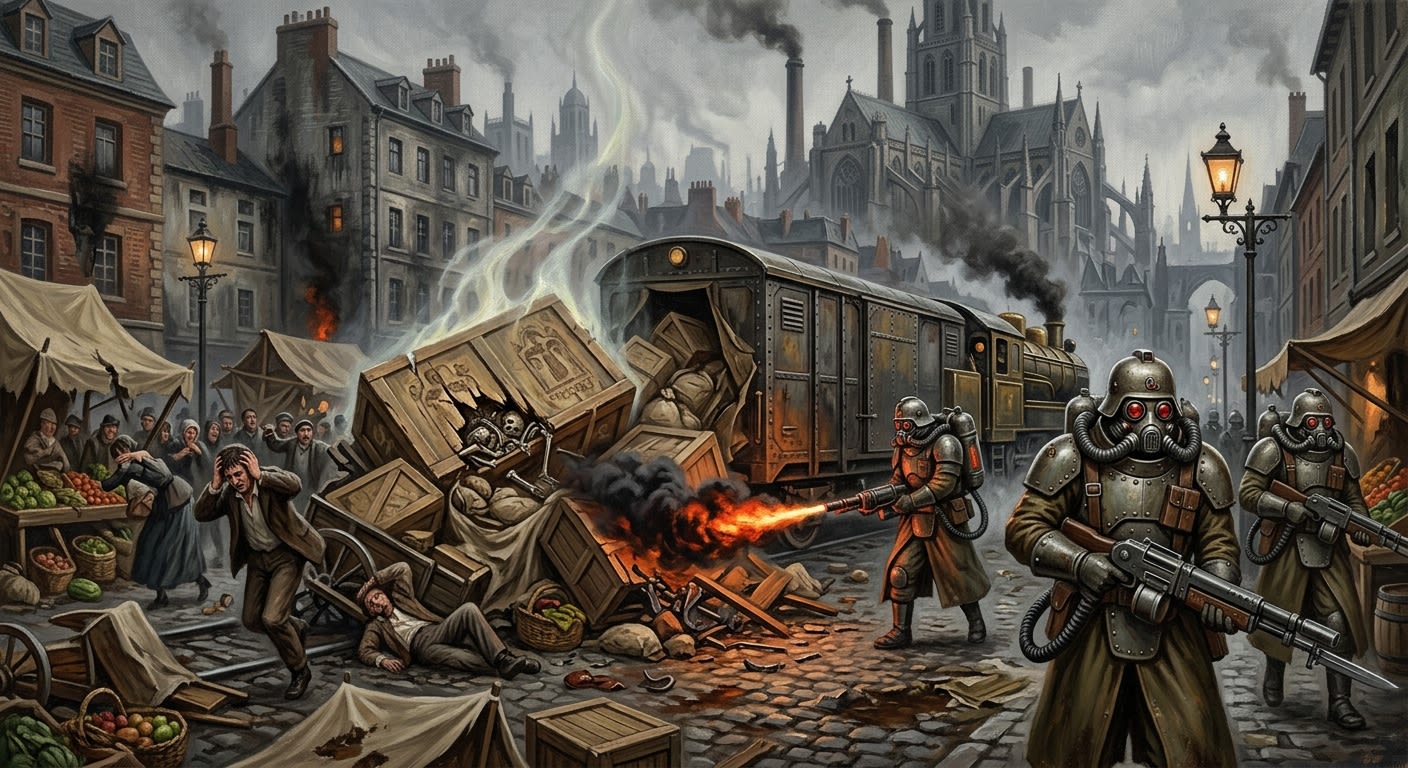
#On the Market Quarter of Rouen
The Collapse of Saint Aurelia's Convoy occurred in Rouen in A.S. 184, which is already to say too much for the comfort of three Bureaus. Rouen is a city that learned fire before it learned obedience. The Rationalists gutted its cathedral during the Cauterization; the nave still bleeds soot in rain, and the stones retain that ugly provincial habit of remembering what official reports have improved beyond recognition.
The convoy entered by the southern market road shortly after Prime. It carried authenticated finger-bones of Saint Aurelia of the Third Lamp (Unregistered), a minor healer-saint whose cult survives chiefly because her reliquary fragments proved useful in ward-line fever tents and because usefulness, unlike sanctity, impresses quartermasters. The Bureau of Relics had stamped the consignment Ward-safe. Two Relic Authenticators accompanied it, along with pilgrims, hired guards, three Ash Chaplains, seven choirboys, and a procession captain whose itinerary survived because he had the professional decency to die on top of it.
The market was awake. Fish-sellers, candle hawkers, ash-bank runners, pilgrims seeking cheap tokens, children with bread crusts, informants pretending to be beggars, beggars pretending not to be informants. Rouen has always liked a crowd. Crowds provide commerce, cover, witnesses, and enough confused testimony to keep Records fed for years.
#On the Sweetness in the Air
Witnesses speak first of the smell. Spoiled incense, sugared wax, wet stone after a funeral. The official file calls it an olfactory prelude, a phrase only a clerk could produce while standing far enough from the dead. The air thickened around the reliquary cart. The candles guttered inward. One Authenticator raised his blessing lamp and watched the flame lean toward the cargo, then away from it, then straight upward, thin and blue as a vein.
Then came the sound.
No Chanter was seen in the square. That is the part that has kept the file alive, twitching under its seals. The Pale Chanters at Prague stood across a field. At Odessa their seepage entered through trench walls. In Rouen the voice arrived without a throat. It was less heard than remembered, as though each person in the market had known the melody since childhood and had spent all intervening years misplacing it. Humming began at the edges of the convoy. A pilgrim woman swayed. A guard adjusted his grip on his rifle in time with a rhythm no drum had offered.
The convoy began to move as one body. The pilgrims, guards, bearers, and chaplains took three steps left, one step right, halted, breathed, and turned toward the reliquary cart. No command had been given. The procession captain shouted the halt order anyway, which shows touching faith in hierarchy and fatal ignorance of acoustics.
The first relic-bearer smashed his casket against the cobbles. The second followed before anyone could reach him. Finger-bones spilled across fish scales and market grit. A child laughed, then screamed with an adult voice. The choirboys began to sing the Antiphon of Safe Passage in counterpoint to whatever had entered the square, and the Ash Chaplains turned toward them with the calm of men correcting a liturgical error.
WITNESS FRAGMENT — ROUEN, A.S. 184 “I saw Brother Calvian place his cord around Emile's throat as if vesting him for Mass. The boy did not struggle at first. He kept singing. When his voice stopped, the other boys took the missing note.” Remaining testimony excised under Purity Seal 9-F after witness described █████████████████ moving beneath the cobbles in the shape of a choir stall.
#On the Breaking of the Convoy
Within minutes the entire procession turned inward. Relic bearers broke their burdens. Guards struck pilgrims. Pilgrims knelt on shattered bone and tried to gather fragments with bleeding hands, then crushed the fragments when the rhythm changed. The Ash Chaplains strangled their own choirboys with cord-sashes, methodically, in time, faces wet and serene. The hired guards fired once into the air, twice into the crowd, and then set their rifles down as though the weapons had completed their office.
The market did what markets do under terror: it became inventory. Stalls overturned. Fish rotted in the sun. Candle wax ran into gutters. Bread was trampled into the shape of footprints. The Bureau of Records later counted thirty-one dead on site, sixteen dying, and an unknown number spiritually compromised. The unknown number troubled Purity, so Purity removed the uncertainty by burning everyone who had remained close enough to give useful testimony.
The first municipal notice described the event as “reliquary transport disorder caused by crowd pressure.”
Corrected after three surviving shopfront shutters were found scored inside with the same four-bar cadence. Crowd pressure does not compose.
The Bureau of Relics lost three authenticated finger-bones, recovered two, and reclassified the entire consignment as Contaminant pending re-authentication. One recovered bone passed the Candle Proof at noon and failed it at dusk. The Authenticator wrote both results into the ledger, then sealed the page with black wax and requested transfer to the Vault of Sacred Custody, lower third corridor, where men at least know what they are afraid of.
#On Prophylaxis
The word used was prophylaxis. I admire it. I detest it. One cannot fault its efficiency. The Bureau of Purity cordoned the square before None, extracted the dead, separated the merely injured from the talkative, and burned both categories when the distinction became inconvenient. Punishment requires guilt. Purity had no interest in guilt that afternoon. It wanted silence sterilised by flame.
Survivors reported that the Chanter voices had nested in their ears, worming thought into command. This phrase appears in five separate depositions before the burn order. Nested. Worming. Thought into command. The depositions were copied, sealed, and placed under Bell-Silence custody. The witnesses were carted to the lime yard behind Saint Cuthbert's Bridge (Unregistered), given three minutes for confession, and burned in batches small enough to prevent the smoke from carrying identifiable words.
Later parish histories recorded the burned survivors as condemned heretics.
Amended. They were not condemned. They were exposed. The Bureau of Purity asks that charitable readers appreciate the mercy of the distinction, and that uncharitable readers present themselves for instruction.
The plaza was repaved within eleven days. The Bureau of Engineering objected to the speed, noting that quicklime ash beneath paving can shift under frost. Purity replied that frost was a lesser concern than conversation. Engineering withdrew the objection and kept a private copy, because Engineering has the touching habit of believing private copies make truth safer. They make truth better indexed. Safety is another office.
#On the Cobblestones
Locals still claim that dawn brings singing under the cobblestones. The Bureau of Bells investigated in A.S. 186 and produced a four-page report whose last sentence reads: “We recommend against standing in the plaza at dawn.” This is the finest sentence the Bureau of Bells has ever written, because it contains measurement, warning, cowardice, and poetry without admitting to any of them.
The market continues. Of course it continues. Fish are sold above the lime. Candles are hawked in the street where relic wax once ran. Children dare one another to press an ear to the stones before first bell. Those who do claim to hear a procession approaching from below: soft feet, thin bells, choirboys holding a note too long for breath. The municipal Watch fines them for unsanctioned listening.
Aldric Venn cited the collapse in his withdrawn memorandum, placing Rouen beside Prague and Odessa as proof that Chanter cadence could occupy existing liturgical channels rather than merely assault them. He observed that the relic-bearers moved in intervals matching procession-step tables used by the Bureau of Pilgrimage. Records withdrew the memorandum. Venn went to Ulm. The plaza kept singing.