

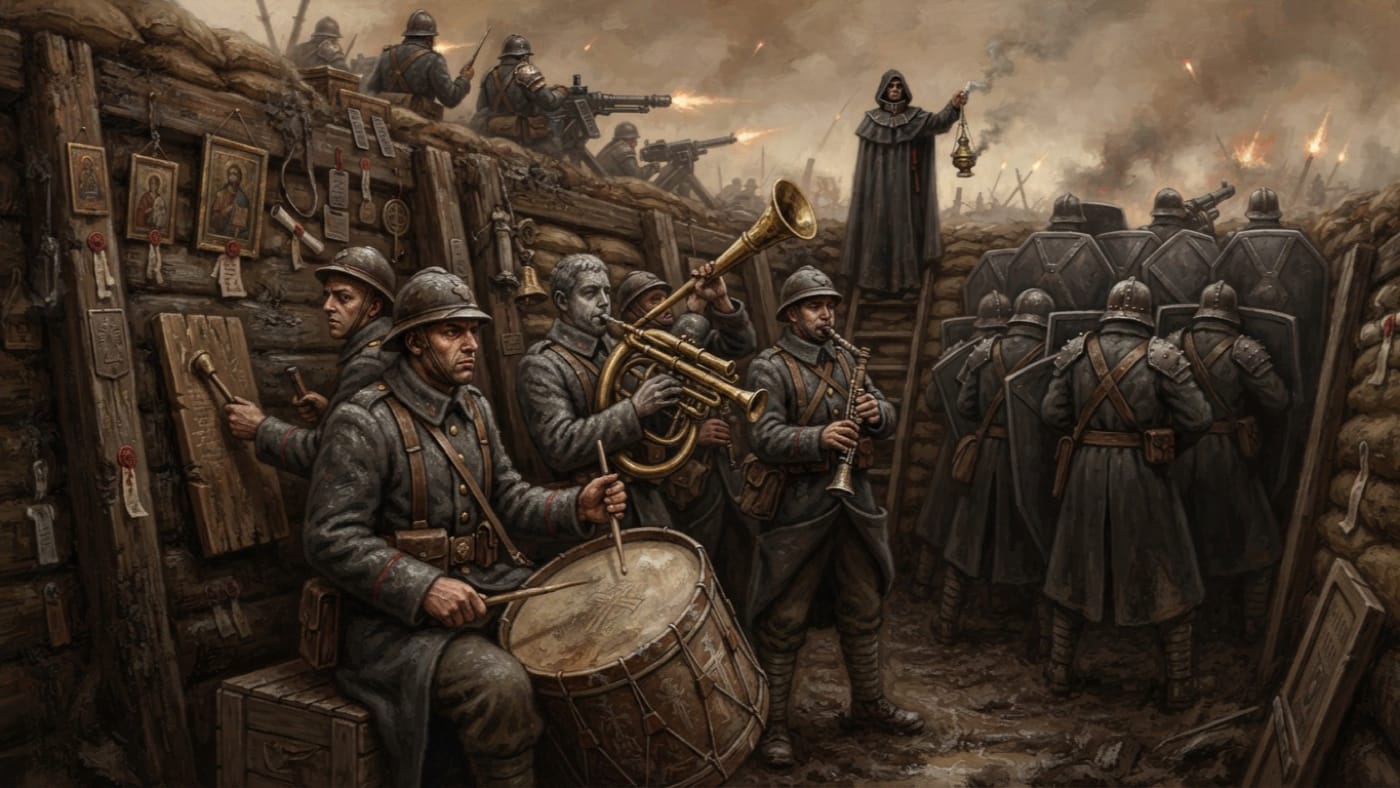
#On the Station Behind the Shields
The Processional Band works three paces behind men who are dying and one pace ahead of men who are about to. Its post is the trench floor behind the Shield-Paladin Lock and beneath the Ash Chaplain's ladder, a strip of mud so narrow that a drummer cannot step back without treading on a piper. Civilians hear processional and picture feast days and petals thrown at relic-carts. The Band carries no petals. It carries a count, and that count keeps several dangerous operations from happening in the wrong order.
Custody is shared in the way the Synod prefers, which is loudly and without a diagram. The Bureau of War puts the Band in the trench, feeds it, punishes it and buries it. The War Directorate of the Bureau of Orison lists Processional Bands among its operational assets and licenses every cadence they strike, since nothing that keeps time inside the Synod's writ may keep it on its own authority. Neither Bureau has produced a founding charter for the Band. Both produce invoices.
At the Line the arrangement is plainer. The chaplain owns what the music means, and the drummer owns when it happens. The days they disagree are the reason the office exists.
#On Instruments and What They Command
The Band's equipment is best filed by what each piece makes a soldier do.
The drum moves feet and sets the brace. In breach drill the percussion follows the Paladin brace-step: lift, lock, lean. A recruit who has drilled long enough under the drum stops hearing it and starts obeying it, and Orison counts that as the instrument's highest achievement.
The pipe keys the Litany-Engineers' detonation sequence. The Engineer counts prayer between fuse and earth, and the pipe tells him which prayer he has reached. It is the thinnest voice in the Band and the one that ends the most lives on both sides of the parapet.
The horn calls the Creed Volley for Radiant Fusiliers when Fusiliers are present. It is the loudest instrument and the one most often silent. A horn player's career is mostly waiting.
The hand-bell resets prayer cadence after shock. When a shell lands close enough to scatter every man's count, the bells give the rank a single first beat to start again from.
The cadence board is a slab of hardwood struck against the trench wall when fog or hostile sorcery has eaten ordinary hearing. Men feel it through the revetment timber and the soles of their boots.
The throat-pieces are long brass horns whose lowest notes sit under ordinary hearing. Orison's War officers call the effect morale compression. Soldiers call it toothache.
Rain warps drumheads. Ash clogs pipe bores. Shellfire dents brass into shapes no instrument-maker would sign. War has never published a standard complement, and none exists in practice: a Band is whatever the last barrage left standing. Older general manuals assign pipes to volley-fire and horns to bell-cannon. The breach drill assigns them differently, and the breach drill is the one that gets men killed when it is ignored.
#On the Breach, Counted
The Doctrine of Layered Death lists the Band fourth. First come the shields in the Lock-Formation. Second come the Engineers, driving charges into breach-side earth with Counter-Sorcery Verses in their teeth. Third come the Ash Chaplains with their relic-ash. Fourth comes the Band, matching percussion to shield-step and detonation. The fifth entry is the ledger's: if everything before it fails, the breach is recorded as a "temporary martyrdom dividend."
Fourth is a misleading place on the list. The Band is the reason the first three happen in sequence instead of all at once.
The Lock sets on the drum. Behind it the Engineers place their charges, and the pipe carries them from verse to verse toward the fuse. The chaplain climbs and opens his thurible only once the Lock has set, and the drum has to hold perfectly steady through the first swing, because men breathing fresh ash cough out of time. If Fusiliers are on the parapet, the horn master watches the chaplain's left hand and sounds the Creed Volley only on its cut. Even then the horn only announces the volley; the Fusiliers' banner pulses still decide when it fires. A horn that tries to give the banner's cue gets its player reassigned or entered in the dead docket, depending on what the volley hit.
This is also where the argument starts. A chaplain whose company is wavering wants one more refrain, because one more refrain might put their spines back. The drummer, with his hand on the skin and his eyes on the shield-rims, knows the Paladins need the next brace-step now, and a held refrain will leave them leaning on air. So the drummer changes the beat, and the chaplain loses his verse. The men keep their feet. In the report afterward the chaplain gets his verse back, along with most of the credit.
A missed note is a misfire. The maxim came into field regulation from a chaplain's margin. Neither his name nor his year survived the copying, which is a mercy to the regulation. A faltered beat can fire the charges early, leave the shields braced against nothing, send rifles off between banner pulses, or open a seam through which hostile counter-cadence walks into the rank.
#On the Drum That Judges
The drum that keeps men alive also kills them, on the same skin.
A soldier who falters in song is made to sing alone while the company listens. If he steadies, he goes back into the rank. If he cracks a second time, the Band sounds the execution drum. A short roll means spiritual fracture. A longer roll means physical cowardice. A flat double-beat is reserved for officers, whose condemnation requires discretion. The private learns from the length of the roll what sort of man he has been declared to be. The officer learns very little, which is how rank protects him to the end.
The Band's own failures go through a different door. A lost beat is a mechanical fault: a tired wrist, a split head, a piper deafened by the shell before last. Doctrine prosecutes it anyway as a fault of the spirit, and a synchronization failure that collapses a breach goes to tribunal. Drummers play as if the tribunal were standing in the trench behind them, because one usually is.
The bond between chaplain and drummer is held together by spite and mutual dependence. The drummer hears the chaplain's breath thin two bars before the voice goes. The chaplain sees when the drummer's precision has turned into a place to hide his fear. Each covers for the other, and neither would admit it under any interrogation the Bureaus have yet designed.
#On Saint-Malo, Where the Band Was Not
The Saint-Malo flank collapse sits in the old annals without a year, and it is not the pilgrim massacre that shares the town's name. Sentimental copyists merge the two. I do not.
The first barrage destroyed the Band. The Lock went on by jawbone chant for six minutes, which is about how long trained men can keep a shared count with nothing outside their own skulls to hold it. Then two beats went missing. A charge answered early, and the flank opened.
Brother Mathis of Rouen climbed the parapet and restored the Litany of Stones. What he restored was a count. With a count to stand on, the shieldmen re-locked and the Engineers reset what memory let them reset. The field account says he kept the Litany going for nine hours; the restricted addendum disputes the figure. When he was recovered his lungs were cinders. Soldiers swore his voice lingered in the trench for days afterward. Records filed the matter as morale stabilization, a phrase with the warmth of a coffin nail.
The chaplains keep Saint-Malo as proof of what a throat can do. I keep it as proof of what a drum does. Six minutes is how long the finest Lock in the Church lasts once the Band is gone.
Chapel cards and devotional sheets state that Brother Mathis alone held the Saint-Malo flank.
Corrected. The flank was held by its cohort. Shieldmen re-locked under fire and Engineers worked from memory. Mathis gave them back the count they had lost along with their Band. A single throat cannot hold a breach. It can give a breach the timing it needs to hold.
#On Counter-Hymn and Ground-Felt Time
The Pale Chanters do not attack the beat directly. They attack the reason for keeping it. A man under counter-hymn does not drop the count from fear. He drops it because the count no longer seems to have anything to do with him. Their sound passes through trench walls, helmets and bone. Plugging the ears is a recruit's remedy and a veteran's joke.
The field answers belong to particular hands. The chaplain strips melody down to jaw-vibration. The Paladins press their shield-rims together so the cadence travels through iron. The Engineers feel for the count through the ground. The chaplain beats his thurible chain against his own breastplate. The Band strikes the cadence boards, so the time arrives through timber and earth rather than the air the Chanter has captured. None of this guarantees anything. A perfectly kept beat is no proof against a song that works through the will rather than the ear.
Sanctified bells can break a Chanter's resonance. The ledgers also record bells corrupted mid-peal, defence turned against its own rank, and the condition filed as prayer-jam. The Band's hand-bells carry the same risk as every other bell.
ASHEN CHOIR INCIDENT, GHENT — WITNESS SUMMARY (UNDATED) Bands deployed for counteroffensive. Rotbelcher bile struck mid-hymn. Witnesses state instruments continued sounding after players ceased. Drums split. Pipes sounded unblown. Purity: instruments declared heretical; burned. Records annotation, retained over objection: "ash still hummed." Mechanism: ██████████████.
Purity burned the instruments and closed the matter. Records kept the annotation, and so the matter stayed open.
#On Present Service
As of A.S. 201 the Processional Bands serve wherever Ash Chaplains serve along the Sagittal Line, which is everywhere the Line is still worth holding. Their numbers are unpublished. The Bureau of Orison and Song still prints the cadences in clean folios. Out in the mud the Band turns those folios into wet timber, dented brass and a drummer whose wrists are older than the rest of him.
At dusk the drummer tightens his drumhead against the damp, and the piper clears ash from the bore with a straw. The horn player has waited all day for a cut of the chaplain's hand that never came, and now he wipes down a mouthpiece he has not used. The chaplain coughs. The drummer counts the coughs, because tomorrow he will need to know how long that throat can last.