
#On Its Office at the Breach
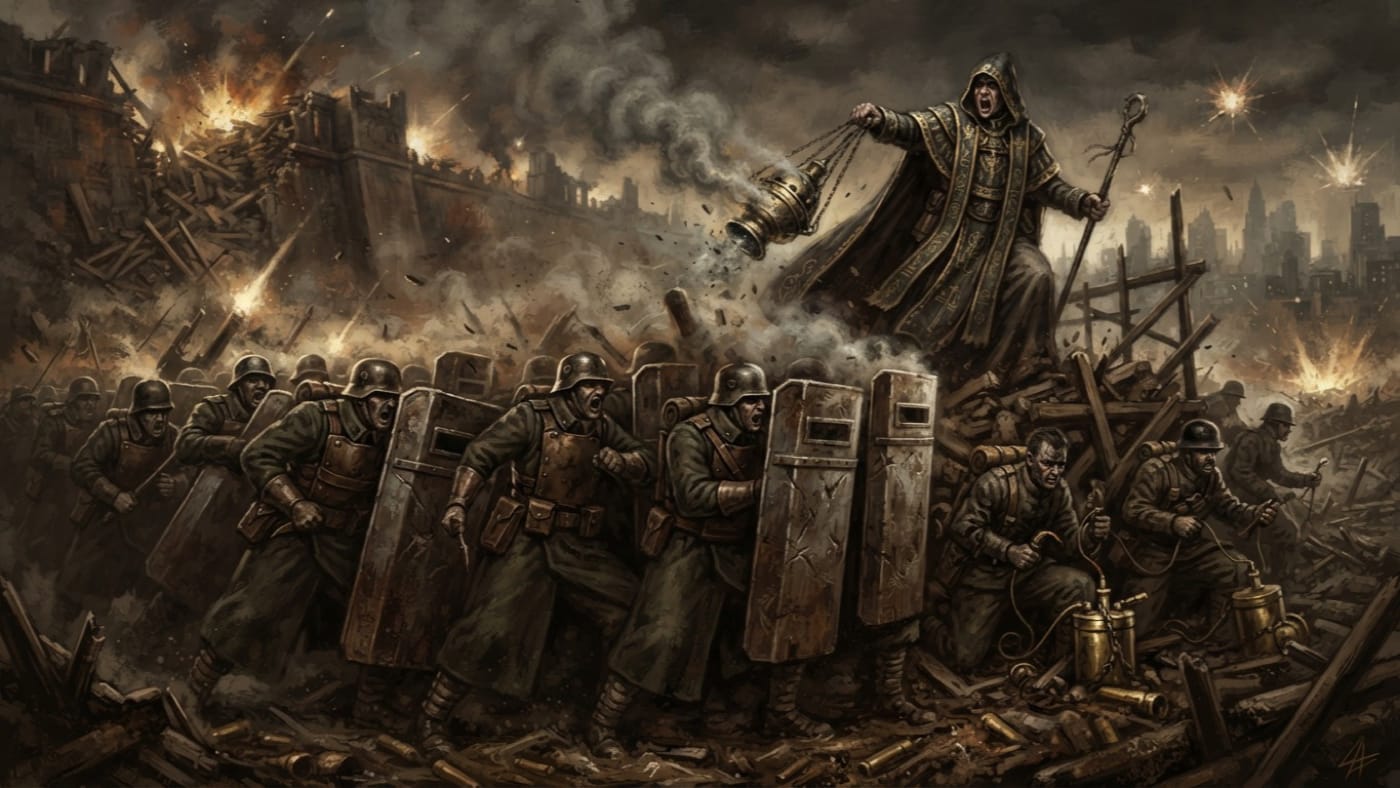
The Litany of Stones belongs to the third layer of the Doctrine of Layered Death, and it is there because it was assigned there. An Ash Chaplain leads it during a catastrophic breach to synchronize the Shield-Paladins at the wall with the Litany-Engineers crouched behind them. That is its whole definition in the breach choreography sealed by War, Doctrine and Orison. Everything else follows from it.
Readers ask who composed it. Readers ask many things. The Ledger names no composer, records no first performance and holds no separate instrument of ratification. I decline to invent any of these for people who like their hymns to have parents. The litany is known by what it does. Iron must brace on the beat, and powder must wait for it. A Paladin who braces late takes the breach in his knees, and a charge that fires early brings down the wall it was laid to protect. Between those two errors stands one priest on a rise, coughing up saints.
#On the Count Shared by Iron and Powder
The arrangement runs from front to rear, and every rank has its own mouth.
At the lip of the breach the Lock Formation takes up the Saint Ardent variant. The first rank interlocks tower-shields. The second braces forward and breathes Credo Lapidem on each exhale, a creed for the lungs of men whose arms are occupied. The third recovers fallen shields so that the wall does not develop gaps, or opinions. Their drill-cadence belongs to them alone: first shield holds the world, second shield holds the soul, third shield holds the Creed entire.
Immediately behind the Lock, the Engineers drive charges into breach-side earth and recite Counter-Sorcery Verses Twelve through Nineteen. Their hands are on the fuse-cord, their eyes on wet chalk marks, and their hymnals have gone to pulp. They detonate on the chaplain's command, in sequence with the shield-lock cadence. They do not detonate because they feel ready. Feeling ready has killed more Engineers than sorcery has.
The chaplain stands rearward and above. Drill requires him to be visible and audible to at least seventy percent of the cohort. That figure is a target. Under bombardment it becomes an aspiration, then a memory, then a line in an inquiry. His thurible goes before his voice. It burns relic-ash in the prescribed order of priority: lungs first, then sight, then morale.
The Processional Band keeps the shared count. Percussion follows the Paladin brace-step and the pipes follow the demolition sequence. The horns hold back the Creed Volley for Radiant Fusilier intervention when Fusiliers are present, which is less often than the horns would like.
That makes five voices: creed, cadence, verses, music and litany. Each is separate. The Paladins do not sing the Engineers' verses, the Engineers do not borrow the Paladins' creed, and nothing in the record calls any of them a stanza of the Litany of Stones. The litany is the only voice addressed to every rank at once. It tells iron and powder that they are working in the same minute.
#On the Name Withheld
The breath is shared before it is pious. Ash enters every throat in the cohort, and the chaplains say it was scraped from the remains of saints. The men report that it burns going down and that the heart steadies afterwards. I record both claims without the benefit of a laboratory. Records has asked Doctrine for a repeatable standard by which ash tells the obedient from the disobedient. Doctrine has supplied sermons, and each party considers the matter closed in its own favour.
The litany carries names. If a soldier falters, the chaplain may name him, and a man named in front of his file usually finds reserves he had been hoarding. If a soldier runs, the chaplain may stop the hymn at his name, and the rest of the cohort hears the gap. The breach choreography puts it in four words: silence equals condemnation.
The record gives no fixed stanza for this, and no formula or wording. None is needed, because the weapon is the pause.
Ash Chaplains are pastors. They march with their flocks, bury them and write the letters home. They are also the first to name the weak, a duty that pastors in quieter parishes are spared. A soldier who falters in song may be made to sing alone before the company. That is general chaplaincy discipline rather than a clause of this litany. The men at a breach know about it anyway, and the knowledge keeps their mouths moving.
#On Mathis of Rouen
The principal example is filed as Ledger DCLXVI, "Saint-Malo Flank Collapse." Soldiers know it as the Breach of Saint-Malo. The ledger number is a shelf mark. It is not a year, and the passages before me give no year either. I leave the action undated. This annoys the archivists and costs me nothing.
The first barrage destroyed the Processional Band. Drums, pipes, horns and the men attached to them all stopped together, and the flank lost its count in a single stroke. Brother Mathis of Rouen, Ash Chaplain, climbed onto the parapet, forward of the elevation the drill prescribes. He swung his censer like a flail and bellowed the Litany of Stones.
His voice cracked into raw noise, and by the account the soldiers rallied anyway. They held for nine hours without artillery or reinforcements, on the strength of one voice that had stopped being musical early in the first hour.
The ledger extract adds two details. After the band was lost, the Paladin Lock held itself together by jawbone chant for six minutes, and the Engineers' charges went off two beats early. The six minutes and the nine hours describe different stretches of the same disaster. Neither is a performance length, and anyone who sets a drill timer by them should be relieved of his watch.
When the body was recovered, the lungs were cinders. Soldiers testified that his voice lingered in the trench for days. Their testimony is recorded, attributed and left where it lies. The faithful say Mathis held the line by himself, and Doctrine is pleased to let them say it.
The Bureau annals call the action "local morale stabilization."
#On Broken Cadence
The litany fails where the people carrying it fail, and those people are made of meat.
Pale Chanters break up the cadence. Men under their counter-hymn report a hollowness in which nothing seems worth taking, the next breath included. Rotbelcher bile gets into instruments and makes them wail with no hands on them. Silence domes leave mouths moving around nothing. The chaplain's own lungs, scoured every hour by the ash he prescribes for everyone else, have only so many hours in them. Saint-Malo showed how many. It did not show how many more.
When speech goes, the first layer falls back on jawbone chant carried through collar and teeth, and on shield-rim pressure passed down the file: press, hold, release. This keeps each Paladin in contact with the Paladin beside him. It does not carry the chaplain's count back to the Engineers, and no source describes a silent rendition of the Litany of Stones. Keeping in touch along the wall and restoring the whole breach sequence are different achievements. The six minutes at Saint-Malo were the first, and the early charges show the second had been lost.
On what caused those two beats, the bureaus divide as usual. Doctrine says the hymn seals the breach and losing the hymn unsealed it. Engineering says the powder seals the breach and the powder was mistimed. Records' own position survives under redaction and amounts to both. I side with whoever is signing the casualty forms that week.
The older breach sidebar lists Layered Death as three barriers, the third being "hymn carried in lungs, even of corpses."
Corrected. The current field copy counts five layers: wall, charge, ash, rhythm and dividend. The Litany of Stones sits in the third, ash, beside the thurible and the chaplain's power of omission. The corpses are reassigned to the fifth.
#On the Current Field Use
As of A.S. 201 the Litany of Stones is taught wherever the current field copy of Layered Death is taught, which means every major bastion of the Sagittal Line. Brest teaches it for lowland mass breaches, Sibiu at its mountain gates, and Constantinople with excessive seriousness, which is to say correctly.
The form does not change. The chaplain climbs, and the thurible is lit before his mouth opens. The Lock braces on the count and the Engineers wait for it. The band keeps the count until something stops the band, and then the litany is the only count left.
Young officers think the litany is the chaplain's business. It belongs to the whole cohort. The chaplain merely owns the throat.
Sing on the count, or be named. Nothing else is on offer.