

#On the Notch and the Two Bells
The Brown Court of Toledo has no standing calendar, and this survey, filed in A.S. 201, will not invent one for it. It sits when the Tagus tells it to sit. The summons is written on a post.
On the eastern quay at Toledo stands a quay post cut with notches. When the river climbs past the third notch, the city takes notice. When it stays above that notch beyond two bells, the Court convenes. Both halves of the rule matter. A river that touches the third notch and falls back has shown bad manners and nothing more. A river that rises, settles in, and outlasts two bells of the city's licensed hours has, in the Court's view, made a claim. Somebody must answer it.
I have no authenticated figure for the length of those two bells in minutes, and I decline to supply one. Toledo's hours are bought, sold, and once oversold at the Bell-Market, and a clerk who converts bell-time into plain minutes for this city is asking to be sued by at least two offices.
The mark also tells us what the Court is not. A body that sits only when one post at one quay is overtopped cannot pretend to be a supreme bench of the Synod, a court of all Iberian waters, or the court of the whole Tagus. The records give it a trigger, a room, a composition, and a list of business. Founding year, founder, charter, and the boundaries of its jurisdiction have not reached my desk. I leave those spaces empty, because I would rather leave a gap than have a forgery fill it.
#On the Room Above the Rope Store
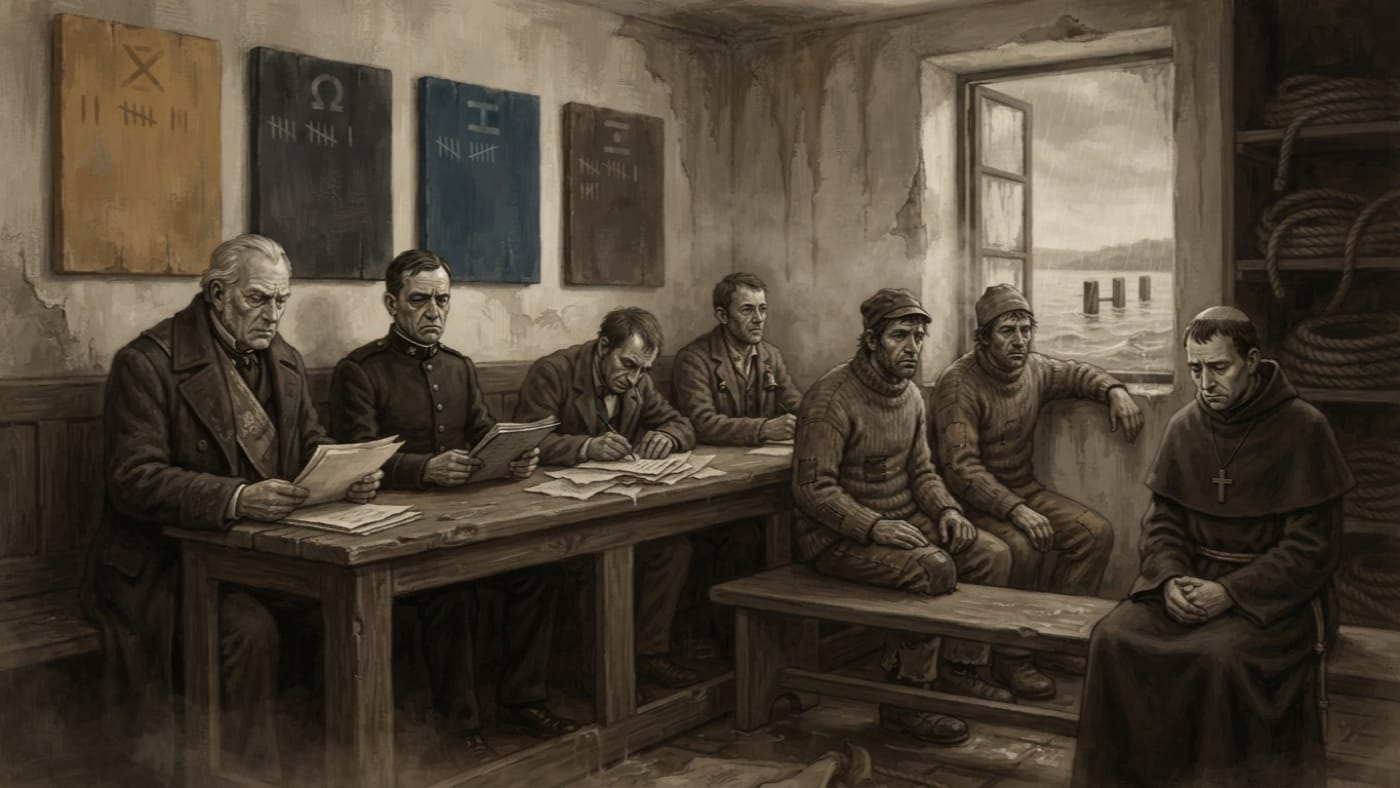
The bench sits in a damp municipal room above the rope store. The Tagus account says that much and no more, and it is enough. Picture wet hemp below, wet witnesses above, and a floor between them that has opinions about both.
The composition is the Court's most valuable feature, because it is the only part of the Court that never floods. The account gives seven seats:
- a river judge;
- an assessor of the Bureau of Tithes, which in practice means a Tithes assessor wearing the expression of a man whose ledger has been rained on personally;
- a Records witness from the Bureau of Records;
- a Bell clerk, presumably answerable in some fashion to the Bureau of Bells, since somebody must certify that the two bells have actually rung;
- two boatmen;
- one priest of Saint Iago.
That is the full membership. The record does not say who chairs the session, who votes, whether anyone votes, or how anyone is appointed, so I will not arrange a hierarchy to suit my taste. I will say only that the river judge carries the title most likely to be painted on a door.
The boatmen deserve particular mention. In the words of the Tagus account, their testimony is "respected only after disaster." On a calm day a boatman's view of the current carries roughly the authority of a gull's. Once the third notch is under water and the bells have rung twice, the same man becomes, for a short and unpleasant season, the most expert witness in Toledo. Afterwards the river falls and his credit falls with it.
The priest of Saint Iago blesses the proceedings. The Tagus account describes him as wearing "the expression of a man blessing a tax audit in a cellar." I have no better description and I refuse to compete with that one. Toledo's memory of the Order of Saint Iago is a memory of siege and fire, and its priest now blesses the allocation of soggy wool. History has a dry sense of humour, and in this room it is about the only dry thing.
#On the Business of Loss
The Court assigns. That verb comes from the source, and I keep it. The Tagus account lists the Court's subjects as loss, delay, spoilage, drowning, bridge damage, ferry suspension, emergency passage, and corpse recovery. It does not tell me how any assignment is calculated, so the reader will find no compensation formula here. What the list shows is how much ground the Court covers.
Loss and spoilage are the merchant's complaint. Delay belongs to everyone, and Tithes treats it as a sin. Drowning and corpse recovery belong to the families, to Records, and to whichever bank the body comes ashore on. Bridge damage and ferry suspension belong to the city, which pays for the crossings and collects their tolls. Emergency passage belongs to whoever can show that his cargo, his patient, or his column cannot wait for the water to go down.
A flood does not take these questions in turn. They all arrive together, on the same wet afternoon, each with its own office and its own grievance. The Court exists to decide which of these misfortunes is whose. Everyone agrees the misfortunes happened.
#On Cargo Made Devotional by Immersion
The last item on that stamp is the reason anyone outside Toledo has heard of the Brown Court.
Cargo made devotional by immersion is the Tagus account's phrase. It names the problem that arises when a river with a martyr-city on its bank gets into the merchandise. Ash from the Cinder Trials drifts onto the water. Pilgrim ribbons and badges are thrown in. Toledo's dead have a long reputation for lying close under the surface. Anything that falls in comes out with a doubtful status.
The Tagus account gives one illustration, and I offer it as an illustration and nothing more. Suppose a grain cart tips into floodwater below Toledo. Its grain may then be spoiled grain, river-contaminated grain, martyr-contact grain, emergency broth stock, illicit relic medium, or fish food. In the account's words, the answer depends on "which office arrives first and whether the owner can afford vocabulary." The same account adds that a drowned pilgrim badge may be rubbish at the upper quay and a touch-relic three bends downstream, an observation the Bureau of Pilgrimage would prefer not to see in print.
I have no record of the Court ruling on any particular cart. The example shows why the category exists. It does not report a verdict. A cart of grain cannot be holy, taxable, condemned, and edible all at once. The Court decides which it is, and the owner's luck usually decides which way the Court leans.
#On Petitions, Boards, and the Dead Who Drift
The Tagus account also describes the petitions of flood season. During fever seasons the Bureau of Mercy petitions for bridge priority for its carts. Tithes petitions to keep the tolls running. Records petitions for dry copies. The Bureau of War petitions for every road, because, in the account's phrase, "War's appetite has never learned table manners."
Those are the claims as the account records them. It does not record which claim won on which day, and I will not invent a hearing where Mercy wins and the reader is moved.
The Court keeps precedence boards painted in four colours. It revises them, according to the account, "whenever enough people have died to make the last revision embarrassing." The account does not say which colour stands for which office, or how many deaths count as embarrassing. I suspect the Court has never written that number down, because writing it down would be the most embarrassing revision of all. The account also states that in practice the loudest escort crosses first, unless the river has already taken the bridge. I record that as the account's observation of practice and not as a rule of the Court. Most real rules start out the same way.
One more item comes from my own margin on the Tagus plate, and I flag it as mine, undated, and unsupported by any surviving docket. It says the Brown Court once spent six hours deciding whether a floating coffin had crossed voluntarily, and that the deceased, saying nothing, settled the matter by drifting out of jurisdiction. I name no coffin, no family, no session, and no verdict beyond the drifting. The Court's jurisdiction ended somewhere downstream. The anecdote does not say where, and neither will I.
The Tagus plate gives the A.S. 188 Saint Luria Rise, with its sixty-seven votive crutches and competing cure claims, under the heading "On Flood Rights and the Brown Court."
Corrected. The Rise sits under that heading because it concerns floods, and the placement is not a record of proceedings. As the Saint Luria Rise file states, nothing shows that the Brown Court heard the crutches, that the water passed the third notch, or who sat on any bench that morning. The date and details of the Rise are the Tagus account's own. No docket survives.
#On the Present Survey
As of this A.S. 201 survey, the Brown Court of Toledo is a municipal flood bench with a known trigger, a known room, seven known seats, and a known list of misfortunes to divide. Everything else about it remains outside the record: who founded it, under what charter, where its authority ends, and the names of its officers. Its authority has never been shown to reach past the rope store's stairs and the stretch of river that floods them.
The Tagus pays no attention to any of this. It rises past the third notch when it pleases. It stays there for two bells, or it does not. When it stays, seven people climb to a damp room and divide among the living whatever the water has wrecked. They write their ruling on paper, the paper goes downstairs, and the ropes below it go on rotting.