

#On the Compilation and Its Subject
This plate is compiled in A.S. 201, 1911 CE, from what the Codex already holds on the Tagus. That year belongs to the compilation. The flood belongs to A.S. 188, 1898 CE, thirteen years earlier, and the river has never asked to share credit with a clerk.
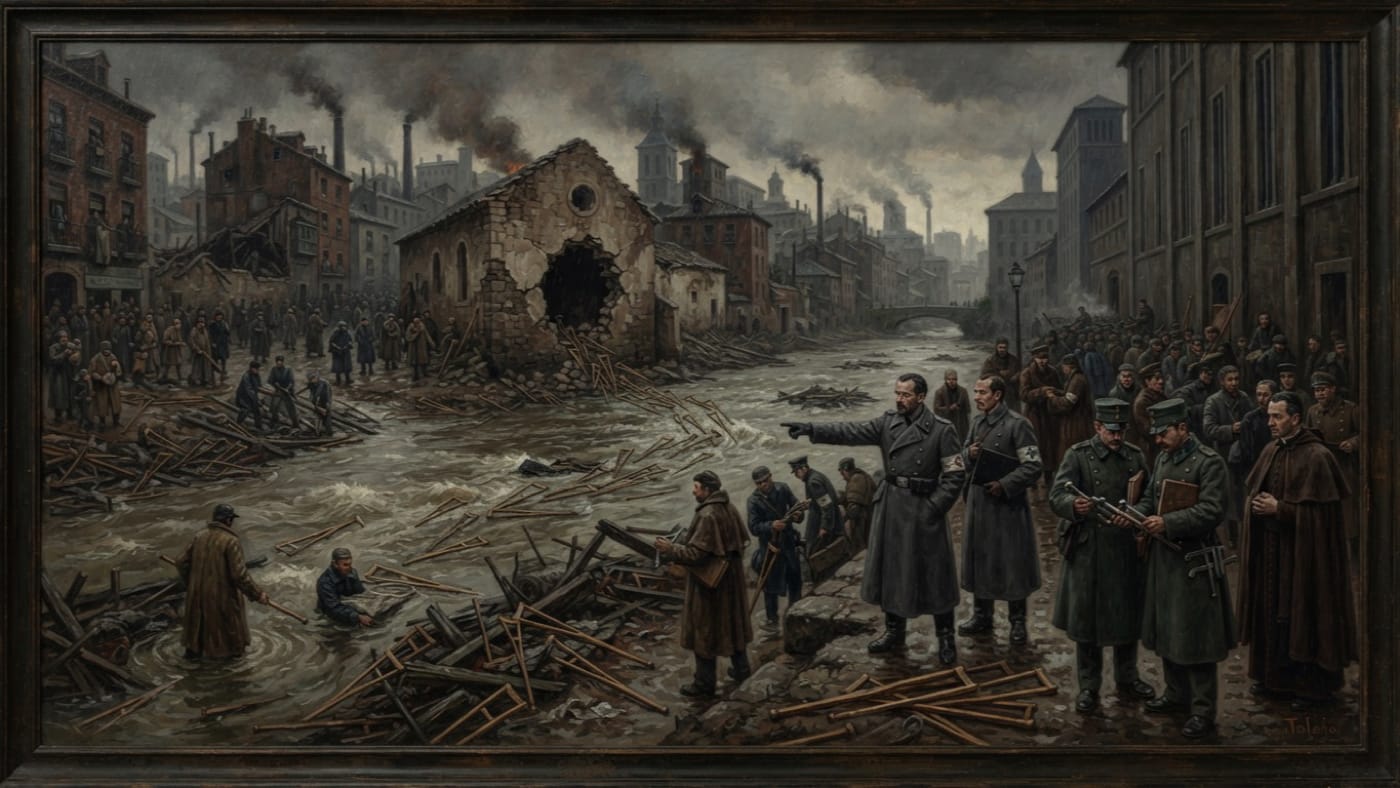
The Saint Luria Rise is, in the words of the Tagus file, the worst flood on the current books. I keep the phrase exactly as written. "The current books" ranks ledgers. It does not rank every flood the river has committed since it first learned to be brown, and I will not have some provincial almanac quoting this plate as proof of an all-time record. The Rise takes its name from a chapel. The chapel bears the name of Saint Luria. Its lower wall came down in the flood and sixty-seven votive crutches went into the current.
That is the event. Everything after it is jurisdiction.
A reader who came for a saint may leave by the side door. The Codex holds no life of Saint Luria, and a chapel's dedication tells us nothing about her feast, her relics or whether she ever set foot near Iberian water. The file holds a name over a door, a wall that failed and wood that floated. I have built careers on less, but never biographies.
An archived Codex referral once filed "Saint Luria Rise" among persons, pending review of identity.
Corrected. The Rise is a flood. Saint Luria is the dedication of the chapel it was named for. No person is under review, and no vita will be carved to fill the empty niche.
#On the Wall and What Went Through It
The votive crutch is among the oldest receipts in the Church. By custom a pilgrim arrives leaning, leaves upright, and nails the wood to the chapel wall as proof the transaction cleared. That is the custom. The Tagus file does not say who left these sixty-seven, in what decade, or whether any of them walked out unaided. A crutch on a wall proves that somebody parted with a crutch. Gratitude hangs there. So does the heir who cleared a dead man's cupboard and wanted the chaplain to feel useful. On a nail they look the same.
The lower wall collapsed. The record says that much and stops. It holds no mason's report, no complaint against the mortar and no flood mark scratched on the surviving stones. I supply no cause. A wall standing in the Tagus during the worst flood on its books needs no conspiracy to fall over.
The crutches went with the water. Wood floats. That is a property of wood, and Medicine would later make the point with less charm than I do. Tithes' valuation names a metal cap as one of its measures, so some of the crutches were capped. How many, the file does not say. Nor does it say how far they travelled, how many came ashore, or whether the river kept a few for itself as a handling fee.
By morning three districts had claimed miracle-cure rights over crutches recovered from their banks.
The record names none of the three. It does not say how many crutches each bank yielded or what exactly a cure right granted. Here I can do no more than read the words in the claim. The crutch had hung where healing was alleged. The claimants wanted the allegation to come ashore with the wood, preferably on their side of the water, and preferably before breakfast.
#On the Brown Court and the Missing Docket
Anyone who has read the Tagus plate expects the Brown Court of Toledo at this point, and the Brown Court is worth describing, provided nobody mistakes the description for minutes of this case.
By the general account, the Court convenes when the river stands above the third notch of the eastern quay post for more than two bells. Its bench is a river judge, a Tithes assessor, a Records witness, a Bell clerk, two boatmen and a priest of the Order of Saint Iago. It assigns loss, spoilage, emergency passage and recovery, and it rules on the troublesome category of cargo made devotional by immersion. Sixty-seven crutches loose in floodwater might have been built for that category.
The file does not say the Brown Court heard them. It does not say the Rise passed the third notch at Toledo, who sat on any bench that morning, in what room, or for how many bells. Neither the chapel's address nor a map of the flood survives into the Codex. The category exists. The docket does not.
The general quarrels of Tagus flood seasons are on record, and they show how the offices arrived at the bank. Tithes wants toll continuity. Pilgrimage wants the shrines open. Mercy petitions for its fever carts, but it plays no recorded part in the Rise, and I do not draft it in to swell the cast. Medicine's place in this affair belongs to this affair alone. It came to object.
#On the Four Positions
The Bureau of Tithes valued each crutch by wood, metal cap, devotional contact and resale potential.
I admire the list. Its assessors travel with scales and gilded ledgers, and here they faced objects that were part timber, part iron and part rumour, and they gave each part its own column. The first two columns can be weighed. The third, devotional contact, makes a holy history into a surcharge. The fourth is the honest one. Resale potential asks what someone will pay, and a ledger that asks that question has stopped pretending to ask any other.
Medicine objected that a crutch floating away from a shrine does not prove healing.
Medicine was correct. Correctness is the habit of Medicine that Doctrine forgives least. The objection is narrow and complete. The movement of an object proves the movement of the object. A cure needs a body, a before and an after, and none of the three floated downstream.
The Bureau of Pilgrimage objected to Medicine's tone.
The file records an objection to tone and none to substance. Pilgrimage sets routes, issues permits and licenses the sale of pilgrim tokens, and a crutch publicly certified to have cured nothing makes poor stock for any road. Nobody refuted Medicine. Pilgrimage found it rude. In the Church, a great deal of dogma started life as a complaint about manners.
The Bureau of Doctrine ruled that the question of cure was secondary to the authenticated movement of hope by water.
I sit within that Bureau and I salute the sentence. Look at what it authenticates. Healing it leaves alone. Movement it confirms, and movement no one disputed, since sixty-seven crutches demonstrably left a wall. Doctrine took the one undisputed fact on the bank, gave it the noun "hope" and sealed it. Medicine's objection stayed true and stopped mattering. The districts kept their crutches and lost their miracle. That is a theologian's peace, and I have watched worse settlements kill more people.
The crutches were auctioned in pairs.
Sixty-seven does not divide by two. The file does not say how the pairing was managed, whether all sixty-seven reached the block, where an odd crutch went, or whether some never came out of the river at all. It records no lot count, no date, no bidders and no prices. Nor does it record whether the chapel, the claimant districts or anyone else held title to the wood before the wall came down. Somewhere a single crutch either sold alone, went into a pair it did not match, or stayed with the Tagus. All three outcomes fit the record. None of them is in it.
#On the Broadsheets
The popular press of A.S. 188 did not wait for Doctrine. The Tagus plate already carries the correction. I restate it here because broadsheets breed in damp places.
A.S. 188 popular broadsheets claimed Saint Luria "walked the river" during the flood.
Corrected. No saintly locomotion has been authenticated. Sixty-seven crutches moved, three shrines profited, and one Medicine clerk was bitten by a pilgrim who disliked anatomy.
Note the arithmetic. Three districts claimed and three shrines profited. The record never says these are the same three, that each district had a shrine, or which shrine took which crutches. Two threes in one file are a coincidence of number until some document matches them, and no document does.
The bite stands without a name. The file gives no pilgrim, no clerk, no wound and no hearing. It shows that Medicine's objection reached somebody's teeth before it reached a seal.
#On the Present Reading, A.S. 201
Thirteen years on, this compilation holds what the Tagus file held and nothing more. A chapel wall fell. Sixty-seven crutches entered the river. Three districts claimed cure rights by morning. Four offices gave four answers. Doctrine sealed movement and left healing unexamined. The wood sold in pairs, and the odd number was never explained.
No cure from the Rise is demonstrated in the Codex. No one recorded who first hung the crutches, and no one counted how many walked away from them. The Codex knows nothing of Saint Luria beyond the dedication of a chapel that lost its lower wall. Doctrine was always content to file the matter under hope, which needs no body, no before and no after. It is an excellent category. Nobody has ever been able to sue it.