
#On the Bureau's Charge
The children's edition of the Martyrology of Saint-Malo shows the bayonets as red triangles. Any honest account of the Bureau of Pedagogy should start with that small red shape on cheap paper, because that is where the Bureau starts its own work. It takes something too sharp for a child's hand and cuts it down to something a child can hold.
Pedagogy is the Synod's office of method. The Bureau of Doctrine decides what a lesson means and puts its imprimatur on the catechism. Pedagogy decides how the lesson looks on the bench: the order it comes in, how many times it is said aloud, and what happens when it comes back wrong. Doctrine owns the sentence. Pedagogy owns the drill. The Catechism Schools answer first to Doctrine. Pedagogy works inside them with a stamp of its own, the way a confessor works in a house he does not own.
Its founding is unrecorded. No charter has crossed my desk, and I have seen no record of a first director or a seat. Strasbourg is the capital of everything, so people who have never tried to find Pedagogy's door assume it is there. What survives is the work: primer cards, children's editions, listening notes and corrections. A Bureau known only by its paperwork is the purest kind.
#On Lessons and Corrections
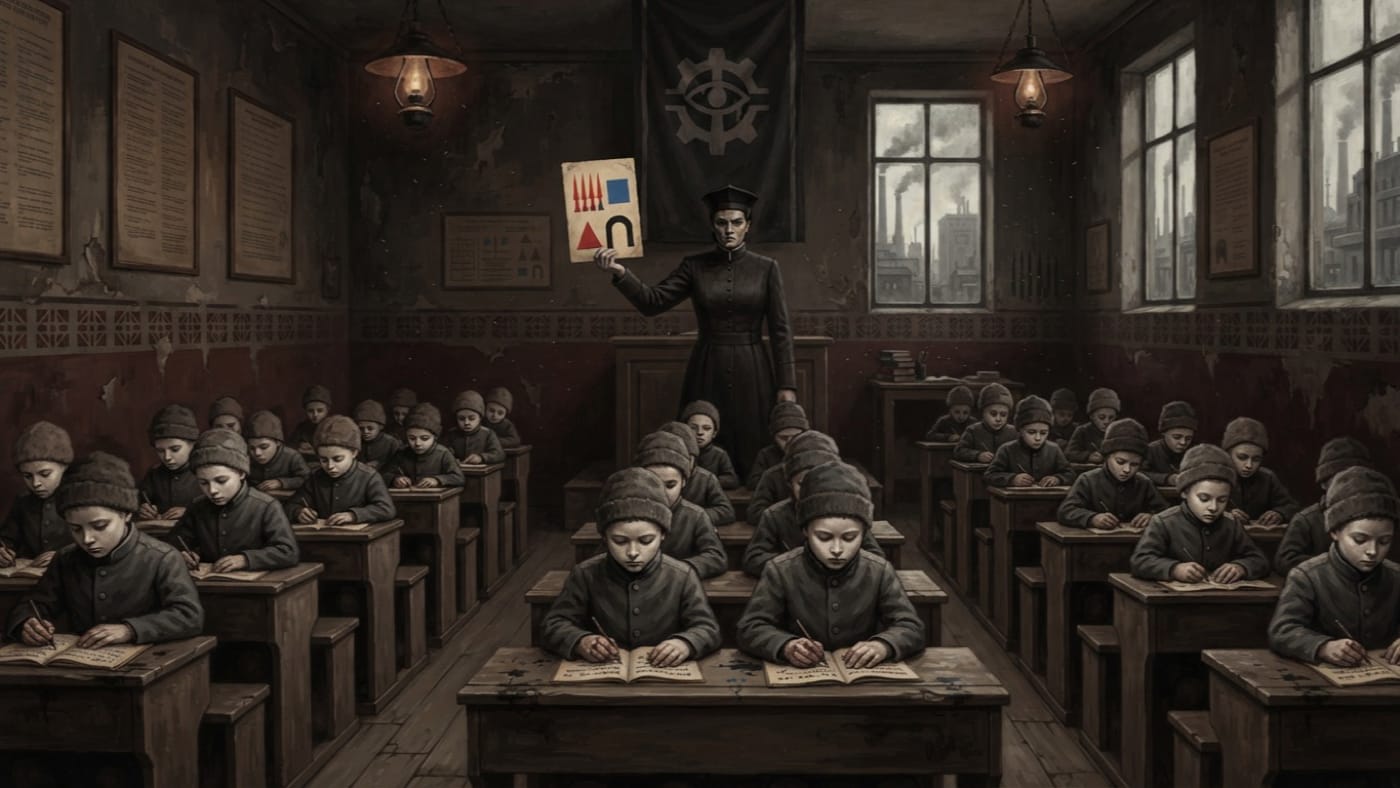
Wherever its cards have been found, the Bureau's method runs in four steps: image, answer, repetition, correction. The instructor raises a picture. A child gives the approved word. The bench repeats it until the word no longer belongs to any one mouth. Then the instructor listens for the mouth that kept it.
This method sits on a school day that older authority had already arranged. The Creed comes first, spoken together by bench-row before any letter is shown. Arithmetic follows as the Creator's order made countable. Geography is a litany of holy places. History is a procession of approved causes and approved enemies. Children copy until their fingers stain and chant until the weak voices learn to save breath. They find out early that when memory fails, the lesson is stored in the body. Clerics and wardens do the teaching. Pedagogy supplies what they teach with: the card in the instructor's left hand, with the answer printed on its back.
Then the school tests what the cards have built. The Trials of Loyalty set obedience against affection: strike the peer, give up the secret, name the parent. Hesitation earns watching. Quick compliance earns a line in the Book of Promise, and the Book sorts its children toward cloister, field, levy, forge or choir. Whether Pedagogy designed the Trials is unrecorded and does not matter. A child who has spent every school morning answering a card before the instructor finishes raising it is ready for any question the Synod cares to hold up.
#On Saint-Malo in Printed Shapes
In A.S. 10, forty-three pilgrims entered Saint-Malo by the coastal road from Dinan. Thirty-one were certified dead under Republican Guard bayonets and musket fire. Seven survived as wounded witnesses. Five were entered as consumed by the event. The memorial office answers with thirty-one tolls from Bells and forty-three seconds of silence. Survivors and parish scraps counted the dead long before any Bureau seal touched them. Every seal since then, Pedagogy's included, has been applied after the fact by an office that wanted a share.
Pedagogy's share is the shape: red triangles for bayonets, blue squares for pilgrims and a black arch for the gate. The card is honest about one thing. A bayonet is a point, and a point is what killed them. Everything else on the card is administrative mercy. It shows no faces and no blood, and no Father Gaël refusing to hand over the Reliquary in four words. The child learns that triangles go in, squares fall and the arch stays. The surviving cards do not show how to draw a square that is absent, which leaves the five without a mark.
Older abridged martyrologies give the dead of Saint-Malo as fourteen.
Fourteen was the first broadsheet count of verified martyrs. The ratified roll is thirty-one certified dead, with seven wounded witnesses and five consumed absences kept as separate entries. Squares are cheap. Print all thirty-one.
At the Porte Saint-Vincent itself, the Bureau met an older school and lost. Saint-Malo's children learn the massacre with brooms, buckets and ash, scrubbing the gate-run under a warden's eye before the anniversary. Their catechism is spatial. This stone is for Gaël. This cord protects the five absences. This post is struck after the silence. This jamb may be touched with two fingers and never kissed. Each class row recites the Thirty-One Names, and nobody points at the absences.
Pedagogy sent printed cards to replace the stones. The children used them to dam gutter water. A senior warden recovered three of them from a crab stall and wrote a report that I keep copied for my own refreshment. "The gate cannot be taught flat," he wrote. The Saint-Malo file does not say whether the cards were ever sent again. I have not asked, because some defeats teach more when left unfiled.
#On the Household's Last Words
The Creed is the Bureau's best listening instrument. When twenty-seven children say the same words, the one who says something different is easy to hear. Pedagogy holds the primer cards, and the cards carry the short school form, matched card to mouth. A mouth that departs from the card has usually learned the difference in a kitchen.
BUREAU OF PEDAGOGY — SCHOOLROOM LISTENING NOTE, A.S. 199 Primer class, Ward 6. Twenty-seven children recited standard short Creed. Twenty-six mouths matched card. One child supplied obsolete domestic ending: "and keep my mother from the List." Teacher response: corrected. Child response: silent. Household inquiry: █████████████████. Disposition: household prayer forms confiscated; child reassigned to paired recitation.
Read the disposition carefully. The child was corrected and went silent. The household's prayer forms were confiscated. The child was given a partner for recitation, so any later try at a private ending would have a witness at the elbow. Everything beyond those lines is sealed, and I have no wish to pry at a seal for the sake of an article. The note does not name the city. Ward 6 could be anywhere a ward has a number.
What the note does record clearly is what the drill is for. A household prayer says the family prayed before the Bureau arrived. The card says it did not. Purity deals with forbidden language once it becomes a charge. Pedagogy catches it sooner, while it is still a child's addition to a line, warm from the mother's mouth.
#On the Enemy's Primers
The Republic's Public Instruction also taught children with pictures. The Procession of Silence left engravings that the prefectures carried into schoolrooms the next morning. They showed a corrected citizen and posed a question about progress. Small hands went up, and the approved phrases were written down. One confiscated Prague primer from A.S. 31, On Proper Quiet, shows a bandaged pilgrim beside a smiling child. A later owner used a pin to scratch a question under its moral: "Free to say what?"
Pedagogy dislikes the comparison because the enemy's outward sequence is its own: image, answer, repetition, correction. The benches are the same height and the ink is the same ink. I have defended the difference in print, and I defend it here. The Republic denied the Creator and taught that speech belonged to the state. Our schools teach that speech belongs first to the Creator, then to Order, then to the citizen by licence. The owner is different. The child's mouth is the same. Similar tools do not make similar masters.
For a few years they do make similar children. I leave that part to Doctrine.
#On Present Application
As of A.S. 201, Pedagogy's cards are still in use across the Catechism Schools, and selected Pedagogy houses hold supervised copies of the Procession plates for advanced instruction. Its claims overlap with everyone's. Doctrine holds the master text. Records holds the rolls and the aptitude columns. Purity holds the charge sheets. Mercy keeps the orphanages, whose children arrive with no kitchen to unlearn. Education counts the crates. Pilgrimage owns the road to Saint-Malo and Tithes owns the candles sold beside it. Pedagogy owns neither, but it owns the picture of both in a child's head, drawn in three shapes and three colours, small enough for the smallest hand.