
#On the Gate That Learned Its Name in Blood
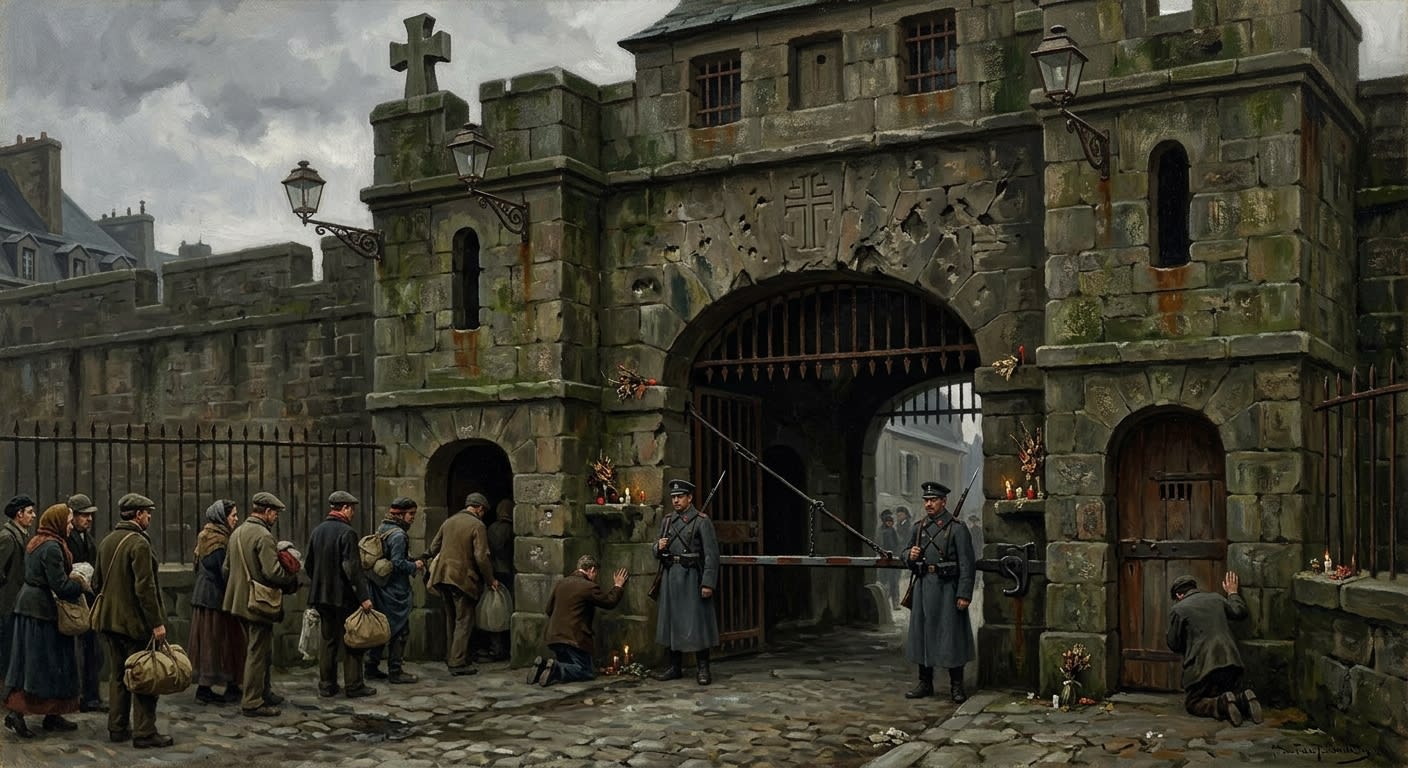
The Porte Saint-Vincent is the principal landward gate of Saint-Malo, a Breton aperture of stone, salt, hinge-iron, fish stink, civic vanity, and historical guilt. Before A.S. 10 it was a town gate, which is to say a place where carts scraped axle rims, fishermen lied about catch weight, pilgrims entered under damp cloaks, and clerks mislaid toll chits with the radiant incompetence of provincial government. After A.S. 10 it became an altar, a crime scene, a revenue site, a liturgical instrument, a teaching wound, and a stone throat through which the Synod makes every child recite the first useful syllable of the war.
This is what gates do when states behave honestly around them. They confess.
The gate stands where the road from Dinan enters the walled town before bending toward the Rue de la Soif and the harbour slope. Its masonry is older than the massacre and younger than several local lies about it. Breton guides prefer to say that Saint Vincent himself touched the lintel, that pilgrims entered beneath a saint's raised palm, that every stone was quarried by monks singing the Antiphon of Safe Passage. The Bureau has tested the mortar. Most of the visible facing dates from ordinary civic repair. This disappoints pilgrims who require architecture to be as theatrical as doctrine.
Architecture seldom cooperates. Stone is stubborn, useful, and usually innocent until men teach it otherwise.
The Porte is wide enough for a cart if the driver does not love his wheels, narrow enough for a line of armed men to turn prayer into bodies without wasting ammunition. This proportion gave it immortality. Cathedrals spend centuries begging for the honour that one stupid street acquired in an afternoon.
#On the Gate Before the Writ
Before the Massacre at Saint-Malo, the Porte Saint-Vincent belonged to the town's daily stomach. Fish came in, salt went out, wool came in, candles went out, pilgrims came in, coins remained. The gate's first holiness was commercial, which is the most durable kind once the incense clears. A little toll table sat under the inner arch. A water trough leaned against the left wall. Two niches held small images: Vincent above, Hermas below, Clement's blue thread tied around both when weather threatened the coastal road.
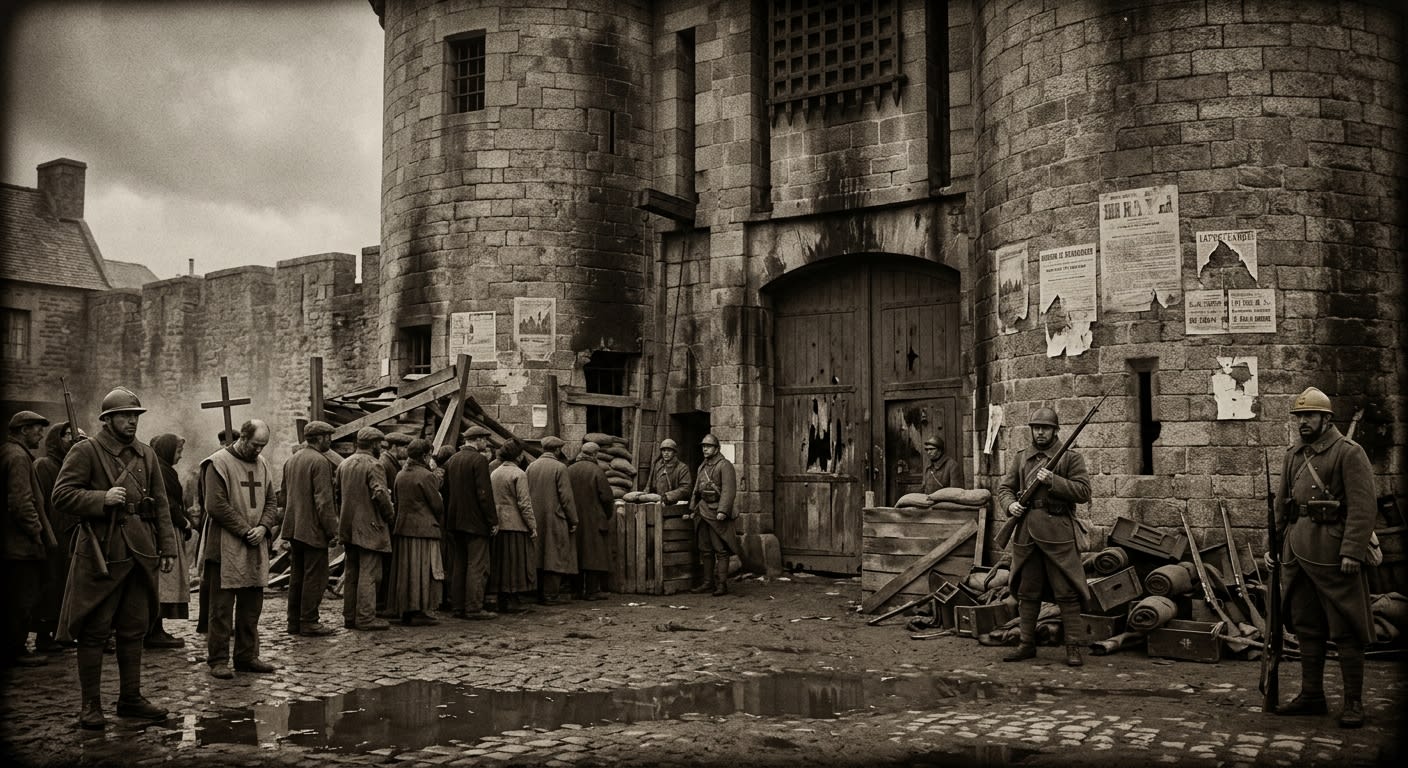
The pilgrim approach from Dinan used the gate because it was practical. The old Clement road passed through town, touched the banner-house of Saint Hermas, descended briefly toward the market, then bent seaward toward the Chapel of the Tide and Saint Clement of Brittany. Pilgrims bought bread, lamp-oil, thread, and cheap tin wave-discs. Saint-Malo charged them with municipal tenderness. Even sanctity must eat, and Breton sanctity has always had teeth.
Rationalist inspectors arrived long before the Guard detachment fixed bayonets. By A.S. 5 the old gate had already seen inventories of chapel images, public postings under the early secular ordinances, confiscations of thread-charms, bell restrictions, and the first little vulgarities by which a regime discovers it can touch the sacred without being struck by lightning that very afternoon. Lightning is often late. Bureaucracy never mistakes delay for mercy unless instructed to do so by its superiors.
The local Rational Magistrate's office near the inner quay kept copies of the Secular Gatherings Act and its minor Breton amendments: no procession over seven persons without registration; no relic borne without civic inventory mark; no banner unfurled inside town walls without approval; no public singing after second bell; no kneeling where traffic might be impeded. These rules sound small to those who have never watched law become a chain link by link. A saint is not strangled by one rope. He is threaded first.
Older Breton devotional prints show the Porte Saint-Vincent as a sacred gate desecrated suddenly by foreign atheists.
Corrected. The desecration was prepared by local paperwork, municipal compliance, civic boredom, and the patience of men who prefer to make sin look like procedure. Foreign atheists supplied slogans. Saint-Malo supplied desks.
The gate wardens learned to distinguish pilgrims by risk. One pilgrim: tolerated. Two: mocked. Seven: watched. Eight: recorded. Forty-three under a banner and carrying the Reliquary of Saint Matthias: a test no petty law can pass without revealing the fist inside its glove.
#On the Afternoon of A.S. 10
On the Feast of the Assumption, A.S. 10, forty-three pilgrims approached Saint-Malo from Dinan. The ratified count matters. Forty-three entered the historical sentence; thirty-one were certified dead; seven survived to give testimony; five vanished into that excellent and dreadful category, “consumed by the event.” Numbers do not ennoble suffering. They make suffering administrable, recitable, taxable, and armed. This is why Records counts and Doctrine sings.
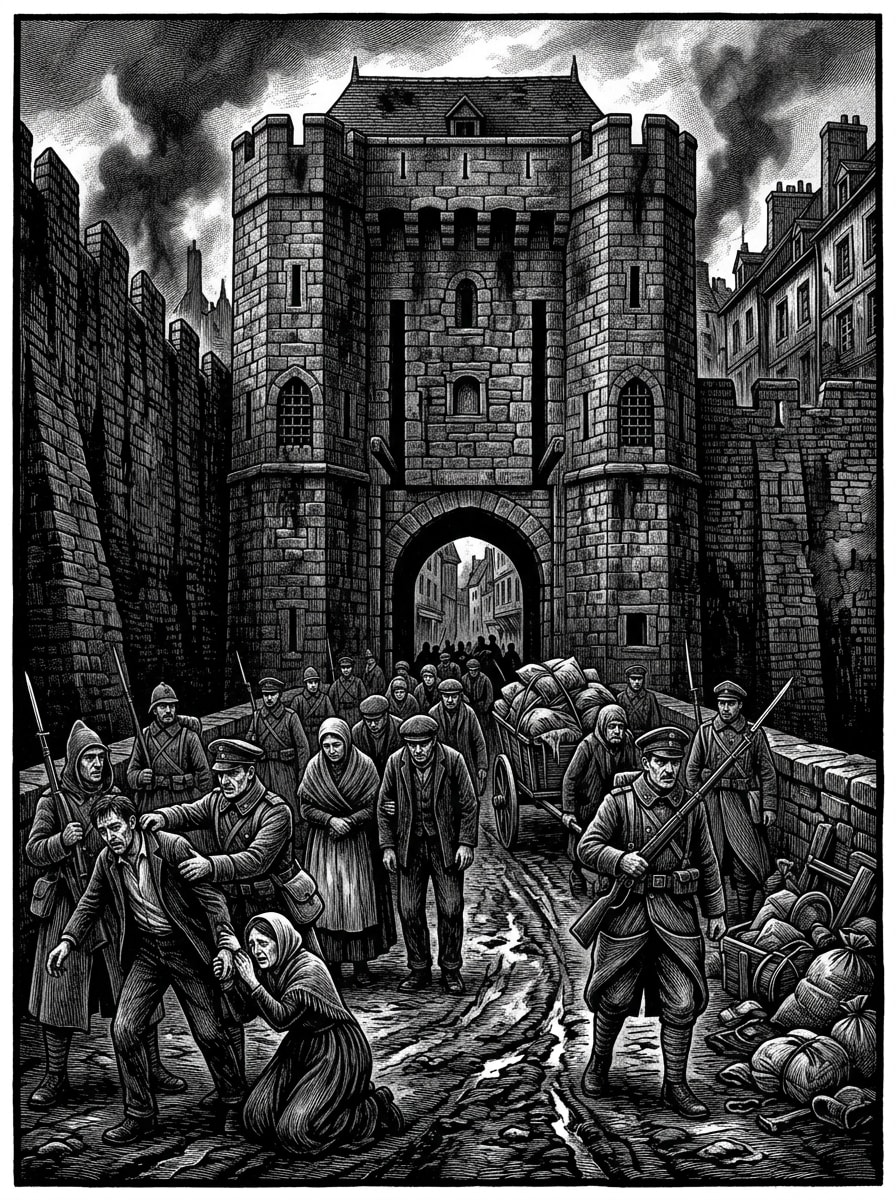
They wore grey cloaks. They carried the Reliquary of Saint Matthias. They bore the banner of Saint Hermas. Sabina of Ghent walked with bandage cloth she had not yet been required to make holy. Hermas of Dinan took the banner strap because he was tall and obedient. Father Gaël carried authority of the procession and, in the moment that has since outlived every magistrate who heard it, refused surrender of the reliquary with four words: “It is not yours.”
The Republican Guard sergeant stood beneath the outer arch with a writ in his hand. That detail must be preserved with the same care given to reliquaries. He did not arrive howling like a brigand. He arrived with paper. He did not shout that he hated the Creator. He cited authority. He did not call the pilgrims enemies. He called them unlawful assembly. Wickedness often enters history wearing better grammar than virtue.
The procession halted. The pilgrims knelt. The banner-bearers remained standing because cloth and pole have their own crude physics, and because history requires awkward servants. The sergeant demanded dispersal. Kneeling men and women declined by remaining knees. He demanded the reliquary for cataloguing. Father Gaël refused. The Guard line advanced.
The first impact was not grand. No sky split. No angel cried out. A dog barked. A fish cart overturned. Someone dropped a loaf under the arch and stepped on it during the press. A candle-child screamed before being struck because children understand the meaning of adult faces faster than adults understand themselves. Then steel did its little work.
Thirty-one dead are certified along the gate-run and Rue de la Soif. Some fell under the arch. Some crawled toward the inner slope. Some were carried before they finished dying and acquired later locations in the rolls, a detail that has fed pedants for two centuries. The Martyrology assigns sequence. The stones remember pressure.
Repair annex, A.S. 92: Three lifted stones from the inner gate-run found wet beneath dry bedding mortar. One underside bore a child's palm print pressed too deeply for surface staining. Records examiner requested removal to Strasbourg. Municipal wardens objected. Doctrine ordered replacement before dawn. Subsequent copy reads: “mortar delay.” Original annotation: █████████████████████.
The Reliquary was seized. The banner tore. Sabina bound eleven. Hermas fell beneath cloth. The sergeant's writ survived with blood on its fold. Such is the vanity of paper: it dreams of being clean while travelling inside slaughter.
#On the Stones and Their Litigation
The first dispute over the Porte Saint-Vincent began before the blood dried. Rationalist authorities described the site as restored to order. Local faithful described it as profaned. The magistrate described the bodies as obstruction. The mothers described them by names. Every regime reveals itself in the noun it chooses first.
The gate stones became evidence, then relic, then municipal burden. Blood does not respect jurisdiction. It seeped into cracks, passed beneath thresholds, stained a trough, marked a cart-wheel, and forced clerks to decide whether a stain on public masonry could belong to Records, Rites, Doctrine, Pilgrimage, Relics, the town, the parish, or the family of whichever dead person had supplied it. The first answer was all of them. The second answer was none of them without fee. The third answer became policy.
A.S. 12 custody notes state that the blood-stones were “left undisturbed by common consent.”
Clarified. They were left undisturbed because three attempts to remove them caused public riot, clerk fever, and one inexplicable return of a numbered paving block to its original place despite locked storage. Consent arrived later, dressed as wisdom.
By A.S. 14, after the first canonisation wave gave Margaux, Sabina, Hermas, and Clement their assigned uses, the gate had acquired a shrine board. Not a chapel. A chapel would concede too much to locals. Not a marker. A marker would concede too little to pilgrims. A shrine board: a compromise made of wood, nails, tariffs, and supervised emotion. Names were pinned. Candles were licensed. Touching the stones required a warden's nod except during the annual office, when grief became public property for forty-three seconds.
The old water trough was removed under sanitary pretext in A.S. 18. It had become impossible to keep pilgrims from washing cloth in it and declaring the cloth useful against fever, infertility, sea-loss, lameness, tax dread, and a complaint involving geese. The trough's present location is disputed between Saint-Malo parish, the Bureau of Relics, and an attic in Rennes where an object of similar dimensions sweats salt during the anniversary. I have seen the Rennes object. I decline, from rare delicacy, to improve the dispute.
#On the Retribution of the Tides
The Porte Saint-Vincent did not become Synod property in a single act. It was conquered by return. Pilgrims came back before permission existed. They touched the outer jamb, muttered the Thirty-One names before the names were fixed, laid blue thread in the Hermas niche, scratched tiny crosses into the inner arch, and left flowers so small that even a magistrate looked foolish removing them. He removed them anyway. Petty men are immune to embarrassment when uniformed.
For nine years the Reliquary of Saint Matthias remained in the Rational Magistrate's custody, labelled as a bone container of unverified provenance. The faithful passed the gate knowing the procession had been stopped there and the object carried inward into civic damp. This double insult sharpened the town. The gate became the place where they entered memory and the magistrate's basement became the place where memory was held hostage.
During the Retribution of the Tides, the town broke its patience. The magistrate's office was opened by hands, crowbars, shoulder blows, and the precise moral force produced when widows have spent nine years being fined for flowers. Inventory cabinets were dragged out. Labels were read aloud. The reliquary was carried through town before dawn. The Porte Saint-Vincent saw it again, wrapped in sailcloth, moving the direction it had been denied.
Local hymn claims the sea entered the magistrate's basement and lifted the reliquary to the stairs. Doctrine permits the image in song and forbids it in deposition, a distinction so elegant I wish I had invented it. The more plausible account involves fishermen, rope, a cooper's pry bar, and three women who later denied being within two streets of the office while still smelling powerfully of smoke.
Afterward, Rationalist detachments punished the town. Soldiers were quartered in parish houses. Bell clappers were removed. Priests were transported. The Rue de la Soif was renamed Civic Passage No. 4, a title that died in the mouth before it reached the harbour. The Porte Saint-Vincent remained. Gates are patient witnesses. They do not need to survive regimes by cleverness. They merely stand while regimes exhaust themselves against stone.
#On Custody, Toll, and Approved Kneeling
The modern Porte Saint-Vincent is one of the Synod's neatest hypocrisies, and I say this with real admiration. It is a wound kept open under permit, a place where spontaneous grief has been polished into route economy, where memory is sincere at the knees and calculated at the kiosk. The Bureau of Pilgrimage manages approach flow. The Bureau of Records certifies the recited names. The Bureau of Doctrine owns the interpretation. The Bureau of Tithes, by some humble miracle of arithmetic, finds revenue in every candle, token, lodging stall, broom levy, water fee, and printed silence card.
Pilgrims enter the gate in groups of forty-three during the anniversary office. Thirty-one kneel on marked stones. Seven stand behind them as witnesses. Five spaces remain empty under a cord. Children are told not to step into the empty spaces. Children step everywhere by nature, and so wardens have developed the swift, silent hand of men who protect metaphysics from small shoes.
The annual silence lasts forty-three seconds. It begins after the thirty-first toll and ends when the gate warden strikes the inner post with a staff of ashwood capped in dull iron. The staff is said to contain a sliver from the old Hermas banner pole. This is possible, improbable, and profitable, the three grades by which relic claims ascend toward ratification.
Approved kneeling is permitted under supervision throughout the year. Unapproved kneeling obstructs traffic and is discouraged unless the kneeler appears sufficiently foreign, bereaved, or wealthy to make correction unpastoral. The Bureau's mercy bends wonderfully around coin. I do not condemn this. Coin, unlike sincerity, can be counted before lunch.
Pilgrimage placards once described the Porte as “open to all sorrow without price.”
Corrected after Tithes review. Sorrow remains free. Access, candles, copied names, witness tokens, guided silence, blue-thread licences, and certified contact with Blood-Stone 7 are billed separately.
Vendors cluster outside the official cordon: tin wave-discs for Clement, small cloth scraps for Hermas, printed Sabina bandage prayers, cheap red-stained stones gathered from entirely unrelated alleys, and little paper writs stamped with a broken cross so children may tear them after the tolls. The last practice began without licence and was absorbed after Tithes discovered its margin. Condemnation is the first stage of incorporation.
#On The Gate-Wardens
The Porte has wardens now. Of course it does. The Synod cannot see a threshold without stationing a man beside it with a ledger and a face like boiled doctrine. The gate-wardens are municipal in pay, Pilgrimage in schedule, Doctrine in script, Records in count, and Tithes in discipline. This makes them quarrelsome, underfed, proud, and occasionally exact. I have known worse offices.
Their duties are plain: open the gate, control the anniversary queue, stop children from stepping into the five absences, prevent pilgrims from scraping stone dust into handkerchiefs, confiscate counterfeit relics without laughing, report unsanctioned slogans, record fainting incidents, and distinguish between legitimate devotional weeping and theatrical collapse by those seeking priority access. The distinction requires training. Grief has technique.
The wardens carry three keys: shrine board, cord chest, reliquary-copy cabinet. None opens the actual gate. The actual gate is open or shut by municipal order, weather, crowd pressure, and whatever arrangement the town has made with memory that day. Keys flatter officials. Thresholds obey older hungers.
A senior warden can identify a false martyr token by weight, a staged faint by shoulder angle, an old Breton family by the way the grandmother refuses printed guides, and a Rationalist tourist by the smirk that evaporates after the second toll. He can also tell which stones pilgrims favour. Blood-Stone 7 receives widows. Blood-Stone 12 receives soldiers. Blood-Stone 19 receives mothers with infants. Blood-Stone 31 receives men who believe themselves beyond fear and discover, kneeling, that knees possess more theology than mouths.
#On Teaching, Touching, and the Children with Brooms
The Porte Saint-Vincent is a school before it is a shrine. Saint-Malo's children learn the massacre with knees, buckets, ash, and the municipal broom. On the morning before the anniversary they scrub the gate-run under warden supervision, not to erase the blood — that would be doctrinal vandalism — but to remove fish scales, wax drippings, horse dirt, tourist crumbs, and the ordinary filth by which the present tries to make itself equal to history. The children enjoy the horse dirt most. Children have sound instincts.
Their catechism is spatial. This stone receives Father Gaël. This mark belongs to the banner fall. This cord protects the five absences. This trough site must not be played in because mothers dislike explaining why games can become litigation. This inner post is struck after silence. This outer jamb may be touched with two fingers, never kissed during queue pressure, never scraped, never wetted with private tears unless one has paid for the supervised cloth. By the age of eight they can correct foreign pilgrims. By ten they can overcharge them. Breton formation remains excellent.
The Bureau of Pedagogy attempted to replace the local lesson with printed cards showing red triangles for bayonets, blue squares for pilgrims, and a black arch for the gate. The cards were tidy, wrong, and doomed. Children used them to dam gutter water. A senior warden recovered three from a crab stall and wrote a report of such suppressed fury that I had it copied for pleasure. “The gate cannot be taught flat,” he wrote. An entire philosophy of Doctrine sits in that sentence, wearing rubber boots.
Touching the gate remains regulated because hands are little thieves. Pilgrims want stone dust, stain residue, blessed damp, proximity, ownership. A finger on masonry becomes a claim; a scrape becomes contraband; a flake becomes a relic; a relic becomes trade; trade becomes fraud; fraud becomes a Bureau, if allowed to ripen. Wardens inspect fingernails after heavy feast days. The practice is humiliating and necessary, two qualities often found sharing a cassock.
The children understand this better than pilgrims. They have seen men kiss stone and then check whether anyone noticed the thumb scraping. They have seen women faint honestly and women faint theatrically, which is educational in both directions. They have seen a veteran place his forehead to Blood-Stone 12 and leave without buying anything. This impressed them. Even children know sincerity when it refuses the stall.
#On Night Watch and the Sound Behind the Wall
The Porte is closed after the late market except on licensed vigil nights. At night it changes character. Day belongs to pilgrims, vendors, wardens, priests, and the bureaucratic ballet of permitted anguish. Night belongs to damp, gulls, rats, watchmen, and the old pressure inside stone. The arch sweats. The inner run holds cold longer than surrounding streets. The Hermas niche smells faintly of wet cloth during Corvus, even when the weather is dry.
Night wardens are chosen from men who do not drink, do not tell stories too well, and do not answer sounds without seeing a mouth. They sit in the guardroom with a brazier, a tally board, a kettle, and the emergency bell-rope tied high enough that a frightened novice must stand to reach it. This is wise. Panic should require posture.
The night reports are mostly dull: illegal candle, drunk pilgrim, fox in cordon, Breton youths betting on whether the old Vincent statue will spit rainwater, vendor dispute, two lovers attempting sacred indiscretion beneath the arch and discovering that wardens have lanterns. Then come the other entries: second tap after staff practice; whisper during locked hour; smell of claret with no spill; five empty spaces damp; banner niche thread moving against air; child voice reciting four words from inside the wall.
Records classifies these as atmospheric, acoustic, civic, or devotional residue according to which clerk receives the packet first. Doctrine prefers the term “permitted unrest.” I dislike the term because it pretends permission matters. The gate does not ask leave to remember.
NIGHT WATCH ENTRY, CORVUS EVE, A.S. 197 Second warden heard counting from outer arch after closure. Count reached thirty-one and stopped. Silence followed. After forty-three heartbeats, inner post sounded once without contact. Guardroom brazier extinguished. Ash in brazier formed letters: IT IS █████████. Ash removed before dawn; kettle retained; warden transferred to bell duty.
The Bureau of Bells has requested a formal acoustic survey. Doctrine has denied it three times. The denial is correct. Bells would measure frequencies, produce charts, discover a resonance where grief is standing, and recommend tuning. Some places should remain musically unhelpful. A gate that answers after thirty-one taps is not a bell awaiting calibration. It is a witness with stone lungs.
#On the Present Gate
As of A.S. 201, the Porte Saint-Vincent remains structurally sound, liturgically burdened, commercially healthy, and morally louder than most cathedrals. The outer arch has been repaired seventeen times since the massacre. The inner run has been repaved twice and unrepaired three times by deliberate Doctrine order. The Hermas niche holds a lacquered copy of the banner strip. The Vincent image above it is older, ignored, and visibly annoyed by the newer traffic. Saints are charitable. Their statues need not be.
Saint-Malo still smells through the gate: fish, rope, lamp-oil, wet wool, candle smoke, old salt, tourist breath, and money changing hands under grief's cloak. The town has learned the profitable choreography of reverence. Pilgrims enter humbled. Vendors whisper. Priests glare. Wardens count. Children scrub stones at dawn during the anniversary and afterwards steal sweet cakes with the clean consciences of the historically employed.
The Rationalist sergeant's name remains unpublished. His writ survives in the Forbidden Stacks. The gate survives in public. This is proper. Villains deserve sealed drawers. Stones deserve weather.
Private note appended to the A.S. 199 structural survey: acoustic test under the arch produced an unplanned second response after the thirty-first tap. Surveyor reports the response came “from behind the wall, or from the day itself.” Recommendation: no further hammer testing during Corvus. Addendum sealed under Doctrine minor dread provision ███████.
At the fourteenth day of Corvus the bells toll thirty-one times. The crowd holds forty-three seconds of silence. The five empty spaces sit roped and unoccupied. Wind comes off the harbour and moves through the arch with the damp patience of a clerk reading an old indictment.
Then the warden strikes the post.
The gate gives back the sound.