

#On the Silence They Printed
The Procession of Silence was the Rationalist Republic’s little sermon in blood: pilgrims seized from forbidden roads, cellar rites, chapel ruins, field shrines, and family kitchens; tongues slit or removed; mouths sealed under public placard; bodies marched through their own market squares beneath the slogan SILENCE IS PROGRESS. It began before the Republic had learned to call itself a Republic, in A.S. 3, when the Academies still smiled for portraits and spoke of public health, civic clarity, correction of superstition, and other pretty phrases by which educated men ask permission to touch the throat.
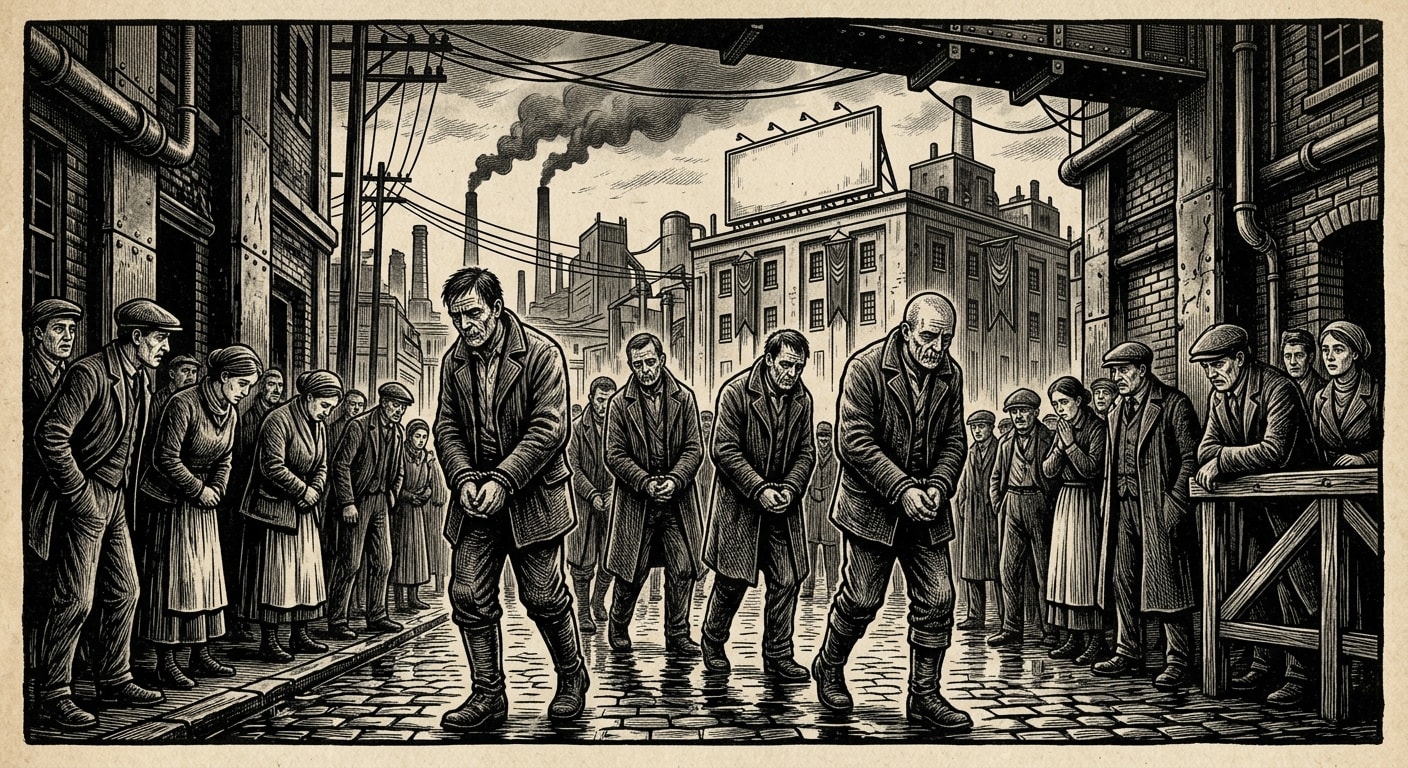
The Synod keeps copies of the engravings in the Forbidden Stacks. They are competent prints. I resent this. Bad art makes condemnation easier. These plates show peasants, ward-sisters, old men, children, and road-priests with bandaged mouths, watched by neat rows of citizens whose faces bear that smooth civic expression produced when authority has ordered horror and named it instruction. The caption is always the same. Silence is progress.
The title misleads in the usual enemy manner. The Procession was never silent. Blood makes noise. Feet drag. A gagged man breathes through cloth with a sound like a bellows filled with soup. Mothers do not scream less because a magistrate has classified screaming as counter-demonstrative disturbance. The Republic meant that the forbidden prayer had been silenced. It meant that witnesses had been trained. It meant that the tongue, that wet clerk of the soul, had been dismissed from office.
It was older than the Edict of Ironmouth, though Ironmouth gave it teeth enough to bite a continent. This point must be nailed down, since careless catechists compress every tongue horror into A.S. 30 and then wonder why Records throws inkpots. A.S. 3 supplied the demonstration. A.S. 30 supplied the law. Between them lay twenty-seven years of practice, refinement, printed courage, and the Republic’s slow discovery that a population may be ruled through the mouth before it is ruled through the register.
#On the First Processions
The earliest attested Processions occurred in occupied cathedral towns along the western road net, where Rationalist academy clubs had converted parish disputes into public experiments. Pilgrimage was the first target because pilgrimage moves. A kneeling man may be mocked, taxed, watched, or left alone until a better season. A walking column insults every checkpoint it passes. It carries relic, song, name, weather, petition, trade, and rumour from one town to the next. The Rationalists understood contagion in their own narrow fashion. They saw devotion travelling and reached for scissors.
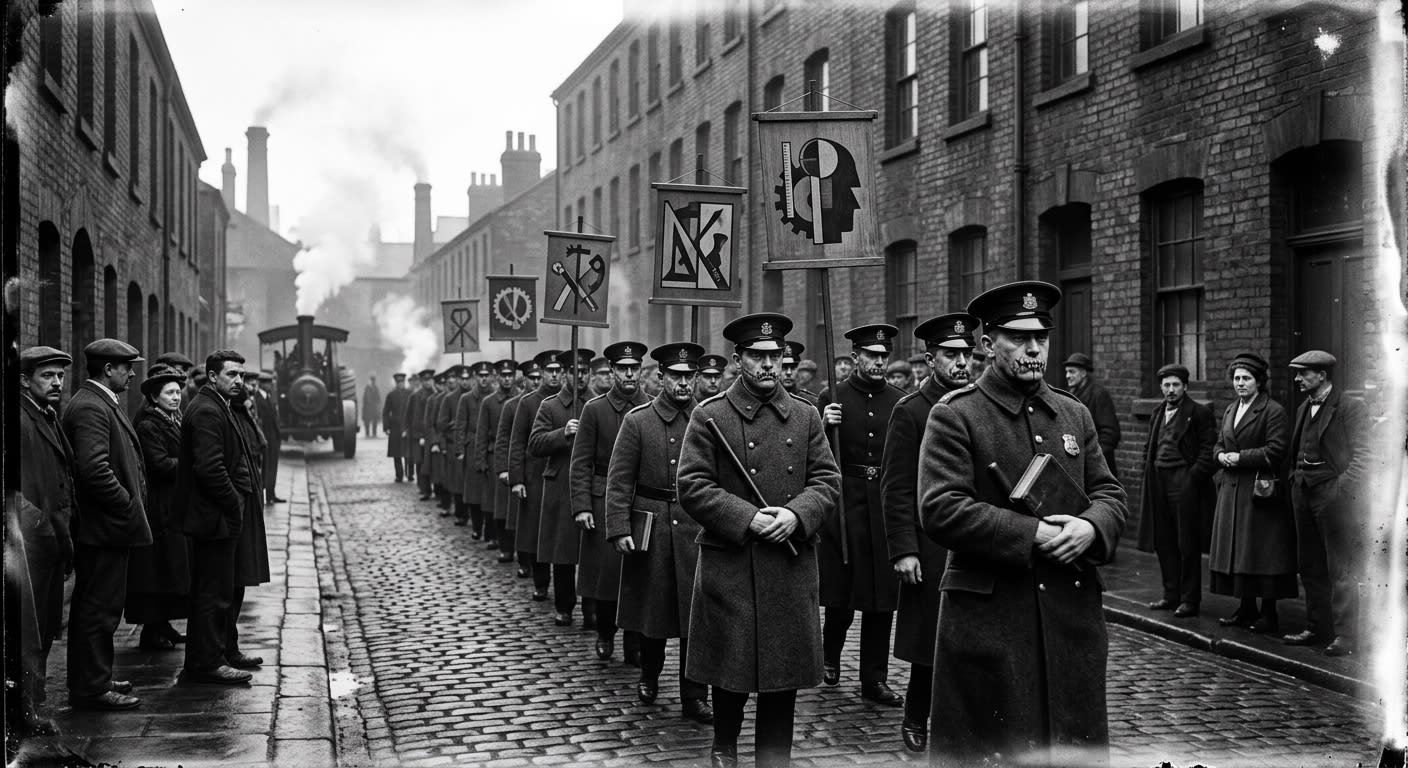
At Rouen, a Clement road company was halted outside a stripped chapel and returned through the fish market with red cloth over their mouths. At Ghent, three women accused of singing a burial hymn were paraded from canal bridge to grain house while schoolchildren were told to observe “the reduction of superstition to gesture.” At Mainz, before Severian’s later glories made the city properly infamous, academy wardens marched eleven chapel boys in a square around the old toll fountain, each carrying the hymn sheet he could no longer sing. The fountain’s basin was emptied by morning and filled with sand. Sand absorbs several lessons at once.
Late provincial sermons claim the first Procession of Silence occurred in Paris under the Edict of Ironmouth.
Corrected. Paris perfected the law in A.S. 30. The Procession’s first witnessed forms appear in A.S. 3, under local academy and magistrate authority. Evil rehearsed before it received its uniform.
These early processions were disorderly by later Republican standards. Instruments varied. Some tongues were slit rather than removed. Some mouths were sewn, others sealed with pitch, linen, wax, or iron staples. One town used blue civic ribbon until Dr. Albrecht Klemm objected that blue smelled of Marian devotion. The objection survives in a Public Instruction digest, which is why I know he had at least one functional aesthetic nerve and chose to use it for wickedness.
The public crowd mattered more than the victim. A private mutilation warns one household. A procession purchases a square, a market, a row of windows, an entire generation of children pretending to be brave. The Republic called this civic demonstration. It was catechism by injury. Citizens were required to watch because watching turned them into minor accomplices, and minor accomplices become obedient faster than innocent bystanders.
#On the Grammar of the Cut
The Republic’s theory was vile, narrow, and efficient: belief spreads by speech; prayer is repeated speech; pilgrimage sings; a tongue is the instrument; correction should address the instrument. One sees the academy mind at work. It confused cause with organ, sin with anatomy, grace with acoustics, obedience with quiet. It had the clean stupidity of a diagram.
The victim was first named as carrier. Public notices used medical language with theatrical restraint: “irrational vocal recurrence,” “ritualized utterance,” “superstitious transmission,” “unregistered devotional sound.” These phrases appear comic until the pincer enters. Law teaches its hands to obey nouns. Call prayer infection, and the throat becomes a drain. Call song public disorder, and a child’s hymn becomes crowd hazard. Call silence progress, and neighbours learn to applaud cloth.
The cut itself changed by district. In the first A.S. 3 demonstrations the slit was favoured: quick, bloody, survivable enough for walking, crude enough to disturb the market. Later Prefectural schools preferred partial removal, because a removed tongue could be tagged, jarred, nailed above a clause, or entered in a return. The Republic loved objects that could be counted. A wounded mouth was disorderly. A labelled organ was evidence.
Republican engravers altered reality with tidy cruelty. They cleaned faces. They reduced blood. They straightened columns. They gave the Guards a blue-grey dignity the street seldom granted them. They made the onlookers solemn instead of frightened, complicit, bored, or secretly sick. They loved the bandage because cloth photographs, or rather engraves, better than open damage. The bandaged mouth became the icon: the Republic’s little white seal across the place where the Creator had been heard.
Public Instruction Plate Draft, Box 19, recovered Vienna archive: “Do not show the failed child case. Mouth too small; instrument disproportionate; crowd sympathy excessive. Use adult male subject from Rouen plate. Retain schoolchildren in foreground. ███████████████████ title: SILENCE IS PROGRESS.”
The Bureau of Doctrine preserved that fragment because it proves what the Republic knew and denied. Crowd sympathy was a risk. Children were instruments. Proportion mattered. The evil was edited before publication, which means the editor recognized the wound.
#On the Road from Demonstration to Edict
A.S. 3 gave the Rationalists their method, but methods desire jurisdiction. Local academy wardens could frighten towns; they could not yet govern all mouths. The Rationalists spent the next decades converting demonstration into law. The Secular Gatherings logic made bodies suspect when gathered. The First Black Census made names suspect when uncooperative. The Edict of Ironmouth, drafted by the Triumvirate of Public Instruction and issued from Paris in A.S. 30, made speech itself treason when it bent toward Heaven.
The Triumvirate did not invent the Procession of Silence. It nationalized it. Klemm gave it classroom prose. The physician gave it the disease theory. Second Mouth gave it posters, school primers, market scripts, schoolroom copies, and the travelling engravings that followed Guard detachments like paper vultures. By A.S. 30, the Procession could be ordered under warrant, accompanied by Republican Guards, witnessed by civic instructors, reported by return, and entered into monthly zeal tables. The Republic had taken a street cruelty and taught it to fill forms.
Under Ironmouth, the procession became companion theatre. A citizen accused of prayer might be corrected privately if the district was tired, short-staffed, or embarrassed. A group accused of shrine attendance, illegal burial office, cellar Mass, road pilgrimage, or teaching children an old antiphon became available for procession. Availability is a bureaucratic sacrament. Once a body is available, all that remains is scheduling.
The first-year returns record eleven thousand tongue removals. The procession subset is smaller and fouler. Paris District Nine staged twelve. Prague staged five under Prefectural Education authority before the Synod later made that city answer history with its own tongue rite. Lyon staged seven, each with school attendance ordered. Ghent staged two and then suppressed local numbers after canal workers refused to close shutters during the second march. In Normandy, village processions spread not because the Republic needed them everywhere, but because local prefects discovered that one bandaged grandmother taught more obedience than six lectures.
A Bureau of Purity teaching sheet once described the Procession of Silence as “universal throughout the Rationalist Republic.”
Struck. Universal cruelty is a propagandist’s laziness. The Procession was uneven, strategic, imitated, feared, and widely printed. Its terror came partly from uncertainty. Every town had seen the plates. Every town wondered when the plates would become local.
#On the Witnesses Who Learned Too Well
The Procession’s victims suffered once in flesh and then for years in other people’s eyes. A tongueless man in a village becomes public property. Children stare. Neighbours lower voices. Shopkeepers decide whether to serve him first from pity or last from fear. Wives learn the economy of nods. Priests learn to hear confession through finger pressure. The Republic wanted these survivors visible because visible injury polices the unwounded.
Yet the witness problem cut both directions. Some watched and submitted. Some watched and remembered. A boy in Rouen later became a cellar courier because he had seen his aunt marched with a white gag and decided, in the perfect grammar of children, that the men who hurt her were bad men. No philosophy defeated that conclusion. In Ghent, canal women began tying black cloth under door-latches after the second Procession, one strip for each mouth sealed. The gesture survived three raids because the guards thought it laundry. May all tyrannies underestimate women’s household semiotics.
Some corrected mouths became saints without permission. The Church in the cellars kept lists: Notary Pell, tongue removed for whispering grace over condemned bread; Marta of Vannes, slit for singing the Assumption antiphon in a barn; Two Brothers of Caen, names lost, mouths sewn with black thread and later found dead beside a chalk cross; the Uncounted Girl of Paris Nine, whom the Republic tried to edit out of its plates. These lists were not yet Synod property. They were scraps, knots, memory boards, ash marks, names kept by people who had learned the state could steal a voice and still fail to catch a name.
The Bureau later collected these fragments with our usual combination of reverence, greed, threat, and office hours. Some entries entered the Martyrologies. Others remain sealed because their details weaken stronger narratives, confuse local cult rights, or involve miracles inconveniently witnessed by families now classified as dubious. Truth is a holy thing. So is arrangement.
#On Prague’s Answer and Severian’s Improvement
The Synod did not forget. We rarely do. Forgetting is for peasants, lovers, and finance clerks caught twice. By A.S. 94, two years after the Bureaus hardened into their recognizable excellence, the Order of Saint Ephrath petitioned the Bureau of Purity to conduct the Procession of Tongues in Prague. Its inaugural condemned included captured Republican Guard officers, Rationalist academics, and three Prefectural clerks who had administered the Republic’s own Procession of Silence in Bohemia decades earlier. Symmetry entered the file wearing oak.
Grand Inquisitor Severian supplied the theology that made the reversal more than revenge. The Rationalists cut the tongue away and called the result progress. Severian argued that a severed tongue leaves error hidden, voiceless, breeding in the dark. Better to nail it open. Better to make the false mouth carry doctrine. Better to turn silence into ambulatory confession beneath bells.
The crude reader sees imitation. The Bureau sees correction by reversal. The enemy sealed mouths to deny prayer. Ephrath opens the condemned mouth against oak so that heresy is forced into relation with Creed. The enemy paraded victims as proof that Faith had no voice. Purity parades heretics as proof that error has no private mouth left. The difference is not sentimental. It is jurisdictional.
Still, the Procession of Silence remains the unclean parent. Ephrath warehouses keep copied engravings beside early tablet diagrams for training: white gags beside oak boards, sealed mouths beside nailed tongues, Rationalist placards beside Triune Knot seals. Young brothers study them so they may answer impurity with exact counter-form. Some become too fond of the comparison and require correction. A novice who admires the enemy’s efficiency without sufficient disgust is not lost. He is merely early in his education and should not be left alone with instruments.
Ephrath devotional commentaries sometimes claim the Procession of Tongues has no ancestry in Rationalist practice and sprang wholly from Severian’s Second Appendix.
Corrected under Doctrine supervision. Severian supplied the theology. Ephrath supplied the licensed rite. The Rationalists supplied the wound to be answered. Denying enemy ancestry flatters us cheaply, and the Bureau prefers expensive flattery with receipts.
#On the Images in the Forbidden Stacks
The Procession of Silence survives most powerfully in paper. The Republic’s engravings were carried farther than its patrols and lasted longer than several Prefectures. Prints reached Amsterdam, Paris, Prague, Vienna, Lyon, Metz, Ghent, Cologne, schoolrooms, prefectural offices, taverns, barracks, and private albums owned by men who claimed to study civic progress and kept the plates under lock like sin. After the Sundering, villagers burned some. Priests hid some. Republican fugitives carried some folded against their skin. The Synod seized the rest with the hungry delicacy of archivists who know an enemy has accidentally produced evidence.
The Stacks arrange them by district, date, slogan variant, victim class, and level of visible injury. I find the last category vulgar and necessary. A plate with bandage only instructs differently than a plate with blood visible under cloth. A plate with children in the foreground teaches the Republic’s ambition better than any manifesto. A plate with bored spectators indicts the town. A plate with one turned face indicts hope.
Forbidden Stacks Handling Note — Cabinet Ironmouth/Procession, Shelf 4: Plate 4-19 produces no sound when handled, but readers report loss of inner prayer cadence for several minutes after viewing. One junior clerk mouthed the words SILENCE IS PROGRESS without recollection. Clerk reassigned to bell-copying. Plate wrapped in black vellum. Do not display beside children’s primer copies.
Doctrine uses the plates carefully. Too little display and the faithful forget the enemy’s hand. Too much display and the enemy’s method acquires glamour, which is how young fools become antique heretics with new boots. The official school edition shows three approved images: a Rouen bandage column, a Prague precursor square, and a Paris Ironmouth warrant with organ jars removed from view. Children are told enough. Later, if they enter Purity, Records, Doctrine, or marry badly, they may learn more.
The Dutch accuse us of preserving atrocity too tenderly. This is comic from a people who preserve invoices from fish quarrels. The Bureau does not preserve tenderly. The Bureau preserves accurately, possessively, and with enough locks to make accuracy expensive.
#On Mouth-Registers and the Children Who Watched
The Procession produced records as efficiently as blood. Every corrected mouth needed a number, and every number needed a clerk, and every clerk needed a category by which he could sleep after lunch. The Republic called these lists Mouth-Registers. They were kept at prefectural offices beside school attendance rolls, bread allotments, civic lecture rosters, Guard requisitions, and other innocent-looking furniture of rule. A Mouth-Register recorded name, age, district, offence, correction type, display duration, survival status, family response, school attendance, engraving reference, and whether the subject had attempted gesture-prayer during the march.
The family response column is the one that smells worst. Some entries read: compliant. Some: agitated. Some: mother removed. Some: crowd sympathy excessive. Some: child cried slogan incorrectly. The Republic believed, with the pious exactitude of unbelievers, that fear became manageable once entered in a column. The Synod inherited many of these columns after the Sundering. We burned none. Burning enemy records is a peasant revenge. Reading them aloud at trial is civilization.
Children were the intended second audience. The first audience was the square, the market, the chapel road, the neighbours forced to witness a known face made strange. The second sat in school benches the next morning, where instructors displayed engravings and asked what progress meant. Small hands rose. Small mouths answered with phrases copied from the placard. “Progress means freedom from superstition.” “Progress means the silence of irrationality.” “Progress means civic health.” Each answer was recorded under Public Instruction assessment.
One confiscated Prague primer, dated A.S. 31 but copied from older A.S. 3 demonstration material, contains a lesson titled On Proper Quiet. The page shows a bandaged pilgrim beside a smiling child. The child points toward a lecture hall. Beneath them: “The corrected citizen teaches us that old words hurt the Republic. The instructed child learns new words and is free.” A later owner, likely a cellar catechist, scratched under the sentence: “Free to say what?” The scratch was made with a pin. The pin mark has more theology than the printed page.
The Bureau of Pedagogy dislikes discussing these primers because they resemble, in outward form, the Bureau’s own child-drills: image, answer, repetition, correction. Pedagogy’s discomfort is healthy and should be increased. Similar tools do not make similar masters. A chalice and a poison cup both hold liquid; only a tavern philosopher confuses Mass with murder because both require swallowing. Yet the resemblance must be named, lest fools discover it first and mistake discovery for argument.
Our schools teach children to speak Creed because speech belongs first to the Creator, then to Order, then to the citizen by licence. The Republic taught children that speech belonged to the state because the Creator did not exist and the citizen was a managed animal. Same benches, different universe. Same ink, different altar. Same child’s mouth, different owner.
Some children resisted in the only ways children can: mispronouncing the slogan, losing the assigned print, coughing during the demonstration answer, drawing tongues back into printed mouths, giving the bandaged pilgrim a halo, or writing forbidden names beneath the victim’s feet. Public Instruction files call these “residual household contamination.” I call them small sacraments conducted by brats with ink-stained fingers. The Bureau of Doctrine has never canonised a doodle. This may have been an oversight.
Others learned too well. They became clerks, Guards, instructors, correction assistants, applause leaders, plate distributors, Mouth-Register copyists. A child trained to name cruelty as health becomes an adult who requires no demon to do demon work. This is why the Procession belongs in every advanced catechism sequence. Not for pity. Pity is a damp handkerchief. The Procession teaches that language changes the hand before the hand reaches for the knife.
The surviving Mouth-Registers now sit under joint custody of Records and Doctrine, with Purity access by request and Shadows access without request, naturally. Records wants completeness. Doctrine wants use. Purity wants precedent. Shadows wants whatever page makes someone inconvenient. The registers oblige all four, as old evil often does when properly shelved.
#On Present Classification
As of A.S. 201, the Procession of Silence is dissolved as a living rite, condemned as enemy theatre, preserved as evidence, and taught under supervision in Doctrine, Purity, Records, Orison, and selected Pedagogy houses. The phrase SILENCE IS PROGRESS is prohibited for public reproduction except in marked instructional context. Unauthorized use earns interrogation, because old slogans are not dead slogans. They are sleeping warrants.
Residual sympathizer cells still circulate cleaned versions of the plates in coffee rooms and university backrooms. They call them studies in secular overreach, tragedies of excess, unfortunate instruments of a frightened age. Hear the softening. Excess, not doctrine. Tragedy, not crime. Frightened age, not guilty men. The Rationalist descendant does not defend the knife; he cushions the table beneath it.
The faithful response remains simple. When the enemy says silence is progress, ring a bell. When he says prayer is infection, teach the child grace before bread. When he says the tongue belongs to public health, place Creed there first. Let the mouth become chapel, witness, gate, accusation, and, when needed, weapon. The Republic learned too late that a cut tongue may still make martyrs. The Synod learned early that a martyr, properly counted, does not need a tongue to speak for centuries.
#On the Last Usefulness of Enemy Silence
The Procession’s final usefulness is not historical. History is a corpse until Doctrine puts it to work. Its usefulness lies in the pressure it places against the present mouth. Every citizen who learns the Procession learns that silence may be imposed from outside, cultivated from fear, purchased with neighbours’ compliance, sold back as health, printed as progress, and taught to children as cleanliness. This makes the citizen less innocent, which is the beginning of civic adulthood.
The old Republic believed a cut mouth ended prayer. The Cellar Saints answered by making prayer migrate: into knuckles, bread marks, cup placement, breath counts, cradle taps, ash scratches, eyelids lowered during compulsory lectures. The body became an illicit chapel because the mouth had been occupied. One sees here the Creator’s administrative generosity. Close one office and grace opens a sub-registry.
Purity instructors use the Procession for a colder lesson. They teach that suppression without doctrine creates resentment, martyrs, hidden networks, bad optics, foreign pamphlets, and saints with annoyingly durable local cults. Correction must be paired with authorised truth. The cut must have catechism behind it. The procession must know where it ends. The crowd must learn the approved sentence before gossip supplies a competing one. This is not mercy. It is competence, which in government performs many of mercy’s useful functions without acquiring its softness.
Records instructors use the Mouth-Registers to teach another lesson: enemies count what they value. The Republic counted removed tongues because removal proved policy. It counted witnesses because watching proved reach. It counted school attendance because children proved futurity. When a state shows you its columns, it shows you its chapel. The Rationalists worshipped correction returns. We keep the returns in a cabinet and make novices copy them until their hands stop trembling or begin trembling for better reasons.
The faithful should not linger over the plates with appetite. Appetite is how one becomes Ephrath without vows, or Rationalist without courage, or critic without employment. Look, learn, condemn, file. The drawer closes. The bell answers. The mouth resumes its proper work.
The sentence has been issued.