

#On the Present Compilation
"An office is ordinarily known by its seal. This one is known by a paper it has not sealed." — V. Drax, survey annotation, A.S. 201
This survey is compiled in A.S. 201, 1911 by the common reckoning. It concerns an office of the Bureau of War that the Ledger knows from one appearance. The Strategic Planning Commissariat enters the record in a single passage of my dossier on the Hollow Court, where certain of its officers are named as the company among whom an unsigned memorandum circulates. That is the whole attestation: one passage, one paper, and a company of readers whose names the passage does not give.
The reader who wants the Commissariat's founding year will not find it here. Its commissioner, its roll of clerks, its premises, its charter and the full extent of its business are absent as well. Nothing on these questions has crossed my desk, and I decline to forge a pedigree for an office merely because it has failed to file one. What follows is a survey taken through a confessional screen. One hears a voice and sees a shape, and one may not name the penitent.
#On Its Place Within War
The parent Bureau has a better pedigree. War was established under the Charter of Crimson Ink in A.S. 105 / 1815 CE, ten years after the Siege of Vienna of A.S. 95 / 1805 CE taught the Synod that the Faith could not be defended by whatever levies a duke felt like lending that season. Its chartered work is raising, equipping, drilling and theologically supervising the forces of the Synod. Its generals wear the crimson sash. By long and loudly advertised rule, a campaign plan circulates as sanctioned only once the Bureau of Doctrine and the Bureau of Purity have both set their seals on it.
That rule is what separates the Commissariat's paper from an order. A plan bearing both seals is a campaign. A plan bearing neither is a conversation with margins. On the evidence of this file the Commissariat plans, and nothing more is shown. No record has it commanding a battery, ordering a march, or granting itself any exemption or dispensation held by another office. Whether it answers to a general, a council of War or a well-locked cupboard, the record does not say. I will not guess, and the reader is forbidden to guess in my name.
#On the Problem Before the Planners
At the geographic centre of the Blightmarsh stands a structure that my dossier places approximately forty leagues east-south-east of ruined Debrecen. Four records support that placement: the observation log of A.S. 174 / 1884 CE, Deposition 11-F of A.S. 188 / 1898 CE, Deposition 7-K of A.S. 196 / 1906 CE, and the soil-resonance survey of A.S. 200 / 1910 CE. The contents of 11-F are not mine to give, and I do not give them. The survey suggests a structure approximately nine miles along its longest axis. That figure was read from displacement in the soil. Soil is a poorer instrument than an eye, and a far poorer one than a gunner's sight.
Kargath sits at the head of its table by the certainty of Doctrine. The certainty is doctrinal and has not been confirmed by any eyewitness. One person is known to have entered the outer galleries and returned. She was an operative of the Bureau of Shadows, and her name and the source of her orders remain withheld. She reached the antechamber of the Great Hall, turned back, and did not see him. She is now in the infirmary at Bastion-Constantinople. No file makes her a Commissariat officer or her mission a Commissariat errand. Any reader who whispers otherwise may whisper it to Purity.
STAMPED ERRATUM — CARRIED FROM THE HOLLOW COURT DOSSIER, A.S. 201 Prior editions of that dossier stated that "no human being has entered the Hollow Court and returned." The dossier has corrected this: one human being entered the outer galleries and returned. This survey has no prior edition of its own. The correction is reproduced so that anyone planning against the Court reads the corrected text.
The Bureau of Records keeps a guest file of four hundred and twelve names. The dossier gives a separate private estimate of three to five thousand for the whole company. The first figure is a register, and the second is arithmetic done on silence. Neither is a casualty return, and I will thank the Commissariat's readers not to use either as one.
Approach is governed. Standing Order 7-K forbids Synod personnel to come within an estimated five leagues without War's countersignature and Doctrine's dispensation. The Bureau of Rites designates the feast a Category One Spiritual Hazard (Proximity-Induced Compulsion). The Bureau of Bells judges that no bell-based countermeasure is likely to prove effective against a source of this magnitude. Anyone who reads those three findings in order will see the appeal of distance, and needs no strategic training to see it.
#On the Circulating Memorandum
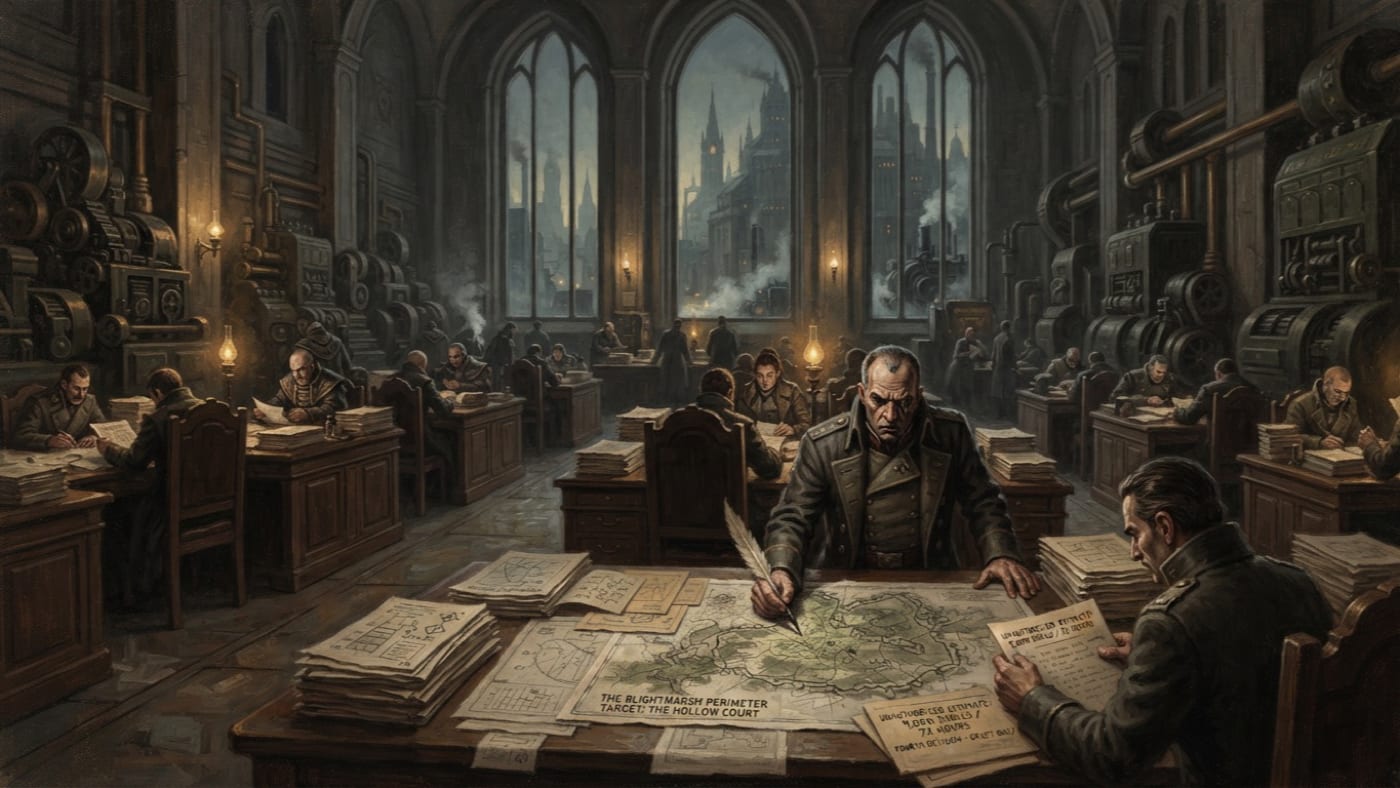
The dossier records three operational proposals concerning the Court. The first, a colonel's forced march of A.S. 175 / 1885 CE, was rejected. The second came from the Bureau of Shadows in A.S. 196 / 1906 CE, and its operative went and came back. The dossier states plainly that the third has never been submitted. It exists as a memorandum circulating among certain officers of the Strategic Planning Commissariat. It proposes destroying the Hollow Court by sustained artillery bombardment from a position west of the Blightmarsh perimeter. By the memorandum's own estimate, this requires nine thousand shells over seventy-two hours.
Both figures belong to the memorandum. An unknown hand set them down as estimates, and neither is an allocation, a firing schedule or an order to expend. No battery is named in anything I hold, and no emplacement is fixed. So far as the Ledger knows, no shell has been drawn against those numbers and no gun has fired.
The memorandum is unsigned. By my count it has reached its fourth revision. I do not reproduce the four; I count them, which is humbler work and the only work the evidence allows. Someone is refining the paper. The paper does not say who, and an unsigned document is the one witness the Bureau cannot frighten into giving a name.
It has not been formally submitted, and War has not acknowledged that it exists. Doctrine has not been consulted. Under War's own rule a campaign plan needs two seals, and this one carries no seal that I have seen. I have read it, and I have filed my own copy. Having it makes me a reader, and a reader is no author. The copy in my cabinet proves that the paper exists and proves nothing else.
#On What the Paper Leaves Unanswered
The memorandum estimates no casualties. It says nothing of what becomes of the guests: four hundred and twelve named, three to five thousand estimated, and not one of them appears in its columns. It does not ask what destroying the palace would do to Kargath. My dossier put the question as bluntly as courtesy allowed: can a Sin-General be inconvenienced by the demolition of his dining room, or would the feast relocate and carry its guests with it? The question has not been answered. I record it as a question because that is all it is. The stones may matter to the hunger, or they may not, and Strasbourg does not know which. To its credit, the memorandum does not claim to know either. To its discredit, it does not ask.
The dossier attributes theological findings about the Court to Doctrine, Rites and Bells. It does not explain how the place works, and I will not invent an explanation for a planner's convenience. A seat of Gluttony might be a building, or a body, or a sacrament turned inside out. Doctrine has not been asked which. Arithmetic cannot settle the matter however carefully it is revised, because the nine thousand assumes an answer that no office has given.
What the paper offers is a position, a quantity and a duration. Nothing on the record shows the Commissariat holding the authority to approve any of the three. The questions it leaves out are the ones the Church would have to answer for: what of the faithful at the table, what of the host, and what is left in the Marsh when the guns go quiet. I trust the Creator keeps a fuller ledger than the Commissariat does. The Commissariat would be wise not to assume it.
#On the Present Condition of the Record
As of this compilation of A.S. 201, the record shows the following. An office called the Strategic Planning Commissariat exists within the Bureau of War. Certain of its officers circulate an unsigned memorandum on bombarding the Hollow Court. That memorandum estimates nine thousand shells over seventy-two hours, has reached what I count as its fourth revision, and has not been submitted. War has not acknowledged it, and Doctrine has not been consulted.
The record shows no approved operation and no new command powers for the Commissariat. It shows no attack begun, fired or finished. The Commissariat's founding, officers, premises, charter, the extent of its business and the memorandum's author all remain unrecorded. They stay unrecorded here, because a Warden who fills gaps with guesses has stopped keeping a ledger and started writing romances.
The Court's feast continues, by every account the dossier holds. The paper continues too, in the hands of men I am unable to name.