

#On the Tables in Present Use
Compiled A.S. 201 (1911 CE) from the published instruments. Sealed by the Bureau of Doctrine.
This survey is compiled in A.S. 201 from the Edict and the paper filed around it. Its subject is narrow on purpose. The Bureau of Purity keeps phonetic tables that govern how every language in Synodal territory must be spelled. I write here about one use of those tables only: the day a clerk lays them beside a dead person's name.
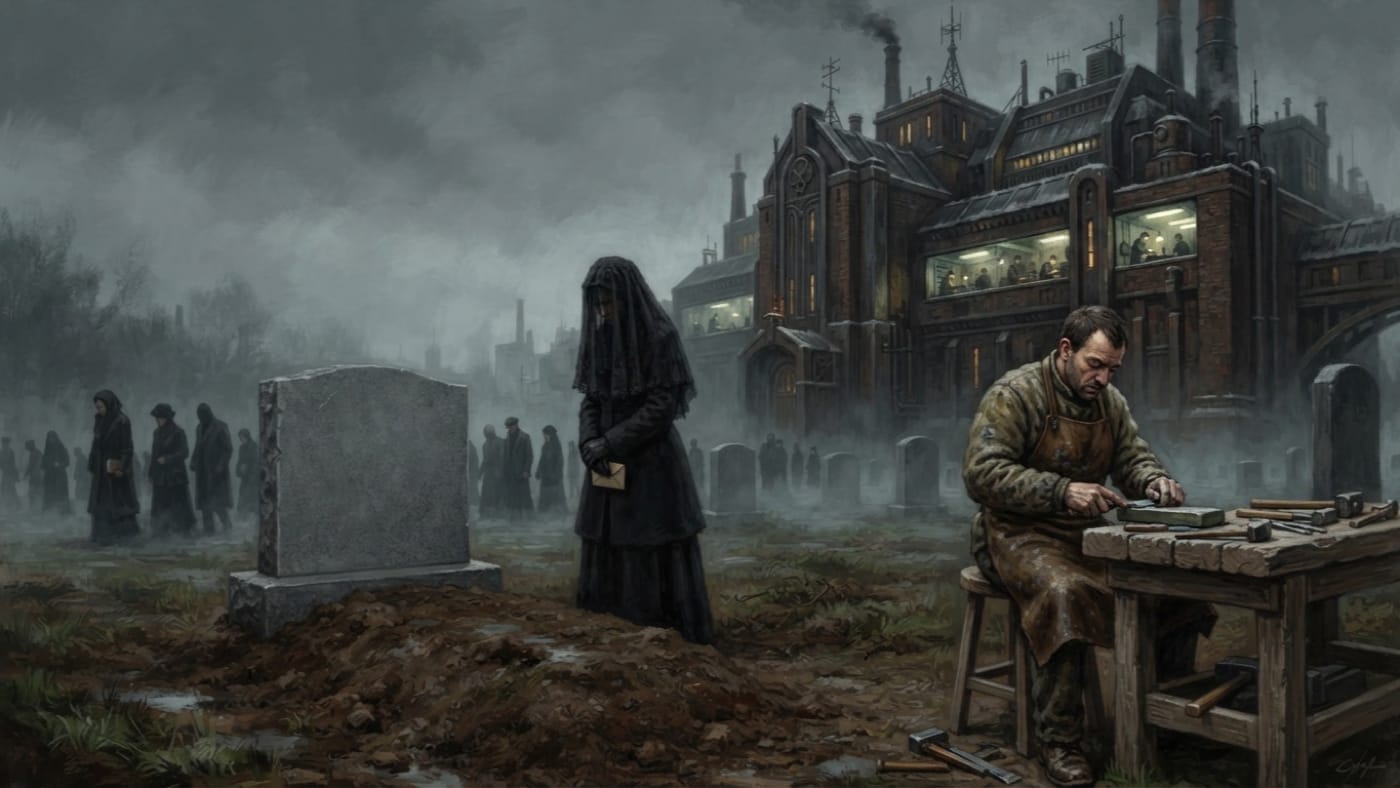
A family buries someone. The ground is opened, the prayers are said and the mound is raised. Then the family wants what families have always wanted, the name on a stone, so the grandchildren know where to stand. Under the Edict of Graphic Uniformity that name may not be cut until the Bureau has checked it against its tables. The mourners have finished with the priest. They have not finished with the clerk.
I call these the Bureau's name tables because that is the work this survey watches them do. The title describes a use. I know of no single volume that bears it, and nobody has shown me a register of every name the Synod will permit.
#On the Spelling Authorized
Three separate questions stand between a remembered name and a lawful inscription, and the provinces confuse them out of habit.
The first question is whether the word may be written at all. The Index Claritatis, Doctrine's compendium of permitted vocabulary, lists the words that may be used. The Index Damnatus lists the words and names that may not. The second question is how a permitted word must be spelled, and that is the business of Purity's phonetic tables. The third is how each letter of that spelling must be stroked. That belongs to the Standing Committee on Graphic Standards, which warrants the twenty-three letterforms of the Triune Alphabet and their geometry.
The Alphabet is a script, and nobody speaks it. A Lombard, a Fleming and a Swabian each talk as their mothers taught them, and all three must be written in the same twenty-three forms. Approved hands existed in the scriptoria before A.S. 178. What Procurator Maxentius della Torre signed that year made the Alphabet the only script the Synod recognises. The tables connect a voice to those forms. They decide which letters a sound shall become.
If the tables cannot place a sound, it receives no written form, and a word without a written form loses official recognition. The Bureau insists that it has never touched the sound itself. The sound may still be spoken at the graveside. It may not be carved above it.
#On Forms 14-C and 14-D
The sequence is short, and the Edict sets out all of it.
The family files a Form 14-C, the Application for Posthumous Inscription. With it goes a Form 14-D, the Phonetic Verification of Deceased's Name Against Current Bureau Tables. The Bureau of Records prints both in quantities it describes as adequate. Purity performs the verification. Once the name has been checked the carver may cut, and until then he may not.
Verification takes nine days on average. No statute sets that figure as a limit, and no family should take it as a promise. Some names come back sooner and some households wait longer. Throughout those days the dead are already in the ground, because the Edict has no quarrel with the grave.
So the churchyard holds a fresh mound with a blank slab at its head, or no slab at all, and a carver who has been asked to wait. The widow walks out on the third day and finds nothing to read. On the seventh day she finds the same nothing. The Bureau does not call this a delay. It calls it procedure.
For six years after promulgation the service cost nothing. In A.S. 184 the Bureau introduced a fee of six copper stamps. I record the fee once because it is charged once, and having two forms does not double it. I know of no tariff for speed. Any clerk who offers one should keep his receipt book where an Inquisitor cannot read it.
"The average verification takes nine days. The average corpse, in the warmer months, does not wait nine days with the patience the Bureau requires." (Codex entry: The Triune Alphabet)
Corrected. The corpse is not asked to wait. Burial proceeds and the inscription waits. The refrigeration and the surcharge mentioned in the same note were proposals, and no record before me shows that either was adopted as procedure.
#On the Word Current
The whole instrument turns on one adjective in the title of Form 14-D. The name is verified against current Bureau Tables, meaning the tables in force on the day the family applies.
That adjective shuts out a great deal. Suppose the grandmother signed her name for sixty years. The parish roll carried it at her baptism and the marriage register at her wedding, and each of those spellings may have been lawful in its season. The clerk consults none of them. The Edict grants no exemption for a spelling the dead used while living, and I have searched for one with the diligence of a man who expects to need it. The tables do not ask what she was called. They ask what she may be called today.
When the familiar sounds cannot take their familiar letters, the stone receives the nearest permitted spelling. The Edict gives the case in one sentence: her grandchildren will visit a name she would not have answered to. I give it no more detail than that. I do not know her name, and I will not invent two spellings of it to decorate the point.
Lombardy supplies the attested example on a larger scale. In A.S. 179 the Lombard vernaculars were classified as Category Three Verbal Contraband, after Bureau theologians found that their vowels carried seditious frequencies. That finding is the Bureau's theology, and I file it there. No acoustician I know of has measured sedition in a vowel. The consequence needs no theology. Family names with sounds the tables would not hold were entered under the nearest licensed spellings, and sons signed rolls bearing names their fathers did not quite own. When those fathers died, the licensed spelling was the one that went to Purity on the 14-D.
The Edict records that the tables are revised as Doctrine requires, and it records nothing more. I have found no published timetable, no numbered series of editions and no account of how a revision travels from Strasbourg to a parish office. A family cannot study for an examination whose paper has never been printed for it. I have not seen the complete tables either, and this survey reproduces no entry from them.
#On the Limits of the Tables
The Synod is full of tables, and careless readers try to bind them into one book.
The Bureau of Mercy keeps tables for the Fourfold Assessment that rank a conscript's capacity to march, dig and carry. Under its own tables the Bureau of Festivals recognises wind, rain, pigeons and children's pockets as causes of confetti loss, and a Pageant Captain files a form for each. Certain other Bureau tables carried the Toulouse campaign that named Narbonne under a year the Codex has since corrected. Each of these belongs to its own office. None of them spells the dead, and the name tables have nothing to say about lungs, confetti or chronology.
Shared numbers mean just as little. Instruments in other Bureaus carry 14-C and 14-D on their headings too. A form's number identifies that form and nothing else.
The Committee's gauge is a separate limit. After Purity releases a spelling, the carver must cut it in approved strokes, so the stone waits on two offices. Nothing in the record has Purity checking geometry or the Committee checking spelling, and neither countersigns the other.
#On the Present Compilation
In A.S. 201 the procedure stands as the Edict wrote it. Families file their 14-C and 14-D, pay their six stamps once, bury their dead without waiting, and then wait for the stone. The tables in force on the morning of application decide the spelling. Doctrine revises them when it requires, and Records keeps the forms in stock.
This survey has found no new rule, and it adds none. It records no edition of the tables, because none has been shown to me. It records no ruling on stones cut before a revision, because I can cite none. A carved name is a finished document. The Bureau has not been asked what later tables would make of it, on any form I have seen.
Somewhere tonight a slab stands blank at the head of a grave nine days old, and a carver is sharpening a chisel he may not yet use. The clerk who will decide is very likely asleep. His tables keep their hours regardless.