

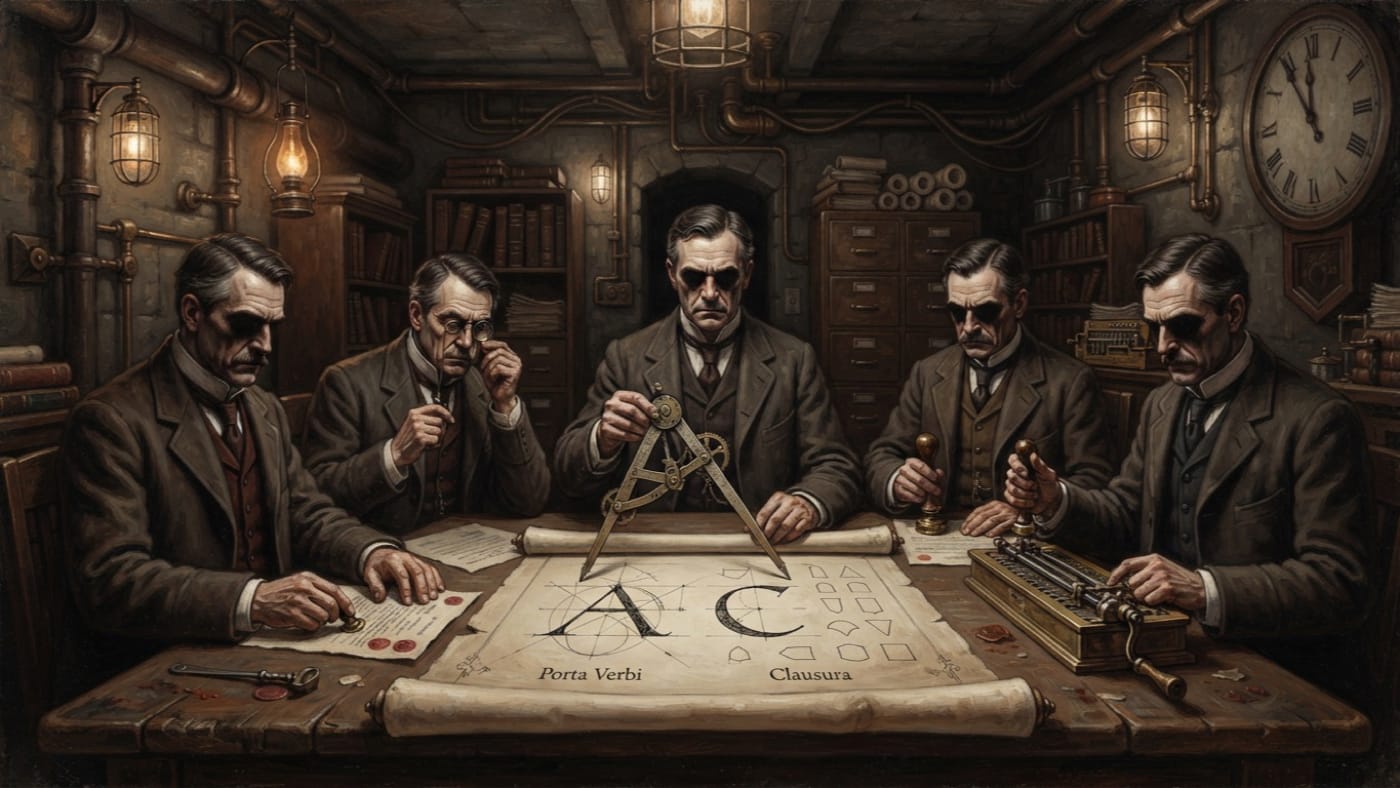
#On the Committee's Station
The Bureau of Purity punishes handwriting. Before it can do that, somebody has to say what handwriting ought to be, and that somebody is the Standing Committee on Graphic Standards. Its instruments are modest: a table, an exemplar, a seal. With them it approves the shapes of letters. Whatever later happens to a scribe in Augsburg or a stonecarver in Lombardy starts as a measurement against a form these people approved.
It meets every second Sabbath in a windowless chamber beneath the Tower of the Quill in Strasbourg. The Tower is the seat of the Bureau of Doctrine, and visitors conclude from the address that the Committee belongs to Doctrine. Visitors conclude a great deal. The address proves only that the Committee sits underneath Doctrine, which in Strasbourg is true of most people. I have not seen any document I am permitted to cite that says whose seal heads its correspondence, who chairs it, or who appoints its members.
What I can cite is a number. The Triune Alphabet was ratified by a committee of eleven. I do not know whether eleven sit in the chamber now. It has no windows, and nobody has ever invited me to count through the keyhole.
#On the Warrant for a Letter
The Committee gives each of the Alphabet's twenty-three letterforms a doctrinal imprimatur, and the imprimatur is the warrant. Without it a shape is a scratch. With it the shape becomes a standard, and a man can fall short of a standard.
The Committee's founding charter holds that the forms derive from the primal shapes of sacred utterance. I have not read the whole charter. I have read the clause the Committee quotes, which it does often. The account published in this Codex gives a plainer pedigree: a Carolingian minuscule specimen from a Ravenna library, associated with Procurator della Torre. The Committee keeps both pedigrees and sees no quarrel between them. Sacred utterance had to be written down somewhere, its members would say, and Ravenna has excellent shelving.
The imprimatur is expressed as geometry. The Edict of Graphic Uniformity lists its parts: angle of entry, order of strokes, length of terminal. I will describe only the first letter and the last. The other twenty-one are not mine to publish, and I would not trust my memory of them against the Committee's gauge.
The Porta Verbi takes fourteen strokes in a prescribed sequence. That is fourteen chances to be wrong, and an Inquisitor who knows the sequence can tell from the pooling of the ink which stroke came seventh. The Clausura is one downstroke and a leftward curl, made without lifting the pen. Lift it and the join shows, and the join is evidence.
Before the imprimatur, a clerk's hand was read. Now it is measured, and every measurement leaves a record behind it.
#On Business Every Second Sabbath
By the published record, the Committee has never once adjourned early. Critics in the provincial scriptoria take this as proof that it has nothing better to do. They misunderstand committees. A body that adjourns early admits that the matter was smaller than the hour, and no matter touching the Creator's letters is smaller than an hour. I respect the discipline. I have sat through Doctrine sessions that ended at Vespers because the chairman's dinner was going cold, and I watched the decrees go cold with it.
I can judge what happens in the chamber only by the paper that comes out of it. The best known is the instructional broadsheet. From it every licensed apprentice learns that the fourteen strokes of the Porta Verbi are "intuitive to the faithful." This is a theological statement wearing a schoolmaster's gown. A pupil who finds the letter difficult has learned something about his penmanship and something about his faith, and the broadsheet leaves him to decide which one to take to his confessor.
Other paper goes in. The Committee receives correspondence, the most famous being Memorandum 1,417, which della Torre addressed to it. The number shows that at least fourteen hundred and sixteen memoranda went before it, from somewhere. It does not show how many reached the Committee, how many sessions they took up, or what the Committee replied. A careless archivist could build a founding date out of that number. Records would file it beside the other careless dates, in the drawer that never quite shuts.
#From Approved Hand to Punishable Name
The machinery runs in one direction. The Committee sets the form. The White-Mantled Inquisitors carry it into the streets on brass gauges calibrated to forty-seven degrees, the angle to which the nib of the Edict's signing pen was filed. Purity's punitive hierarchy, which ends with the Lictors, acts on what the Inquisitors find. Records keeps the paper, and Doctrine supplies the reason any of it was needed. The Committee has no part in the later stages. I have heard its members say so with the calm of men who make rope and have never seen a gallows.
The forty-seven degrees belong to the nib. Whatever the market gossip says, not every stroke of every letter lies at that angle. The gauge is a reference to check against, and nobody traces round it. Men have been cited for deviations of three degrees, and those citations are on record. I know of no published tolerance that sets the line at three, and I advise nobody to go looking for one with his own hand.
The shape of a letter is also a separate matter from the choice of letters. Purity's phonetic tables decide how a word must be spelled. The Index Damnatus decides which words and names may not be written at all. The Committee decides only how each permitted stroke must lie. A Lombard family whose surname was forced into the nearest licensed spelling after the proscription of A.S. 179 owes that injury to the tables. The Committee's share came later. The son signed the new spelling in a perfect hand, and the gauge passed every letter of a name his father would not answer to.
Augsburg shows the Committee's standard at its sharpest. In A.S. 182 three calligraphers were convicted because their serifs curved where no licence allowed a curve and the court read their descenders as doubt. Their spelling was correct and their vocabulary was clean. Their letters failed the geometry, and the geometry was the Committee's. They received five years in the Paper Mines of Ulm. The Committee passed no sentence. It drew the line the sentence was measured from.
The household version is smaller and comes more often. Since A.S. 184 a family that wants to inscribe its dead files Forms 14-C and 14-D with Purity, pays six copper stamps and waits nine days on average. The forms deal with spelling, which is Purity's business. Once permission comes, the carver must cut the approved spelling in approved letters, and the letters are the Committee's business. The stone waits on both.
#On the Exemplar That Preceded Approval
The Committee's authority has one embarrassment, and it is cut in stone on the steppe.
The Treaty-Stones of the Steppe Gate were raised in A.S. 76, one hundred and two years before the Edict made the Triune Alphabet the Synod's only script. Their carvings resemble the approved forms closely enough that Records' palaeographers call the script a variant. The year the stones went up does not date every line cut on them, since stones collect inscriptions the way old men collect debts. The resemblance is there all the same, on monoliths nobody in Strasbourg ever licensed.
A committee that claims to warrant letters is uneasy in front of letters that needed no warrant. Doctrine has supplied the ease. The stones, it says, are proleptic: they anticipated the forms that would later ratify them. The word does a great deal of work and asks no fee. It lets the Committee treat the stones as obedient before the fact, and it lets me record the resemblance without having to account for it.
So I record it. Doctrine holds the attribution. The mechanism is in nobody's keeping.
#On the Present Application
In A.S. 201 the work goes on as before: every second Sabbath beneath the Tower, and every quarter in the provinces, where Inquisitors lay brass against shop signs, primers, contracts and gravestones. The quarterly audits test two things that the untrained confuse. The gauge asks whether a letter is perfect. The licence asks whether the writer was allowed to make it. A perfect form in an unlicensed hand is still an offence, and the Committee has never pretended otherwise.
That distinction now faces an awkward case. Since A.S. 194 the Burnless Archive beneath the Steppe Gate has yielded folios written in licensed letterforms. The ink is still wet when they are found, and every stroke is flawless; the Paper Keepers report that the hand is finer than any living scribe's. The folios would satisfy the gauge at every angle. No author has been identified, so there is nobody to whom a licence could be issued or refused. I report the folios as they have been reported to me. Who writes them and how lie outside this entry, and outside every other entry I have been able to find.
"...a body that meets every second Sabbath in a windowless chamber beneath the Tower of the Quill and that has, in thirty-one years of continuous operation, never once adjourned early." (Codex entry: The Triune Alphabet)
That entry does not say what year the thirty-one years were counted to. Counting back from one year gives one founding date and counting back from another gives a different one, and no record before me confirms either. The figure is withdrawn as a measure of the Committee's age. The rest of the sentence stands: the Committee has still never adjourned early.