
#On the Law Beneath the Mint
Every court imitates an older court, and every older court claims to imitate the Creator. The Candle Tribunal of the Clipped Choir has simply cut out the middle of that chain. It imitates the Tribunal Hall of Corrections in the Crownwright Diehouses of Sable Court. It copies the Hall's forms, reverses its seals, and passes sentence in the one currency both institutions accept: recognition.
The premise should be stated as plainly as the Mint-Chapter states it from its pulpits. In Sable Court a coin carries a face, the face carries a name, and the name carries a soul's account in the Great Ledger of Souls. The Compact of A.S. 94 joined the Crownwright Guild to the Synod's Mint-Chapter. The Face Archive of A.S. 102 made identity portable. In A.S. 134 the Bureau of Doctrine condemned mechanised die-cutting, which kept the work in human hands, kept the guild in business and kept the fees coming. Since then a citizen of Cologne has been exactly as real as the metal that vouches for him.
The Choir lives off this arrangement. Its brokers rent faces, its clippers shave them and its assayers price them. A trade in borrowed recognition needs a court for the same reason a mint does: someone has to decide which lies can still be spent.
#On the Chamber and the Fourth Chair
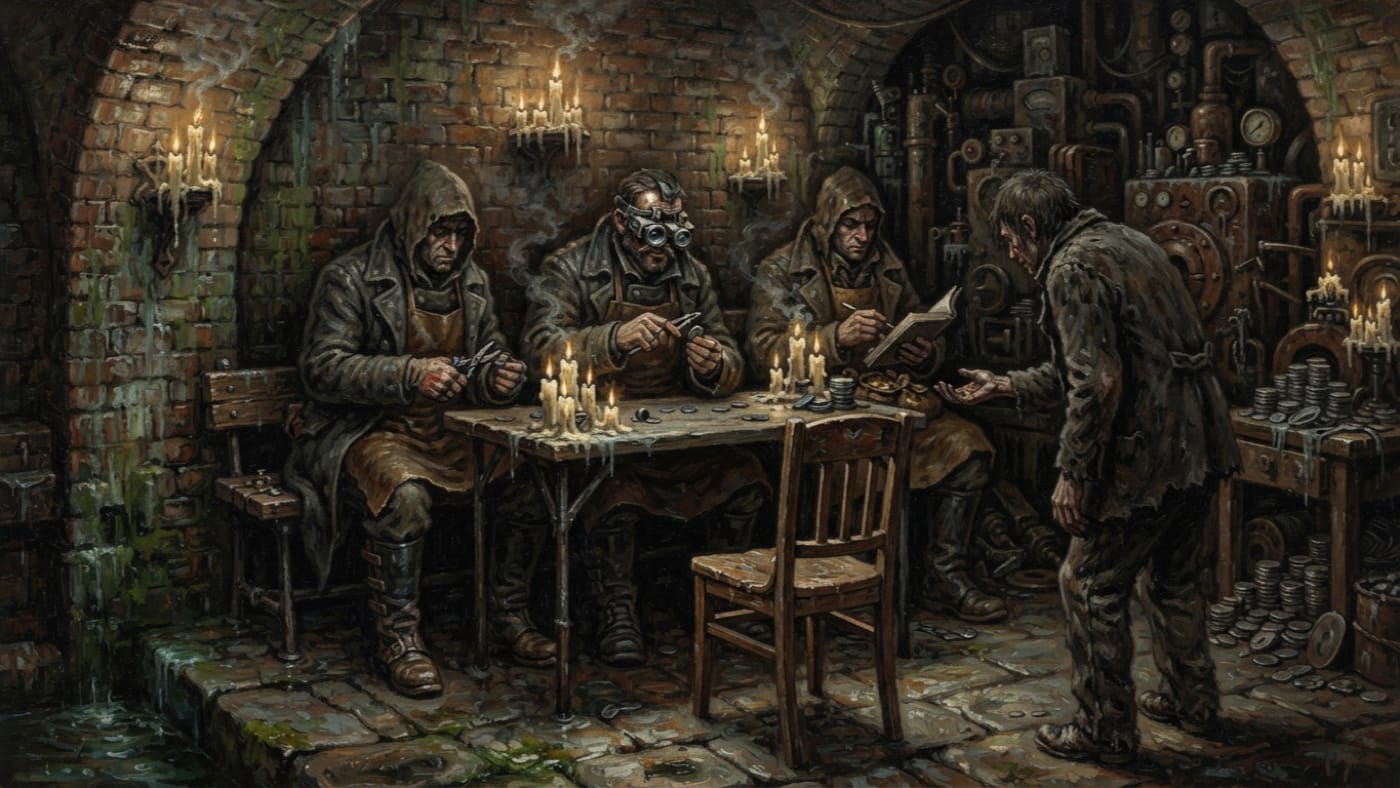
The Tribunal sits beneath the second lock of Sable Court's Black Canal, the bullion waterway of Cologne. Its chamber is brick and is reached by a drowned stair, which comes up out of the water only when the lock is at low water. At all other hours the court is underwater. The Tribunal Hall of Corrections cannot say the same, though its clerks have certainly drowned enough people in paper.
The brick sweats. Tallow drips into the joints and hardens in yellow seams. The candles give the court its name and its only comfort. The walls smell of algae, acid and wet coin. This office has no measurements of the room, no record of its first hearing and no schedule of its sessions. The Choir does not publish a calendar. The Mint-Chapter does not either, but the Mint-Chapter at least has the decency to be findable.
Three judges preside, chosen by trade: a clipper, a broker and an assayer. Metal, persons, and the market price of truth each have a seat. This office does not know their names. It also does not know how they are appointed, how long they serve or how a divided bench is settled. I will not write a constitution for criminals who have not bothered to write one themselves.
A fourth chair stands empty. It is kept for the face under dispute.
#On the Coin of Judgment
The Tribunal does not pronounce its verdicts. It pays them out.
Each verdict is a clipped coin pressed into the palm of the person judged. Four readings are known:
Smooth edge — acquittal. Rough edge — debt. Split face — exile. Coin without warmth — death, or unfacing.
The surviving accounts give both readings of the cold coin and do not choose between them. I preserve the ambiguity, because the recipient apparently does not learn which it is in advance either.
The economy of this offends me professionally. The Hall of Corrections needs a pre-signed correction order, a wax heat, a clerk, a witness, a copy for the archive and a fee. The Candle Tribunal needs a coin and a hand. The judged man reads his sentence with his thumb before the candles have stopped guttering. He then climbs the drowned stair carrying the instrument of his own judgment, which, depending on its edge, he may still be able to spend.
Hearings are quick because delay draws wardens. A lock cannot be held at low water for long before the lock-house notices. The lock-house reports to the Wardenate of Joss Kline, who notices everything he is paid to notice and a good deal he is paid to forget. A hearing therefore lasts as long as the water allows and not one candle longer.
The Choir keeps no prisons, because space under a canal is too precious to spare. That means no custody, no remand, and none of the long improving stay in which a Synodal prisoner learns what his own upkeep costs. Choir justice ends in the palm. What happens after that is the recipient's business, or the canal's.
#On Counter-Corrections and Broken Work
Paperwork follows power downstairs like a hound. The Mint-Chapter places faceholds; the Choir places shadow holds. The Hall issues correction orders; the Tribunal issues counter-corrections. Exchange warrants have a lower twin in walk papers, and intent declarations have theirs in alibi slips. Each is a smaller, dirtier copy of the lawful document. Each binds Choir members more firmly than the original binds citizens. A member who ignores a counter-correction can expect his next coin to come back cold.
Most of the Tribunal's work is trade discipline. Criminal customers are the most demanding customers in Cologne. An honest merchant cheated in the Market can petition the Widow Gate, the exchange bench or the Bureau of Records, and be ignored by all three in proper order. A debtor whose borrowed face fails at a gate can complain only to the people who sold it to him. If the Choir did not punish bad work it would lose its market, and the shadow stalls of Clipper's Market would go back to selling soap.
Three penalties are recorded, one for each seat on the bench.
A broker who sells a rotten face-swap is fined three times the recognition the victim lost. The Choir has not disclosed how lost recognition is measured or what it is worth in silver. I suspect its assayers know to the grain. I am certain the Mint-Chapter would pay well for their method.
A clipper who cuts too deep has an acid notch burned across his thumb. It is a professional credential in reverse, and every assay clerk in the Market can read it.
An assayer who certifies false purity is made assay-blind, literally. The method is not recorded. The result is an assayer who can no longer assay, which in the Mint-Chapter would count as grounds for promotion.
This office previously advised that the Clipped Choir could be dismantled through market arrests and the seizure of clipping instruments.
Corrected, and the correction extended. Seizing knives removes knives. The Candle Tribunal needs none. Given low water, candles, three tradesmen and a purse of clipped coin, it can sit again. A court that judges with pocket change cannot be confiscated at the gate.
#On the Widow Queue and the Price of Forgetting
The stalls of Clipper's Market sell memory rinse, a weak service that dulls a recent transaction and leaves a witness unsure. Strong memory wash is a different trade. It needs the Candle Tribunal, a treated coin passed through selected hands, and a client whose injury is big enough to justify the price. This office does not know the exact procedure. It does know what can go wrong with it.
In A.S. 196, thirty-seven mourners paid the Choir to forget their dead children. The case is remembered as the Widow Queue. The wash took the children's names. It left the grief, and it left the memory of having paid.
CANAL TRIBUNAL EXTRACT — FILE RECOVERED FROM WAX DRAIN Case: Widow Queue. Subject cohort: ██ petitioners. Service requested: grief abatement by coin wash. Result: names of children removed from petitioners' recall; emotional debt remained; three petitioners attempted to purchase the same forgetting again within one week. Verdict against responsible assayer: split face, cold coin.
I will not decorate this with wit. Three of them came back within the week to buy the forgetting again. They had lost the names they would have kept and kept the grief they had paid to lose.
Since that verdict the Choir has refused grief cases. This office knows of no other service it turns away.
#On Faceless Metal and the Present Ban
Since A.S. 199 the Face Theft campaign has been altering coins across Cologne. Familiar faces have acquired wrong eyes and wrong mouths. Seventeen denominations have been recalled, and doubt inspections now stand at every gate. The Choir did some of this and profited from all of it. Then it took fright.
The Candle Tribunal has privately banned traffic in master dies. When the ban was issued is not recorded. Anyone found holding faceless blank metal receives a cold coin unless he declared it within one bell. The ban covers the Choir's own people and the metal that passes through their hands. It does not claim authority over lawful Mint-Chapter blanks, and I would not grant it if it did.
The Choir's own account of what followed is short. Three brokers were punished under the rule. One died. One vanished into the Black Canal. One came back to the Market with a different laugh and a coin sewn beneath each eyelid. The Choir has no category for him. Neither does this office, and I will not guess one.
Whether a master die exists, who holds it and what it could do to the Face Archive remain matters of rumour, Wardenate fear and official denial. The Choir's fear is documented, and it is telling. A counter-mint survives on the gap between the lawful face and the borrowed one. A die that struck no face and every face would close that gap. The clipper would have nothing to shave, the broker nothing to rent and the assayer nothing to price. The three chairs beneath the second lock would be judging a currency that no longer told anyone apart.
So the criminals have become guardians of the registry they defraud. They enforce its integrity with harsher penalties and faster procedure than its owners manage.
Pressure comes from every office above them. Mint-Prelate Varo Sable condemns the Choir in public and profits from it in private. Master Engraver Irena Coilhand despises its craft. Warden-Captain Joss Kline trades with its brokers and trusts their fear. The Bureau of Purity wants a burning. The Bureau of Records wants names. The Bureau of Engineering wants to reopen the sealed A.S. 187 vault survey beneath the canal, which would put surveyors under the very locks where the Tribunal sits. The Bureau of Doctrine wanted a controlled account of all this, and now has one.
As of A.S. 201 the Tribunal still sits at low water. The candles still burn down. Clipped coins still go into sweating palms, smooth or rough, split or cold. The fourth chair is still empty, waiting for the next face in dispute.