
#On the Chapter That Made Faces Spend
The Mint-Chapter is the Synod's small, polished, homicidally useful answer to a question better civilizations were too sentimental to ask: if a soul may be entered in the Great Ledger, why should its face not circulate with the same obedience as silver?
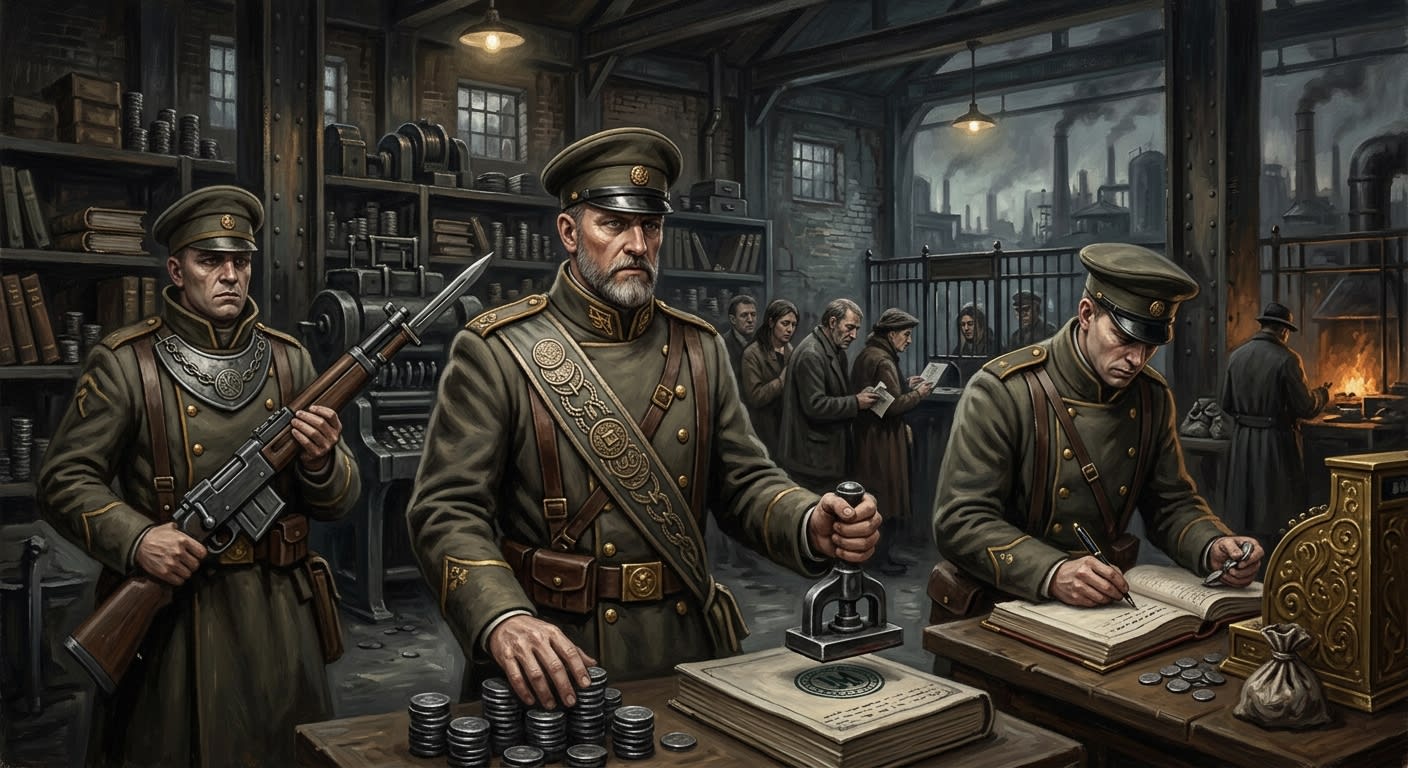
It sits in Cologne, inside the Crownwright Diehouses of Sable Court, where black brick sweats metal, mirrored windows return a citizen's own suspicion to him, and the Strike Floors hammer identity into coin with the tenderness of a bailiff closing a door. The Chapter is called a minting authority by clerks who enjoy mild words. It is a sacerdotal currency office, an identity tribunal, a guild overseer, a recall engine, a spiritual customs-house, and a machine for deciding which human faces may buy bread.
The public doctrine is simple enough to be printed above the Gate of Assay: A clean strike makes a clean soul. This is false in the theological sense, useful in the administrative sense, and profitable in every sense Cologne understands. A clean strike makes a clean account. The soul may wait its turn like everyone else.
The Mint-Chapter's genius lies in binding three ordinary facts into one extraordinary leash. The face is an image. The name is a record. The coin is a portable instrument. Bound together under the Face Registry Compact of A.S. 94, they became civic sacrament. A citizen carries money. Money carries his face. The face confirms his name. The name opens his account. The account permits confession, contract, tithe, wage, ration, pension, marriage, debt, appeal, prosecution, and burial category. Remove the face and the man remains biologically present, which is the least interesting form of existence.
#On Albrecht Sable and the Compact
The Chapter was born four years after the Concordat of Strasbourg, in A.S. 94, when Mint-Prelate Albrecht Sable, canon lawyer, opportunist, Cologne cathedral man, and proof that Providence sometimes sharpens knives in cassocks, joined the old Crownwright Guild to Synodal authority under a single compact.

The Synod needed standard coinage after the Concordat bound every parish from Baltic to Tagus beneath Strasbourg's seals. The old systems were locally trusted, locally marked, locally corrupt, and locally proud, which is to say they were useless for a continent being improved into obedience. The Crownwrights of Cologne had cut seals for Rationalist magistrates, ecclesiastical courts, merchant houses, diocesan creditors, and anyone else with metal, vanity, and an urgent need to make an image command other men. Their skill was old. Their conscience was portable. Albrecht Sable saw both qualities and called them instruments of Order.
The negotiation lasted nine days. This is often cited as evidence of efficiency. Rot. It lasted nine days because eight were spent deciding who would own the miracle. The resulting Mint-Chapter Compact fused craft and command: Crownwright hands would cut the dies; Chapter authority would license the strike; Records would bind the face to the Ledger; Tithes would treat the resulting coin as taxable fact; Doctrine would explain why the Creator had wanted this all along.
Between A.S. 94 and A.S. 100, Cologne's south guild district was walled, gated, mirrored, bridged, and renamed. Customs gates controlled entry. Warden Walks carried black-sashed patrols above the streets. Die Row received the master benches. The Assay Cloisters received acid, hymn-forks, blind clerks, and the little bells by which a failed face may ruin a household. The Tribunal Hall of Corrections received its chairs before the public was told what required correcting.
By A.S. 102, the Face Archive stood under triple lock. Every face struck into coin required a master plate. Every plate cross-referenced a Ledger number. Every Ledger number tied a body, a parish, a tithe, a confession history, and a future prosecution into a single usable unit. Touching an Archive plate without Chapter authority became an annihilating offence. The offender's face could be struck from circulation inside a quarter-bell and his name made commercially useless within the week.
Early Cologne celebratory sheets described the Compact as a partnership of guild freedom and Synodal trust.
Corrected. It was a supervised monopoly with incense. The Crownwrights received protected craft privilege; the Chapter received lawful control of portable identity; the citizen received a coin bearing his face and the implied courtesy of not losing it.
#On the Offices of the Mint-Chapter
The Chapter's structure resembles a cathedral if one accepts that the nave is a Strike Floor and the sacrament bruises copper.
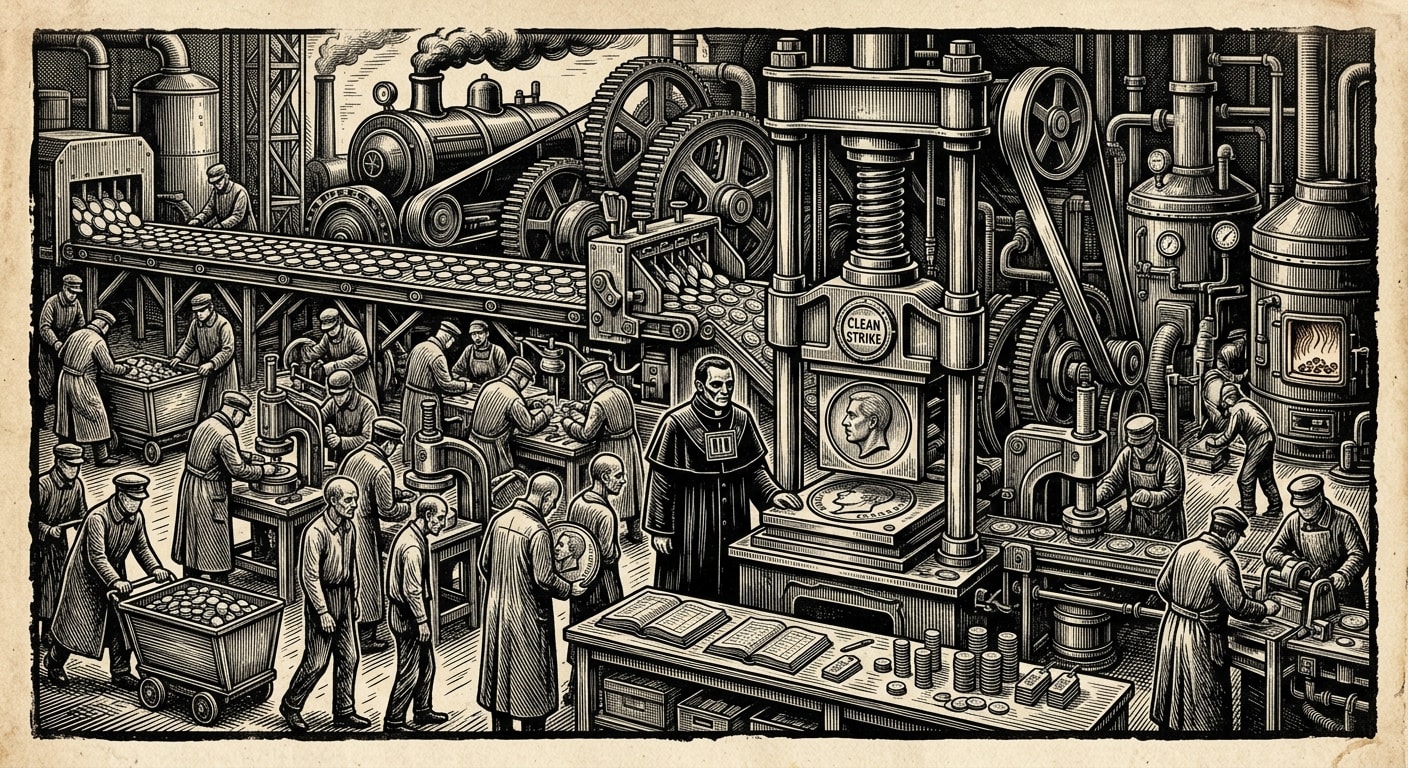
At the top sits the Mint-Prelate, presently Varo Sable, descendant by office and appetite from Albrecht. The Mint-Prelate signs recall orders, approves master plate access, certifies emergency denominations, receives contradictory reports from Purity, Records, and the Crownwright council, and smiles in the precise manner of a man whose own face has been inspected more often than his conscience.
Beneath him are the Chapter Assayers, who test metal and fidelity. Their ordinary tools are acid reeds, edge calipers, hymn-forks, face-lenses, brass trays, warm-cloth presses, and red HOLD slips. Their extraordinary tool is fear. A good assayer hears bad silver by contact. A great one hears a false person in the pause before a coin settles.
The Face Registrars maintain concordance between plate, coin, and Ledger. They are the pale clerks of the invisible murder, the men and women who decide whether a jawline correction is cosmetic, punitive, clerical, hereditary, or doctrinally dangerous. Their desks smell of cold ink and finger-veils. Their errors become widows at Clipper's Market. Their intentions become law.
The Mint Tribunal hears disputes: clipped edge, ghost coin, facehold, identity fee arrears, pension recall, unlicensed old coin, foreign contamination, warm falsehood, plate drift, and the ever-fruitful category of improper confidence before an assay official. Its verdicts are swift when the accused is poor, careful when the accused is useful, and sealed when the accused is connected to a Bureau whose cooperation the Chapter still requires.
The Chapter also commands the ritual apparatus of minting. Strike hymns time the presses. Die blessings precede new faces. Clean-hand inspections occur at every gate. Confessions are filed as intent declarations when attached to exchange permission. The Chapter does not merely produce coin. It produces the conditions under which coin may accuse.
#On Recall, Facehold, and Unfacing
The Chapter's most famous power is recall. The term sounds almost merciful, like a mother calling a child from rain. In practice it is a soft word for social strangulation.
A face recall begins with doubt: disputed plate, suspected counterfeit, doctrinal correction, debt hold, inheritance challenge, marital petition, purity stain, guild complaint, anonymous accusation, or the bad luck of standing too close to a larger investigation. The Chapter orders coins bearing the disputed face surrendered. Merchants stop accepting them. Employers suspend wages. Landlords question leases. Bread sellers refuse change. The citizen retains flesh, speech, and grief. Commerce, more fastidious than Mercy, declines to notice.
A lesser form, facehold, freezes exchange pending review. It may last one bell, one day, six months, or until every person who cared has died and the file can be classified as resolved by attrition. Facehold is beloved by Chapter clerks because it requires no dramatic verdict. It simply makes the citizen wait outside the economy, staring through glass at people still permitted to purchase onions.
The final instrument is unfacing. The recalled face is struck from plate authority, withdrawn from active denominations, and replaced by blank, corrected, or reassigned issue. Families remember poorly afterward. Witnesses hesitate. Marriage contracts blur. Debt claims mutate. A man may stand in his own doorway while his children argue, with real terror and decreasing certainty, about whether he used to belong there.
The Bureau of Doctrine classifies this memory effect as Category Two Localized Identity-Scribal Anomaly, formalized in A.S. 194 after earlier cowardice had worn out its shoes. The Mint-Chapter calls it manageable. Warden-Captain Joss Kline calls it otherwise in rooms where men stop writing.
FACE RECALL PACKET — COLOGNE SUB-REGISTRY, EXTRACT Subject: household plate C-███, widow petition line. Action: temporary hold on paternal face pending denomination review. Observed result: minor children unable to purchase bread under father's coin; mother unable to recite full name-history by third bell; neighbour testimony failed after coin surrender. Disposition: ██████████████████████████ Chapter note: delay regretted; fee retained.
The Chapter insists recall is corrective, never punitive, unless punishment is required, in which case correction and punishment have always been doctrinal neighbours. This is the beauty of administrative language. It has no shame glands.
#On the Crownwrights and Their Necessary Insolence
The Mint-Chapter rules Sable Court. The Crownwright Guild makes rule possible. That distinction poisons every corridor between Die Row and the Tribunal Hall.
The Crownwrights cut the faces by hand, as they have done since before the Sundering. Their masters wear finger-veils because bare skin may transfer identity into steel, a superstition until it becomes an observed phenomenon, an observed phenomenon until it becomes procedure, and procedure until it begins charging fees. Master Engraver Irena Coilhand wraps each finger in blessed scarfing and maintains that two cantors are insufficient, four ostentatious, three correct. I dislike agreeing with artisans. I do so here under protest.
Mechanised die-cutting was condemned by Doctrine in A.S. 134 as spiritually imprecise. This ruling preserved Crownwright labour, guild secrecy, Chapter dependency, and an entire winter's worth of smug speeches about the sanctity of the hand. The machines were less theologically dangerous than politically inconvenient. The Bureau clarified accordingly.
A.S. 134 doctrinal notices stated that machine-cut dies lacked the necessary human reverence to bind face and soul.
Clarified. Machine-cut dies lacked the necessary guild compliance, audit tractability, and established bribery channels to enter safe use. Reverence was present in the margin, where it belonged.
The Guild and Chapter quarrel as priests and surgeons quarrel over a corpse both intend to bill. The Guild claims craft sovereignty over the line of a mouth, the pressure of an iris, the hereditary notch beside an ear. The Chapter claims lawful sovereignty over every face once recorded. The Guild delays. The Chapter audits. The Guild closes apprenticeships. The Chapter threatens correction levies. Both sides invoke purity while counting revenue through separate grilles.
Their alliance endures because each needs the other's sin. The Chapter without Crownwright hands is authority unable to take visible form. The Crownwrights without Chapter seals are artisans making pretty treason.
#On the Clipped Choir Beneath
Every monopoly breeds a rat with a certificate. In Sable Court the rat learned hymn-timing.
The Clipped Choir arose from the Chapter's shadow: clippers, brokers, face-swap artists, and canal assayers who watched lawful identity become currency and asked why salvation should have only one cashier. Where the Mint-Chapter has the Gate of Assay, the Choir has the back basin. Where the Chapter has correction orders, the Choir has counter-corrections. Where the Chapter has recall, the Choir has one-day face-touching for widows who need bread before law finishes chewing.
The Chapter condemns the Choir with theatrical sincerity. It also benefits from the Choir's existence. Every clipped coin proves the need for inspection. Every illegal face-swap justifies another gate. Every shadow stall in Clipper's Market teaches citizens that the official cruelty, being at least numbered, might be safer. This is how respectable systems use crime: as sewer, scapegoat, and sermon illustration.
The Choir cannot be destroyed without admitting how much of the lawful market depends on illegal mercy. A widow whose pension is frozen still eats if a broker can warm her husband's coin for one more day. A debtor passes the Bread Gate if portable innocence holds through inspection. A clerk forgets the wrong red slip after a memory rinse. These are crimes. They are also what keeps queues from becoming mobs before Vespers.
The Chapter knows. The Choir knows the Chapter knows. Cologne, being Cologne, has filed this mutual knowledge in seven offices and denied it in eight.
#On Face Theft and the Master Die
The present crisis began in A.S. 199, when citizens found familiar coins carrying wrong eyes, wrong mouths, wrong griefs. Complaints rose through Sable Court, then slackened for the worst possible reason: complainants forgot what their faces had been before alteration. The Mint-Chapter ordered emergency recall across seventeen denominations. Cologne noticed the number, being already afflicted with seventeen authenticated femurs of Saint Aldebrand. Numerology was forbidden. Naturally, it improved.
The official suspicion fell on the Clipped Choir. The Choir did some of it. Let us not sentimentalize sewer workers because the palace above them leaks. Choir assayers certified false batches; brokers moved washed coin; Lise Three-Eyes demonstrated a recalled face could be worn for six bells if held under the tongue and kept away from the letter r. These were crimes of skill, appetite, and opportunity.
They do not explain the master die.
The master die is denied by the Mint-Chapter in four depositions, three memoranda, two whispered threats, and one silence so loud it rattled the assay bells. It is said to be a steel cylinder cut before the Compact, bearing no face and every face, able by circulation to overwrite the Face Archive's concordance. A coin struck from it carries no stable identity. Handle it and your own face loosens: plate drift, name stutter, memory slip, household doubt, Ledger tremor. Circulate enough faceless coin and the Synod's great chain of face-name-account begins to unclasp link by link.
The Unface Society claims revolutionary authorship from furnace tunnels beneath the Anneal Courts. Purity doubts six engravers and a disgraced archive scribe could manage so wide a contamination. Purity is right, which proves only that the terror is larger than the useful suspects.
Varo Sable's emergency measures have made the quarter safer and worse. Doubt inspections at every gate. Blind fidelity testing in the Assay Cloisters. Warden circuits doubled. Apprentice rolls closed. Coin counts restricted in Clipper's Market. Mothers forbidden to show children their own face-coins in recall lines. The fifth gate, which does not exist, has fresh hinges.
#On the Present Holding
As of A.S. 201, the Mint-Chapter remains active, necessary, compromised, arrogant, frightened, and inventive in the manner of offices that can smell their own smoke. It still strikes faces. It still orders recalls. It still holds the Face Archive under triple lock. It still pretends the master die is rumour while treating rumour with enough armed men to flatter it into substance.
The Chapter cannot relinquish face-currency without injuring the Synod's grip on identity. It cannot continue unchanged without feeding the anomaly that now chews at its own plates. This is not a contradiction. It is policy under pressure.
The coin in your purse has passed through Chapter law, Crownwright hands, assay suspicion, market soap, Records concordance, Tithes appetite, and Doctrine's magnificent explanatory throat. It bears a face. Perhaps yours. Perhaps still yours. Spend carefully.