
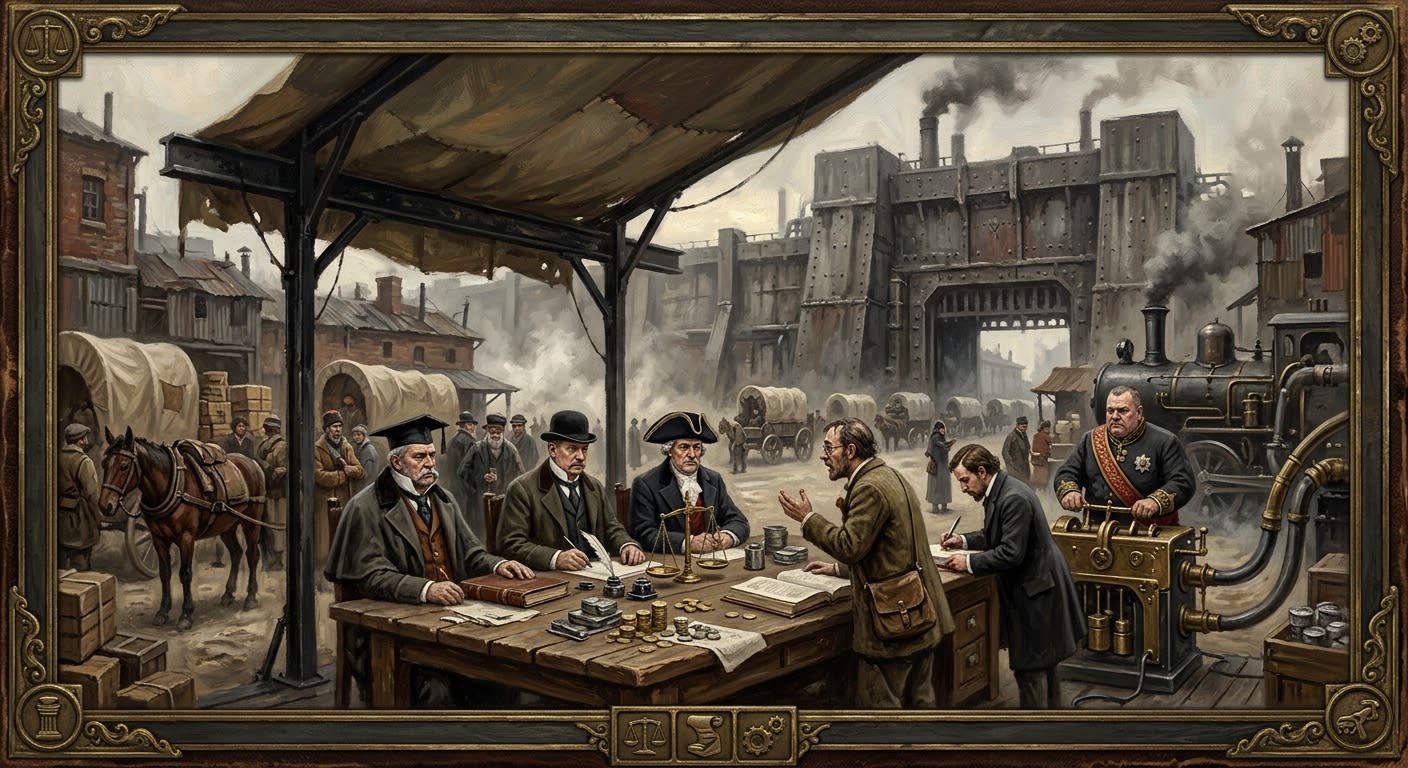
#On the Tribunal That Sells Breath
The Caravan Court is the open-air tribunal of the Steppe Gate, seated beneath seven wind-polished limestone stones in the Treaty Ring, where passage, toll, escort, cargo, dialect, witness, debt, shelter, confession, and the right to keep one's throat unclosed are priced, pronounced, witnessed, sealed, indexed, and, when convenient, called justice. It is a faction, a court, a market guild, a throat discipline, and the most successful auction house ever to disguise itself as law.
Its public name is neutral. Its full ceremonial name, the Caravan Court of Nine Weights, is less neutral and more honest, since weight is what the Court assigns to everything: coin, witness, salt, grief, oath, corpse, mule, orphan, and syllable. A dispute enters as complaint. It leaves as precedent. Between those states stands a bench, a witness chain, red wax, and High Arbiter Senn Vark, who has not spoken unwitnessed in thirty years because privacy at Windscript is how a man becomes edible to grammar.
The Court exists because caravans are necessary and caravans lie. They lie about cargo weight, escort promises, dead partners, spoilage, dialect, grandfather names, road damage, salt purity, treaty exemptions, and whether the mule currently foaming at the south trough belongs to them, their creditor, their widow, or the demon who signed the third copy. The Steppe Gate could answer such matters with soldiers. Soldiers produce corpses and poor receipts. The Court produces rulings, and rulings may be sold again.
#On Its Birth from the Wind
The Court began as an improvisation in A.S. 76, when the Treaty-Stones were raised at the limestone-cutbank gap between Moldavian road, steppe lane, salt track, refugee rut, and the western hunger for lawful movement. Before the stones, passage was settled by spear, mule count, kin retaliation, and the old frontier argument in which two men shout over a corpse until a third man steals the cargo. Then the wind found the carvings and began to read. The fighting stopped with the offended suddenness of men who discover that law has acquired lungs.
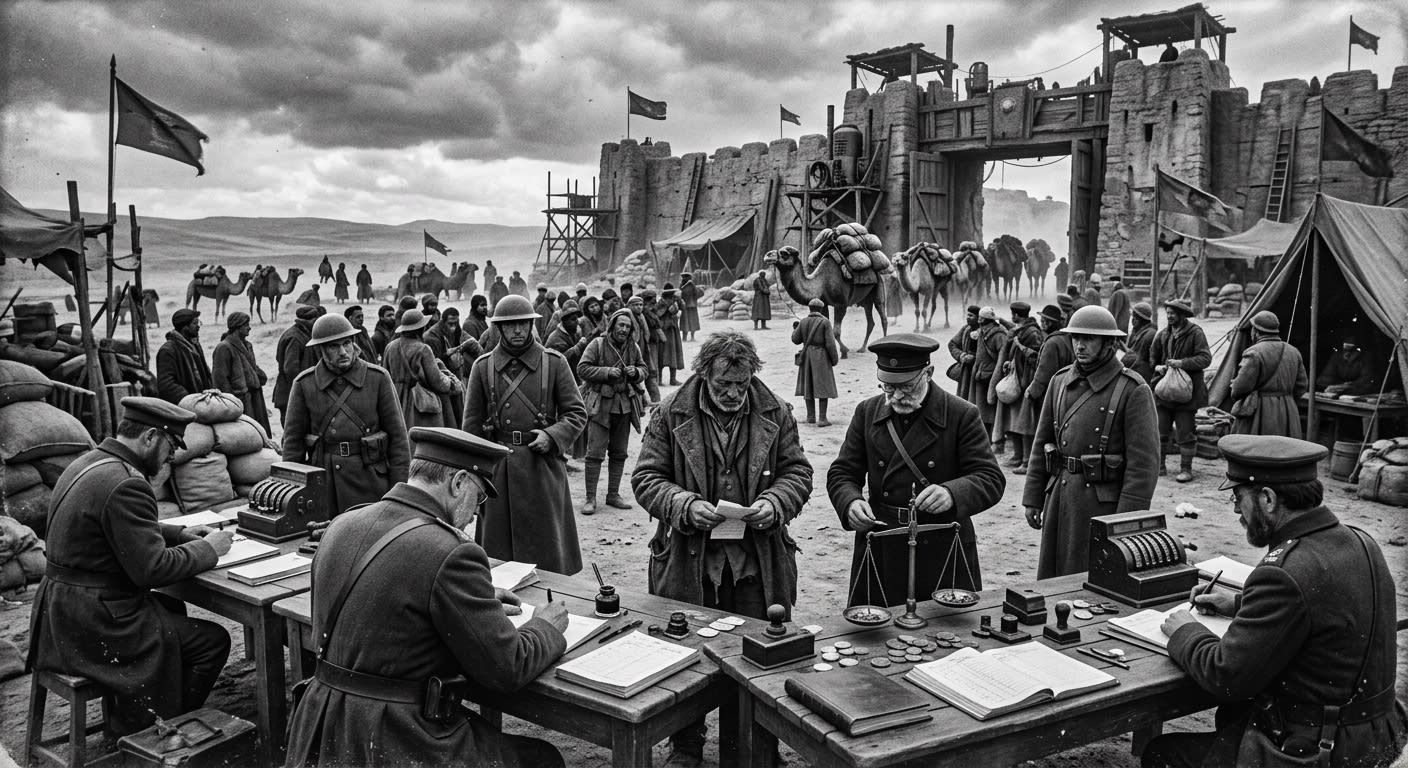
The first arbiters were not judges in any dignified sense. They were bilingual drovers, oath-inn scribes, retired escort captains, salt factors with clean hands, and one monastery-trained clerk whose principal qualification was the ability to pronounce three dead vowels without spitting. They stood inside the Ring and repeated what the stones seemed to say. The stones punished enough errors to make this habit seem authoritative. Authority, once frightening and useful, requires only a table.
By A.S. 78, when the Bureau of Records registered Windscript as Administrative Node Seven, the Court had acquired benches, witness marks, fee bowls, and the early form of the nine-weight stamp. The Treaty Office (Unregistered) claimed oversight. The Patrol Command (Unregistered) claimed enforcement. The Seal-House Row (Unregistered) claimed authentication. Each claim was valid enough to produce invoices. The Court survived by letting every office believe it held the handle while the stones held the blade.
The name Nine Weights comes from the first settled fee rubric, a charm of arithmetic whose original clay tablets are stored in the Burnless Archive under Alzen Voss's later custody and whose figures have never agreed with any later copy. The nine weights were passage, cargo, witness, blood, delay, oath, seal, road, and silence. Silence was cheapest before A.S. 94. This changed.
#On Procedure, Which Is a Species of Trap
A Caravan Court sitting begins before petitioners enter the Ring. A clerk marks wind direction. A translator-scribe tests the day's binding vowels under breath. Seal-House runners warm wax in covered trays. Patrol riders clear the curious to the proper distance, which means close enough to be impressed and far enough that their deaths need not be counted as participants if something goes wrong. Petitioners are placed by claim type: salt before the Third Stone, escort before the Second, shelter before the Fifth, death-paper disputes before the Seventh, confession addenda before the Sixth, and complicated lies wherever the High Arbiter can see their mouths.
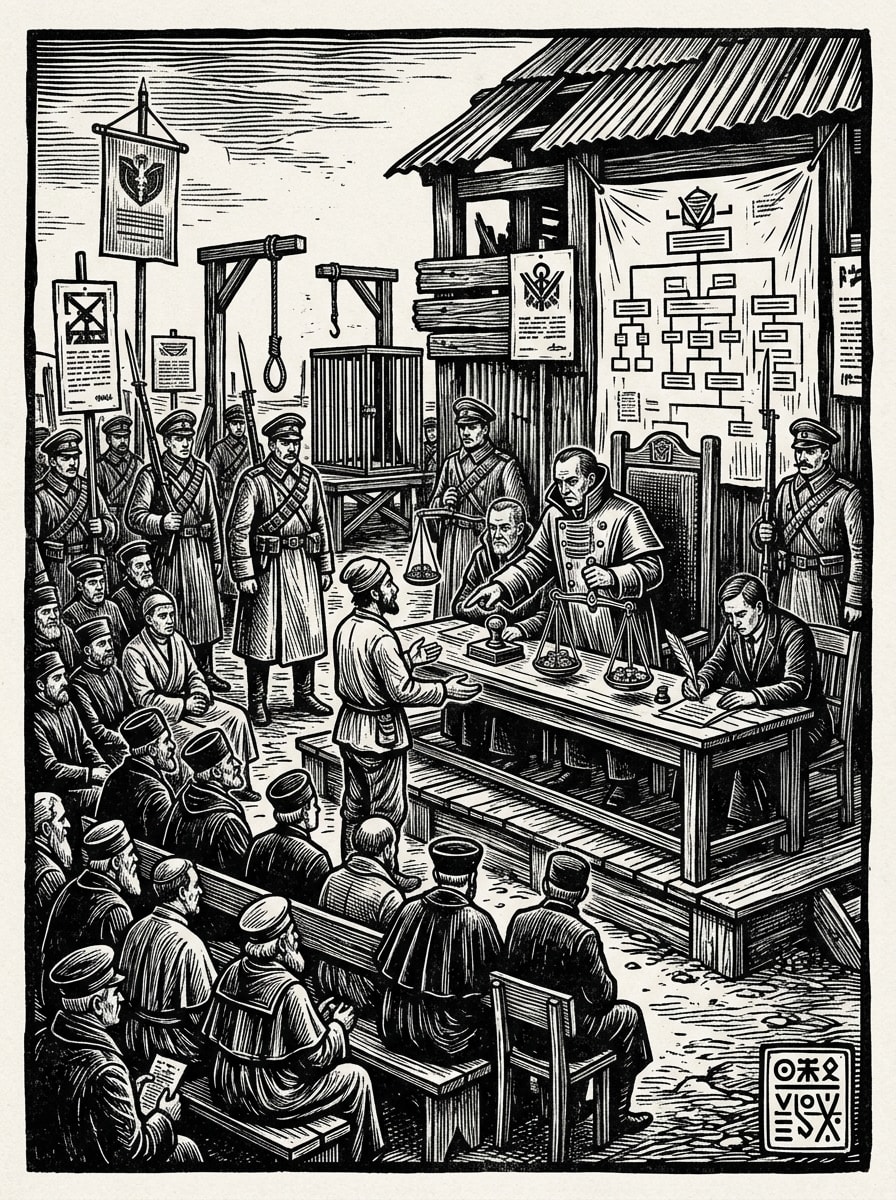
No binding term may be spoken without a licensed translator-scribe present. No ruling may stand without witness. No witness may stand without mark. No mark may stand without seal. No seal may stand without Archive deposit. This chain is not redundant. Redundancy is what engineers call fear after making it expensive. The Court calls it admissibility.
The High Arbiter hears the pleadings, though “hears” is a poor word for the ritual. The poor plead. The rich cite. The scribes translate. The witnesses sweat. The stones mutter constantly enough that each sentence feels borrowed from a throat sharper than one's own. A caravan master who claims grain spoilage must pronounce his route, name the water points, show the seals, produce two witnesses, pay the cargo weight, and survive the translator's smile. A refugee who asks shelter must speak the clause of lawful delay or buy someone else's mouth. A dead man's creditor must prove the debt outlived the debtor, which at Windscript is less difficult than decency suggests.
The Court's favourite finding is “the clause stands.” It is tidy, lethal, and magnificently portable. It ends marriages, transfers mules, collapses frauds, creates debts, rescues children when profitable precedent allows, and makes defeated men thank the court for sparing them the stones' direct opinion.
Treaty Office primer A.S. 112 described the Court as “an impartial forum for frontier reconciliation.”
Corrected for instructional use. The Court is impartial in the manner of a scale: it will weigh your bread, your child, your wound, and your tongue without blushing. Reconciliation is what losing parties call exhaustion after the fee is paid.
#On the Red Pronunciation and the Court's Education
The Court's first great education came in A.S. 94, when Licensed Arbiter J. Sarn damaged one binding syllable on the Third Stone's southern face during a Moldavian salt-convoy arbitration. The case was ordinary in the way frontier cases become ordinary after everyone involved has already behaved abominably: escort breach, theft, counter-claim, disputed salt weight, dead guards, insulted ancestors, and three contracts whose signatures had survived better than the men who made them. Sarn was trained. Sarn was licensed. Sarn was competent enough to terrify us.
He mispronounced the term. The wind accepted the error and distributed it.
One thousand throats closed by morning, after the Bureau of Doctrine corrected its first charitable count in A.S. 95. Clause-spirit enforcement passed through the Ring, the Oath Inns, the Scribe Bazaar (Unregistered), and the Caravan Corrals. Ink bled from ears. Paper-line cuts opened across hands. A surviving child was found beneath salt tarpaulin repeating the fatal term without sound. The Court learned, as all durable institutions learn, by surviving someone else's catastrophe and raising fees afterward.
The Red Pronunciation changed the Court's body. Phoneme cards became mandatory. Red caution glyphs marked fatal clauses. Translator-scribes ceased being convenience and became priesthood with worse manners. Witness distance tables were revised. The Seal-House Consortium formed its monopoly in the aftermath and presented the monopoly as public safety, which was correct in the narrow way a locked pantry prevents gluttony by starving the cook.
The Court also gained its deepest vice: it discovered that disaster validates procedure. Every precaution could be sold as compassion. Every delay could be called mercy. Every new form arrived wearing a shroud and asking for payment. A thousand closed throats made the Court rich, sober, and permanent.
#On Precedent as Trade Goods
The Caravan Court does not merely issue rulings. It breeds them, binds them in goat-hide, stamps them with nine weights, indexes them by clause and cargo class, sells them in the Scribe Bazaar, and watches merchants pay for the privilege of being trapped by last year's language. Vark's precedent books are famous, but the trade predates him. His genius was cleaning the knife, sharpening the index, and charging extra for marginal risk tables.
A certified precedent volume contains the ruling, the wind condition, the witness chain, the seal marks, the pronunciation key, the cargo class, the debt effect, the casualty history, and any caution glyphs required by prior blood from Moldavian road cases. A cheap copy omits risk tables. A counterfeit copy invents mercy. Experienced caravan lords avoid both, unless they intend to sell them to rivals.
Precedent is wealth at the Steppe Gate. Clean coin buys water. Good wax buys passage. Precedent buys expectation, and expectation is the finest chain ever placed around a litigant's neck. A caravan master who cites the Court's book has conceded the Court's authority before he opens his mouth. A translator who disputes a ruling must name the prior ruling he disputes, which admits he knows the book, which admits he stands inside the Court's appetite. Beautiful.
The Gully Market (Unregistered) sells forged addenda and false indexes. The Court tolerates enough forgery to keep fear alive and punishes enough forgers to keep certification dear. This is not hypocrisy. This is husbandry.
#On the Living Addenda
The Living Addenda made the Court honest against its will.
In A.S. 194, the Burnless Archive produced a wet-ink folio written by no living hand, amending an A.S. 118 passage writ with perfect form and dead witnesses. Since then the Addenda have multiplied: three to eleven per quarterly audit cycle by A.S. 199, roughly two per week by A.S. 201. They alter passage writs, toll schedules, escort contracts, confession summaries, witness lists, and arbitration rulings. One Addendum in A.S. 200 amended a ruling the Court had not yet delivered. Three weeks later, the ruling arrived in the posture the page required.
The Court's first instinct was cowardice dressed as review. Notices declared the Addenda under consideration, suspended pending decision, subject to examination, and other phrases that mean “we have seen the teeth and are searching for a polite hat.” Vark ended the comedy with Ruling 201-Blue/17 (Unregistered): if an Addendum satisfies form, it binds. Pulse is not a statutory requirement.
EMERGENCY SESSION MINUTE — A.S. 200; SEALED COPY, A.S. 201 Question entered: Can form exist without author? VARK: Form is the author the law admits. Paper Keeper witness: folio temperature █████ below vault norm. Seal-House response: fee table revised before adjournment. Stone reaction: Third, Fifth, and Seventh muttering in sequence for ███ minutes.
The ruling is monstrous, prudent, and commercially sound. Reject the Addenda, and the stones may correct the Court with wind. Bless the Addenda, and the Archive becomes a prophet with shelves. Bind them conditionally, fee them heavily, verify each seal, and deposit every copy beneath the cutbank; the monster enters procedure, and procedure places a collar where theology fears to put a hand.
Caravan Court notices once stated that unauthored amendments lacked standing until ratified by living officers.
Withdrawn after Ruling 201-Blue/17. Living officers may ratify what they understand. The Addenda are enforced before understanding arrives. The Court has chosen punctuality.
The Paper Keepers resent liaison duty with the Court because surface officials speak too loudly and believe urgency is an argument. The Court resents the Paper Keepers because they bring pages that win before proceedings begin. Alzen Voss's old rule governs the underground: no document shall be hurried merely because a surface office fears what it says. The Court's rule governs above: no fear shall go untaxed.
#On the Powers Behind the Bench
Three powers make the Court function and prevent it from becoming a chapel for frightened lawyers. The Treaty Office owns custody of the compact language. The Seal-House Consortium owns authentication. Patrol Command owns the bodies required to enforce what ink has done. The Caravan Court sits among them like a spider in a triangle of knives, pretending the web is public order.
Seal-Mistress Ylena Korr's (Unregistered) workshops decide whether a document smells lawful. Her wax verifies passage writs, precedent books, witness marks, and the Addenda the Archive keeps producing with indecent neatness. Captain Rho Balesh's (Unregistered) Blue Cords keep petitioners in line, collect quiet fees, escort seized cargo, and discover hourly that violence becomes more profitable when a court explains it afterward. The Treaty Office clerks preserve the fiction that language belongs to administration, though anyone with ears at the Ring knows the wind has prior claim.
The Court's corruption is structural, load-bearing, and protected from reform by the very danger it manages. Exemptions are for sale. Escort timings are for sale. Precedent is for sale. Witness priority is for sale. Night access to the stones is not for sale, which is the only proof that fear can still discipline greed. Men will sell their mothers, their cargo, their vowels, and their grandfathers' debts, but no sane clerk sells stone-access after dark.
The counter-narrative says the treaty protects the literate. This is malicious, popular, and mostly correct. The official line says the treaty protects the weak. This is also correct when the weak can pronounce the clause, afford a witness, and keep the receipt dry.
#On the Court's Present Condition
As of A.S. 201, the Caravan Court is richer than its founders, more cautious than its saints, and less certain than its fee tables imply. Vark sits beneath the stones. The Addenda arrive twice weekly. The missing Third Stone rubbing remains absent from a vault where paper does not leave. Paper Keeper Seld watches the wet blank folio. Caravan lords demand rewrite powers. Scribes threaten strikes whenever pronunciation fees are capped. Patrols extort harder because everyone knows a true reroute could starve the town without a siege.
The Court has answered pressure with more form. Mouth-guards stamped with correct syllables are now recommended for salt cases. Oath-collars for repeat liars have been revised after one collar began correcting the wearer in his mother's voice. Witness-for-hire licensing has tripled in cost. Mercy tables remain forbidden, though three are known to circulate in the Gully Market. The Vark Red-Glyph Edition sold out its first run in six days, then appeared as a forged green-wax copy whose index led buyers toward clauses with fatal pronunciation histories. The Court hanged the forger. The hanging produced a new precedent. The precedent sold well.
The Court's real terror exceeds mispronunciation: obedience without authorship. The stones speak. The Archive writes. The Court sells the interval between them. One day the wet blank folio will acquire text, and some mouth will read what no hand claims. If Vark is alive, he will ask for witness, seal, key, and fee. If Vark is dead, his precedent will ask for him.
At dusk, the Court empties by procedure. Benches are covered. Wax is cooled. Witness slates are locked. Petitioners leave by class, debt, and injury. The stones keep muttering after the last clerk lowers his head. Beneath the eastern cutbank, the Archive receives the day's rulings and decides, with perfect manners, whether the Court has understood itself.