
#On the Community Under Decree
The Carmelites of Kraków first appear in the Ledger as people already being hunted. No register in Bureau keeping records when they came to the city, who first held their keys, what name their house carried over its door, or how many brothers sat at their table before the Prefect began counting them for his own purposes. The Bureau of Records has asked. The archive sent back a requisition slip and a smell of mice. I will not invent a founder for them. Founders invented by clerks tend to acquire beards, visions, and a convenient spring.
The decree, however, is on record. In A.S. 14 / 1724 CE, Colonel-Prefect Ignaz Brechtold, governing Kraków for the Rationalist administration, dissolved the city's monastic houses. In A.S. 15 / 1725 CE he seized the endowment of the Cathedral on Wawel Hill. Then came the bell restrictions, then the confiscated clappers, then the informers, the fines and the raids. A cloister is a building, and a decree can empty a building. A rule of life is harder to padlock. The Carmelites carried theirs indoors and up the stairs.
#On the Hidden Rooms
They were not alone in the walls. During the years of the Atheist Wars, parish priests, Dominican friars and a few Jesuits who refused to admit their order had been dissolved all kept services in cellars, attics and butchers' back rooms, where the smell of blood covered the incense. Later preachers like to make the Carmelites captains of this underground, complete with passwords, couriers and a chain of command running from one attic to the next. No document supports them. The hidden Church of Kraków was a scatter of cupboards, and every cupboard carried its own risk.
The Carmelite share of that scatter consisted of back rooms, false walls, pantry chapels and attic altars. They measured out incense as if it were contraband medicine, which under the decree it was.
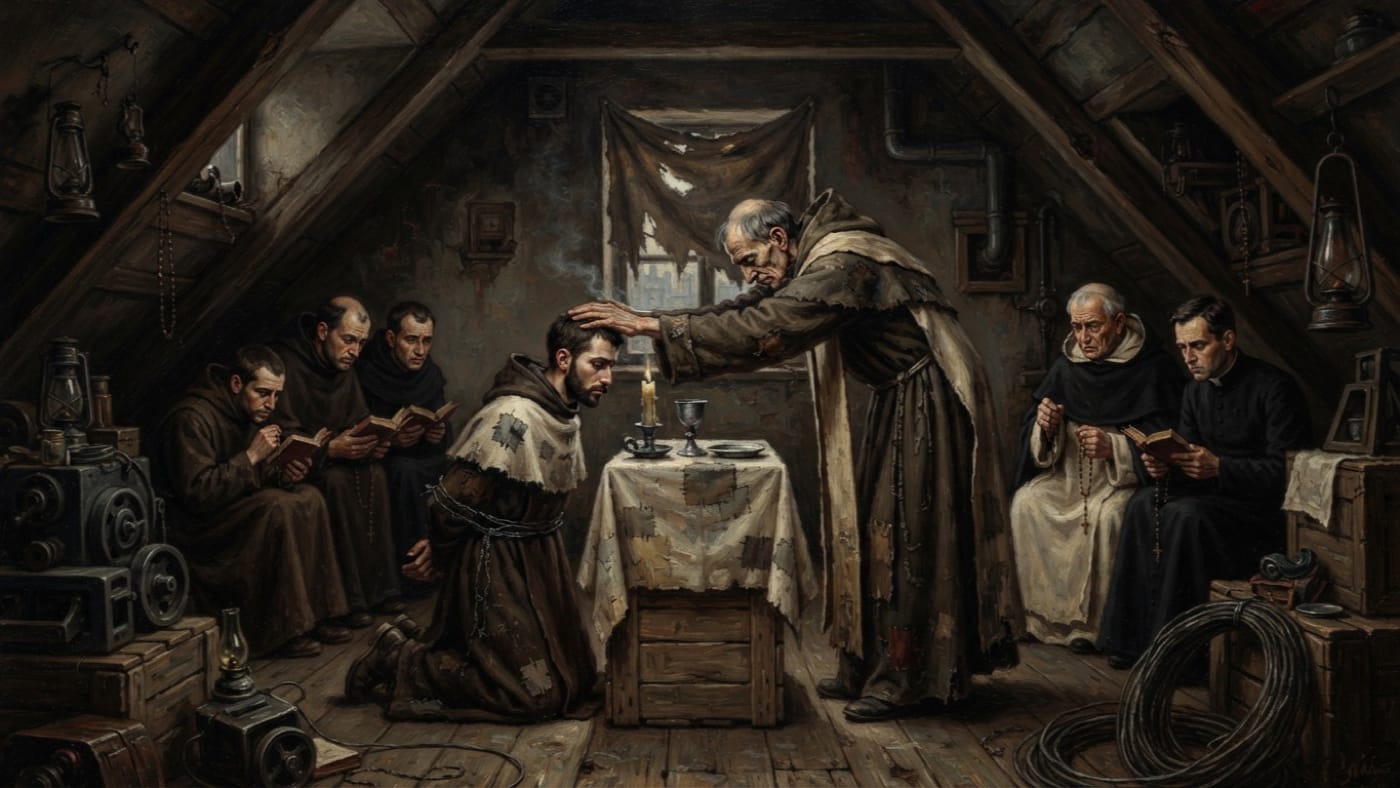
We have the inventory of one room, and only because a young man was ordained there and murdered four days later. Brother Paweł Nowak received the imposition of hands under a roofline so low that the officiant had to bend over him. The chalice was pewter. The altar cloth had been cut from a widow's sheet. The candle smoked. The Bureau's schedule of liturgical vessels rates pewter "acceptable under necessity," and in that attic necessity was the whole rubric.
A devotional card in circulation among Kraków parishes shows the Carmelite ordinations of the suppression years, Brother Paweł's among them, taking place before the high altar of Wawel Cathedral.
Withdrawn. The Cathedral's endowment had been seized, its bells policed and its public offices strangled. Paweł was ordained in a concealed room. The card has been reissued without the architecture.
The four days that followed are the best account we have of Carmelite practice under suppression. Paweł heard confessions in whispers. He carried oil under his sleeve in a corked vial. He learned to fold a vestment so that it would pass for laundry if the stairs filled with boots. In A.S. 18 a Carmelite learned laundering before he learned to preach.
An older Carmelite gave him the emergency psalm to memorize for raids. That brother's name is missing from the public ledger, and I will not supply it. The words of the psalm are missing as well. A psalm invented to fill the gap would be a forgery set to music.
#On the Additional Brother
On 17 Martius A.S. 18 / 1728 CE, between the second and third hours after midnight, sixty-three men of the Kraków Secular Guard and fourteen of the Rationalist Philosophical Police moved at once against eleven locations. They seized forty-seven clergy of several orders. The rest of that night belongs to the Night of Knives in Kraków and need not be repeated here.
Forty-seven is the number for the whole massacre. It is not a count of Carmelites. The public record does not say how many of the forty-seven belonged to this community, and I will not divide the river by guesswork. Nor does anything in Bureau keeping show that the community died entirely that night. Its rooms lost their occupants. Whether every room did, no one wrote down.
Brechtold's target list survives in two columns. The principal column names the Carmelite superior. What happened to that superior after the list was written is not in the record, so the column is all I can give. Paweł appears in the secondary column: additional religious male, young, Carmelite habit probable. Bureau of Shadows annotators later circled the word additional three times. Tyranny keeps its main column tidy and leaves its most damning entries in the appendices.
Sister Agata Wiśniewska watched the procession from above Grodzka Gate. She was a Poor Clare. The Carmelites owe the survival of their youngest martyr to a woman of another order, a debt they have never been able to repay and have the grace not to try. She saw the young Carmelite try twice to cross himself with bound hands and fail both times. She counted the wire on his mouth: three turns and a broken pull. Her window did not look over the whole of the Dębnicki Bridge. She saw the street and the march. The drowning in the Vistula, with ice still in the current, is established from her testimony read together with the recovery evidence, and with no single pair of eyes at every plunge.
#On the Record Returned
The river carried the bodies downstream to Sandomierz, and over the following nine days fishermen pulled them out. Paweł was among the later ones. The surviving copies of the recovery log put him on the sixth day or the seventh, and the dispute has used up good ink without settling anything. A surviving fragment of habit confirmed the order. There was no miracle at the recovery: no fragrance, no light, and no fish arranged into heraldry.
Several Kraków hymnals hold that the young Carmelite sang beneath the water, and that the fishermen followed the sound to his body.
Withdrawn from sanctioned hymnody. His mouth was wired shut. The hymnals have been corrected at source, and the Carmelites who sang the verse were among the first to strike it.
Agata's testimony went out of Kraków hidden in the binding of a psalter. So the Carmelites' memory of their youngest brother depended on two things: the stitching of a Poor Clare's book and the patience of Sandomierz fishermen.
#On Formation and the Refused Feast
As of A.S. 201, Brother Paweł is taught to Carmelite novices, and his name is part of the Kraków Carmelite formation rites. Whether the house that teaches him descends in an unbroken line from the attic rooms of A.S. 18 is something the Bureau's holdings cannot certify. There is a gap of generations in the record, and I decline to fill it with a list of superiors made out of plausibility. The present community teaches as the heir of those rooms. Doctrine has never disputed that inheritance. It has disputed the feast.
The Kraków Carmelites petitioned for a youth-martyr observance in A.S. 172 / 1882 CE. They petitioned again in A.S. 188 / 1898 CE and again in A.S. 200 / 1910 CE. The Bureau of Doctrine declined all three times, giving three reasons: liturgical congestion, evidentiary modesty, and the danger of encouraging adolescent enthusiasm in religious houses.
I have read the refusals. They are short, courteous and carefully filed. The first two reasons deserve a hearing. The calendar is crowded, and the evidence for Paweł amounts to a name, an order, an age, four days, two failed gestures and a count of wire. On the third reason, Doctrine is correct, and I record that with no pleasure at all. Novices given a nineteen-year-old martyr with his vows still fresh will imagine themselves dying beautifully. Paweł did not die beautifully. He died wet, gagged and beaten, in water carrying ice.
The refusals deny a feast and nothing more. They do not forbid the formation teaching, the novice instruction, or the ordinary remembrance a religious house keeps for its dead. Anyone who cites the refusals as a ban on speaking his name in the novitiate should be reported to me, and I will return the citation with corrections in red.
#On the Approved Commemoration
The formal Vigil of the Drowned Priests was established in A.S. 148 / 1858 CE by the Fifteenth Doctrinal Congress, which ratified Agata's testimony one hundred and thirty years after the murders. Local mourning had begun long before then. Grief does not wait for a quorum. Each 17 Martius the Bureau of Bells silences Kraków for one hour, under the calendar authority of the Bureau of Festivals. Forty-seven candles are carried to the bridge and put out, and the wicks are dropped into the river, which carries them downstream to Sandomierz. Paweł is remembered there as one of the forty-seven, a small page in a larger missal. Some parishes name him first.
The Carmelites wanted him to have a day of his own. Doctrine keeps him among the company he drowned with. Neither position is dishonourable, and only one carries a seal.