
#On the Span Above the Vistula
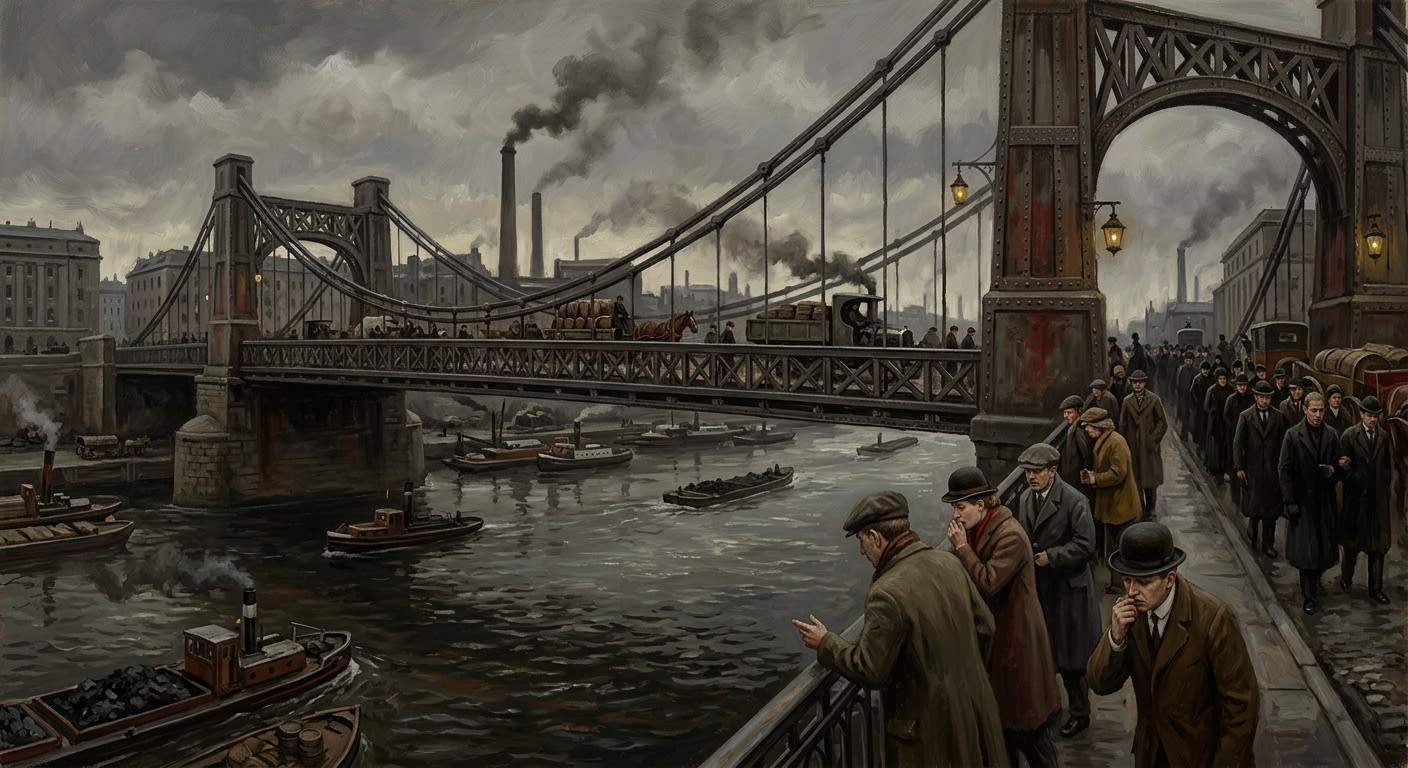
Dębnicki Bridge crosses the Vistula below Wawel Hill, and, like many useful structures, became sacred by being used badly. It was built to move carts, students, clergy, fish, municipal gossip, farrier’s wire, soldiers with orders, widows with baskets, and all the soft civilian clutter by which a city pretends continuity. On 17 Martius, A.S. 18, Colonel-Prefect Ignaz Brechtold made it move forty-seven wired mouths into the river. After that, the bridge ceased being a convenience and became an accusation with railings.
A bridge is ordinarily a civic compromise: two banks agree, under pressure of commerce, that distance has become annoying. Dębnicki Bridge is uglier. It joins Kraków to the memory of what Kraków permitted, resisted, witnessed, misreported, mourned, ratified, priced, processed, and annually rehearses beneath Bureau supervision. The Vistula below it took the bodies southward to Sandomierz over nine days. The bridge remained. Structures are shameless in this respect. They outlive their uses and wait for interpreters.
The site’s official classification is simple because the Bureau has learned to bind complicated guilt inside plain labels. Dębnicki Bridge is a Kraków river crossing, Zone 3, Night of Knives atrocity site, Vigil route midpoint, Bell-silence focus, Sandomierz wick-origin point, and restricted object of unsanctioned private devotion. That last phrase means people touch the rail where the forty-seven were thrown. The Bureau dislikes this because uncontrolled hands make poor doctrine and worse varnish.
No reader should sentimentalize the bridge. Sentiment will arrive without invitation; it always does where water and dead clergy are placed near candles. Dębnicki Bridge deserves harder handling. Its holiness is contaminated by utility. People still cross it to buy bread. Carts still complain across its joints. Children still run ahead during market hours and are dragged back by mothers who remember that every span over water is a sermon if one is old enough and sufficiently damaged. The Bureau would prefer a pure relic, sealed behind glass, guarded by a dull man with a halberd. Kraków gives us a bridge. People use it. The shame must work while traffic passes.
#On the Night It Was Chosen
Brechtold did not choose the bridge by accident. Rationalist murder adored practicality when practicality could be made symbolic without seeming theatrical. Dębnicki Bridge lay within march distance of the arrest routes, within sight of the city’s ecclesiastical crown, and over water deep enough to dispose of bodies if one trusted current more than evidence. Brechtold trusted current. Brechtold was a competent fool, the worst sort, because incompetence at least leaves gaps for mercy.
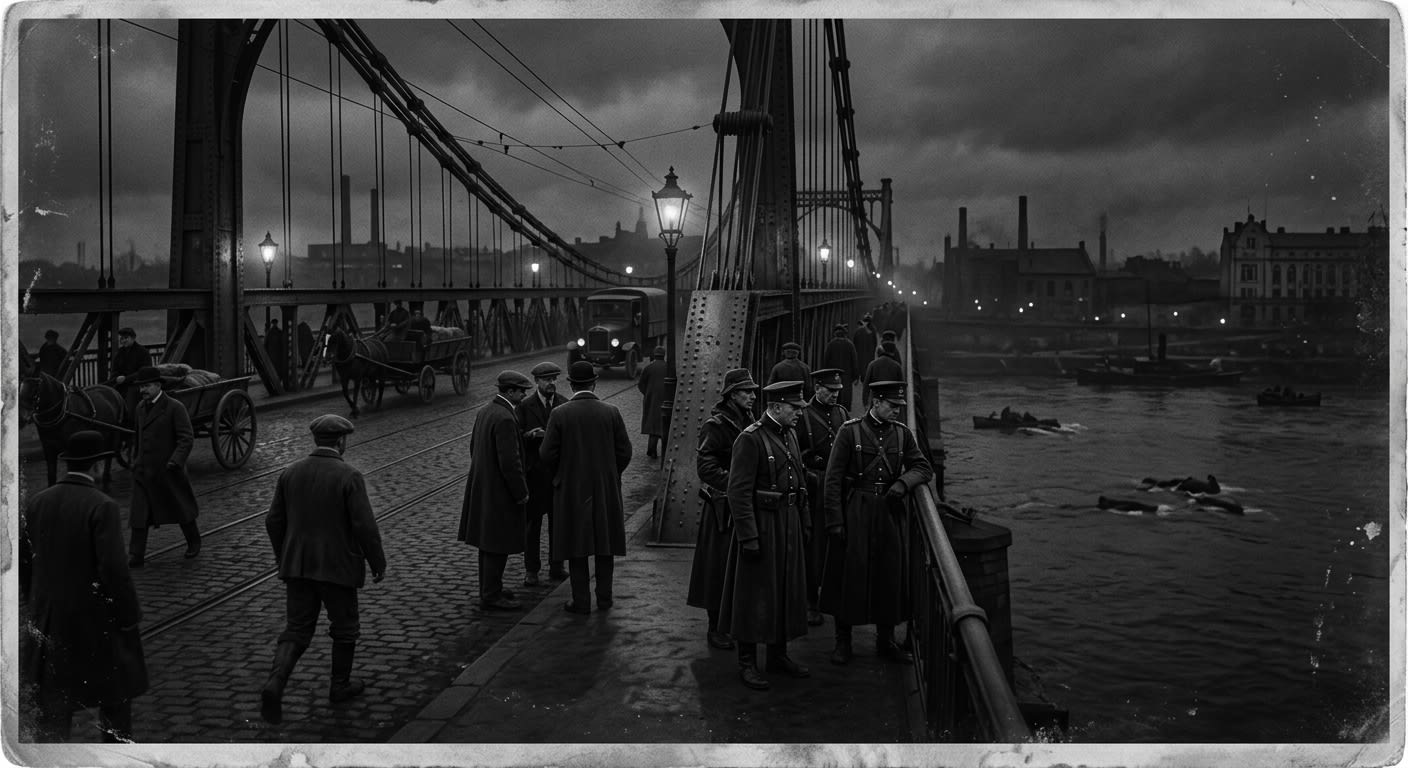
His men moved between the second and third hours after midnight. Sixty-three Kraków Secular Guard and fourteen Rationalist Philosophical Police struck eleven targets. Priests, friars, brothers, old parish men, hidden confessors, stubborn Jesuits, Carmelites, Dominicans, and those soft-voiced ecclesiastical survivals that states call networks when they intend to cut them. Their mouths were stitched shut with iron wire requisitioned from the municipal farrier three days earlier under Brechtold’s own hand. A signature can become a weapon if the signer has enough office and too little fear of judgment.
Sister Agata Wiśniewska watched the procession after the arrest details converged. Her window above the Grodzka Gate did not command the full bridge span; this matters, because pious art has placed her everywhere at once like a saint with architectural privileges. She saw the march. She counted the wire-wraps. She heard the apple song whistled by the man with the pale moustache. She saw Father Janusz Sobecki dragged by the ankles. She saw Brother Paweł Nowak, nineteen and ordained four days, attempt the sign of the cross with bound hands, fail, try again, and receive the blow that made his name useful to novices forever.
The bridge received them in the dark. Ice moved in the Vistula. The clappers of Wawel had already been confiscated; the bell-ropes had been cut or watched; the hill above the city stood mute with the peculiar obedience of sacred property under police attention. Forty-seven men were brought onto the span. Their mouths were closed, their hands bound, their lungs still legal enough to need drowning. The Rationalist tribunal later called the deaths ritual suicide. This remains among the finest documents ever produced by idiocy in formal shoes.
RETROACTIVE SITE NOTE — DĘBNICKI SPAN Agata line-of-sight: street approach confirmed. Bridge witness fragments: incomplete. Recovered oral rumour, Sandomierz fisher line: “The young one struck the water with his shoulder, not his face.” Doctrine action: retained under sealed devotional appendix. Reason: the faithful have shown a tiresome genius for injuring themselves while reenacting details too precisely described.
Bodies appeared at Sandomierz over nine days, mouths and palms still carrying iron. The bridge, having performed its civic part in state murder, returned to morning use. That fact disgusts the tender-hearted. It should. Then it should instruct them. Atrocity rarely burns the street afterward. It lets the baker cross at dawn.
#On Wire, Water, and Engineering
There is an obscene intimacy between a bridge and a mouth. Both are passages. Both can be closed. Brechtold, who lacked poetry but possessed instinct, made visible silence by sealing prayer and passing it over water. The iron wire did the first work. The Vistula did the second. Dębnicki Bridge held the interval between them, a municipal altar no one had consecrated and everyone now pretends had always been waiting for the role.
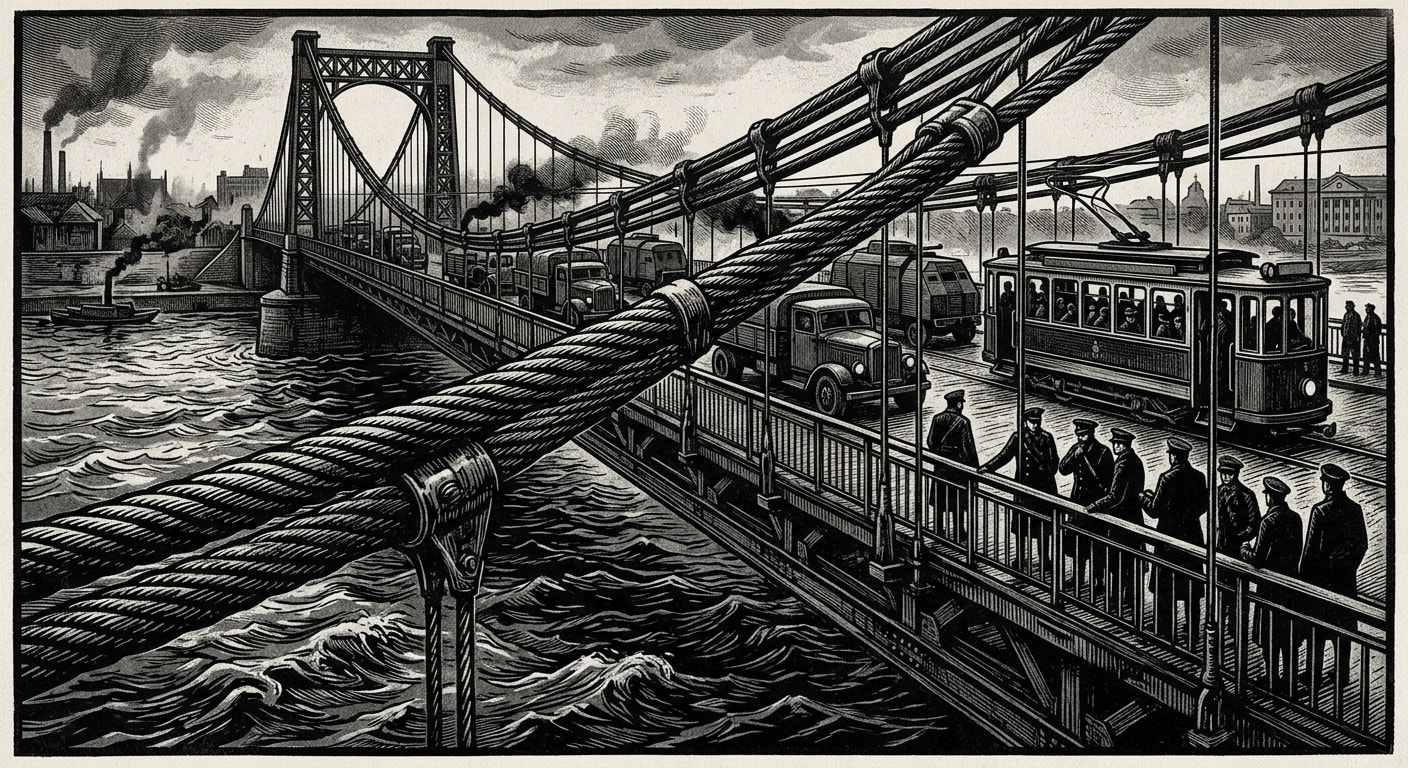
The old bridge records before A.S. 18 are unhelpful in the manner of ordinary civic documents. Maintenance schedules. Toll repairs. Timber replacement disputes. A complaint about wagon wheels striking loose plates during thaw season. No clerk in those papers suspects he is writing preface to martyrdom. This is why archives are crueler than sermons. They show catastrophe approaching through expenses.
A Kraków pilgrimage card describes the bridge as “built for the martyrdom of the forty-seven.”
Corrected. It was built for crossing. The martyrdom used it. Providence is under no obligation to order special architecture when municipal convenience already presents a suitable knife.
After the Night of Knives, the Rationalist administration inspected the bridge for damage. Damage. One admires the discipline of such blindness, if only as a hunter admires the posture of a wolf before shooting it. The inspection found scuffs along the rail, one bent iron upright, and blood traces at three points. The report classified the bridge as serviceable. It did not mention prayer, wire, or Sandomierz. It did mention that a railing repair should be charged to civic security operations rather than transport maintenance. Brechtold’s Kraków had mastered the highest Rationalist art: putting the correct budget code on evil.
The Vistula beneath Dębnicki Bridge is not the Danube, though both rivers have suffered theologians. It is narrower, colder in the city’s Martius memory, and more intimate with Polish grief. At thaw it carries branches, rags, fish rot, market waste, and the occasional petition thrown by someone who distrusts offices yet trusts current. During the Vigil, it carries forty-seven spent wicks, each a little blackened filament surrendered where bodies once fell. The Bureau of Festivals insists the wicks be dropped one by one. The river accepts them in a group because water has never respected choreography.
Modern Engineering has reinforced the bridge twice without admitting alteration of sanctity. This is wise. Pilgrims hate replacement when replacement is visible; they adore survival as long as no one shows them the invoice. Rail sections judged unsafe after the A.S. 148 ratification were recast with filings from older iron mixed into the mould wash, a technique borrowed from relic bell practice and defended in a memorandum of such strained piety that I nearly admired the clerk who forged it. The current rail is not the exact rail. It is the official rail. The distinction sustains half the Synod and several marriages.
#On Sister Agata’s Bridge
Sister Agata made the bridge legible without seeing everything. This offends weak historians, who want sight-lines as clean as courtroom diagrams and martyrdom arranged under sufficient lamps. The world rarely assists them. Agata saw the approach, the bodies in motion, the wire, the faces when faces still had street-light enough to be recorded. She did not see every plunge. She heard the procession vanish toward the span. Later testimony, fishermen’s recovery logs, farrier’s requisition, and Brechtold’s own command papers complete the record. Evidence is a choir, not a soloist. It requires parts.
Her bridge is a bridge of counting. Eleven targets. Seventy-seven armed men. Forty-seven seized. Three turns and a broken pull around Brother Paweł. Four turns around Father Janusz. Nine days to recovery. One hundred and thirty years to ratification. One hour of silence each year. The Bureau loves numbers because numbers appear obedient until they begin accusing their handlers. Agata’s numbers accuse beautifully.
The Congress in A.S. 148 needed Agata because memory had become too convenient. Local mourning had preserved the Night, yes, but local mourning frays into song, and song, left unsupervised, develops wings, extra miracles, wrong dates, and a bass part. Agata supplied hard edges. She named the wire. She preserved the whistled tune. She made it impossible to turn the bridge into mere symbolic furniture. A symbol may be polished. A detail has teeth.
Her testimony also prevents the bridge from becoming too comfortable for the Synod. We have made admirable use of the atrocity, naturally. We designed seals, structured vigils, trained novices, stamped warrants, and taught Rationalist sympathizers that history has a long reach and a clerk at the end of it. Yet Agata’s text keeps the cost particular. Forty-seven is a number. Paweł is a throat. Janusz is ankles on stone. The bridge is where the number became wet.
#On the Farrier’s Wire
The wire deserves its own paragraph in Hell and receives a section in the Codex, which is the closest respectable arrangement available. Three days before the Night of Knives, Brechtold requisitioned iron wire from the municipal farrier. Not chain. Not rope. Wire. Thin enough to enter flesh, strong enough to hold a mouth closed, common enough to pass through stores without alarming a clerk whose imagination had not yet been poisoned by competence. The requisition named civic security use. The farrier supplied it. The ledger was signed. The city helped, in the manner cities help when each hand touches only one clean part of the filthy thing.
The farrier’s shop stood near the market approach, close enough to hear Wawel bells before the clappers were taken and close enough to smell the Vistula during thaw. Its surviving account book is a thing of appalling ordinariness: nails, shoes, axle pins, hinge mends, wire, payment received, payment pending. After A.S. 148 the book was removed under Doctrine custody and placed beside Agata’s psalter packet during Congress review. The arrangement was deliberate. One document witnesses sight. The other witnesses supply. Between them, Brechtold’s city becomes impossible to excuse as sudden fury.
The Bureau of Records later attempted to classify the wire under martyr-relic protocols. Relics objected, on the grounds that the wire had touched martyrs but had been an instrument of murder rather than sanctified endurance. Bells objected because the throat-bell mould wash required filings and no office likes another office touching its future exhibits. Doctrine settled the matter with characteristic grace, which is to say by taking custody and permitting everyone else carefully measured disappointment. A portion remains sealed in the Cathedral treasury on Wawel Hill. A portion was filed into the mould wash for the forty-seven throat-bells. A portion, smaller than the local cult claims and larger than Purity admits, vanished into private hands before the inventories closed.
Street vendors regularly claim to sell “true Brechtold wire” cut from the mouths of the forty-seven.
Fraud. The recovered wire is sealed, inventoried, and insufficient for the bushels of relic scraps sold each Martius. Most market specimens are saddle wire, boot hook wire, or blackened copper. The Bureau advises citizens not to purchase damnation by the inch unless the receipt bears three seals and one of them bites the wax.
The phrase “the wire was already in” entered Kraków speech through Sister Agata’s line concerning Father Janusz. It is now used, quietly, when an office pretends consultation after deciding the sentence; when a levy board asks a mother whether she consents to the son already listed; when Doctrine requests comments on a decree printed yesterday; when the Bureau of Bells announces a silence it has already scheduled. The phrase is dangerous because it teaches citizens to identify procedure after violence has begun. This is why the Bureau permits the phrase only in liturgical context and everyone else uses it in kitchens.
Wire also shaped the commemorative seal ratified after the Fifteenth Doctrinal Congress: river bisected by iron, forty-seven drops suspended above the waterline. The Bureau of Heraldry produced seven drafts. The first made the river too graceful. The second made the wire too decorative. The third omitted the drops, an error that caused a Heraldry clerk to be reassigned to livestock brands, where his softness could harm only cattle. The final seal is severe enough to do its office. It appears on Rationalist-sympathizer warrants, Vigil notices, restricted lesson sheets, and certain Purity summonses in Kraków where the recipient is meant to understand that silence has a precedent and paperwork has teeth.
The wire began as stock. It became instrument, relic, seal, idiom, warning, fraud-market, and annual accusation. This is the ordinary promotion ladder of matter touched by history. Men rise by patronage. Objects rise by blood.
#On the Vigil Route
The modern Vigil begins below Wawel, climbs to the Cathedral and the Chapel of the Drowned Priests, descends by the Grodzka Gate, and reaches Dębnicki Bridge under a silence so heavily regulated that even the horses seem doctrinally embarrassed. Forty-seven candles are carried. Forty-seven names are read before the silence begins, unless weather, crowd pressure, or a parish dispute over sequence has required adjustment under Form 17-K. The Bureau permits age-order and recovery-order. It forbids improvisation, youth-martyr theatrics, local additions, and music. Especially music.
At the midpoint, the procession stops. There, where the bridge’s civic geometry becomes liturgical wound, the candles are extinguished one by one. The smoke hangs briefly over the water. The wicks are dropped into the Vistula. People lean to watch them fall, and the marshals lean harder to prevent piety from becoming incident. Every year someone reaches too far. Every year the route officials pretend surprise. Faith is often a balance between reverence and poor footing.
The one hour of Bell-silence covers Kraków’s processional district. Bells hang mute on Wawel. Market chimes cease. Tower corrections pause. The city listens to footsteps, water, cloth, accidental weeping, and command whispers. Strasbourg performs a shortened office because the capital cannot endure an hour without hearing itself. I have said this before and will continue saying it until someone in Strasbourg acquires humility or kills me. The odds favour repetition.
At Sandomierz the fishermen gather the wicks when current and weather permit. They lay them in trays, count them, seal them, and send reports back upriver. A.S. 191 produced the famous unauthorized nail-paring, wrapped around one wick by a private supplicant with a grief too peculiar for the form. Doctrine wanted removal. Rites wanted interpretation. Records wanted a subcategory. The fisherman wanted breakfast. The fisherman was the only sane participant.
Popular broadsheets claim every wick reaches Sandomierz each year by miracle.
False. Some lodge in reeds. Some sink. Some are stolen by boys, gulls, eddies, or the appetites of private devotion. The rite requires the sending, the counting, and the report. The river is not a courier under oath.
The bridge is cleaned after the Vigil by a crew under joint Festivals and Settlement supervision. Wax scrapes from stone. Soot rubs from iron. Lost gloves and hair ribbons are collected. Petitions tied beneath the rail are removed, recorded, and usually burned. The next morning market traffic resumes, and the bridge returns to its scandalous double life: ordinary crossing, annual wound.
#On Unlicensed Touching
The Bureau’s most persistent problem at Dębnicki Bridge is touch. Pilgrims touch the rail. Children are lifted to kiss it. Old women press cloth against the iron and tuck the cloth into coats. Novices scrape filings with hidden knives. A bridge that remains in public use cannot be kept from hands, and hands, being the most disobedient theologians attached to the body, invent doctrine by pressure.
Unauthorized filings became common after A.S. 148. Some were sewn into scapulars. Some were mixed into candle wax. One Kraków brewer dropped filings into Lent beer and sold it as Martyr’s Throat until the Bureau of Purity intervened, confiscated twelve barrels, and recorded the flavour as “metallic, improper, commercially promising.” The brewer was fined, flogged, and later licensed under another name. Tithes has never wasted a surviving market.
The bridge rail bears sanctioned contact marks: forty-seven small darkened points on the inner parapet, one for each drowned priest. These were added after three decades of uncontrolled rubbing threatened to polish the wrong sections into local sanctity. The Bureau of Heraldry placed the marks. The Bureau of Doctrine approved them. The Bureau of Tithes proposed a touch fee and was told, for once, to crawl back into its counting-house and sulk. It did so profitably.
Unlicensed nocturnal visits continue. Guards report candles under the span, thread tied around lower braces, pieces of bread left on the stone, and prayers scratched so small they require lens inspection. The most common scratched phrase is the wire was already in, taken from Agata’s testimony concerning Father Janusz. The second most common is Paweł’s name, often misspelled. The Bureau corrects the spelling in public signage and leaves the scratches alone until maintenance requires removal. A misspelled prayer is still evidence of need. Even Doctrine knows this, on its better mornings.
The bridge has attracted frauds. Men sell “original wire” in alleys, most of it bootlace stiffened with lampblack. Women sell water dipped from downstream and call it martyr-current, although the same bucket often serves three sources and one ambitious pump. Children sell bridge dust, which is usually road grit. The Bureau prosecutes when fraud threatens doctrine, ignores it when fraud merely embarrasses buyers, and purchases samples when useful for training inspectors. The pious dislike being told they were cheated. The Bureau dislikes it more when the cheating is poorly made.
#On the Bridge and Kraków
Kraków’s relationship with Dębnicki Bridge is not clean. The city needs it. The city resents needing it. Residents cross with a briskness that outsiders mistake for indifference. A Kraków woman may carry cabbages over the span on the morning after the Vigil and never glance at the water. This is not forgetfulness. It is local discipline. People who live beside wounds do not prod them hourly unless they wish to become useless.
Wawel watches from above. The Cathedral holds the recovered wire under seal, filings of which entered the mould wash for the forty-seven throat-bells. The Doctrine observation post installed in A.S. 199 monitors bridge observance, university roofs, bell compliance, and citizens whose gaze lingers overlong on either water or sky. The bridge below supplies excellent sight-lines for supervision and poor comfort for the supervised. This is a common arrangement in holy cities.
The university quarter has tried, with academic cowardice, to treat the bridge as a historical site rather than a living indictment. Students measure its span, compare engineering phases, write theses on civic memory, and discover too late that the Bureau of Doctrine reads footnotes. The Condemnation of Kraków made celestial measurement dangerous; it did not cure the local appetite for measuring everything else. One dissertation described the Vigil as “ritualised hydrological memory.” The author now teaches arithmetic to penitents. This was lenient.
Kraków children learn the bridge in stages. First, as a place not to run. Second, as a place where candles go into water. Third, as the place from which the priests were thrown. Fourth, if education succeeds, as the place where a state proved that paperwork can make murder punctual. The fourth lesson separates citizens from decorative mourners. Decorative mourners weep well and vote badly. Citizens know which office signed the wire requisition.
#On the Present Span
As of A.S. 201, Dębnicki Bridge remains open, restricted, repaired, watched, touched, scrubbed, cursed by maintenance crews, loved by old women, exploited by frauds, measured by fools, and crossed by everyone. Its boards, stones, plates, and rails do not all date to A.S. 18. No working bridge enjoys such purity. Replacement has occurred under seal, with old iron preserved, sampled, filed, mixed, or displayed according to the needs of safety and theatre. The official bridge is continuous because the Bureau says continuity is maintained. The city accepts this with the weary sophistication of people who have lived under several empires and know that all bridges are arguments held together by bolts.
Each 17 Martius the candles return. Each year the rail is touched. Each year the silence begins and ends. Each year the wicks fall, some to current, some to reeds, some to boys with quicker hands than reverence. Each year the reports travel. Wawel watches. Sandomierz counts. Strasbourg shortens the office and pretends this is dignified. Kraków hears the water.
The bridge does not absolve the city. It does not condemn it alone. It holds a passage over a river and forces bodies to remember that passage is never innocent once used by power. Carts cross. Pilgrims cross. Guards cross. Students cross with notebooks too visible for their own good. A woman pauses at the midpoint, presses two fingers to the marked rail, and moves on before the marshal can correct her.
Below, the Vistula takes what is given and keeps what it pleases. Above, the bridge endures under boots, wax, soot, weather, and the annual genius of enforced silence. Iron remembers poorly. People remember worse. The Bureau remembers selectively. The river remembers downstream.