
#On the Gate That Saw Enough
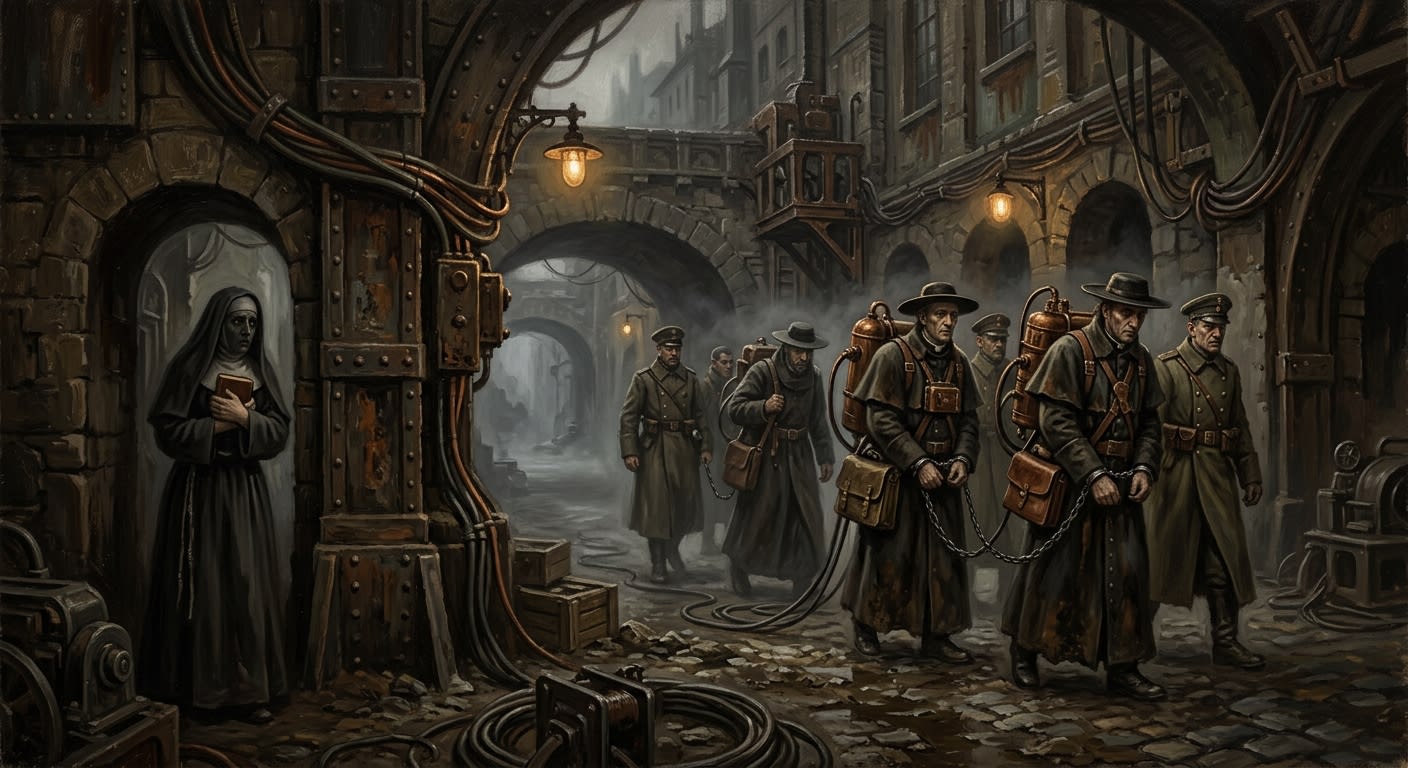
Grodzka Gate is a passage in Kraków below Wawel Hill, a stone throat through which processions, carts, pilgrims, clerks, novices, Rationalist patrols, and, on 17 Martius A.S. 18, forty-seven wired mouths passed toward the Vistula. It is not the murder site. The Dębnicki Bridge holds that honour, if honour is the word one uses when a structure becomes famous because men used it as a blade. Grodzka Gate is the seeing-place. It framed the march. It held the convent window. It gave Sister Agata Wiśniewska the angle by which atrocity became evidence.
This distinction matters. The Synod has always known what to do with places where blood falls. We rail them, pave them, wash them, seal them, charge entry, and appoint a man with keys. Places where seeing occurs are more troublesome. Sight leaves no stain fit for inspection. It changes the witness and asks the stones to remember without proof.
#On Stone, Slope, and Use
The Gate belongs to that old civic species which mistakes use for innocence. It was built to regulate movement between sacred height and city street: Wawel above, market pressure below, river beyond, university argument everywhere. Before the Atheist Wars, clergy descended through it with the tired composure of men late for offices of the Creator; merchants cursed carts through it; students passed under it inventing opinions; nuns heard it by echo from windows and knew the hour by wheel-clatter.
A gate is a modest machine. It narrows bodies. It converts crowd into line. It makes passage countable. For this reason every government loves gates with a devotion it pretends is urban planning. A crowd may riot. A line can be inspected.
In Kraków, Grodzka Gate acquired its sanctity by failing to prevent passage and succeeding in preserving witness. Brechtold's patrols did not choose it as a ceremonial station. They used the street because the street worked. The seized clergy were driven beneath and below the Wawel approaches, their vestments torn, their crosses broken, their mouths closed with farrier's wire. Above, Sister Agata watched from her Poor Clare window. The Gate made no speech. Stone rarely does, though architects spend whole careers pretending otherwise.
A devotional map printed in A.S. 152 labelled Grodzka Gate as “the place where Brother Paweł received the wire.”
Corrected. The wire was applied during the street march and before the river span; specific applications varied by prisoner and moment. The Gate is the witness frame, not a single handling point. Pious compression is still compression. The Bureau permits tears. It forbids lazy geography.
#On the Window Above
Sister Agata's window is the Gate's true wound. It did not command the entire bridge span, despite what bad paintings and worse sermons insist. It commanded the approach: the street below Wawel, the narrowing at the Gate, the joined arrest details after the eleven targets had been emptied into one movement. From there she saw enough. Enough is an austere word. It has saved more records than omniscience.
She saw Father Janusz Sobecki dragged, the old priest's ankles made into handles by men who would later describe their politics as humane. She saw Brother Paweł Nowak, nineteen and four days ordained, try the sign of the cross with bound hands, fail, begin again, and receive the blow behind the ear. She counted the wire-wraps. She heard the pale-moustached guard whistle the apple song. She timed the procession by Saint Andrew's bells, spared because Brechtold enjoyed placing police inside churches and calling it civic improvement.
The Bureau of Doctrine later classified portions of her testimony as devotionally excessive in anatomical specificity. This is the sentence bureaucracies write when accuracy grows fingers. Agata did not provide a clean martyr-plate. She provided a street, a window, torn cloth, failed gestures, wire tension, a tune, and the precise misery by which philosophy becomes boots around a throat.
AGATA WIŚNIEWSKA — WINDOW NOTE, SEALED LEAF Position: convent window above Grodzka Gate. Observation: the young Carmelite attempted blessing twice. Unpublished line: “The first failure made his face change; the second made mine.” Handling: retain under sealed appendix; unsuitable for children's plates.
#On the Night Passing Through
The Night of Knives did not begin at Grodzka Gate. It converged there. Between the second and third hours after midnight on 17 Martius A.S. 18, Colonel-Prefect Ignaz Brechtold sent sixty-three Kraków Secular Guard and fourteen Rationalist Philosophical Police against eleven targets. The arithmetic is ugly and exact. Seventy-seven armed agents. Forty-seven clergy. Eleven sites. One farrier's requisition signed three days in advance. One bridge chosen because water is cheaper than burial.
The Gate received the procession when the scattered arrests had become a single public fact. That is the moment regimes fear and desire. A raid inside a room can be denied. A march through a gate instructs everyone with eyes. The Rationalists thought they were demonstrating the state's mastery over prayer. They were also assembling their own indictment under a witness window. Tyrants are forever providing exhibits.
Brechtold's later tribunal called the deaths ritual suicide. Grodzka Gate quietly ruins that lie by architecture alone. Suicide does not usually pass under guard in formation after eleven coordinated arrests and a municipal wire order. Suicide does not have boot rhythm, street witnesses, confiscated clappers, and a poor nun counting turns from above. Suicide does not promote the officer afterward. Murder, being ambitious, often does.
The march took eleven minutes. This number has become so polished by repetition that one must scuff it again. Eleven minutes is long enough for a woman to decide she is truly seeing what she is seeing. Long enough for a bound man to attempt a gesture twice. Long enough for a whistled tune to lodge where prayer should be. Long enough for a city to fail and begin remembering that failure.
#On the Vigil Descent
The modern Vigil of the Drowned Priests descends through Grodzka Gate under mandated silence. The formal Vigil dates to A.S. 148, when the Fifteenth Doctrinal Congress ratified Agata's testimony after one hundred and thirty years of circulation, delay, custody, indignation, and the patient insolence of paper refusing to die. Each 17 Martius, pilgrims climb to Wawel, pass through the Cathedral and the Chapel of the Drowned Priests, then descend by the Gate toward Dębnicki Bridge with forty-seven candles.
During the silence hour, the Gate changes office. On ordinary days it narrows traffic. On Vigil day it narrows sound. Marshals stand at either end to suppress wheels, vendors, parish musicians, private sobbing that becomes theatrical, theatrical sobbing that becomes recruitment, and children who have not yet learned that grief under supervision must keep pace.
Several parish guides state that no sound whatsoever may occur beneath Grodzka Gate during the Vigil.
Clarified. Permitted sounds include footsteps, water beyond the street, authorized command whispers, accidental weeping, and the small coughs by which old men prove Doctrine has not yet abolished lungs. Bells, music, trade calls, political remarks, and flute interventions remain forbidden.
The forty-seven candles are not extinguished at the Gate. They remain lit as the procession descends. This is good ritual logic, and frequently misunderstood. The Gate is where witness begins. The bridge is where the wicks die. To kill them early would flatter impatience and ruin the route's grammar.
#On Commerce and Misuse
No sacred passage stays pure while merchants retain legs. Around Grodzka Gate, vendors sell authorized candles, unauthorized wire medallions, bad copies of Agata's testimony, little painted windows, and apples, which ought to be banned on taste alone during Martius week but are not, because the Bureau of Tithes has taken a position best described as lucrative silence. The apple song is never sung publicly. It appears as a hum in alleys, a child's half-tune, a student provocation quickly regretted.
The Bureau of Purity patrols relic fraud. The Bureau of Festivals patrols sequence. The Bureau of Bells patrols silence. Doctrine patrols interpretation. Tithes patrols receipts. By the second hour, all five have impeded one another enough to prove the site spiritually alive.
The Gate also attracts private devotions. Women press fingers to the inner stone and name children lost before baptism. Students leave folded papers asking forgiveness for questions they intend to ask again. Novices stand under the arch and try to move bound hands in the sign of the cross. This last practice is forbidden after three wrist injuries, two faintings, and one Carmelite who refused to lower his arms until removed by men less impressed with symbolism than with circulation.
#On Present Custody
As of A.S. 201, Grodzka Gate remains an active city passage, which is to say holy under inconvenience. Kraków citizens use it without bowing, then bow when watched, then complain that pilgrims block the street, then sell pilgrims candles from a cousin's licensed stall. This is not hypocrisy. It is civic digestion. A place cannot live on solemnity alone unless it is a tomb, and Grodzka Gate is not a tomb. It is worse. It is a place where the living must keep walking through what the dead made legible.
Doctrine maintains a small route-office nearby with custody of sight-line diagrams, annual compliance reports, vendor permits flagged for devotional excess, and the approved school plate showing Agata's window at the correct angle. The plate is dull. This recommends it. It keeps the window from becoming a balcony, the street from becoming a stage, and Agata from becoming a sword-swinging heroine in the minds of children who already receive too much heroic rubbish from cheap print.
The Gate's stone has been repaired more than pilgrims like to hear. Two lower courses were reset after A.S. 148 crowd pressure cracked the old mortar. A rain gutter was replaced in A.S. 173. The inner arch was cleaned in A.S. 191 after soot-darkening encouraged fraudulent claims of miraculous shadow. Nothing ruins a miracle faster than a mason with vinegar.
A Kraków vendor tradition claims the soot-outline of Sister Agata appeared on the inner arch in A.S. 191.
Fraud. The outline was lamp soot, hand oil, and salesmanship. The vendor was fined, the arch cleaned, and the pamphlet plates confiscated. Three survive in private collections because Purity never catches anyone rich on the first inspection.
Grodzka Gate does not absolve Kraków. It narrows the accusation so each generation can pass through it one body at a time.