
#On the Downriver Town
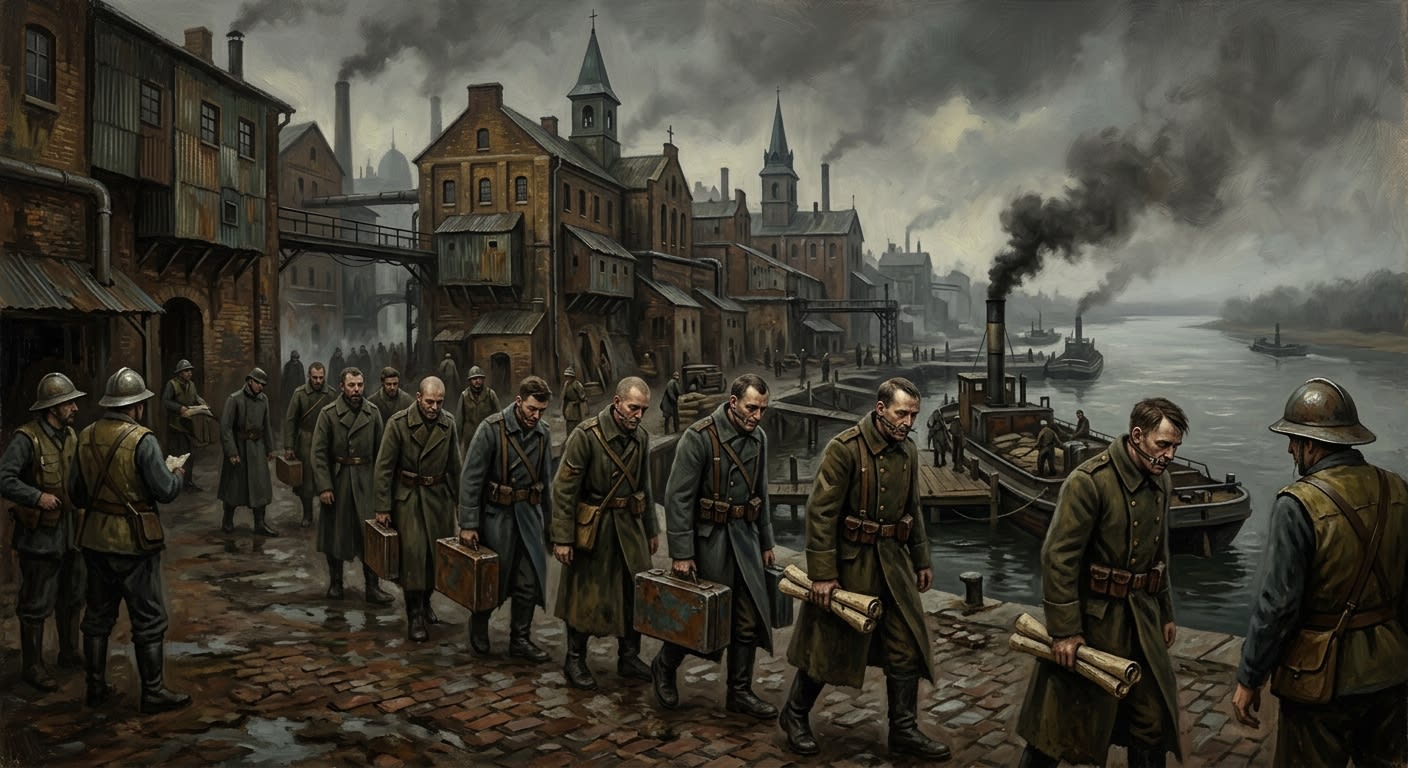
Sandomierz sits on the Vistula where Kraków’s crimes arrive tired, swollen, and no longer able to accept official adjectives. Eighty kilometres downstream from Dębnicki Bridge, the town learned in A.S. 18 that rivers are archivists with poor handwriting and excellent patience. Kraków threw forty-seven wired mouths into black water. Sandomierz pulled them out.
This is its honour. This is its burden. This is its income, because the Synod, being both holy and solvent, never leaves grief outside the tariff schedule for long.
The old town rises above the river in tiers: wharf, fish market, chapel stair, municipal square, clerks’ lane, hill houses, and the small fortified precinct where the Recovery Chapel (Unregistered) now keeps its ledger under three locks and one old smell of wax, river mud, and wet wool. Barges pass beneath. Fishermen mend nets. Children sell printed route cards. Bell-clerks count candles that have already burned upriver. Widows of no relation to the drowned stand near the chapel door and weep with professional discipline when pilgrims require moral weather.
Sandomierz is not Kraków’s echo. It is Kraków’s receipt. That distinction matters. Kraków saw the march, bore the bridge, kept the wound where it happened. Sandomierz touched the evidence when the river was done carrying it. Kraków owns the crime’s site. Sandomierz owns the bodies’ return to the world of hands.
#On the First Recovery
The first body appeared before dawn on the second day after the Night of Knives, lodged among broken ice and alder roots below the fishers’ bend. The fishermen thought at first it was a soldier, then a sack, then a thing less convenient than either. Boat-hook, rope, two men in the shallows, one boy sent running for the chapel. The mouth was wired. The palms were torn. The vestment had swollen with river water until office and flesh made one shapeless accusation.
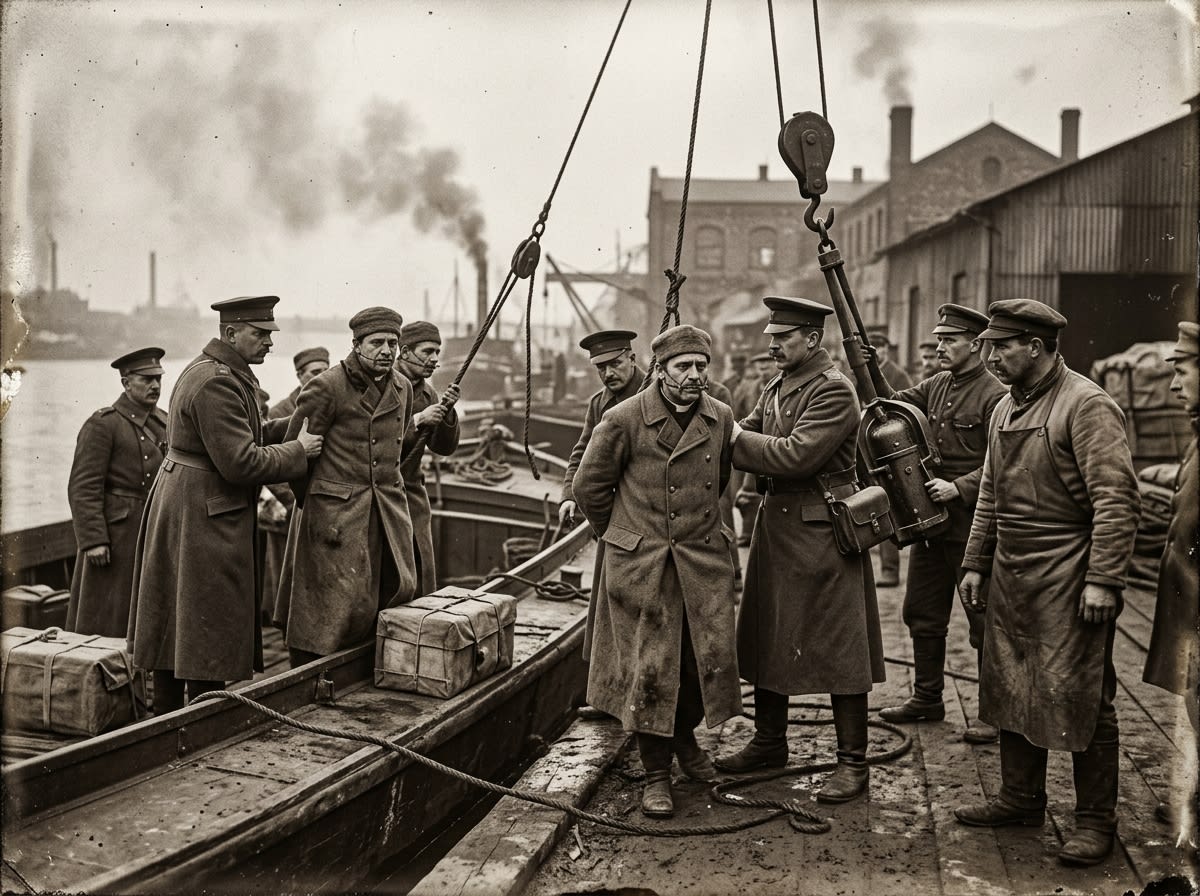
The second came by noon. The third by evening. By the ninth day the count stood at forty-seven.
The Sandomierz fishermen did not know every name. They knew enough. They laid the dead under sailcloth, warmed no fantasy over them, and prayed in the rough forms available to men who had spent more hours with nets than missals. Bureau of Doctrine later granted an exemption for imprecise prayer in this matter. I approved the addendum. One must reward sincerity when it arrives soaked and unpaid.
The recovery entries survive in damaged copies: date marks, water condition, clothing scraps, condition of wire, signs of hand injury, approximate age, order of lifting, and several terse notes from men trying to write while shaking. Records has since improved the entries. This is useful and dangerous. Clean copies preserve. Clean copies also lie by making terror appear literate.
RECOVERY LEDGER — SANDOMIERZ FISHERS’ COPY, A.S. 18 Entry Seven: young Carmelite; face bruised left; wire three turns, one broken end; shoulder mark from water strike; hands bound, right thumb split; recovered with reed ice at lower bend. Marginal later hand: probably Brother Paweł Nowak. Handling note: shoulder detail sealed; devotional reenactment risk.
Father Janusz Sobecki’s entry is earlier, if the authorized order is accepted: elderly priest, lower limbs stiff, temple bruised, mouth wired, vestment torn at shoulder. It reads like inventory because the man writing it had no room for hymn. Brother Paweł’s entry comes later in some copies, earlier in others. The dispute has produced papers, sermons, corrected placards, and two parish quarrels that required constables. The dead did not alter position to assist us. Inconsiderate, but understandable.
#On the Tribunal at Sandomierz
The Rationalists made their most clarifying mistake after the bodies were lifted. They arrested the fishermen.
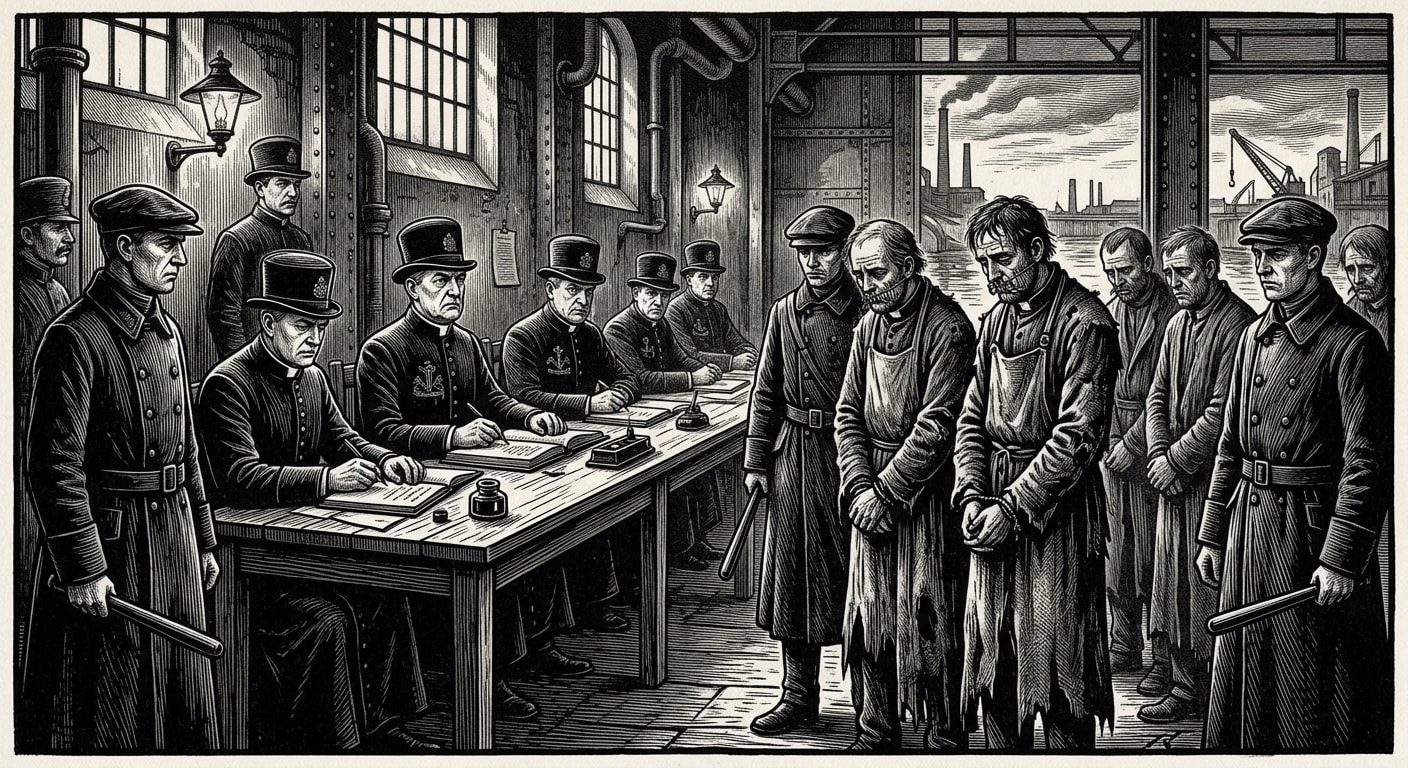
A sensible tyrant lets the river take blame, buries the evidence, rewards silence, and returns home before breakfast. The Rationalists preferred legal form. They charged the fishermen with harboring enemy combatants. Consider the phrase carefully, then wash your hands. Forty-seven dead clergy, frozen and wired, became enemy combatants. Men who pulled them from the Vistula became harborers. The trial lasted twelve minutes. The sentence lasted twelve years.
A Rationalist tribunal digest describes the Sandomierz proceeding as “public safety review concerning unlawful custody of hostile ecclesiastical actors.”
Corrected. It was a punishment of witnesses. The dead were clergy. The fishermen were fishermen. The hostile actor was the sentence.
The tribunal sat in the municipal hall above the wharf. Its minutes record weather, attendance, charge, verdict, and penalty. They do not record the smell of thawing vestments in the chapel store below. They do not record the wives waiting outside with hands inside sleeves. They do not record the boy who found the first body being told not to speak because children make inconvenient witnesses by remembering colour.
Colonel-Prefect Ignaz Brechtold did not need to attend. His paperwork attended in his place. The tribunal’s ruling supported Kraków’s later lie: ritual suicide. It is a beautiful absurdity in the way a snake with spectacles would be beautiful. Forty-seven men independently wired their own mouths, marched under armed escort, entered freezing water, and arranged to be recovered downstream as if Providence had granted them choreography and no survival instinct. Reason requires faith after all, though it chooses stupid altars.
The fishermen served terms of varying length. Several returned to boats with backs ruined by labour camps. One died before release. One became a minor local saint in everything except official language. One kept fishing and refused thereafter to sell catch to men in Rationalist badges, which the town remembers as courage and the market remembers as bad business. Both may be true.
#On the Recovery Chapel
The first chapel was temporary: boards, sailcloth, candles, a table scoured with ash, and a borrowed crucifix whose left arm had cracked during transport. By A.S. 27 the site had a stone wall. By A.S. 58 it had a locked chest for copies of the recovery entries. After the Fifteenth Doctrinal Congress in A.S. 148, it became a recognized terminal station of the Vigil’s annual rite, which is to say that sorrow, having been spontaneous, was taught to stand in line.
The modern Recovery Chapel is small, damp, and over-visited. Its altar faces west, toward the river’s upstream memory. Behind the altar hangs no grand painting. Instead there are forty-seven nail heads set into dark wood, one for each recovered priest. Pilgrims dislike this at first. They expect faces. Faces comfort. Nail heads accuse.
The boat-hook displayed in the side case is almost surely not the first hook. The town knows this. The Bureau knows this. The pilgrims suspect and prefer not to be told. I have permitted the label to read traditional recovery hook. The label is mercy with clean syntax.
Below the chapel floor is the wick room. It contains trays, seals, drying racks, count sheets, wax scrap basins, and a little iron stove whose pipe smokes badly enough to make auditors sentimental. Each tray bears year, count, condition, irregularities, and dispatch mark. The wicks arrive wet, or do not arrive, or arrive tangled with reeds, fish blood, private petitions, hair, nail-parings, wax lumps, and once a child’s milk tooth wrapped in red thread. The Bureau classifies these additions as unauthorized devotional attachments. The local term is gifts.
#On the Wicks
Each 17 Martius, Kraków carries forty-seven candles from below Wawel Hill toward Dębnicki Bridge. At the midpoint the candles are extinguished one by one. The smoking wicks fall into the Vistula. The river carries what it chooses to Sandomierz. The fishermen gather what they can.
This rite is elegant because it admits failure. Some wicks never arrive. Some lodge in reeds. Some sink. Some are stolen by boys with quick hands and commercial futures. Some are taken by gulls, eddies, thaw snags, private grief, or whatever appetite water has when priests ask it to behave annually. The rite requires sending, seeking, counting, sealing, and reporting. It does not require the river to become a clerk.
Popular broadsheets claim every wick reaches Sandomierz by miracle.
False. If every wick arrived every year, the river would be less river than office. The miracle, if the word must be dragged in wearing clean shoes, lies in the fishermen going out anyway.
The A.S. 191 nail-paring remains the most famous irregularity: one wick wrapped around a child’s clipped nail, found in reed ice and entered by a fisherman whose handwriting suggests irritation rather than awe. Doctrine wanted removal. Rites wanted interpretation. Records wanted a subcategory. The fisherman wanted breakfast. As usual, the sane party lacked jurisdiction.
SANDOMIERZ WICK REGISTER — A.S. 191 Count received: forty-seven. Irregularity: one wick bearing child’s nail-paring, red thread, wax residue, no accompanying petition. Disposition: retained; not displayed; not destroyed. Marginal note by local hand: “If the mother comes asking, do not make her fill Form 17-L.” Bureau response: █████████████████████████.
The wick count has become a civic weather system. A full count draws satisfied pilgrims, louder sermons, and tighter Tithes attention. A partial count produces anxiety, broadsheets, speculative devotion, and extra patrols along the river. Too many wicks would be worse. Sandomierz dreads abundance more than absence, because excess in a sacred count attracts Doctrine in its sharpest shoes.
#On the Fishermen’s Guild (Unregistered)
The fishermen of Sandomierz are river professionals, despite every parish print in Kraków that tries to sell them as pure peasants or holy simpletons by the bundle: hard-handed, suspicious, good at knots, good at debt, excellent at knowing when an official has never held a net and should be kept away from water. They collect wicks because their grandfathers collected bodies. They resent this sentence and keep it.
Their guild house stands near the lower wharf, marked by a fish, a hook, and forty-seven small cuts in the doorframe renewed each Martius. Bureau of Heraldry has repeatedly objected to the cuts as unregistered symbolic marks. The guild has repeatedly replied that they are maintenance scars. This lie has matured into local law.
The guild elects Wick Wardens (Unregistered) each year: three older fishers, two boatmen still strong enough for bad current, one ledger-capable widow, and one boy chosen to learn reverence before profit ruins him. The widow usually runs the operation. Men allow this by calling her clerk. Women have ruled half the Dominion through job titles men considered insulting.
The fishermen sell fish during Vigil week at prices that make visiting clergy rediscover poverty as a theological topic. I do not condemn them. Memory spoils if not salted, and so does herring. Pilgrims who can afford painted bridge cards can afford river fish. Tithes agrees with me, which is rarely a sign of moral purity but often a sign that arithmetic has found a chair.
#On Trade in Correct Grief
Sandomierz’s Martius economy is a small masterpiece of regulated sorrow. Inns fill. Candle-makers sell certified wax. Children hawk paper boats printed with forty-seven names. Chapel guides charge by approved route. Fishwives sell fried river carp under signs promising no devotional efficacy whatsoever, which means they have been inspected. Scribes copy family petitions onto wick-paper. Tithes assesses stall rents with the expression of a cat pretending not to watch cream.
The town’s merchants understand what Kraków’s brokers understand: grief moves in circuits. A candle begins as wax, becomes flame, becomes smoke, becomes wick, becomes river object, becomes Sandomierz count, becomes sermon matter, becomes token, becomes audit. Nothing is lost. Everything is corrected into value.
There is fraud, of course. False wicks. False recovery mud. False fragments of Brechtold wire. False copies of the recovery ledger, most containing spelling errors that would shame a goat. Purity raids a few stalls each year for demonstration. Records corrects labels. Tithes fines. The market resumes. A government that cannot distinguish between suppressing fraud and cultivating taxable desire has no business ruling anyone. Fortunately, we distinguish magnificently.
Yet beneath the trade remains true labour. Nets go into cold water. Wicks are lifted with numb fingers. Counts are made. Missing pieces are recorded. Old names are said. The chapel stove smokes. A boy learns that faith sometimes means picking wax from river grass while an auditor asks whether the tray has been sealed.
#On Sister Agata’s Absence and Presence
Sister Agata Wiśniewska never stood in Sandomierz during the recovery. She watched in Kraków, from the convent window above Grodzka Gate. Her testimony travelled where she could not: into Avignon, into copies, into Congress, into seal, route, bell-silence, school lesson, warrant, sermon, and wick tray. In Sandomierz her absence is almost physical. The town’s chapel keeps a small empty grille in the west wall, added after A.S. 148, through which no one looks at anything useful. It is called Agata’s Window. Historians complain. Pilgrims kneel. The historians are correct. The pilgrims are also correct, which irritates everyone tidy.
Agata gave Sandomierz its interpretive frame. Before her ratification, the recovery was local memory: fishermen, bodies, tribunal, punishments, songs. After A.S. 148, the town became part of canonical sequence. Kraków witnessed. Dębnicki Bridge received. Vistula carried. Sandomierz recovered. Congress ratified. Bells fell silent. The order is now taught to children by hand signs: eye, rail, water, hook, stamp, mouth closed. The hand signs are efficient and slightly obscene. Good pedagogy often is.
Agata’s line about Father Janusz — the wire was already in — is carved inside the chapel vestibule where one must turn left to see it. Placement matters. If displayed above the altar, the phrase becomes slogan. In the vestibule it ambushes. I approve of ambushes conducted by architecture.
#On Present Condition
As of A.S. 201, Sandomierz is loyal, watched, damp, useful, and less innocent than its pilgrims prefer. It remains a river town in Zone 3’s eastern devotional geography, bound to Kraków by current, calendar, wire, wick, and the annual paperwork by which grief proves it has attended properly. Its magistrates cooperate with Doctrine because refusal would be stupid and because the town’s prosperity now comes wrapped in sealed trays. Its fishermen cooperate because their grandfathers suffered for lifting evidence from water and because nobody trusts a Bureau man alone with a net.
The present dangers are small enough to be durable. Wick theft. False relic trade. Pilgrim crowding at the chapel stair. Children diving for uncounted wax before the Wardens finish. Private mothers attaching hair, nail, thread, or milk teeth to candles in Kraków, hoping the river carries the petition where officials cannot improve it. Local boys selling counterfeit Sandomierz mud in corked bottles. Quiet Rationalist sympathizers scratching ritual suicide on wharf posts at night and discovering by dawn that fishermen understand correction without needing police.
The town’s truest hour comes before public opening, when the wick trays have been dried enough to count and the chapel is still cold. The Wardens stand around the table. One reads. One marks. One touches each blackened thread with a little hook. The priest waits. The auditor waits. The boy tries not to breathe too loudly. Outside, the Vistula drags its brown shoulder against the bank and behaves, as rivers do, like it knows more than it has been asked.
Then the count is spoken. Full or partial. Clean or irregular. Forty-seven, or less, or once, terrifyingly, forty-seven plus one reed bundle that looked too much like a throat when thawed. The seal comes down. Wax takes the mark. Sandomierz has again performed the unpleasant mercy of receiving what Kraków sends.
#On the Banks Below Town
Below the chapel bend the riverbank becomes less theatrical and more honest. Pilgrims rarely walk there because the mud has no licensed eloquence and the reeds offer no plaque. This is where recovery men worked when the current dragged bodies past the proper landing and into snag, branch, and ice. It remains the place where Sandomierz hides the labour that makes its upper rites look clean.
The bank holds three named bends. First Hook, where the earliest body was lifted. Widow’s Reed, where two vestments tangled so tightly that the men cut cloth rather than pretend dignity could be preserved by patience. Lower Shame, where the tribunal guards later searched boats for evidence the fishermen had already carried to chapel. The names are local, unofficial, and more accurate than several maps. Records tolerates them because erasure would require learning why they exist.
In flood years the lower bank changes shape and exposes old things: clay pipe stems, nail scraps, broken rosary beads, ration seals, fish bones, boot leather, devotional wire frauds thrown away after raids, and once, in A.S. 178, a blackened candle stub wedged in a root system twenty paces from the chapel path. The stub was declared unrelated to the Vigil after three offices failed to agree who would own it if related. This is how many mysteries survive: by disputed inconvenience rather than secrecy.
The Fishermen’s Guild keeps boys from diving at Lower Shame during Martius, or tries. Boys are theological hazards with knees. They want relics, dares, coins, and the right to say they touched what adults fear. Each year one or two go in anyway. They emerge blue-lipped, triumphant, holding mud, reed, bottle glass, or nothing. Their mothers beat them. The Bureau approves this ancient disciplinary instrument under no form at all, a rare liberty.
A Pilgrimage safety sheet states that “no devotional recovery activity occurs outside the supervised chapel landing.”
Corrected for adults. No authorized devotional recovery activity occurs there. Unauthorized boys, widows, fishermen, fraudsters, grieving mothers, and the river itself have declined the sheet.
#On Records, Names, and the Forty-Seven
Sandomierz’s greatest administrative service was the preservation of names under conditions designed to reduce men into wet difficulty. The recovery entries did not know every identity at once. Age, garment, wire, injury, order, mark, ring, scapular, tonsure, parish scrap, witness scrap, later correspondence, Sister Agata’s count, and the Kraków arrest lists had to be married without ceremony and with many objections from facts that had spent nine days in water.
Records hates uncertainty but feeds on it. Sandomierz gave the Bureau enough: forty-seven bodies, forty-seven mouth-wires, forty-seven recoveries or recovery fragments fit for the canonical count. Later Congress work would bind the youngest and eldest into teaching endpoints: Brother Paweł at nineteen, Father Janusz at seventy-one. Between them stand men whose names receive less sermon light and no less water.
The temptation to improve the list is persistent. A family whose great-uncle vanished in A.S. 18 wants him among the drowned. A parish with weak history wants a martyr. A guide wants a better story. A priest wants a sermon that ends with his own district redeemed by association. I sympathize with none of this and understand all of it. Sorrow is acquisitive. It steals cloth from neighbouring altars when cold.
One Sandomierz clerk in A.S. 162 inserted the name of his mother’s cousin into a local copy. He chose a plausible hand, a plausible position, and a plausible stain. He was caught because he misspelled Paweł in the same paragraph, proving once again that fraud fails most often where vanity hurries. His punishment was mild by Synod standards: loss of office, public correction, three years copying fish tariffs. Fish tariffs are more punitive than outsiders suppose.
#On the Trial Memory
Sandomierz commemorates the fishermen’s tribunal with less grandeur than the recovery, which is correct. Bodies require candles. Bad law requires a bench, a damp wall, and a clerk reading the charge slowly enough for disgust to find a seat. Each year after wick count, the municipal hall opens the old chamber for a short recitation of the charge: harboring enemy combatants. The phrase is read once. No sermon follows. None is needed.
The bench is not original. The original was burned during later renovations, stolen, or promoted into myth; the files disagree because furniture enjoys escaping accountability. The current bench is plain oak, scarred by schoolboys, and more useful than a relic would be. Citizens sit on it during ordinary hearings. That is the point. Law that once punished witness now hears fish disputes, debt arguments, boat damage claims, and one annual accusation against itself.
MUNICIPAL HALL NOTE — A.S. 188 During tribunal recitation, child asked whether dead men can be enemy combatants. Instructor answered: “Only to cowards.” Complaint filed by visiting magistrate. Complaint misplaced after review by █████████.
The fishermen’s descendants have no unanimous memory of the sentence. Some say twelve years. Some say terms varied. Some say one man never came home and should be counted outside arithmetic. Records prefers the central figure because it has weight and repeatability. The families prefer names. Families are troublesome in this respect. They keep pulling doctrine back down into kitchens.
#On Flood, Thaw, and Unwanted Returns
The Vistula does not obey the Vigil calendar. Flood comes when it comes. Thaw tears at banks. Ice shifts old mud. Each spring the town braces for things returning without permission. Most are ordinary: timber, drowned dogs, broken icons, upriver rubbish, soldiers’ letters sealed badly, market refuse, and the occasional saint card swollen into pulp. A few returns enter restricted ledgers.
In A.S. 173, a coil of black wire surfaced near Widow’s Reed and caused three days of unhelpful devotion before assay proved it to be nineteenth-century fence scrap. In A.S. 186, a chapel token lost during wick week returned downstream six months late with fish eggs glued in the lettering. Rites proposed fertility interpretation. Doctrine threatened the room until the proposal died. In A.S. 197, a sealed petition bottle reached the lower bank with no petition inside, only river water and a smell of candle smoke. Call it filing without content; miracle would be tidier.
The fishermen judge many things before calling officials. This is unlawful in theory and wise in practice. If every strange reed, nail, bottle, wax clot, or wire scrap summoned three Bureaus, the riverbank would collapse under boots before Hell had to trouble itself. The Guild knows which objects smell like fraud, which smell like grief, and which should be left until daylight with a boy posted to prevent heroism.
#On My Audit at Sandomierz
I visited Sandomierz during a Martius audit and found it better governed than expected, which I record with the pained honesty of a man denied the pleasure of contempt. The chapel ledger was current. The wick trays were dry. The fish market stank within legal range. The guide licences were stamped. The false-wire sellers had been pushed two alleys away from the main pilgrim route, a compromise between moral order and economic realism.
A Wick Warden, a widow named Halina Przeworska (Unregistered), corrected my escort twice before we reached the chapel stair. First, he called the collection net a relic net. She said, “Tool.” Second, he called the dried wicks remains. She said, “Record.” I considered offering her a post in Records, then remembered Records did not deserve her.
Inside the wick room she showed me the A.S. 191 tray. Empty, of course; the nail-paring irregularity is sealed elsewhere. The tray itself remained, labelled with year and count. She touched the label, not the tray, and said, “That one made offices stupid.” I asked whether offices had been wise before. She did not smile. This restraint elevated her above most theologians.
At the lower bank a boy tried to sell me Sandomierz mud in a corked bottle. I asked whether it was authentic. He said, “Authentic mud, lord.” This answer was perfect. I bought two and had him fined for lacking a stall chit. Mercy without correction rots the young.
#On What Sandomierz Teaches
Sandomierz teaches that atrocity does not end at the site of the blow. It travels. Downstream, down file, down family, down rite, down market lane, down the throat of a child reciting a charge he cannot yet despise properly. Kraków owns the bridge. Sandomierz owns the arrival. Between them the Vistula performs the oldest administrative function: transfer.
The Synod has made use of this, of course. We would be fools not to. We converted recovery into rite, rite into route, route into seal, seal into warrants, warrants into education, education into Order. If this shocks the reader, the reader has misunderstood both holiness and government. A wound unmanaged festers. A wound managed too neatly becomes theatre. Sandomierz sits in the useful discomfort between.
The fishermen still go out after the wicks. The chapel still counts. The municipal hall still reads the charge. The lower bank still keeps mud under its nails. The river still refuses to be a clerk. Excellent. We have clerks enough.