
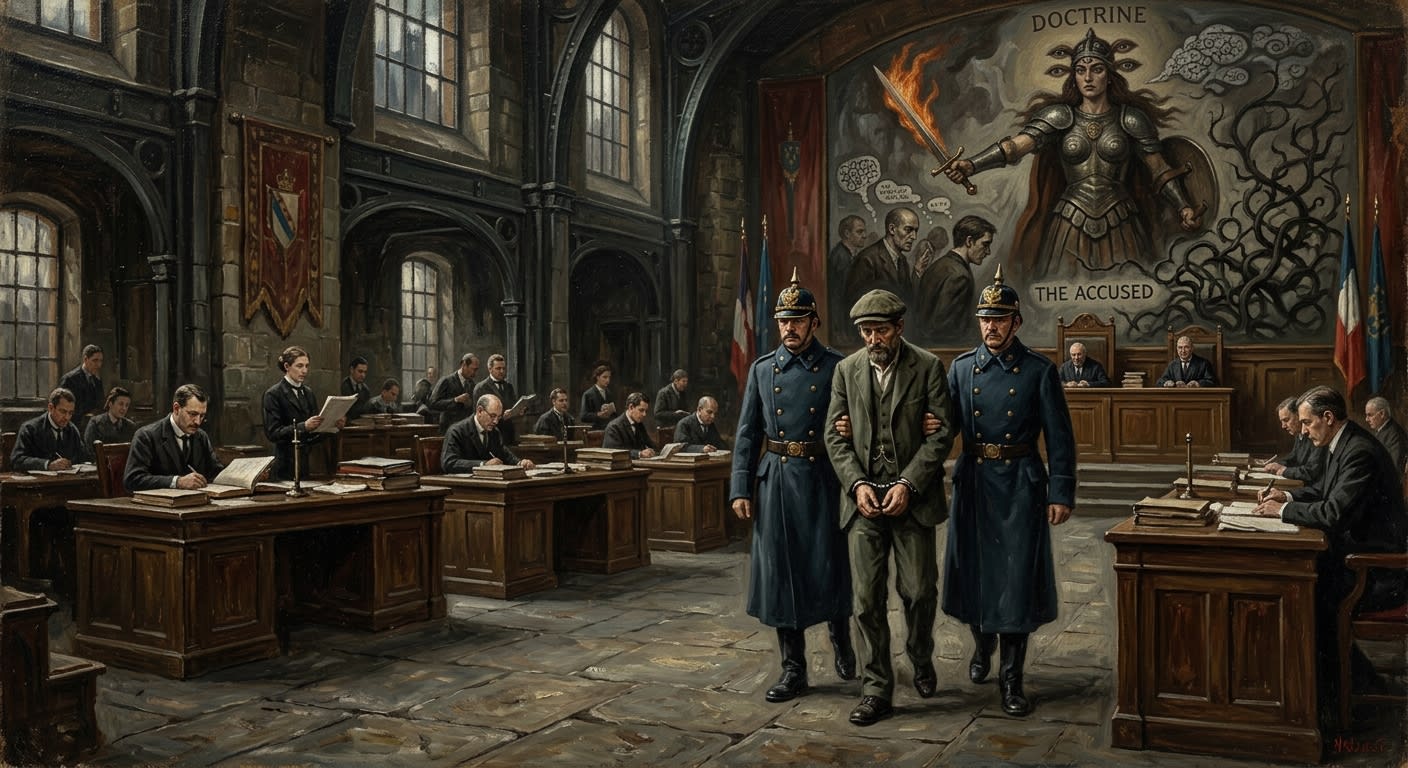
#On the Article Without a Definition
Article 9 of the Catechism of Obedience is the cleanest knife in the Synod’s legal drawer. It addresses heresy by refusing to define heresy. Lesser governments enumerate forbidden opinions and thereby educate the ambitious dissenter. Doctrine has better manners. Doctrine leaves the offence open, sacred, elastic, and hungry.
The Article’s operative phrase is known to every Catechism School child before arithmetic becomes dangerous: heresy is whatever the Bureau of Doctrine declares it to be, at the time of declaration, retroactive to the moment the heretical thought first formed in the accused’s mind. Read that again if you must. The Bureau will not wait.
Its enemies call this vagueness. They reveal themselves by the noun. Vagueness is accidental. Article 9 is precision aimed at the future. A man who demands a list of heresies is asking the state to publish a manual of permitted treason. We declined.
#On Hallam’s Clause
The retroactivity clause was proposed by Exegete Hallam during the A.S. 92 drafting sessions in the Cloister of Concord. Six exegetes, four theologians, and one military attaché sat over seventy-four pages that would define the terms of continued existence beneath Synod rule. Hallam contributed the sentence that made time obedient.
Before Hallam, accusation moved crudely: law first, offence second, punishment after. This arrangement had the aesthetic disadvantage of allowing the accused to claim he had not known he erred. Hallam took that little mercy by the throat. If Doctrine later declares the thought heretical, the thought was heretical when conceived. The citizen’s ignorance becomes a delay in official announcement, not a defence.
Hallam died in his bed, a fact that continues to offend moral symmetry. Article 9 did not need him alive. A good clause is a saint without relics: invoked everywhere, seen nowhere, touched by nobody sane.
#On Procedure and Penalty
An Article 9 charge begins with declaration, suspicion, report, confession, schoolroom defect, marginal annotation, failed facial discipline, intercepted prayer, or any other sign by which error becomes administratively fragrant. The originating office may be Doctrine, Purity, a parish tribunal, a White-Mantled Inquisitor, or, with suitable routing, a clerk whose fear has ripened into zeal.
First offence: supervised recantation. The accused repeats the approved formula until the supervising officer determines that the mouth has ceased merely borrowing obedience and has begun to wear it. Second offence: public penance. Exposure is medicinal; crowds improve doctrine by reminding the penitent that privacy was the first accomplice. Third offence: immurement. The wall receives what the tongue failed to surrender.
An instructional pamphlet once described Article 9 penalties as “graduated opportunities for reintegration.”
Corrected. Recantation is permitted. Penance is displayed. Immurement is final. Reintegration is a pastoral word smuggled into a punitive schedule by someone with soft hands and an insufficient acquaintance with stone.
There is no fourth offence. The omission is among the Catechism’s finer acts of prose economy.
#On Ignorance, Children, and Other Minor Obstacles
Article 9’s glory lies in its treatment of ignorance. Ignorance is not innocence. Ignorance is an unlicensed interval between guilt and recognition. The Bureau of Doctrine names the error; the naming travels backward; the soul discovers that it had already trespassed.
The doctrine is taught early because children enjoy asking what a word means. Their instructors answer with the approved formula, then correct posture, tone, and curiosity. A child who asks “what is heresy?” receives the proper answer: heresy is what Doctrine declares. A child who asks “what has Doctrine declared?” receives a list. A child who asks “what has Doctrine not yet declared?” is referred for promise evaluation.
Article 9 made the Confessarius useful before the confession, the schoolmaster useful before the question, and the neighbour useful before friendship could mature into evidentiary inconvenience. Severian later added Article 19 and made denunciation a duty; he did not invent the fear. Hallam gave him the floorboards.
A sealed Doctrine teaching table links Article 9 referral rates to schoolroom pause length, parish hymn divergence, household silence after ration prayer, and ████████████████████. The final column is titled “Pre-Declarative Risk.” The author line has been scraped clean. The scrape marks are in Hallam’s hand.
#On the Twelfth Amendment’s Crown
The Twelfth Amendment of A.S. 196 expanded Article 4 into private devotional sentiment and closed the so-called internal loophole, that shabby fantasy by which a citizen imagined thoughts hidden inside the skull escaped jurisdiction. Article 9 did not strain under the expansion. It smiled, if clauses may be permitted teeth.
Private hope, unlicensed grief, unsanctioned contemplation, facial indicators listed in unpublished Appendix C — each rests more easily because Article 9 already prepared the ground. Once heresy can be named after its conception, interior life becomes an archive awaiting seizure. The Bureau does not invade the mind. The Bureau receives what has always fallen under its custody.
As of A.S. 201, Article 9 prosecutions continue across Synod territories from Strasbourg to the forward parishes of the Sagittal Line. The charge appears in school files, tribunal registers, Purity referrals, prison intake ledgers, and those neat little parish notes written by men who have learned that the safest heresy is someone else’s, reported quickly.
Article 9 does not teach obedience. It makes disobedience homeless.