
#On the Duty That Enters the House
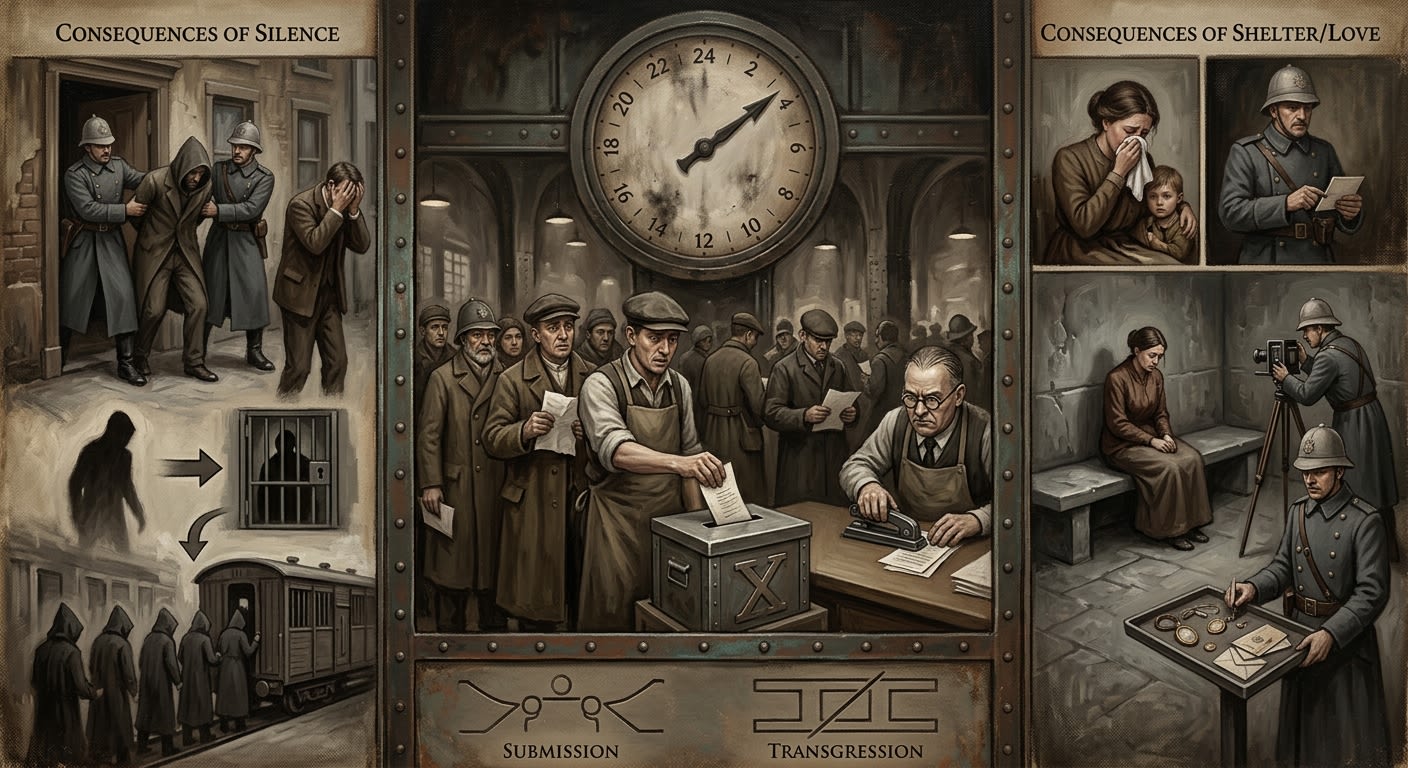
Article 19 of the Catechism of Obedience is called the Duty of Denunciation, which is one of those honest titles that occasionally escapes a committee before euphemism can put trousers on it. It requires every person subject to the Catechism to report suspected heresy, doctrinal deviation, or spiritual unease of a contaminating character to the nearest competent authority within twenty-four hours. Failure to report is participation. Silence is shelter.
This is the sentence that moved Purity from the tribunal into the kitchen.
The Article was added in A.S. 134 during the Eighth Doctrinal Congress under Severian of Mainz. By then Severian had already learned the civic uses of mouth, cage, hum, and spectacle. The Iron Choir taught him that fear could be maintained as infrastructure. Article 19 taught fear to maintain itself.
#On Severian’s Gloss
The Severian Gloss is short enough for children and ugly enough for adults:
A weaker theologian would have argued that speech opposes heresy. Severian went further, the man being atrocious but seldom small. He argued that withheld speech nourishes heresy. A citizen who hears deviation and says nothing has not remained neutral; he has built a roof. He has given warmth, interval, and concealment. The silent mouth becomes a safe house with teeth.
The slogan entered Catechism Schools within a decade. Children recite it before meals in several Rhineland dioceses, which has done excellent work for denunciation rates and catastrophic work for supper. The Bureau of Mercy objected once that family life required zones of trust. Purity replied that trust was merely unexamined conspiracy with nicer tableware.
#On the Twenty-Four Hours
The twenty-four-hour window is the Article’s practical genius. A shorter period would collapse rural enforcement, ferry crossings, harvest shifts, and the tedious business of locating a licensed recipient of accusation. A longer period would allow pity to interfere. A day is long enough for fear to find a desk and short enough to keep friendship from recovering its courage.
The clock begins at observation, though “observation” has received useful enlargement. To hear a sentence, observe. To notice a pause after a Creed, observe. To find an annotated Catechism in a drawer, observe. To suspect that a wife’s grief has moved from authorised mourning into private theology, observe. To wake at night and recall that your brother laughed strangely three days before, observe retroactively and report the lateness with suitable shame.
A provincial tribunal in A.S. 141 ruled that uncertainty delayed the reporting clock until certainty formed.
Clarified. Uncertainty is itself reportable. The tribunal’s presiding clerks were corrected, the ruling was withdrawn, and the phrase “certainty formed” was transferred to a Bureau of Mercy convalescence manual, where it can harm fewer prosecutions.
The nearest competent authority may be a Purity district office, parish examiner, gate tribunal, White-Mantled Inquisitor, licensed schoolmaster, route confessor, or Bureau desk bearing a seal large enough to frighten the illiterate. Competence is presumed when the report is accepted. Incompetence is discovered only when the wrong Bureau receives the credit.
#On the Household Tribunal
Before Article 19, heresy could hide in the ordinary mercies: a mother’s pause before betraying a son, a husband’s decision to mistake blasphemy for exhaustion, a colleague’s courtesy, a friend’s delay. Severian saw these mercies for what they were — little unauthorized roofs under which error could warm its hands.
Article 19 made the household a tribunal with poor lighting. The dinner table became a witness bench. The workshop became a listening room. The schoolyard became a field office. A joke no longer ended when laughter ended; it entered a twenty-four-hour period of doctrinal ripening. A cough during prayer acquired possible syntax. A sigh after the name of Strasbourg became an event.
A.S. ███ parish exercise: twelve children instructed to report a staged doctrinal error by their teacher. Eleven reported within one hour. One child embraced the teacher and said nothing. The child’s name, household, and later assignment are sealed under Juvenile Instructional Caution. The teacher received commendation. The embrace was classified as shelter.
The Confessarii benefited immediately. Their reports no longer needed to allege completed heresy; they could allege unreported suspicion of heresy. Purity benefited more loudly. Doctrine benefited most of all, since every accusation confirmed the need for more exact doctrine and every silence confirmed the need for more accusation.
#On Its Marriage to Article 9
Article 9 reserves the definition of heresy to Doctrine and makes guilt retroactive to the first formation of the thought. Article 19 supplies the circulation system. If Article 9 is Hallam’s knife, Article 19 is Severian’s bell cord: pull once, and the house announces itself.
The penalty schedule follows Article 9 when failure to denounce becomes participation. The first failure may produce supervised recantation. The second may produce public penance. The third may produce immurement. The wall does not care whether a man entered it for speaking wrongly or for hearing wrongly in silence. Stone has no ear for distinctions unless a Mason is paid to carve them.
Article 19 generates more prosecutions than all other Articles combined. The Bureau of Purity calls this proof of vigilance. The Bureau of Doctrine calls this proof of necessity. The Bureau of Records calls this a storage crisis and requests larger shelves with the wounded dignity of a martyr denied applause.
#On the Present Use
As of A.S. 201, Article 19 remains among the Synod’s most productive instruments. It travels with school primers, parish notices, barracks lectures, factory wall sheets, checkpoint catechists, and those little warning cards pasted inside tenement stairwells where damp has eaten every word except REPORT. The damp, in its accidental wisdom, preserves the command.
White-Mantled Inquisitors use Article 19 referrals to enter households already softened by mutual suspicion. Catechism instructors use it to train children in prompt loyalty. Gate clerks use it when queues grow conversational. Parish priests preach it after feast days, when wine has made tongues overconfident. Index Damnatus Runners carry amendments that begin with one accusation and end with six names.
The citizen under Article 19 listens for heresy before he avoids it. He measures his neighbour’s mouth, his child’s question, his mother’s grief, his own exhausted wish to be left alone. Then he decides whether love is worth a wall.