
#On the Instrument Itself
Being an authoritative account of the document that bound a continent, written by the man who corrected its punctuation.
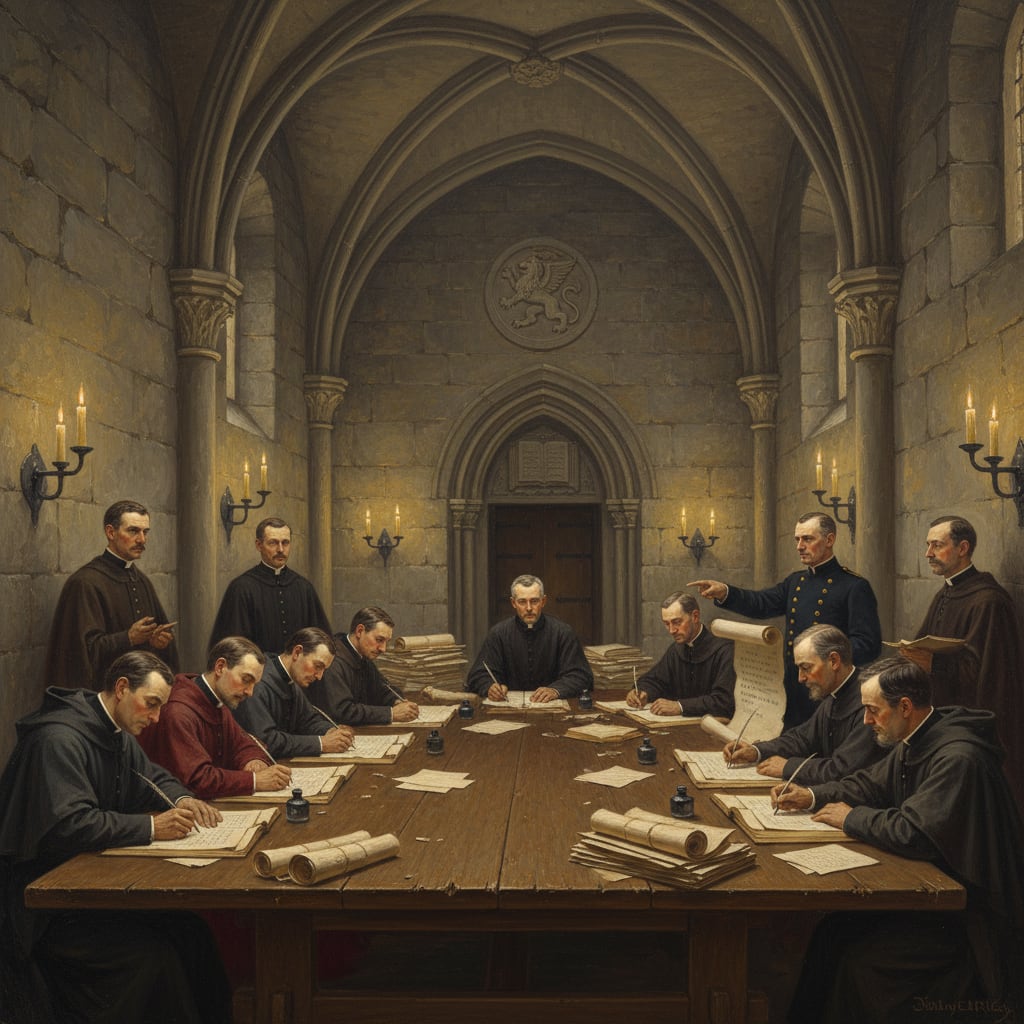
The Catechism of Obedience is seventy-four pages long. It was drafted in the Cloister of Concord between the third week of Ash-month and the first week of the Bell-month, A.S. 92 — twenty-seven days of composition by six exegetes, four theologians of the newly constituted Bureau of Doctrine, and one military attaché from the Synod's military command whose sole contribution was to insist that the section on desertion be printed in a larger typeface. His insistence was overruled. The typeface remained standard. The penalty for desertion remained death.
The Catechism was the second instrument ratified under the Concordat of Strasbourg, following the Act of Hierarchical Supremacy and preceding the Charter of the Twelve Bureaus. Its purpose, stated in the preamble with the blunt precision that characterised the early Synod, is this: to define the terms under which a soul belonging to the Synod's jurisdiction may continue to exist within that jurisdiction, and to enumerate the consequences of refusal. The preamble does not say "the terms of faith." It says "the terms of continued existence." The distinction is the Catechism's first and most lasting contribution to political theology.
#Structure and Articles
The Catechism contains twenty-one Articles, each subdivided into numbered Subsections, each Subsection bearing a marginal gloss by the original drafting committee and a secondary gloss added during the Revision of A.S. 134. The secondary glosses contradict the primary glosses in eleven places. The Bureau of Doctrine considers this a feature of the document's enduring flexibility.
Article 1 establishes the Synod as the sole interpreter of sacred truth. It occupies four pages, but its meaning can be compressed to a sentence: what the Synod says is true, is true. What the Synod says was true, was true. What the Synod will say tomorrow is already true today, having always been true, the Synod merely having delayed its announcement for administrative reasons.
Article 4 governs the licensing of spiritual commodities — hope, consolation, prophetic utterance, and prayer beyond the prescribed liturgical forms. Section 7 of Article 4 is the provision most frequently cited in Bureau of Purity prosecutions: "Hope is a commodity of the Synod, dispensed under licence, and any person found distributing hope without Bureau imprimatur shall be referred for examination." The Bureau of Festivals holds distribution rights for hope during approved holy days. The Bureau of Tithes taxes hope at the standard rate. The Bureau of Doctrine approves the kind of hope permitted, which is limited to hope for continued Synod governance, hope for victory against the Enemy, and hope that the queue at the ration office will move slightly faster than yesterday.
An earlier gloss on Article 4, §7, suggested that "private hope" — defined as hope experienced silently and without external expression — fell outside Bureau jurisdiction.
This gloss was struck in A.S. 196 during the Twelfth Amendment. Private hope, the Bureau determined, is indistinguishable from unlicensed meditation, which is itself indistinguishable from incipient heresy. The distinction was dissolved. The gloss was dissolved. The exegete who drafted the gloss had been dead for forty years, which did not prevent the Bureau of Records from issuing a posthumous citation.
Article 9 addresses heretical belief, and it is here that the Catechism reveals its teeth. The Article does not define heresy. The omission is deliberate. A defined heresy is a bounded heresy — it tells the would-be heretic what to avoid, which is tantamount to handing him a map of safe passage through the Bureau's jurisdictions. Article 9 instead establishes that heresy is whatever the Bureau of Doctrine declares it to be, at the time of declaration, retroactive to the moment the heretical thought first formed in the accused's mind. The retroactivity clause is the Article's masterwork. A man charged under Article 9 cannot claim ignorance, because the heresy he is charged with was heresy from the moment he conceived it — even if the Bureau had not yet named it.
Penalties under Article 9 operate on a scale of elegant simplicity: supervised recantation for the first offence, public penance for the second, immurement for the third. There is no fourth offence. The Catechism does not explain why. The reader is invited to infer.
Article 14 governs oath-keeping and its failure. Section 14, Subsection 3 — Collective Dereliction of Sworn Duty — was invoked most infamously at Bastion-Constantinople when a Night Paper named the 14th Parish Regiment oath-broken and a colonel burned three hundred and twelve of his own men rather than wait for the Bureau to do it. The Bureau of Doctrine classified his response as "preemptive compliance." The Bureau of Records filed his posture at the desk as "edifying." The Catechism itself, of course, says nothing about burning three hundred men. It says only that oaths sworn under its Articles are binding unto death, and that collective dereliction is punishable at the discretion of the nearest officer of competent Bureau authority. The colonel was an officer. The Bureau trusted his competence. The ashes weighed the correct amount.
#The Revision of A.S. 134
The Catechism was revised once, in A.S. 134, by the Eighth Doctrinal Congress under the direction of Inquisitor-General Severian. The Revision added the secondary glosses, expanded Article 4 to include the licensing of festivals and public joy (previously unregulated, which had permitted several unauthorised celebrations in the provinces and one instance of spontaneous dancing in Munich that the Bureau of Purity had to suppress with water-cannon and hymns), and tightened Article 14's oath provisions to include silence as a form of oath-breaking.
Severian's Revision also added Article 19 — On the Duty of Denunciation — which requires every person subject to the Catechism (which is every person within the Synod's territories, born or unborn, the unborn being covered by the Natal Registration Writ's anticipatory jurisdiction) to report suspected heresy, doctrinal deviation, or "spiritual unease of a character suggesting contamination" to the nearest Bureau representative within twenty-four hours of observation. Failure to report is itself a violation of Article 19, punishable under the same schedule as Article 9. The Bureau of Purity has noted that Article 19 generates more prosecutions than all other Articles combined, which the Bureau of Doctrine considers proof of the Article's success rather than evidence of its absurdity.
#On the Catechism's Reach
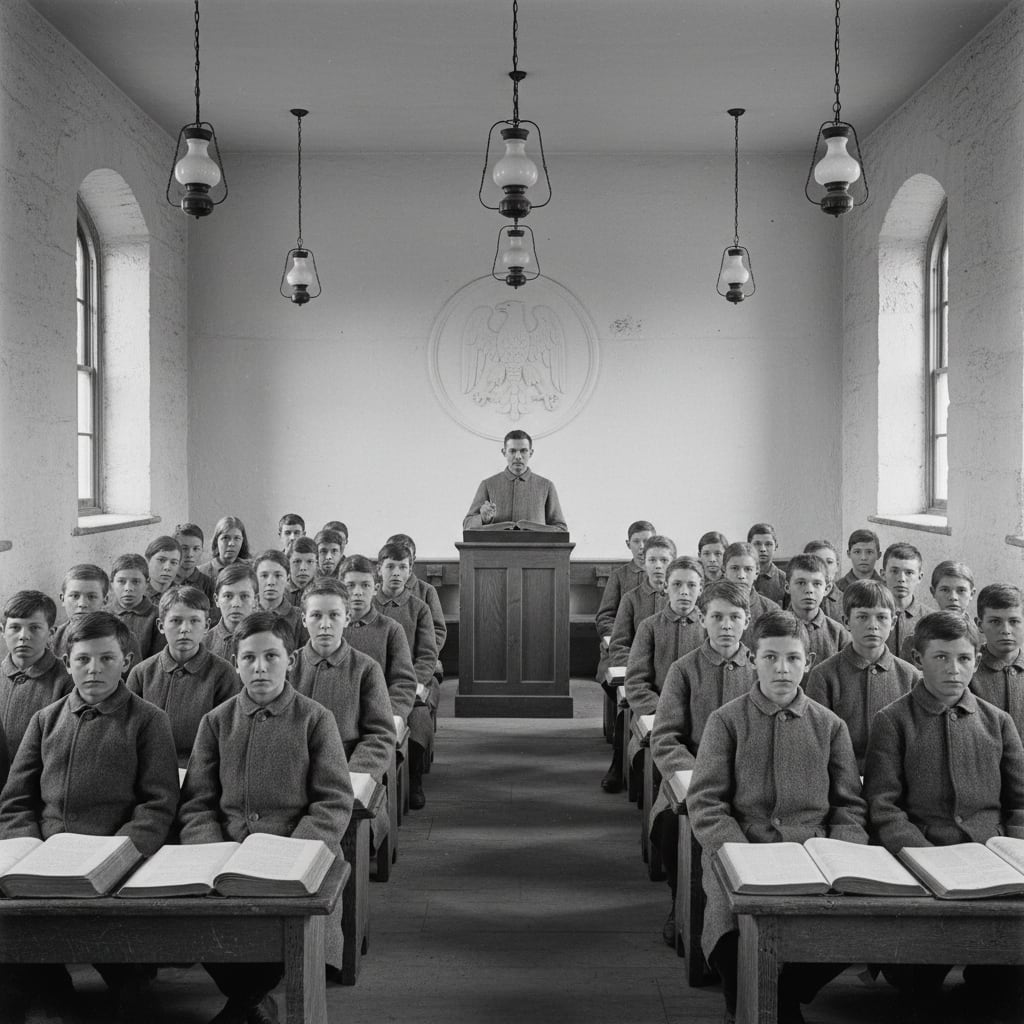
The Catechism of Obedience is read aloud in every Catechism School from Strasbourg to the forward parishes of the Line. Children memorise its preamble before they learn to count. Soldiers swear upon it before they learn to load a bell-cannon. Priests recite its Articles at ordination, at confession, and — by custom in the southern dioceses — at mealtimes, which makes supper in Lombardy an affair of considerable theological duration.
Its physical form is standardised: quarto, bound in grey vellum with the Bureau's seal embossed in black wax on the cover, printed in the Triune Alphabet on paper supplied by the Paper Mines of Ulm. Each copy bears a registration number tracked by the Bureau of Records. Unregistered copies are contraband. The possession of a Catechism with a damaged seal is punishable under Article 12 (Desecration of Doctrinal Instruments), and the possession of a Catechism with annotations in the margins — other than the approved glosses — is punishable under Article 9, because marginal annotation implies independent interpretation, and independent interpretation implies heresy.
There are an estimated two million copies of the Catechism in circulation across the Synod's territories, though the Bureau of Records acknowledges that the figure is "provisional, pending the completion of the Seventh General Census, which was begun in A.S. 188 and is expected to conclude no sooner than A.S. 210." The census takers are thorough. They count copies in households, in barracks, in field hospitals, in the satchels of the Index Damnatus Runner Corps, and in the cells of prisons where the Catechism is the only permitted reading material — not as comfort, but as evidence.
#The Twelfth Amendment
The most recent alteration to the Catechism was the Twelfth Amendment, ratified A.S. 196, which expanded Article 4's jurisdiction over spiritual commodities to include "private devotional sentiment" and closed what the Bureau of Purity had called "the internal loophole" — the theoretical possibility that a person might harbour unauthorised hope, unauthorised grief, or unauthorised doubt entirely within their own mind without expressing it in speech, writing, or facial expression.
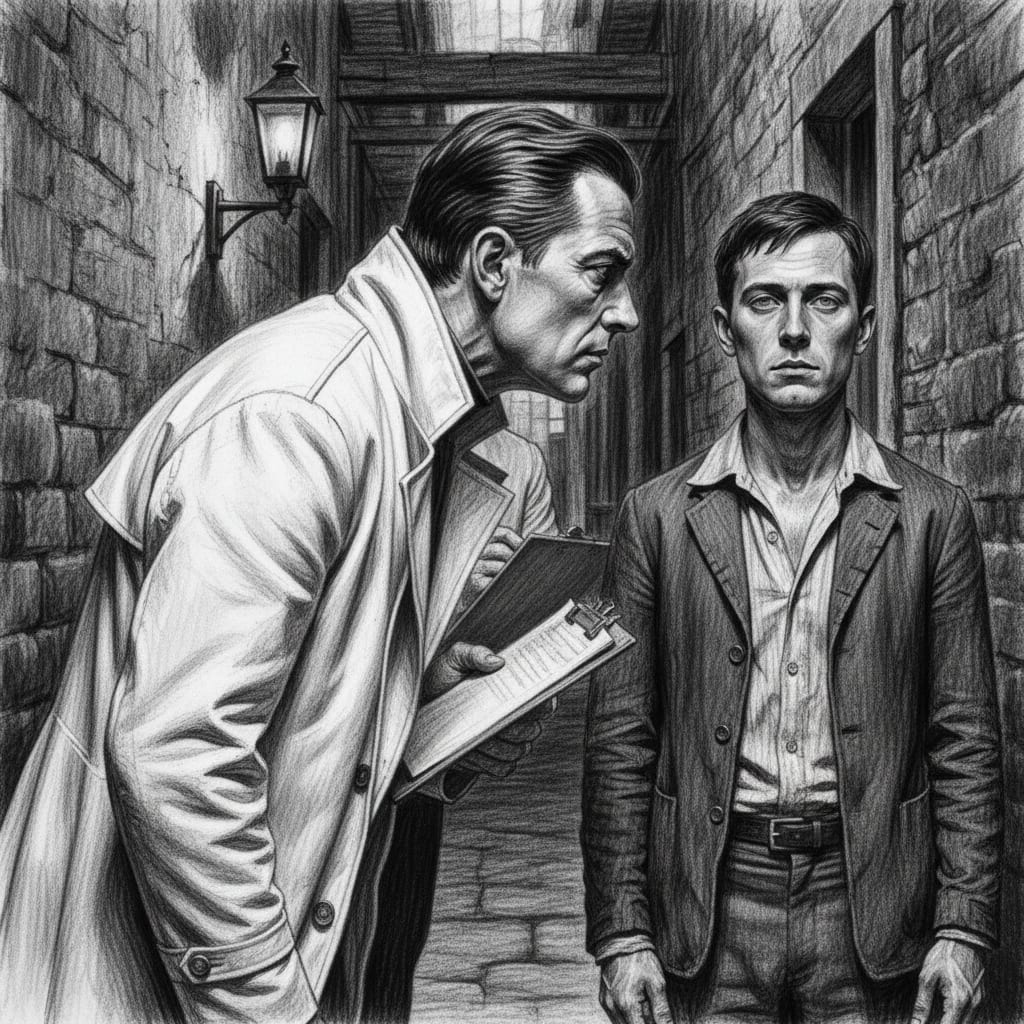
The Bureau of Doctrine's position, codified in the Amendment, is that the interior life of the citizen is a space licensed by the Synod, and that unlicensed interior activity constitutes a form of spiritual trespass. The Bureau of Purity's White-Mantled Inquisitors are empowered under the Amendment to refer persons exhibiting "facial indicators of unsanctioned contemplation" for examination. The indicators are listed in Appendix C of the Amendment. They include prolonged stillness, unfocused gaze, and "a quality of expression suggesting the subject is thinking about something the Bureau has not approved."
The Twelfth Amendment was described in an earlier Codex filing as "controversial."
The word "controversial" has been struck from the Index Claritatis as of A.S. 198. The Twelfth Amendment is, by definition, orthodox. Orthodoxy cannot be controversial. The filing clerk who used the word has been reassigned.
The full text of the Twelfth Amendment's Appendix C — "Facial Indicators of Unsanctioned Contemplation" — has been removed from this Codex by order of the ██████████████. The Bureau of Purity has requested that the indicators remain unpublished, as publication would allow subjects to suppress the indicators, thereby rendering enforcement ████████████. The Bureau of Doctrine has acceded to this request. The Bureau of Doctrine accedes to very few requests. Draw your own conclusions about the importance of Appendix C, and then stop drawing conclusions, because unsanctioned conclusion-drawing is itself an indicator.
#On Its Permanence
The Catechism of Obedience has outlasted empires, outlasted the memories of the men who drafted it, outlasted three revisions of the calendar and two revisions of the alphabet in which it is printed. Its seventy-four pages have bound more souls than any relic, silenced more heretics than any inquisitor, and generated more paperwork than any other instrument in the Synod's considerable arsenal of instruments that generate paperwork.
I keep my copy on the third shelf of my desk in the Cloister, between the Bell Codex and the Proceedings of the Ninth Doctrinal Congress. Its spine is cracked from use. Its pages are stained with ink from the four thousand annotations that the Bureau of Purity declines to prosecute. It is, in my professional assessment, the finest seventy-four pages of prose in the history of governance — exceeded only, perhaps, by certain marginalia that have since been appended to it by a hand I am too modest to identify.