
#On the Text and Its Author
"Desire more than your ration and you desire the Enemy's table." — Catechism of Restraint, Stanza 12
The Catechism of Restraint teaches the Doctrine of Enough to people who have not had enough. It tells the faithful that the share allotted to them is the share appointed for them. Contentment with that share is holiness, and hunger for more is sin. It is short enough to read aloud before a meal and plain enough for a recruit who cannot read. I wrote it to do both.
I wrote it in my office in Strasbourg. This entry does not date the original composition. The Ledger keeps a better record of the text's use than of its birth, and I have never found the birth interesting. The Ledger does record a revision by a later Doctrinal commission in A.S. 189. It also records the distribution that followed, to every garrison chapel, mess hall and ration office from the Channel to the Bosphorus. I wrote the text against Kargath, and it went wherever Kargath is feared. In practice that means wherever a loaf is counted.
#On the Meaning of Enough
The Catechism does one thing and makes no apology for it. It replaces the body's measure of sufficiency with the ledger's measure. Under the Catechism, enough no longer means what keeps a sentry standing through a winter watch. Enough means what the ration office has entered against his name. The allocation is sanctified, and the stomach is a witness the Catechism declines to call.
Everything else in the text depends on Stanza 12. Read it in an eastern mess hall, with the ladle already scraping the bottom of the pot, and it is a theorem that cannot be refuted. If you want more, you want what the Enemy offers. The man who wants more is already halfway to the Enemy's table. The Catechism forbids nobody to eat. It forbids them to want.
The text draws no distinction between a soldier who wants a second portion because his first was half a crust and a merchant who wants a second warehouse because his first is full. Both desire beyond their allotment, so in the Catechism's arithmetic both have taken a chair at Kargath's table. I wrote it that way on purpose. A distinction invites a tribunal, a tribunal invites argument, and argument in a mess hall invites a riot. If a doctrine weighed the soldier's need against the merchant's appetite, every counter would need a clerk competent to weigh both. The Synod has neither the clerks nor the patience.
The merchant has generally found Stanza 12 easy to bear. His second warehouse is registered, and a registered warehouse counts as an allocation. Nobody can be accused of desiring an allocation. He simply holds it.
#On the Enemy's Provision
The Catechism exists because the Enemy feeds people.
The defining horror of Kargath is need that grows the more it is fed. Gluttony as a fat man at a banquet is a provincial misreading. Kargath does not go looking for the glutton. He goes looking for the mother with three children and rations for two, the smallholder afraid of next winter, and the refugee walking west with nothing to give his household except the hope of a field ahead. Real scarcity is where he finds them. Fear of future want opens the gate.
In the Abundance Fields at the edge of the Blightmarsh, the Enemy's table is literal. The grain can be reaped and the fruit can be picked. The first mouthful satisfies more deeply than any bread the eater has known. The hunger then returns doubled, and the body wastes while it goes on eating. Harvest Engines do the same work in a village barn. The yields look like miracles, the community prospers for a season, and then it starves in the middle of plenty.
So there is a real Enemy's table, and it stands in the Fields. The Catechism's achievement, a word I use in the Bureau's sense, was to stretch that table until it covered the counter of the ration office. A corporal who eats Field apples has traded with the Enemy in the most literal sense the Bureau of Medicine can measure. Under Stanza 12, a corporal who asks the quartermaster for a second ladle has made the same trade, in a sense the Bureau of Medicine cannot measure at all. The apples are evidence. The ladle is doctrine. I have never allowed the two to be filed in the same drawer, and I have never allowed the Catechism to notice that the drawers differ.
The produce of the Abundance Fields operates as "demonic illusion operating on the gustatory senses" (Bureau of Doctrine, Provisional Classification, A.S. 141).
Withdrawn. The produce is real. The nutrition is real, and so is the hunger that follows it. While the illusion classification stood, the faithful could be taught that the Enemy's table was a trick played on the tongue, and that the sin lay in being deceived. Once the food was certified as food, the danger could only be placed in the wanting. The Doctrine of Enough had always been severe. The correction made it carry the weight.
#On the Administration of Restraint
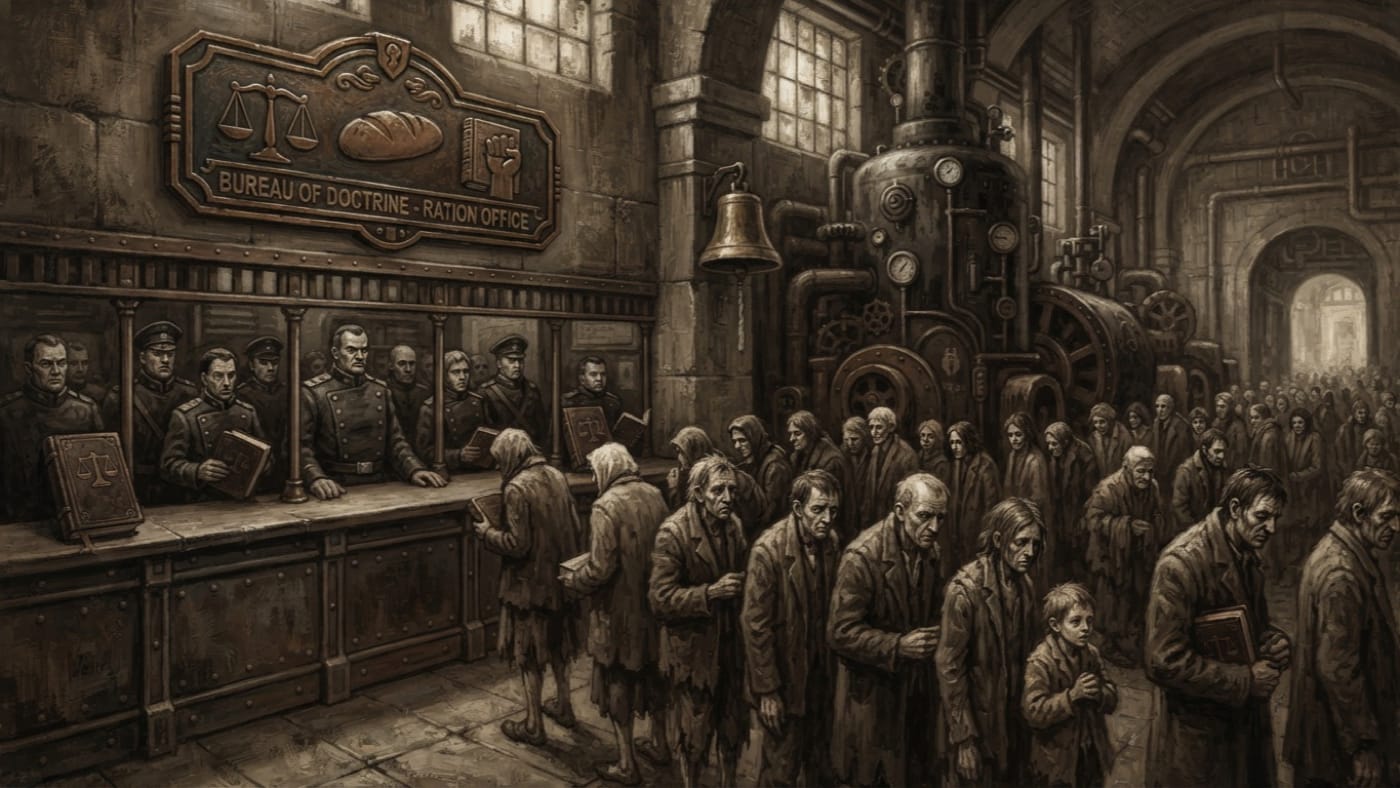
The Catechism is enforced at the counter. In the mess halls it is read where bread is issued, so the portion and the instruction arrive together. Eating alone is discouraged. Communal meals are the rule, on the principle that men who eat together cannot hoard and men who share cannot starve in private. Fasts are mandatory throughout the Dominion, on the theory that hunger chosen in obedience hardens the soul against hunger offered by the Enemy. Before distribution the Bureau of Relics blesses the provisions, and its stated position is that properly blessed food cannot carry Kargath's curse.
The civilian offices carry it further. In the Ration Parliament of Wexel, grain is counted and quotas are assigned at a daily sitting. Every household keeps a ledger, and every mouth is accounted for in chits. Measured mouths, measured hearts. I did not write that motto, though I have been accused of it, and I have not denied the accusation. On the Queue Road food arrives by bell, and the bell decides which windows open, when, and for whom. In both places the Catechism supplies the reason why the bell and the quota are holy and not merely enforced.
The military instruments are separate, and I will not have them confused. Standing Order 119-F, issued by the Eastern Command at Bastion-Constantinople in A.S. 163, orders patrols to withdraw from cultivated land near the Blightmarsh. The Litany of Sufficiency is the prayer chaplains must begin when such land comes into sight. The Order tells the feet where they may not go, and the Litany tells the mouth what to say at the edge. The Catechism governs every other day of the year, and it tells the stomach what it may want.
The penalties are separate as well. Anyone caught hoarding beyond their allocation is executed publicly, and their stores are redistributed. Eating produce from unregistered sources in the eastern sector falls under Martial Code 14-D, Spiritual Contamination (Voluntary), and the sentence is the pyre. A request for a second ladle falls under neither. The Catechism punishes it with shame, which costs less than firewood and burns longer.
#On the Body's Objections
The body has filed several objections. I have them all.
The first is simple. Fasting produces hunger, and hunger makes a man easier to persuade. The Catechism tells the starving to be content with starvation, and that teaching delivers to Kargath the very congregation he prefers. The fasting regimen weakens the faithful, and the weak are the ones who hear the bread-smell on the wind. It maintains order, and order has value. It has not stopped Kargath.
The second objection concerns reserves. A widow who keeps a sack of rye beneath the parish stair against February is a hoarder under the Catechism. A quartermaster who keeps four hundred sacks beneath the bastion against the same February is keeping a strategic reserve, and he is commended. The difference is a stamp. The Grain Keepers live in the gap between those two classifications. They hide calories from the quotas and decide by their own lights who eats when the bellies grow louder than the prayers. Some keep whole streets alive. Some own those streets afterwards. The Catechism condemns them as hoarders in either case and does not inquire which.
The third objection is the Triumph of the Gaunt, the Doctrine of Enough performed as theatre. Each spring the thinnest citizens are crowned with iron wire, and the fattest are flogged as carriers of "treacherous abundance." Mothers starve themselves so their children will look suitably skeletal on the day. The Bureau of Doctrine says the festival builds spiritual resistance. A Bureau of Medicine memorandum I was not supposed to see calls it "a public rehearsal for the kind of death the Abundance Fields inflict, performed voluntarily and celebrated as piety."
#On Its Continuing Application
The Catechism of Restraint is still in circulation in A.S. 201. It is read at mess counters on the Sagittal Line and in the ration offices of the Heartlands. I am told it is recited under the breath in the queue at the bell-windows, which is the only applause a doctrine of this kind receives.
Its efficacy against the Enemy has not been established. No recitation has restored anyone who ate from the Fields. Fasting has not been shown to protect anyone exposed to them. Field produce that has been blessed remains cursed, whatever the Bureau of Relics maintains. All the Catechism can be shown to do is keep the hungry quiet while the counter is open. The Bureau accepts that result, and so do I.