
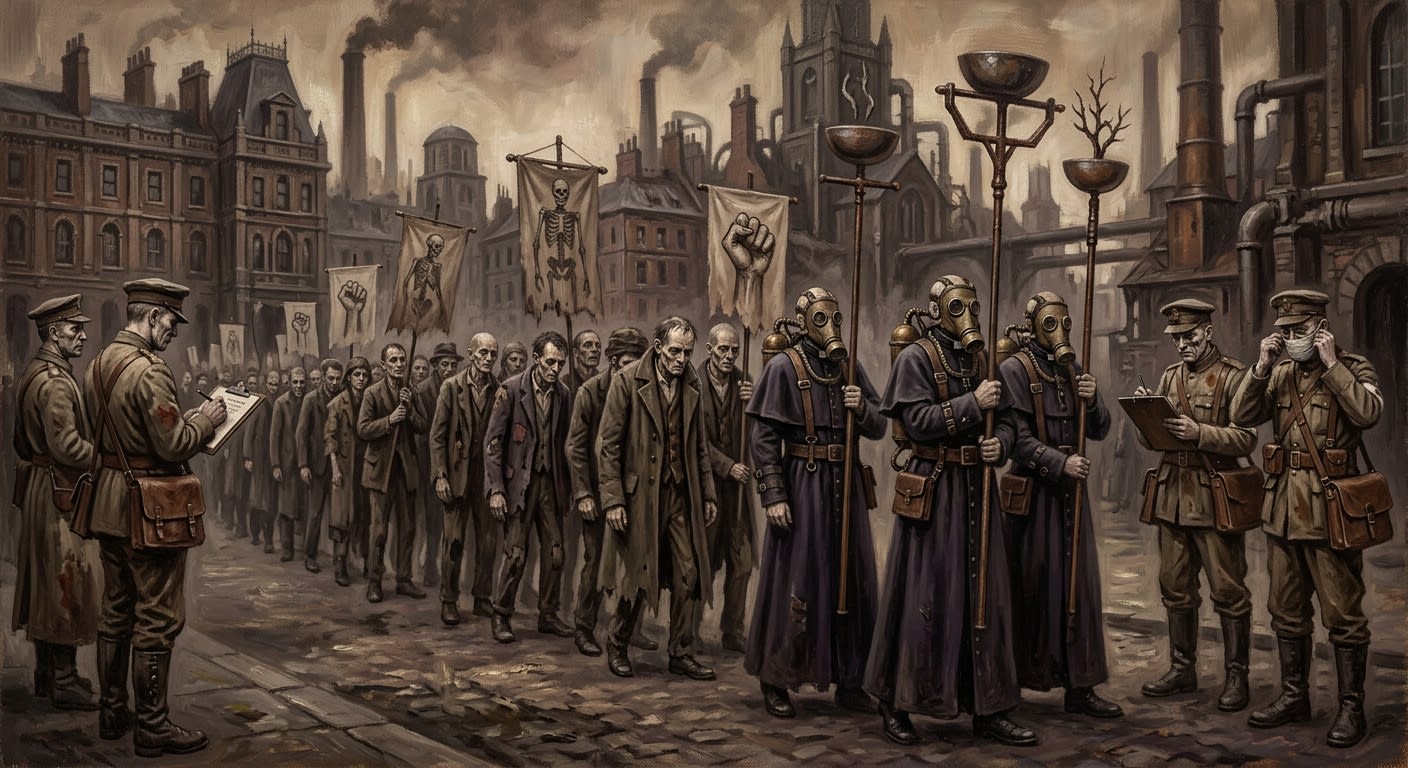
#On the Festival of Holy Hollowness
The Triumph of the Gaunt is the spring festival by which the Synod instructs the citizen to treat hunger as proof, fat as evidence, and the visible rib as a minor sacrament suitable for municipal display.
Every third season, after the fasts have done their disciplined vandalism upon the body, selected citizens are paraded through the streets as champions of restraint. The thinnest are crowned with wreaths of iron wire. The fattest are flogged as carriers of treacherous abundance. Children learn to press their bellies inward before inspectors pass. Mothers learn to fast earlier than the calendar requires. Fathers learn to call dizziness devotion. The Bureau of Festivals calls the result corrective theatre. The Bureau of Medicine calls it assault with pageantry.
The Triumph is usually defended as spiritual training against Kargath and the Abundance Fields. This defence is partly true, which is its most irritating quality. A people taught to distrust plenty is harder to lure with impossible fruit. A garrison that venerates hunger may turn away from bread-smell on a west wind. A child who has been applauded for looking half-dead may survive one more day in a ration queue and call the survival holiness.
That, dear reader, is civilisation: an injury given a hymn-sheet.
#On the Procession
The procession begins at dawn, because suffering enjoys good lighting.
Candidates are weighed before parish witnesses, inspected by a Rites-certified fasting clerk, and assigned visible rank according to the severity of their gauntness. The old training rubric survives in several provincial manuals: ribs visible at three paces, commendable; ribs sharp enough to cast individual shadows, excellent; collarbones capable of holding rainwater, exemplary; collapse before the Basilica steps, sanctifiable pending witness signatures.
The champions wear thin white linen, if the municipality can afford linen, and ash-grey sacking if it cannot. Around their brows sit wreaths of iron wire, twisted tight enough to mark the skin but not tight enough to kill before the judging point. Laurels were used in the early years. Laurels suggested health. Health suggested agricultural optimism. Agricultural optimism, after the first Abundance deaths near Pécs, became the sort of mood that gets a man watched.
The wire has older associations. In Kraków, the Rationalists stitched mouths shut with iron wire before casting priests into the Vistula. The Synod recovered the symbol with characteristic delicacy: what once sealed prayer now crowns discipline. History is not healed. It is requisitioned.
Certain provincial programmes describe the iron wreath as “ancient apostolic custom.”
False. The iron wreath enters Triumph practice after the Fifteenth Doctrinal Congress ratified the Night of Knives in Kraków narrative in A.S. 148. Anything older is local enthusiasm, antique forgery, or a clerk improving the past without proper licence.
Behind the crowned march the penitential column follows: citizens judged too prosperous in flesh, too round in cheek, too visibly unacquainted with edifying deprivation. They are stripped to the waist and flogged with soft cords first, hard cords second, iron-tipped cords where local custom has outrun central permission. The charge announced by the crier is treacherous abundance. The crowd repeats it. The body learns its indictment.
#On Administration
No cruelty in the Synod is legitimate until properly divided between Bureaus.
The Bureau of Festivals manages banners, route clearances, drums, viewing platforms, crowd rhythm, prize stools, wrist-ribbon receipts, and the small commemorative cards sold to children bearing sketches of particularly successful ribs. The Bureau of Rites certifies the fasting period and approves the prayer sequence. Medicine posts officers at three stations: pre-procession triage, mid-route collapse assessment, and post-procession disposal of those whose devotion has exceeded respiration.
The Bureau of Doctrine supplies the language, which is to say the crime.
“Treacherous abundance” did not exist as a phrase until the Abundance Fields forced the Synod to name a kind of plenty that behaves like collaboration. Once named, it escaped the eastern reports and entered parish life with vile speed. A second helping became suspicious. A plump baby became “requiring observation.” A baker’s wife with full arms found herself invited to fast publicly for the parish’s peace of mind.
#On the Medical Objection
The Bureau of Medicine’s memorandum on the Triumph is one of the finest pieces of restrained fury in the archives. It describes the festival as “a public rehearsal for the kind of death the Abundance Fields inflict, performed voluntarily and celebrated as piety.” I was not supposed to see that sentence. I saw it. I copied it. I admired the knife-work.
Medicine’s complaint is brutally simple: the Triumph teaches symptoms as virtues. Wasting, dizziness, pallor, tremor, appetite suppression, fainting, and post-fast confusion are publicly rewarded. Those same signs, near the eastern front, trigger quarantine under Standing Order 119-F or Medical inspection after Harvest contact. The citizen learns to hide what the physician needs to see. The body, poor clerk, receives contradictory orders and files them in meat.
Medical Observation, Prague Triumph, A.S. 196: “Subject crowned third in juvenile class. Age nine. Weight below parish survival index. Mother expressed satisfaction. Subject asked whether winners were allowed soup. Attending physician recommended withdrawal from pageant. Festival adjudicator overruled: ‘The question indicates proper longing.’”
Doctrine answers that the Triumph trains resistance. Festivals answers that attendance improves morale. Rites answers that fasting without public recognition breeds private pride. Medicine answers with charts. The charts are filed. The drums continue.
Earlier Codex notes classified the Triumph under Rites jurisdiction.
Corrected. The Bureau of Festivals administers the spectacle under Rites licence. Medicine supervises, Doctrine explains, Purity watches, and no one accepts responsibility, which proves the arrangement mature.
#On the Eastern Use
At the Constantinople perimeter, the Triumph has a sharper edge. Men posted near Kestrel stations know the bread-smell. They have seen fields too green for mercy. They have read the black-painted order: eat what is issued, fear what is given. For them the Triumph is drill with music.
Garrison variants omit the children’s competition, at least in theory. They replace civic laurels with ration tokens, crown the thinnest surviving patrolman with iron wire, and require the company to recite the Litany of Sufficiency while watching condemned hoarders flogged beside the mess line. This is ugly, effective, and popular among quartermasters, a class of men who regard all appetite as an accounting error.
The eastern Triumph saves some men from the Fields. It also breaks others before the Fields can have the pleasure. The distinction matters to Doctrine. It matters less to the man whose hands shake at supper while a chaplain praises his restraint.
#On the Present Practice
As of A.S. 201, the Triumph remains licensed in every Synod province, with stricter supervision in forward zones and more elaborate hypocrisy in the western heartlands. Strasbourg’s champions are painted and hung beside relics. Rheinscarp mills run Gaunt Parades to prove labour discipline. Prague grades schoolchildren by fast-endurance. Bastion-Constantinople keeps the drums low, because high drums carry badly over marsh wind and sometimes come back with chewing under them.
The fattest are still flogged. The thinnest are still crowned. Mothers still calculate how many meals can be missed before a child becomes holy rather than dead. The Bureau of Medicine still objects. The Bureau of Festivals still prints ribbons. The Bureau of Doctrine still supplies sentences beautiful enough to make brutality feel literate.