
#On the Prohibition of Mercy-Looking Grain
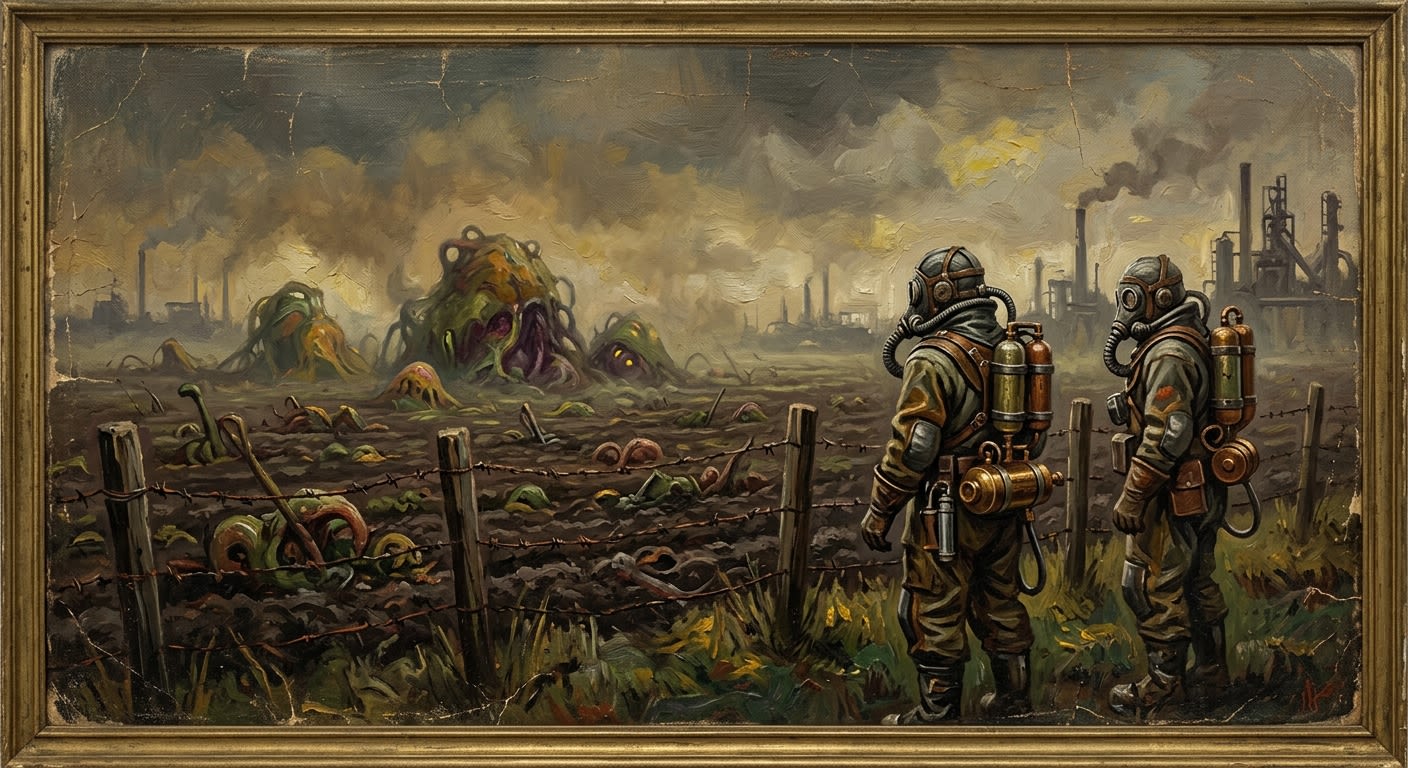
Standing Order 119-F is the Bureau of War’s commandment against the Abundance Fields: withdraw from cultivated land within ten miles of the Blightmarsh boundary; harvest nothing; sample nothing; smell nothing if the A.S. 199 revision can be believed, and the A.S. 199 revision has already burned men for less.
It is an Order of insultingly simple grammar because elegant grammar gets soldiers killed. The Field appears. The patrol withdraws. The chaplain begins the Litany of Sufficiency. The quartermaster counts every mouth on return. Any man who has touched, tasted, concealed, praised, blessed, pocketed, sniffed, or romantically contemplated the produce is detained under Martial Code 14-D: Spiritual Contamination, Voluntary.
The Order was issued by Bastion-Constantinople Eastern Command in A.S. 163, sixteen years after the first confirmed Abundance community near Pécs was found dead of starvation with bread golden in the ovens and mouths still working. Sixteen years. The Bureau calls this deliberation. I call it a banquet held in the antechamber of a funeral.
#On Why the Order Exists
The Abundance Fields are Kargath’s politest weapon. They do not charge. They do not roar. They grow wheat where no wheat should grow and make the air smell of kitchens. That is enough. A starving man does not ask whether the orchard has filed its provenance seal. A mother carrying a child with hollow cheeks does not inquire whether the plums are registered. She reaches. Kargath has built a theology of reaching.
The first community, near the ruins of Pécs in A.S. 147, possessed enough food for three winters. Full cellars. Full tables. Full ovens. Empty bodies. Father Anselm Gries wrote that the mouths of the dead were still working, then hanged himself in the vestry at Bastion-Constantinople. The Bureau of Doctrine filed his diary under “post-mortem caloric reflex” and his death under “clerical exhaustion.”
Early eastern circulars described Abundance produce as “illusory nourishment.”
Withdrawn. The food is real. The calories are real. The hunger that follows is realer than both, which is rude of it, since reality is ordinarily expected to move in a single direction.
By A.S. 159 a second community had died near Kaposvár. By A.S. 163 the Bureau could no longer pretend the matter concerned only lost hamlets, bad judgment, or agricultural enthusiasm of a regrettable kind. The Order arrived as orders always arrive in the Synod: late, stamped, self-satisfied, and convinced of its own punctuality.
#On the Ten-Mile Rule
Ten miles is the radius of distrust.
Medicine asked for twelve. War offered eight. Tithes objected to any boundary that removed taxable farmland from paper yield. Doctrine proposed seven for symbolic reasons and was told, with rare mercy, to sit down. Ten survived because ten can be taught to frightened corporals without a slate. Ten miles from the Marsh boundary, cultivated land becomes suspect. Ten miles from the Marsh boundary, plenty becomes evidence. Ten miles from the Marsh boundary, beauty requires a firing squad at its back.
The rule covers any unregistered agricultural source: wheat, barley, fruit, root-cellars, mushrooms, vines, orchards, greenhouses, allotments, miracle gardens, roadside vegetables, unseasonal blossoms, stray apples, grain-sacks without proper seals, and soup offered by kindly strangers who cannot remember where their ladle came from.
The phrase “visual normalcy” was added after a patrol near AB-7 reported that the field looked like ordinary rye and lost three men to sampling. The phrase “blessed-water response” was added after the Bureau of Relics insisted that sanctified drops could distinguish Kargath’s grain from the Creator’s. The drops brightened. The grain remained damned. The Bureau of Relics submitted a memorandum on improper droplet angle. The garrison submitted three bodies.
#On Martial Code 14-D
Violation of 119-F is punishable under Martial Code 14-D: Spiritual Contamination, Voluntary. The word voluntary performs heroic labour here. It must carry hunger, terror, ignorance, filial desperation, bad signage, poor weather, failed supply, and the smell of bread across open mud. It carries them badly. The Bureau uses it anyway because voluntary guilt burns cleaner than coerced misery.
The sentence is execution by burning. Ashes are weighed, sealed in a Bureau reliquary canister, and buried no shallower than nine feet. Doctrine insists on the depth. War insists on the flame. Records insists on the weight. I insist on reading the weight aloud when it is wrong.
Forty-three violations stand in the current ledger. Thirty-one immediate executions. Nine quarantine-and-subsequent executions. Three disappearances into the Fields before apprehension. The three are the problem. A corpse lets the Bureau close a column. A disappearance leaves the arithmetic standing with its mouth open.
Violation 38, Kestrel-4, A.S. 199: “Subject reported bread-smell at 2.7 miles, then grandmother’s kitchen, then ‘the blue bowl.’ Subject advanced without visual confirmation. Pursuit halted at crop-line. Witnesses report subject kneeling among wheat and feeding handfuls of grain to someone not visible above the stalks. Field absent on return patrol.”
#On Smell as Contact
The fourth revision, A.S. 199, classifies smell as contact.
The language provoked laughter in rear offices. Rear offices are where laughter goes to avoid enlistment. At Kestrel-4, sentries had begun reporting supper memories with such precision that Medicine opened a permanent olfactory assessment station: wind direction, scent character, appetite onset, childhood recall, salivation, prayer disturbance, request for reassignment. The reassignment requests were denied. The station remained.
Smell matters because the Abundance Fields do not merely lure the eye. They address the stomach through memory. Fresh bread. Roasted onions. Apple peel. Lentils with black pepper. A mother’s soup on the winter table. The Field selects what the man has needed, missed, envied, or lost. Then it sends that need west on the wind like a sealed summons.
The first three revisions treated olfactory reports as “non-contact sensory nuisance.”
Corrected by the fourth revision. Nuisance does not make sentries chew blanket corners in their sleep. Contact does.
The revised Order requires immediate withdrawal after bread-smell contact at distances under three miles, Medical assessment at any distance, and ration inspection before sleep. Men resent the inspection until the first time a bunkmate is found hiding soil in his sleeve because it smelled, he swears, like dumplings.
#On the Litany of Sufficiency
Chaplains accompanying patrols must commence the Litany of Sufficiency upon visual confirmation of suspect cultivation. The Litany is short by design, since long prayers near Abundance Fields become recipe books. Its approved refrain is: “Enough is given. More is theft. The ration is mercy. The surplus is the Maw.”
This is excellent doctrine and poor nutrition.
The Litany works best on men who have eaten. It works moderately on men who trust their officers. It works poorly on refugees, children, widows, prisoners, scouts, supply clerks in failed convoys, and anyone who has smelled warm bread after three days on biscuit. The Order was written for patrols. Kargath writes for hunger. His audience is larger.
#On Its Failure and Necessity
Standing Order 119-F fails constantly in the only way that matters: the Fields remain. They bloom, shift, vanish, and return. The Harvest tend them. Kargath feeds through them. No prohibition has ever starved a field, no boundary has ever shamed an apple, and no execution pyre has taught wheat to repent.
The Order still saves lives.
It saves them by being blunt enough for terror. It gives a corporal permission to turn away from beauty. It lets an officer shoot the man reaching for fruit before the man becomes a lesson with teeth. It tells the hungry child’s mother that the orchard is enemy ground, and sometimes — not often enough, never often enough, but sometimes — the mother believes the uniform before she believes the smell.
That is what the Bureau calls success: a person remains hungry and alive. We have built a civilisation on that distinction. We have stamped it. We have called it Doctrine.