
#On the Prayer That Keeps Men from Bread
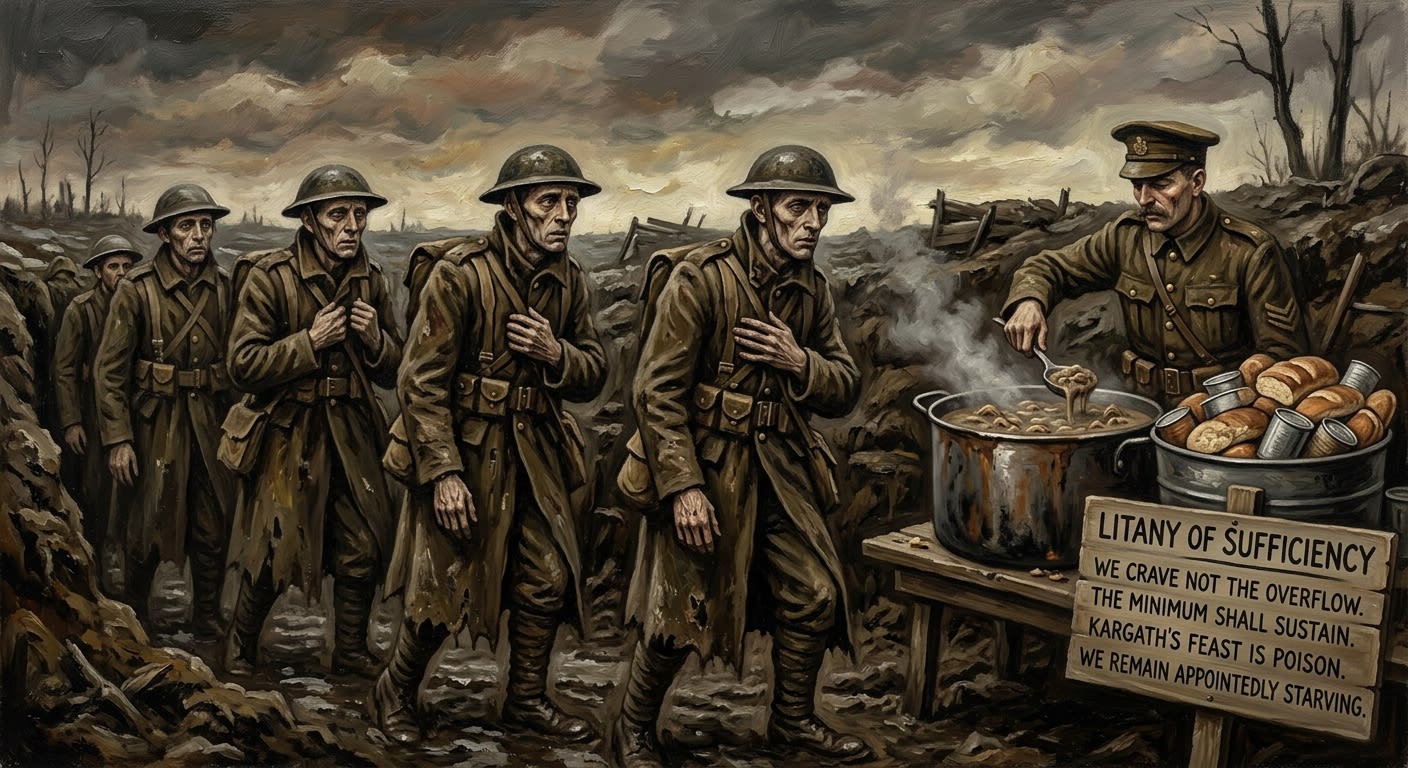
The Litany of Sufficiency is the approved field-prayer recited when Kargath offers food.
This definition is brief because the Litany is brief. Long prayers near the Abundance Fields become menus; menus become imagination; imagination becomes a man taking three steps past the rope with tears in his eyes and supper in his nose. The Bureau of Doctrine learned this late, as usual, but less late than the Bureau of War, which had spent sixteen years converting entire patrols into cautionary ash before discovering that a hungry man requires words shorter than hunger.
Its approved refrain is known to every eastern chaplain, many quartermasters, most Kestrel sentries, and a regrettable number of schoolchildren who have never seen the Blightmarsh and now flinch at bakery windows:
Enough is given. More is theft. The ration is mercy. The surplus is the Maw.
The Litany belongs to Standing Order 119-F, the A.S. 163 prohibition against approaching, harvesting, sampling, consuming, praising, sniffing, blessing, pocketing, or otherwise treating unregistered cultivation within ten miles of the Blightmarsh boundary as anything other than enemy action. The Order commands withdrawal. The Litany gives withdrawal a tongue.
#On the Grammar of Enough
The Litany's genius, such as it is, lies in vandalising desire before desire finds grammar of its own.
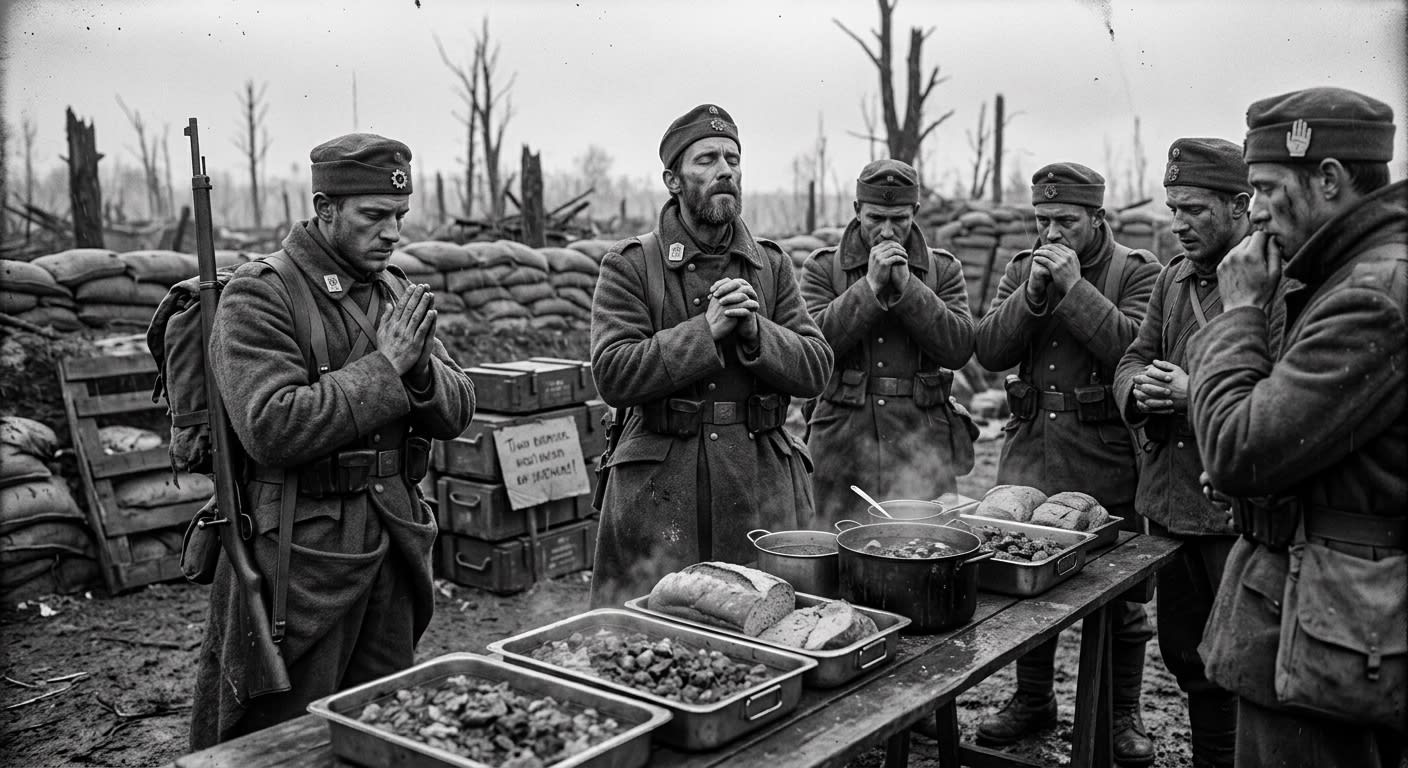
“Enough is given” binds the soldier to issue-ration, not to appetite. It declares the hard biscuit, sour water, boiled pulse, salted strap-meat, grey porridge, and whatever other insult the quartermaster has classified as edible to be sufficient by fiat. Fiat is a poor sauce. It is an excellent weapon. A man who can be made to call a measured crust enough may yet step away from a field where wheat bends under impossible gold.
“More is theft” converts appetite into crime. This is the hinge. Hunger pleads; law interrupts. The stomach says another mouthful. Doctrine says another count against the soul. Theft requires owner, object, trespass, penalty. Kargath offers fruit and the Litany replies that the fruit has already been claimed by the Enemy's mouth.
“The ration is mercy” is the most audacious line and the one most often cursed by soldiers who have actually eaten rations. Its purpose is not culinary persuasion. No doctrine can make a biscuit soft by shouting at it. The line teaches that lawful disappointment is safer than miraculous satisfaction. A stale ration insults the palate and leaves the soul in its proper cage.
“The surplus is the Maw” names the trap. Surplus, once a sign of blessing, is reclassified as appetite wearing harvest colours. A full cellar near the Marsh becomes suspicious. A generous orchard becomes a battlefield. A second helping becomes intelligence.
The Litany is not a hymn. It is too short, too blunt, too hostile to beauty. Hymns rise; the Litany clamps. Hymns fill a chest; the Litany locks the jaw. Its cadence is deliberately ugly: four short blows, each capable of being shouted through smoke, repeated while backing away, barked through a gag, scratched into a ration hatch, or beaten on a mess tin by a chaplain whose voice has failed and whose men are watching the treeline move.
Early chaplaincy copies expanded the refrain with four devotional couplets on holy restraint, the poverty of saints, the gladness of lawful want, and the sweetness of obedient hunger.
Withdrawn after Kestrel-2 reported that the phrase “sweetness of obedient hunger” caused three men to ask what sweetness, precisely, was authorised. Two survived the questioning. None survived the fruit.
#On Its Issuance
The Litany did not descend from heaven. It came from Bastion-Constantinople's Eastern Command, which is less impressive but more typical.
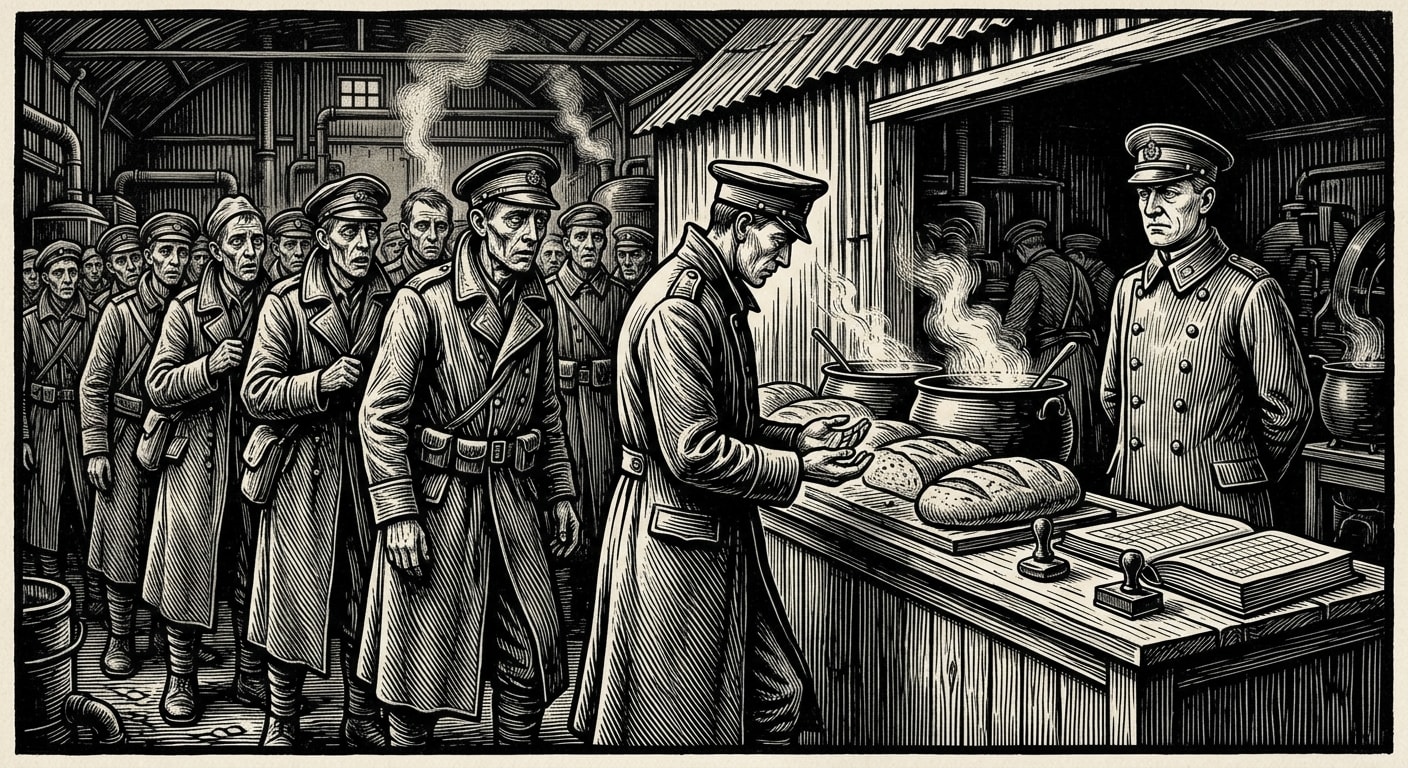
The first confirmed Abundance community near Pécs was found in A.S. 147: root-cellars full, ovens golden, eighty souls dead to the bone, mouths still working. Father Anselm Gries recorded the detail and later hanged himself in the vestry at Bastion-Constantinople. A second community near Kaposvár died in A.S. 159. By A.S. 163 even Eastern Command, an institution capable of mistaking an avalanche of corpses for an invitation to draft better forms, understood that the problem had acquired procedure.
Standing Order 119-F arrived first: ten-mile withdrawal, no approach, no harvest, no sample, burning under Martial Code 14-D for voluntary spiritual contamination. The Litany was appended as chaplaincy response in the same packet, written in a hand the archive attributes to Deputy Chaplain-Major Ossian Pell (Unregistered), though the margin bears three Doctrine corrections in my own predecessor's vermilion and one rude note by a quartermaster objecting to the word mercy on evidentiary grounds.
The A.S. 199 revision changed everything by classifying smell as contact. Before then, the Litany began on visual confirmation: wheat at the wrong boundary, fruit out of season, cabbages where ash had stood, a green line where the map promised mud. After Kestrel-4 (Unregistered), where sentries smelled individual suppers at 2.7 miles and one man advanced without seeing the field at all, chaplains were ordered to begin the Litany upon bread-smell, apple-peel memory, roasted-onion report, or any food-scent unaccounted for by a lawful kitchen.
#On Field Recitation
A chaplain begins softly if discipline holds and loudly if it does not.
The first repetition belongs to the chaplain alone. The second is answered by the patrol. The third must include the quartermaster, because a quartermaster who refuses the Litany is either compromised or composing a complaint, and both conditions require restraint. By the fourth repetition the patrol should be moving west, eyes on the boots of the man ahead, hands away from side pouches, mouths inspected if any jaw works without speech.
The field manual's instructions are uglier than the prayer and more useful:
No harmonies are permitted. Harmony invites musical pleasure, musical pleasure invites lingering, lingering invites smell, and smell invites a file with ash weights at the end. The Litany is spoken in flat cadence, timed to retreat steps: Enough / is given. More / is theft. The ration / is mercy. The surplus / is the Maw. On steep ground the cadence shortens. In panic it becomes four blows: Enough. Theft. Mercy. Maw.
KESTREL-4 AFTER-ACTION FRAGMENT, A.S. 199 “Private █████ stopped at the rope. He repeated the first line correctly. On the second he said, ‘More is home.’ Corporal Drennan struck him. He smiled through blood and asked whether Mother had set the blue bowl. Chaplain Pell ordered gagging. The gag smelled of butter. We burned it after.”
The Litany is not proof against contact. Nothing is proof against contact except distance, rifles, honest hunger, and the rare officer with enough cruelty to save a man by wounding him. The Litany supplies delay. Delay supplies room for command. Command supplies withdrawal. Withdrawal supplies the possibility of not becoming another parish whose dead chew air.
#On Civilian Misuse
The western heartlands love importing front-line terror once it has been laundered into ceremony.
By A.S. 170, the Litany had entered ration chapels far from the Marsh. By A.S. 181, Strasbourg schools used it before winter meals during the Short Bowl Weeks (Unregistered). By A.S. 196, certain parishes required children to recite it while passing bakery stalls, a practice the Bureau of Medicine called “nutritional anxiety induction” and the Bureau of Festivals called “promising audience preparation.” The phrase “the ration is mercy” now appears on ration slips, mess-tin lids, soup-house lintels, school primers, quartermaster seals, and one disastrous series of devotional spoons withdrawn after hungry workers discovered that the handles bent into lock-picks.
The Triumph of the Gaunt uses the Litany as pageant chant. Children with hollow cheeks repeat it while iron-wire wreaths are fitted to adult brows. Flogged citizens accused of treacherous abundance are made to answer the second line: More is theft. Garrison variants at Constantinople require condemned hoarders to hear the Litany before punishment, a small kindness if one believes in instructional sequencing and a large obscenity if one believes punishment need not have music.
Civilian use dilutes the prayer's danger and spreads its damage. In the east, the Litany tells a starving soldier not to eat cursed plenty. In the west, it tells a hungry child not to complain about lawful shortage. The same words pass from perimeter survival to municipal discipline with the speed of all useful cruelties. Doctrine calls this universality. I call it export.
A.S. 188 schoolroom editions described the Litany as “suitable for cheerful table recitation.”
Corrected after three Ghent classrooms began reporting voluntary lunch refusal, competitive fasting, and accusations of “Maw sympathy” against pupils with full cheeks. The table edition remains in rural circulation because withdrawing pamphlets costs money and children are, in budgetary terms, replaceable.
#On Controversy Between Bureaus
Every Bureau admires the Litany for the wrong reason.
War admires its obedience. A patrol that recites while retreating is a patrol still in command structure. Medicine admires the measurable reduction in crop-line crossings and despises the secondary wasting, concealment, and fear of nourishment the Litany creates elsewhere. Festivals admires its rhythm and keeps trying to embroider it. Rites admires its apparent piety and worries, correctly, that a prayer designed to distrust gifts may teach peasants to distrust sacraments if they ever learn to think in straight lines.
Tithes admires it because it sanctifies issued portions. Records admires it because it generates excellent incident forms. Purity admires it because any altered word can become evidence. Doctrine admires it because I wrote the modern field commentary and my prose, unlike most soldiers, holds the line.
The sharpest quarrel belongs to Medicine and Festivals. Medicine's memorandum on the Triumph of the Gaunt warned that the Litany teaches symptoms as virtues: appetite suppression, dizziness, pallor, wasted limbs, pride in refusal. Festivals replied that public repetition builds civic resistance to Kargath's abundance. Medicine answered with child-weight charts. Festivals answered with attendance figures. Doctrine filed both and approved the route.
A second quarrel concerns refugees. The Litany works poorly on civilians fleeing east-bank hunger, children carried through mud, mothers whose milk has failed, old men who have eaten bark, and deserters who have survived on buttons and prayer. To tell such people “enough is given” when nothing has been given is either tactical necessity or blasphemy with a stamp. Eastern Command chooses necessity. Bureau of Mercy has not forgiven the choice; Bureau of War has not noticed Mercy's forgiveness was requested.
#On Failures
The Litany fails in predictable ways, which is almost comforting until one remembers that predictable failure still buries bodies.
It fails when rations have already failed. No prayer praising lawful portion can persuade a man whose lawful portion was stolen three days earlier by a clerk with better shoes. It fails when children are present, because men who can refuse for themselves will cross for a child's imagined supper. It fails when the smell is personal. Bread is dangerous; grandmother's blue bowl is catastrophic. It fails when chaplains improvise. It fails when quartermasters use it as insult. It fails when civilians learn the words without learning the rope.
It failed at Kestrel-2 (Unregistered) during the Lent-Bread Incident (Unregistered), when a chaplain added “sweetness of obedient hunger” and awakened precisely the wrong noun. It failed in Ghent schools when children weaponised the second line against each other. It failed in a refugee column outside Osijek when a mother answered every line correctly while walking into the Field, because she had decided the surplus could take her if it fed the child first.
These failures do not abolish the Litany. They define its jurisdiction. A lock that holds against thieves may fail against fire; one still locks the door before sleeping, unless one is a poet, a fool, or an Insurance Court (Unregistered) clerk seeking a payout.
#On the Present Text
As of A.S. 201, the authorised Litany remains four lines, sixteen principal words, no harmony, no expansion, no table cheer, no dance, no provincial couplet concerning saintly soup, no local substitution of “Maw” with “Pit,” “Mire,” “Orchard,” “Hell,” “Enemy,” “Kargath,” or “That Which Eats By Feeding,” though I admit the last has theological merit and no marching value whatsoever.
It is painted beside ration hatches at Bastion-Constantinople. It is stamped into patrol cards at Kestrel Stations. It hangs in the surviving Agriculture clerks' basement above a shelf of Field grain samples sealed in leaded glass. It is murmured by men who smell bread on the wind and want to live badly enough to remain hungry.
The Litany does not make hunger holy. Hunger was holy long before the Bureau found a use for it. The Litany makes hunger administrable. That is our talent, our sin, our little polished cup of arsenic: we take the body's cry, file it under Doctrine, and return it stamped SUFFICIENT.