
#On the Document in Use
This entry is a survey, made in A.S. 201, of the Catechism of the Sundering as it is handled today. It is read in parish squares, cued by a bell, entered into attendance columns and, where necessary, enforced. The survey covers the book in use. Its origins lie outside the survey. No sealing date for a first issue has been recovered. No first edition sits in any vault I am permitted to name. The Codex will not invent a birthday for a text simply because readers find birthdays comforting.
The title borrows the Sundering of 1 November A.S. 45. The borrowing dates the wound. It says nothing about when the dressing was applied.
Two facts are fixed. The first is that the Catechism bears the imprimatur of the Bureau of Doctrine, as every catechism read aloud in the Church's lands must. The second is that one of its approved passages, filed as Standing Catechism 3-F, concerns obedience after fracture. That passage does real work. Every harvest season, in the districts touched by the Heresy of Siena, it is carried into a circle of tired dancers and set down at the point where the dance used to end on its own.
That is the evidence. The rest is ink and nerve.
#On the Imprimatur
Doctrine claims the Flame of Interpretation, and the claim is a practical one. Before a sentence may be recited to a village, someone in Strasbourg must have declared it fit for recitation. The work is done in the Cloister of Concord, beneath the Tower of the Quill, by exegetes who look at a loose relative clause the way a Purity captain looks at an open city gate.
The Bureau's own account of approval runs as follows: seven readings in the Cloister, four rounds of theological review, two rounds of stylistic correction, and final approval from the Seal-Bearer before any press may move. That is the procedure for catechisms in general. The Ledger does not say whether this particular book passed each stage on particular dates, in particular rooms, under particular candles. I will not invent the candles.
What the imprimatur confers matters more than how it was obtained. Once a text bears Doctrine's seal it is no longer an opinion. It becomes the official voice of the Church whenever it is spoken, whoever is speaking it. This is fortunate, given the speakers available in rural Tuscany. A parish substitute with a head cold and a weak grip on his letters reads with the same authority as an exegete of the Cloister. The seal does the speaking. He moves his lips.
This is why the Catechism could serve as an instrument at Siena. A village can argue with a homily. A sealed passage leaves only three choices: obey it, ignore it, or report someone who ignored it.
#On the Reading After the Last Turn
The Siena disturbance began in A.S. 141. It spread through three Tuscan provinces before any office understood what was spreading. There was no manifesto and no teacher. There was a step pattern, hands joined at the third circuit, silence at the seventh, and a dance that kept going while the priest read at it. The Bureau of Purity classified the state as "unsanctioned communal ecstasy." I reproduce that as Purity's classification and claim nothing more for it. The Bureau of Rites objected in writing that the dancers had found fellowship without vertical authority. In the vulgar tongue, the peasants were enjoying one another without a supervisor.
The Bureau of Festivals answered with a decree whose elegance I still admire on bad days. The dance would survive. Its ending would be taken from it.
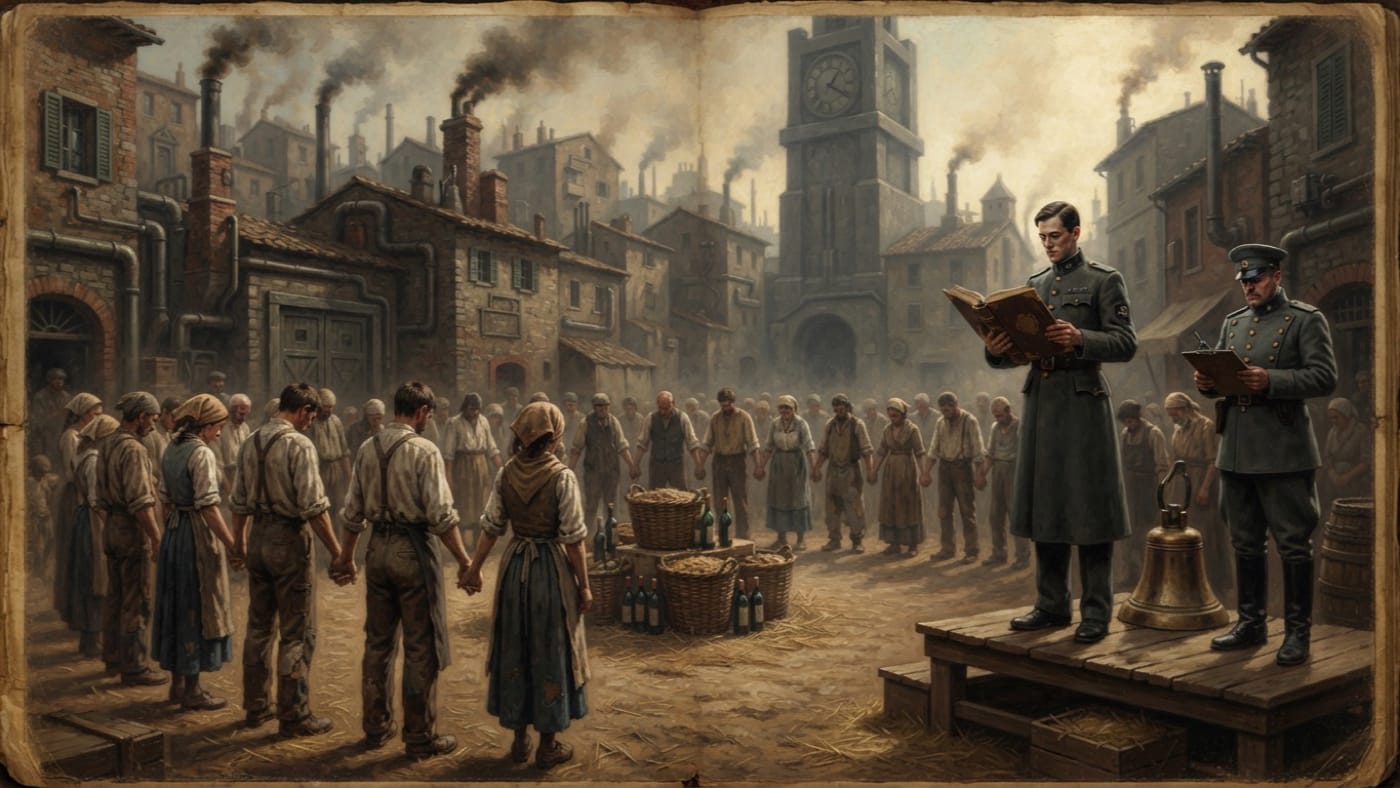
The prescribed sequence runs like this. The last turn of the dance is made. The approved reading from the Catechism of the Sundering follows. Only after the reading may the grain baskets cross the circle. Only after the baskets may the wine be poured, and only after the wine may the local songs begin. The old women of the parish used to decide when the grain had heard enough. Now a folio decides.
Standing Catechism 3-F supplies the passage. Its subject is obedience after fracture, and I will not reproduce its wording, for two reasons. This survey does not quote what it cannot show the reader in an authenticated copy. And the wording matters less than the timing. Read in a cathedral at Vespers, a passage on obedience is instruction. Read to sweating villagers who have just stopped turning, with the baskets at their feet and the wine still corked, the same passage becomes a demonstration. The village learns that its own festival ends only when Doctrine says so.
Festival teaching copies describe the Siena settlement as a "prohibition of the Sienese heresy."
Corrected. Nothing was prohibited. The dance was kept and its conclusion was confiscated. A prohibited rite acquires martyrs. A rite with an appointed ending acquires an attendance column.
#On the Officers of Completion
An approved passage is only ink until someone is ordered to read it aloud and someone else is ordered to listen. The Siena decree divided the task among three of the Holy Bureaus. They have never confused their duties, though they have often resented them.
Festivals cues. The bell belongs to Festivals, and so does the moment it rings. The officer marks the last turn, sounds the bell, and opens the circle to the reader. Where a Festival Chorus-Master is posted, the cue comes from his baton and bell. Where none is posted, a parish substitute takes his place and is expected to look trained.
Records logs. The Bureau of Records supplies the attendance sheets, which record who stood in the circle when the Catechism was read. Attending the reading and attending the dance are separate facts. Records keeps the first and leaves the second to the grandmothers, who keep better books in any case.
Purity enforces. Its role is escalation, and its preference has always been severance: stop the dance, part the hands, burn the fiddle, close the file. Festivals preferred custody, and Festivals won the decree. Purity accepted the outcome the way it accepts every compromise. It stays at the edge of each harvest with a notebook and waits for the circle to misbehave.
The arrangement deserves a cold eye. Doctrine supplies words it will never hear spoken in that field. Festivals supplies the moment, Records the proof, and Purity the threat. Each office can say with a straight face that it did nothing harsh. Yet the four of them close the circle every season, on schedule.
#On the Prescribed Survivals
As of this survey, A.S. 201, the register lists the Sienese harvest forms as prescribed, supervised rural rites. Current handling requires three things. The approved Catechism closure must be read. A Festival Chorus-Master or parish substitute must be present. Purity may escalate in only two cases: if the silence runs past its permitted span, or if hands stay joined during the reading. No document available to this survey states the permitted span, and I will not fix a number for it. Officers are expected to recognise an excessive silence the way they recognise an excessive smile, and to note it in the attendance column.
The sequence is fixed, but its performance varies, and the variations are officially tolerated wherever attendance stays high. In Tuscany the reader stands at the north edge of the circle. In parts of Umbria the reader enters only after the grain baskets have touched earth. This reverses the standard order, and so far it has been allowed to stand. In two Lombard parishes the old women still decide when the seventh circuit ends. The local Chorus-Master found that contradicting them halved his attendance and did unexplained damage to his carriage. These are local arrangements. They are no evidence of a second edition, a rival text, or a provincial Catechism, and anyone who reports them as such will get a correction from my desk.
Even where the order is kept to the letter, the Catechism governs one thing only, and it governs it absolutely. Steps, tunes and the count of circuits remain local matters, tolerated and noted. Its jurisdiction is the ending. The village may turn as it has always turned. It may not finish. The right to finish belongs to an approved passage, an officer's bell, and a column on a sheet that will travel to a provincial office and be filed in triplicate.
The harvest belongs to the village. The last word belongs to Strasbourg.